eBook - ePub
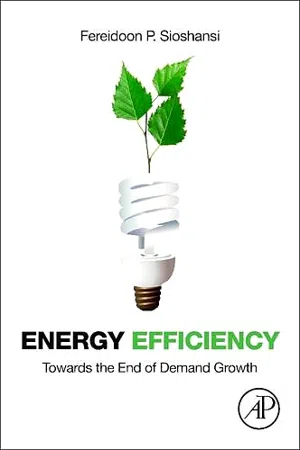
Energy Efficiency
Towards the End of Demand Growth
- 688 pages
- English
- ePUB (mobile friendly)
- Available on iOS & Android
eBook - ePub
About this book
Energy Efficiency: Towards the End of Demand Growth is a detailed guide to new energy efficiency technologies and policy frameworks affecting the profitability of efficiency projects. The contributions drawn together by F.P. Sioshansi feature insights from recognized thought leaders, detailed examinations of evolving technologies, and practical case studies yielding best practices for project planners, implementers and financiers. This volume challenges the "more is better" paradigm in energy production, examining efficiency technologies and measurement across the supply chain.
- Comparative financial analysis of efficiency vs. increased generation
- Case studies from four continents highlight the examples of successful technologies and projects
- Explains how existing and developing regulatory frameworks impact cost and implementation
Information
Topic
Negocios y empresaSubtopic
Industria energéticaPart I
End of Demand Growth is within Reach
Chapter 1 Will Energy Efficiency make a Difference?
Chapter 2 Utility Energy Efficiency Programs
Chapter 3 A Global Perspective on the Long-term Impact of Increased Energy Efficiency
Chapter 4 Carpe Diem – Why Retail Electricity Pricing must Change Now
Chapter 5 Is There an Energy Efficiency Gap?
Chapter 1
Will Energy Efficiency make a Difference?
Fereidoon P. Sioshansi, Menlo Energy Economics. With contributions from Ahmad Faruqui, The Brattle Group, and, Gregory Wikler, EnerNOC
1 Introduction
Interest in energy efficiency got a significant boost following the 1973 Arab oil embargo when rich economies collectively got a wake-up call on just how vulnerable they were to the whims of the oil exporting countries or potential disruptions in the flow of oil – whether through the Strait of Hormuz or Malacca – or broader conflicts in the Middle East and beyond. The Iranian Revolution of 1979 provided a second wake-up call.1 Surprisingly, the vulnerability persists, despite four decades of efforts to address it.2
The initial response of the oil-importing countries was entirely supply-side focused. The knee-jerk reaction was to decide how best to ration limited supplies of oil among the needy and who should stockpile how much to cushion a sudden disruption of future supplies.3 A minority decided to address the demand, rather than the supply-side of the equation.4 President Jimmy Carter, to his credit, gave a famous TV address from the White House, sitting by the fireplace wearing a sweater and encouraging the American public to turn down their thermostats. He called energy conservation “the moral equivalent to war.5”
Mr. Carter was ridiculed at the time by many who saw the problem as not having sufficient domestic supplies of oil or sufficient stockpiles to withstand through a prolonged embargo. Others identified the need for a bigger Navy to keep the bad guys at bay and keep oil tankers flowing.6
Carter was also ridiculed for wearing a sweater and encouraging his fellow citizens to conserve energy. Conservation, after all, has a negative connotation – it suggests deprivation, sacrifice, hardship, doing without, lowering one’s standard of comfort and so on. Decades later, during another debate about U.S. energy policy, then Vice President Dick Cheney said, “Conservation may be considered a personal virtue, but should not be part of a country’s energy policy.”
This book, of course, is not about oil or broad energy policy issues, but the preceding discussion is important because:

The electric power sector, a prominent consumer of energy,7 has been debating the virtues of energy efficiency ever since.8 As further explained in Box 1.1, the issues have evolved and the debate about energy efficiency has matured over the years. Likewise a lot has been learned from what works and what does not, yet many perplexing questions still remain.
This chapter is rather narrowly focused on answering the question, “will energy efficiency make a difference?” It is organized into three sections: Section 2 provides a brief historical perspective on prior studies on the scope of energy efficiency potential and the debate on its cost-effectiveness with references to relevant chapters in the book. Section 3 provides a range of estimates offered by several prominent recent studies and surveys that offer alternative scenarios or visions of the future scope of energy efficiency, also making references to relevant chapters. Section 4 is focused on a number of measures and policies, which taken together, can make a difference in the future course of demand g...
Table of contents
- Cover image
- Title page
- Table of Contents
- Copyright
- About the Authors
- Foreword. Is Zero Energy Growth in Our Future?
- Preface
- Introduction
- Part I: End of Demand Growth is within Reach
- Part II: The – Frustratingly Slow – Evolution of Energy Efficiency
- Part III: Case Studies of Low-Energy Communities and Projects
- Part IV: Opportunities and Remaining Obstacles
- Epilogue. How Do We Get There From Here?
- Index
Trusted by 375,005 students
Access to over 1.5 million titles for a fair monthly price.
Study more efficiently using our study tools.
Frequently asked questions
Yes, you can cancel anytime from the Subscription tab in your account settings on the Perlego website. Your subscription will stay active until the end of your current billing period. Learn how to cancel your subscription
No, books cannot be downloaded as external files, such as PDFs, for use outside of Perlego. However, you can download books within the Perlego app for offline reading on mobile or tablet. Learn how to download books offline
Perlego offers two plans: Essential and Complete
- Essential is ideal for learners and professionals who enjoy exploring a wide range of subjects. Access the Essential Library with 800,000+ trusted titles and best-sellers across business, personal growth, and the humanities. Includes unlimited reading time and Standard Read Aloud voice.
- Complete: Perfect for advanced learners and researchers needing full, unrestricted access. Unlock 1.5M+ books across hundreds of subjects, including academic and specialized titles. The Complete Plan also includes advanced features like Premium Read Aloud and Research Assistant.
We are an online textbook subscription service, where you can get access to an entire online library for less than the price of a single book per month. With over 1.5 million books across 990+ topics, we’ve got you covered! Learn about our mission
Look out for the read-aloud symbol on your next book to see if you can listen to it. The read-aloud tool reads text aloud for you, highlighting the text as it is being read. You can pause it, speed it up and slow it down. Learn more about Read Aloud
Yes! You can use the Perlego app on both iOS and Android devices to read anytime, anywhere — even offline. Perfect for commutes or when you’re on the go.
Please note we cannot support devices running on iOS 13 and Android 7 or earlier. Learn more about using the app
Please note we cannot support devices running on iOS 13 and Android 7 or earlier. Learn more about using the app
Yes, you can access Energy Efficiency by Fereidoon Sioshansi,Fereidoon P. Sioshansi in PDF and/or ePUB format, as well as other popular books in Negocios y empresa & Industria energética. We have over 1.5 million books available in our catalogue for you to explore.