- 552 pages
- English
- ePUB (mobile friendly)
- Available on iOS & Android
eBook - ePub
About this book
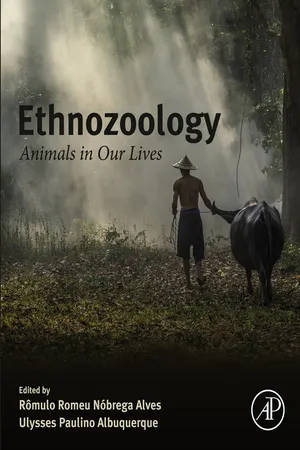
Ethnozoology: Animals In Our Lives represents the first book about this discipline, providing a discussion on key themes on human-animal interactions and their implications, along with recent major advances in research.
Humans share the world with a bewildering variety of other animals, and have interacted with them in different ways. This variety of interactions (both past and present) is investigated through ethnozoology, which is a hybrid discipline structured with elements from both the natural and social sciences, as it seeks to understand how humans have perceived and interacted with faunal resources throughout history.
In a broader context, ethnozoology, and its companion discipline, ethnobotany, form part of the larger body of the science of ethnobiology. In recent years, the importance of ethnozoological/ethnobiological studies has increasingly been recognized, unsurprisingly given the strong human influence on biodiversity.
From the perspective of ethnozoology, the book addresses all aspects of human connection, animals and health, from its use in traditional medicine, to bioprospecting derivatives of fauna for pharmaceuticals, with expert contributions from leading researchers in the field.
- Draws on editors' and contributors' extensive research, experience and studies covering ethnozoology and ethnobiology
- Covers all aspects of human-animal interaction through the lens of this emerging discipline, with coverage of both domestic and wild animal topics
- Presents topics of great interest to a variety of researchers including those in wildlife/conservation (biologists, ecologists, conservationists) and domestic-related disciplines (psychologists, sociologists)
Information
Table of contents
- Cover image
- Title page
- Table of Contents
- Copyright
- List of Contributors
- Chapter 1. Introduction: Animals in Our Lives
- Chapter 2. Ethnozoology: Conceptual and Historical Aspects
- Chapter 3. Zooarcheology: Investigating Past Interactions Between Humans and Other Animals
- Chapter 4. Studying Ethnozoology in Historical Documents
- Chapter 5. Imaginary Zoology: Mysterious Fauna in the Reports of Ancient Travelers and Chroniclers
- Chapter 6. Ethnotaxomy as a Methodological Tool for Studies of the Ichthyofauna and Its Conservation Implications: A Review
- Chapter 7. The Importance of Hunting in Human Societies
- Chapter 8. People and Fishery Resources: A Multidimensional Approach
- Chapter 9. Animal Domestication and Ethnozootechny
- Chapter 10. Wild Fauna on the Menu
- Chapter 11. Insects as Human Food
- Chapter 12. Current Levels, Recent Historical Trends, and Drivers of Wildmeat Trade in the Amazon Tri-Frontier Region Between Colombia, Peru, and Brazil
- Chapter 13. Animals and Human Health: Where Do They Meet?
- Chapter 14. Use and Commercialization of Animals as Decoration
- Chapter 15. The Role of Animals in Human Culture
- Chapter 16. Fauna at Home: Animals as Pets
- Chapter 17. What About the Unusual Soldiers? Animals Used in War
- Chapter 18. The Ethnozoological Role of Working Animals in Traction and Transport
- Chapter 19. Wildlife Attractions: Zoos and Aquariums
- Chapter 20. From Roman Arenas to Movie Screens: Animals in Entertainment and Sport
- Chapter 21. Animals as Ethnozooindicators of Weather and Climate
- Chapter 22. Understanding Human–Wildlife Conflicts and Their Implications
- Chapter 23. Biological Predispositions and Individual Differences in Human Attitudes Toward Animals
- Chapter 24. The Role of Ethnozoology in Animal Studies
- Chapter 25. Ethnozoology and Animal Conservation
- Chapter 26. The Use of Traditional Ecological Knowledge in the Context of Participatory Wildlife Management: Examples From Indigenous Communities in Puerto Nariño, Amazonas-Colombia
- Chapter 27. Ethnozoology: An Overview and Current Perspectives
- Index
Trusted by 375,005 students
Access to over 1.5 million titles for a fair monthly price.
Study more efficiently using our study tools.
Frequently asked questions
Yes, you can cancel anytime from the Subscription tab in your account settings on the Perlego website. Your subscription will stay active until the end of your current billing period. Learn how to cancel your subscription
No, books cannot be downloaded as external files, such as PDFs, for use outside of Perlego. However, you can download books within the Perlego app for offline reading on mobile or tablet. Learn how to download books offline
We are an online textbook subscription service, where you can get access to an entire online library for less than the price of a single book per month. With over 1.5 million books across 990+ topics, we’ve got you covered! Learn about our mission
Look out for the read-aloud symbol on your next book to see if you can listen to it. The read-aloud tool reads text aloud for you, highlighting the text as it is being read. You can pause it, speed it up and slow it down. Learn more about Read Aloud
Yes! You can use the Perlego app on both iOS and Android devices to read anytime, anywhere — even offline. Perfect for commutes or when you’re on the go.
Please note we cannot support devices running on iOS 13 and Android 7 or earlier. Learn more about using the app
Please note we cannot support devices running on iOS 13 and Android 7 or earlier. Learn more about using the app
Yes, you can access Ethnozoology by Romulo Romeu Nobrega Alves,Ulysses Paulino Albuquerque in PDF and/or ePUB format, as well as other popular books in Biological Sciences & Evolution. We have over 1.5 million books available in our catalogue for you to explore.