- 1,454 pages
- English
- ePUB (mobile friendly)
- Available on iOS & Android
eBook - ePub
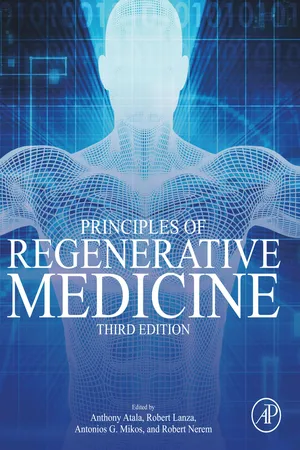
Principles of Regenerative Medicine
About this book
Principles of Regenerative Medicine, Third Edition, details the technologies and advances applied in recent years to strategies for healing and generating tissue. Contributions from a stellar cast of researchers cover the biological and molecular basis of regenerative medicine, highlighting stem cells, wound healing and cell and tissue development. Advances in cell and tissue therapy, including replacement of tissues and organs damaged by disease and previously untreatable conditions, such as diabetes, heart disease, liver disease and renal failure are also incorporated to provide a view to the future and framework for additional studies.
- Comprehensively covers the interdisciplinary field of regenerative medicine with contributions from leaders in tissue engineering, cell and developmental biology, biomaterials sciences, nanotechnology, physics, chemistry, bioengineering and surgery
- Includes new chapters devoted to iPS cells and other alternative sources for generating stem cells as written by the scientists who made the breakthroughs
- Edited by a world-renowned team to present a complete story of the development and promise of regenerative medicine
Information
Table of contents
- Principles of Regenerative Medicine
- Chapter 1 Molecular Organization of Cells
- Chapter 2 Cell–Extracellular Matrix Interactions in Repair and Regeneration
- Chapter 3 Mechanisms of Blastema Formation and Growth in Regenerating Urodele Limbs
- Chapter 4 The Molecular Circuitry Underlying Pluripotency in Embryonic and Induced Pluripotent Stem Cells
- Chapter 5 Scarless Wound Healing
- Chapter 6 Progenitor and Stem Cell Heterogeneity
- Chapter 7 Embryonic Stem Cells
- Chapter 8 Alternative Sources of Human Embryonic Stem Cells
- Chapter 9 Stem Cells From the Amnion
- Chapter 10 Cord Blood Stem Cells
- Chapter 11 Induced Pluripotent Stem Cells
- Chapter 12 Multipotent Adult Progenitor Cells
- Chapter 13 Hematopoietic Stem Cell Properties, Markers, and Therapeutics
- Chapter 14 Mesenchymal Stem Cells
- Chapter 15 Mesenchymal Stem Cells in Regenerative Medicine
- Chapter 16 Cell Therapy of Liver Disease
- Chapter 17 Cardiac Stem Cells
- Chapter 18 Skeletal Muscle Stem Cells
- Chapter 19 Stem Cells Derived From Fat
- Chapter 20 Peripheral Blood Stem Cells
- Chapter 21 From Adult Pancreatic Islets to Stem Cells
- Chapter 22 Stem Cells for Diseases of the Retina
- Chapter 23 Stem Cells for Traumatic Brain Injury
- Chapter 24 Mechanical Determinants of Tissue Development
- Chapter 25 Morphogenesis, Bone Morphogenetic Proteins, and Regeneration of Bone and Articular Cartilage
- Chapter 26 Physical Stress as a Factor in Tissue Growth and Remodeling
- Chapter 27 Cell–Substrate Interactions
- Chapter 28 Intelligent Surfaces for Cell Sheet Engineering
- Chapter 29 Applications of Nanotechnology for Regenerative Medicine; Healing Tissues at the Nanoscale
- Chapter 30 Design Principles in Biomaterials and Scaffolds
- Chapter 31 Proteins Controlled With Precision at Organic, Polymeric, and Biopolymer Interfaces for Tissue Engineering and Regenerative Medicine
- Chapter 32 Natural Origin Materials for Bone Tissue Engineering
- Chapter 33 Synthetic Polymers
- Chapter 34 Calcium Phosphate Bioceramics and Cements
- Chapter 35 Biologic Scaffolds Composed of Extracellular Matrix for Regenerative Medicine
- Chapter 36 Hydrogels in Regenerative Medicine
- Chapter 37 Surface Modification of Biomaterials
- Chapter 38 Histogenesis in Three-Dimensional Scaffolds
- Chapter 39 Biocompatibility and Bioresponse to Biomaterials
- Chapter 40 Hybrid Composite Biomaterials
- Chapter 41 Materials-Based Cancer Immunotherapies
- Chapter 42 Gene Editing in Regenerative Medicine
- Chapter 43 Preclinical Bone Repair Models in Regenerative Medicine
- Chapter 44 Body-on-a-Chip: Regenerative Medicine for Personalized Medicine
- Chapter 45 Bioreactors in Regenerative Medicine
- Chapter 46 Bioinks for Three-Dimensional Printing in Regenerative Medicine
- Chapter 47 Three-Dimensional Tissue and Organ Printing in Regenerative Medicine
- Chapter 48 Biomineralization and Bone Regeneration
- Chapter 49 Hair Cell Regeneration in the Inner Ear and Lateral Line
- Chapter 50 Craniofacial Regenerative Medicine
- Chapter 51 Dental Tissue Engineering
- Chapter 52 Cell Therapy for Blood Substitutes
- Chapter 53 Cartilage Tissue Engineering
- Chapter 54 Stem Cell Therapy for Musculoskeletal Diseases
- Chapter 55 Myoblast Transplantation in Skeletal Muscles
- Chapter 56 Islet Cell Transplantation
- Chapter 57 Prenatal Cell- and Gene-Based Therapies for Regenerative Medicine
- Chapter 58 Engineering of Large Diameter Vessels
- Chapter 59 Regenerative Medicine Approaches for Tissue Engineered Heart Valves
- Chapter 60 Regenerative Medicine of the Respiratory Tract
- Chapter 61 Cardiac Tissue
- Chapter 62 Bioengineering of Liver Tissue
- Chapter 63 Regenerative Medicine in the Cornea
- Chapter 64 Alimentary Tract
- Chapter 65 Extracorporeal Renal Replacement
- Chapter 66 Regenerative Medicine Approaches for the Kidney
- Chapter 67 Functional Tissue Engineering of Ligament and Tendon Injuries
- Chapter 68 Central Nervous System
- Chapter 69 Peripheral Nerve Regeneration
- Chapter 70 Regenerative Medicine for the Female Reproductive System
- Chapter 71 Regenerative Medicine for the Male Reproductive System
- Chapter 72 Regenerative Medicine of the Bladder
- Chapter 73 Therapeutic Applications
- Chapter 74 Regenerative Medicine Approaches for Engineering a Human Hair Follicle
- Chapter 75 US Stem Cell Research Policy
- Chapter 76 Ethical Considerations∗
- Chapter 77 Overview of the US Food and Drug Administration Regulatory Process
- Chapter 78 Regenerative Medicine Manufacturing—Challenges and Opportunities
- Index
Trusted by 375,005 students
Access to over 1.5 million titles for a fair monthly price.
Study more efficiently using our study tools.
Frequently asked questions
Yes, you can cancel anytime from the Subscription tab in your account settings on the Perlego website. Your subscription will stay active until the end of your current billing period. Learn how to cancel your subscription
No, books cannot be downloaded as external files, such as PDFs, for use outside of Perlego. However, you can download books within the Perlego app for offline reading on mobile or tablet. Learn how to download books offline
Perlego offers two plans: Essential and Complete
- Essential is ideal for learners and professionals who enjoy exploring a wide range of subjects. Access the Essential Library with 800,000+ trusted titles and best-sellers across business, personal growth, and the humanities. Includes unlimited reading time and Standard Read Aloud voice.
- Complete: Perfect for advanced learners and researchers needing full, unrestricted access. Unlock 1.5M+ books across hundreds of subjects, including academic and specialized titles. The Complete Plan also includes advanced features like Premium Read Aloud and Research Assistant.
We are an online textbook subscription service, where you can get access to an entire online library for less than the price of a single book per month. With over 1.5 million books across 990+ topics, we’ve got you covered! Learn about our mission
Look out for the read-aloud symbol on your next book to see if you can listen to it. The read-aloud tool reads text aloud for you, highlighting the text as it is being read. You can pause it, speed it up and slow it down. Learn more about Read Aloud
Yes! You can use the Perlego app on both iOS and Android devices to read anytime, anywhere — even offline. Perfect for commutes or when you’re on the go.
Please note we cannot support devices running on iOS 13 and Android 7 or earlier. Learn more about using the app
Please note we cannot support devices running on iOS 13 and Android 7 or earlier. Learn more about using the app
Yes, you can access Principles of Regenerative Medicine by Anthony Atala,Robert Lanza,Tony Mikos,Robert Nerem in PDF and/or ePUB format, as well as other popular books in Biological Sciences & Biochemistry. We have over 1.5 million books available in our catalogue for you to explore.