eBook - ePub
The Political Economy of Business Ethics in East Asia
A Historical and Comparative Perspective
- 176 pages
- English
- ePUB (mobile friendly)
- Available on iOS & Android
eBook - ePub
The Political Economy of Business Ethics in East Asia
A Historical and Comparative Perspective
About this book
The Political Economy of Business Ethics in East Asia: A Historical and Comparative Perspective deals with modes of ethical persuasion in both public and private sectors of the national economy in East Asia, from the periods of the fourteenth century, to the modern era. Authors in this volume ask how, and why, governments in pre-modern Joseon Korea, modern Korea, and modern Japan used moral persuasion of different kinds in designing national economic institutions.
Case studies demonstrate that the concept of modes of exchange first developed by John Lie (1992) provides a more convincing explanation on the evolution of pre-modern and modern economic institutions compared with Marx's modes of production as historically-specific social relations, or Smith's free market as a terminal stage of human economic development.
The pre-modern and modern cases presented in this volume reveal that different modes of exchange have coexisted throughout human history. Furthermore, business ethics or corporate social responsibility is not a purely European economic ideology because manorial, market, entrepreneurial, and mercantilist moral persuasions had widely been used by state rulers and policymakers in East Asia for their programs of advancing dissimilar modes of exchange. In a similar vein, the domination of the market and entrepreneurial modes in the twenty-first century world is also complemented by other competing modes of change, such as state welfarism, public sector economies, and protectionism.
- Compares Chinese, Japanese, and Korean business ethics from a comparative and historical context
- Explores recent theoretical approaches to capitalist development in modern history in non-Western regions
- Discusses the theoretical usefulness of new institutionalism, modes of exchange, and neoclassical discussions of business ethics
- Evaluates historical texts in their own languages in its attempt to compare Chinese, Japanese, and Korean business ethics in the pre-modern and modern times
Information
Chapter 1
Comparing State Economic Ideologies and Business Ethics in East Asia*
I. Oh Korea University, Seoul, South Korea
Abstract
This collection of essays deals with modes of ethical persuasion in both public and private sectors of the national economy in East Asia from the 14th century to the modern era. Authors in this volume ask how and why governments in premodern Joseon Korea, modern Korea, and modern Japan used moral persuasions of different kinds in designing national economic institutions. Our case study chapters demonstrate that the concept of modes of exchange first developed by Lie (1992) provides a more convincing explanation on the evolution of premodern and modern economic institutions compared with Marx’s modes of production as historically specific social relations or Smith’s free market as a terminal stage of human economic development. The premodern and modern cases presented in this volume reveal that different modes of exchange have coexisted throughout human history, contrary to deterministic and Eurocentric views of economic history. Furthermore, business ethics or corporate social responsibility is not a purely European economic ideology, because manorial, market, entrepreneurial, and mercantilist moral persuasions had widely been used by state rulers and policymakers in East Asia for their programs of advancing dissimilar modes of exchange. In a similar vein, the domination of the market and entrepreneurial modes in the 21st century world is also complemented by other competing modes of exchange, such as state welfarism, public sector economies, and protectionism.
Keywords
Business ethics; East Asia; Modes of exchange; Japan; Joseon; Korea
1.1 Introduction
Marxist explanations of institutional evolution in human economic history have drastically waned over the years due to the collapse of global socialism and the rapid development of East Asian and other newly industrialized countries (NICS) economies, paradigmatic cases of the Asiatic mode of production (see inter alia, Giddens, 2002; Wade, 1990; Wallerstein, 2011). However, the ebb of the Marxian mode of production opened up an inexorable domination of free market discourses of “the end of history” (see inter alia, Curtis, 1995; Fukuyama, 2006; Marks, 1997; Palma, 2009; Williams, Sullivan, & Gwynn Matthews, 1997). The free market discourse also invited a new field of business ethics studies, where corporate social responsibility (CSR) along with ethical government regulations for business transparencies are taught to be Western in origin and generally feasible in mature neoclassical capitalism (see inter alia, Dahlsrud, 2008; Gjølberg, 2009; Matten & Moon, 2008).
Our understanding of human economic history, compiled in this volume, differs from these deterministic paradigms, as the authors find that different modes of production existed concomitantly in a given historical period. Also, macroeconomic institutions did not evolve from one predetermined stage to another, nor did they progress in dichotomous fashions, such as feudalism versus capitalism or capitalism versus socialism. Both materialistic and ideological headways in history confirm that progressions at one point in history ushered in regressions at the other without major exceptions, as our cases in this volume vindicate.
To capture the dynamics of progression and regression in material and ideological worlds of human economic history, we propose to use the concept of “modes of exchange” first coined by Lie (1992) in his seminal analysis of British and Japanese institutional developments. He found that four different, instead of two dichotomous, modes of exchange, namely, manorial-market (intraregional trade) versus mercantilist-entrepreneurial (interregional trade), existed in early British and Japanese economic institutions (see Table 1.1). Furthermore, these four modes of exchange were routinely contested by power elites who represented different class or status interests, which were either highly polarized or highly leveled, within their own central and local political and economic institutions, and were either highly centralized or highly localized (fragmented). This new model of economic history exposes that the four modes of exchange existed concurrently even in highly centralized states with highly polarized social hierarchies.
Table 1.1
Descriptive typology of modes of exchange
| Region | Open trade | Closed trade |
| Intraregional | Market | Manorial |
| Interregional | Entrepreneurial | Mercantile |
The theoretical contribution of this volume to Lie’s modes of exchange is adding a new theoretical layer of business ethics or moral persuasion to his model. Authors in this volume argue that moral persuasions preceded or accompanied confrontations among groups over the choice of particular modes of exchange in national and local economic institutions. The argument presented in this volume highlights that, for example, proponents of the market mode in intraregional trade during a specific historical period advanced not only the economic justifications of abolishing the manorial mode in favor of the other, but moral or ethical persuasions for the adoption of a new mode as well. In addition to the economic justification of efficiency supposedly epiphenomenal in the market mode, exponents of the mode argued that it would also harness fairness, purportedly a moral value, in intraregional trade. Therefore, business ethics is also a very fluid concept that has been widely modified by East Asian policymakers and scholars to supplement their advocacy of a particular mode of exchange.
Whether the modes of exchange preceded moral/ethical persuasions historically or vice versa is not our main question in this special volume. Our intention is not to engage in an ongoing debate on materialism versus idealism (see Béland & Cox, 2010). Rather, our intention is to show that moral/ethical justifications that occur concomitantly with changes in modes of exchange were fluid in nature, with no absolute moral or philosophical value attached to a particular mode of exchange. For example, this volume finds that the institutional adoption of the free market and entrepreneurial modes of exchange would not necessarily necessitate a nationwide consensus that it is morally or ethically superior to that of the manorial/mercantile modes of exchange.
Having discovered this conceptual linkage between the mode of exchange and mode of moral persuasion, authors in this volume undertook year-long research and amassed empirical research results on historical and contemporary cases in East Asia with a theoretical chapter by John Lie. In this chapter, I outline theoretical foundations of modes of exchange and empirical findings each author has illustrated in their respective cases.
1.2 Modes of Exchange and Ethical Persuasion
As illustrated also in Chapter 2 of this book, Lie’s (1992) concept of modes of exchange was a sociological attempt to revise the postwar understanding of the free market economy and its business ethics. A canard of the free market economy was its deliberate and consistent avoidance of defining the meaning of the free market under perfect competition and how it would actually work in human society (Lie, 1992). By not knowing what the free market actually was, studies of business ethics, including critiques of the free market economy ranging from Kantian ethics and utilitarianism to Rawlsian ethics, failed to criticize the perfect free market per se, as they focused on its imperfectness (Kant, 1997; Lie, 1992; Rawls, 2009).
Thinking within the parameter of an imaginary concept of the free market, utilitarian thinkers, for example, could not foresee or explain unintended consequences of the free market even with perfect competition. In a situation of perfect competition, for example, markets would produce goods and services for the wealthy disproportionately to the demands of the poor who would not be able to afford such expensive products (Lie, 1992). In a similar vein, Kantians did not bother to ask what the state could provide its citizens beyond the basic utility of security and property protection, although they correctly visualized certain absolute values in society that needed to be protected against individual or mass utilities (Sullivan, 1996). For that matter, Kantians would not take into consideration that the unregulated market would sometimes damage people’s happiness and welfare despite the perfect market (e.g., environmental destruction).
Like Polanyi (1944), Rawls (2009) was no exception in that he conceived the perfect market as real and argued that his difference principle would be realized in the perfect market, where firms would not employ market dominating behavior against competitors, allowing a complete decentralization of the market. However, it is not difficult to imagine firms’ reluctance to decentralize their planning processes completely against the wishes of the perfect market in order to take advantage of the difference principle—namely, it is necessary that the government has to provide safety nets for the underprivileged from the market, and some firms would want to dominate the business-to-government market.
Instead of relying on an imaginary concept of the market, a sociological understanding of modes of exchange and moral/ethical persuasions “denotes an ensemble of traders engaged in commodity exchange under historically specific technological and socio-institutional constraints” (Lie, 1992, p. 510). According to the mode of exchange, “[e]xchange relations among traders […] stem from the underlying dynamic of macrostructural change,” which creates “opportunities for groups to construct exchange networks and to establish social organizations with an infrastructure, rules, and norms” (Lie, 1992, p. 510). Therefore, by highlighting concrete actors, their social networks, opportunity structures, and institutional changes within different modes of exchange, it is also clear as to who would actively promote or sometimes passively accept a particular mode of moral/ethical persuasion tied with the given opportunity structures, technological and socio-institutional constraints, and institutional or network preferences of a particular mode of exchange. In other words, the inadequacy of the moral critique of the free market economy by not being able to criticize the concept of market itself can now be supplanted by an alternative explanation. That is, moral persuasions are ideological justifications in tandem with economic reasoning in order to consolidate institutional transitions from one mode of exchange to another.
Conceived in this way, modes of exchange and moral/ethical persuasions are neither dichotomous (e.g., feudalism versus capitalism; capitalism versus socialism) nor continuous. It is often the norm in modern history to find the coexistence of different modes of exchange in one period, while movements from one mode to another are not always progressive but rather regressive. Modes of exchanges are fourfold, depending on the type of trade carried out by business actors in light of territorial and institutional restrictions (Table 1.2).
Table 1.2
Explanatory typology of modes of exchange
| Local stratification | ||
| National centralization | Low | High |
| Low | Market | Manorial |
| High | Entrepreneurial | Mercantile |
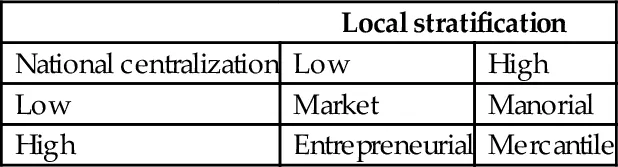
As the above tables show, four modes of exchange have descriptive and explanatory typologies. The descriptive one highlights the different business outcomes of the four types based on the patterns of t...
Table of contents
- Cover image
- Title page
- Table of Contents
- Copyright
- Contributors
- Author Biography
- Chapter 1: Comparing State Economic Ideologies and Business Ethics in East Asia
- Chapter 2: From Market to Mode of Exchange
- Chapter 3: Confucianism and Work Ethic—Introducing the ReVaMB Model
- Chapter 4: Corporate Authoritarianism and Civil Society Responding in Korea: The Case of Minority Shareholders’ Movement
- Chapter 5: Business Ethics in Korea: Chaebol Dynastic Practices and the Uneven Transition From a Market to an Entrepreneurial Mode of Exchange
- Chapter 6: Mapping K-Pop Past and Present: Shifting the Modes of Exchange
- Chapter 7: Business Ethics and Government Intervention in the Market in Joseon
- Chapter 8: The Politics of Institutional Restructuring and Its Moral Persuasion in Japan: The Case of the Iron and Steel Industry (1919–34)
- Chapter 9: Political Economy of Business Ethics in East Asia
- Index
Trusted by 375,005 students
Access to over 1.5 million titles for a fair monthly price.
Study more efficiently using our study tools.
Frequently asked questions
Yes, you can cancel anytime from the Subscription tab in your account settings on the Perlego website. Your subscription will stay active until the end of your current billing period. Learn how to cancel your subscription
No, books cannot be downloaded as external files, such as PDFs, for use outside of Perlego. However, you can download books within the Perlego app for offline reading on mobile or tablet. Learn how to download books offline
Perlego offers two plans: Essential and Complete
- Essential is ideal for learners and professionals who enjoy exploring a wide range of subjects. Access the Essential Library with 800,000+ trusted titles and best-sellers across business, personal growth, and the humanities. Includes unlimited reading time and Standard Read Aloud voice.
- Complete: Perfect for advanced learners and researchers needing full, unrestricted access. Unlock 1.5M+ books across hundreds of subjects, including academic and specialized titles. The Complete Plan also includes advanced features like Premium Read Aloud and Research Assistant.
We are an online textbook subscription service, where you can get access to an entire online library for less than the price of a single book per month. With over 1.5 million books across 990+ topics, we’ve got you covered! Learn about our mission
Look out for the read-aloud symbol on your next book to see if you can listen to it. The read-aloud tool reads text aloud for you, highlighting the text as it is being read. You can pause it, speed it up and slow it down. Learn more about Read Aloud
Yes! You can use the Perlego app on both iOS and Android devices to read anytime, anywhere — even offline. Perfect for commutes or when you’re on the go.
Please note we cannot support devices running on iOS 13 and Android 7 or earlier. Learn more about using the app
Please note we cannot support devices running on iOS 13 and Android 7 or earlier. Learn more about using the app
Yes, you can access The Political Economy of Business Ethics in East Asia by Ingyu Oh,Gil Sung Park in PDF and/or ePUB format, as well as other popular books in Economics & Economic Theory. We have over 1.5 million books available in our catalogue for you to explore.