eBook - PDF
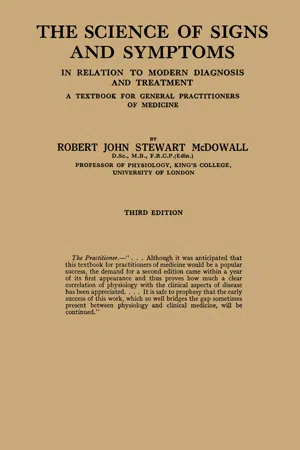
The Science of Signs and Symptoms
In Relation to Modern Diagnosis and Treatment: A Textbook for General Practitioners of Medicine
- 575 pages
- English
- PDF
- Available on iOS & Android
eBook - PDF
The Science of Signs and Symptoms
In Relation to Modern Diagnosis and Treatment: A Textbook for General Practitioners of Medicine
About this book
The Science of Signs and Symptoms in Relation to Modern Diagnosis and Treatment describes the state of consciousness in relation to concussion, cerebral compression, and quality of the blood. This book is composed of 48 chapters that discuss the physical basis of pain sensations, the different types of paralysis, and the significance of having a recurring headache. Some of the topics covered in the book are the pathways to different varieties of sensation; functions of the nervous pathway; varieties of sensory paralysis; description of functional disturbances; definition of axon and spinal reflex; important nature of tendon reflex; and neurological basis of clinical abnormalities of tone and posture. Other chapters deal with the different types of convulsions and the role of the eyes, muscle sense, and vestibular apparatus in equilibrium are extensively discussed. An analysis of the causes of vertigo is provided. The remaining chapters look into the formation and types of aphasia. These chapters also examine the effects of intracranial pressure. The book can provide useful information to the medical instructors, doctors, students, and researchers.
Information
Table of contents
- Front Cover
- The Science of Signs and Symptoms: In Relation to Modern Diagnosis and Treatment: A Textbook for General Practitioners of Medicine
- Table of Contents
- PREFACE TO THIRD EDITION
- EXTRACT FROM PREFACE TO SECOND EDITION
- PREFACE TO FIRST EDITION
- LIST OF ILLUSTRATIONS
- CHAPTER I. LIFE AS A CLINICAL ENTITY
- CHAPTER II. CONSCIOUSNESS
- CHAPTER III. DELIRIUM
- CHAPTER IV. VOLUNTARY MOVEMENT
- CHAPTER V. SENSATION
- CHAPTER VI. HEADACHE
- CHAPTER VII. REFLEXES
- CHAPTER VIII. MUSCLE TONE AND POSTURE
- CHAPTER IX. CONVULSIONS
- CHAPTER X. EQUILIBRIUM, VERTIGO, ATAXIA, GAIT
- CHAPTER XI. TREMOR, CHOREA, ATHETOSIS
- CHAPTER XII. SPEECH
- CHAPTER XIII. THE CEREBRO-SPINAL FLUID
- CHAPTER XIV. SIGHT AND THE REFLEXES OF THE EYE
- CHAPTER XV. HEARING. TASTE
- CHAPTER XVI. THE RATE OF THE HEART BEAT
- CHAPTER XVII. THE PULSE AND THE HEART SOUNDS
- CHAPTER XVIII. THE POLYGRAPH. THE ELECTROCARDIOGRAPH THE VENOUS PULSE
- CHAPTER XIX. BLOOD PRESSURE
- CHAPTER XX. HÆMORRHAGE AND SHOCK. THE NATURALARREST OF HÆMORRHAGE
- CHAPTER XXI. THE HISTOLOGY OF THE BLOOD
- CHAPTER XXII. PHYSIOLOGICAL PRINCIPLES IN RELATION TO CARDIAC EFFICIENCY AND DISEASE
- CHAPTER XXIII. BREATHING AND FAILURE OF RESPIRATION
- CHAPTER XXIV. CYANOSIS AND ITS RELATION TO BREATHLESSNESS. ANOXÆIA AND OXYGEN THERAPY
- CHAPTER XXV. THE PROTECTIVE RESPIRATORY REFLEXES
- CHAPTER XXVI. PHYSIOLOGICAL PRINCIPLES IN FEEDING
- CHAPTER XXVII. VITAMINS
- CHAPTER XXVIII. SWALLOWING. DIGESTION IN THE STOMACH SWALLOWING
- CHAPTER XXIX. DIGESTION. INTERMEDIATE METABOLISM
- CHAPTER XXX. GASTRIC PAIN. COMMON GASTRIC AILMENTS.VOMITING
- CHAPTER XXXI. INTESTINAL MOVEMENT AND PAIN
- CHAPTER XXXII. BILE. JAUNDICE
- CHAPTER XXXIII. THE METABOLIC RATE
- CHAPTER XXXIV. BLOOD-SUGAR AND PANCREATIC EFFICIENCY
- CHAPTER XXXV. DISORDERS OF METABOLISM
- CHAPTER XXXVI. BODY WEIGHT
- CHAPTER XXXVII. GROWTH
- CHAPTER XXXVIII. THE URINE
- CHAPTER XXXIX. OEDEMA AND THE WATER CONTENT OF THE BODY
- CHAPTER XL. THE TEMPERATURE OF THE BODY
- CHAPTER XLI. THE SKIN
- CHAPTER XLII. HYPERSENSITIVITY AND ALLERGY
- CHAPTER XLIII: THE ACID-BASE EQUILIBRIUM OF THE BODY
- ALVEOLAR CARBON DIOXIDE AND ITS SIGNIFICANCE
- CHAPTER XLIV. THE AUTONOMIG NERVOUS SYSTEM
- CHAPTER XLV. EXERCISE AND REST
- CHAPTER XLVI. PROTECTION AGAINST DISEASE
- CHAPTER XLVII. PHYSIOLOGICAL PRINCIPLES IN THE TREATMENT OF CERTAIN EMERGENCIES
- CHAPTER XLVIII. THE PSYCHOLOGICAL PRODUCTION OF SYMPTOMS
- SELECTED BIBLIOGRAPHY
- INDEX
Trusted by 375,005 students
Access to over 1.5 million titles for a fair monthly price.
Study more efficiently using our study tools.
Frequently asked questions
Yes, you can cancel anytime from the Subscription tab in your account settings on the Perlego website. Your subscription will stay active until the end of your current billing period. Learn how to cancel your subscription
No, books cannot be downloaded as external files, such as PDFs, for use outside of Perlego. However, you can download books within the Perlego app for offline reading on mobile or tablet. Learn how to download books offline
Perlego offers two plans: Essential and Complete
- Essential is ideal for learners and professionals who enjoy exploring a wide range of subjects. Access the Essential Library with 800,000+ trusted titles and best-sellers across business, personal growth, and the humanities. Includes unlimited reading time and Standard Read Aloud voice.
- Complete: Perfect for advanced learners and researchers needing full, unrestricted access. Unlock 1.5M+ books across hundreds of subjects, including academic and specialized titles. The Complete Plan also includes advanced features like Premium Read Aloud and Research Assistant.
We are an online textbook subscription service, where you can get access to an entire online library for less than the price of a single book per month. With over 1.5 million books across 990+ topics, we’ve got you covered! Learn about our mission
Look out for the read-aloud symbol on your next book to see if you can listen to it. The read-aloud tool reads text aloud for you, highlighting the text as it is being read. You can pause it, speed it up and slow it down. Learn more about Read Aloud
Yes! You can use the Perlego app on both iOS and Android devices to read anytime, anywhere — even offline. Perfect for commutes or when you’re on the go.
Please note we cannot support devices running on iOS 13 and Android 7 or earlier. Learn more about using the app
Please note we cannot support devices running on iOS 13 and Android 7 or earlier. Learn more about using the app
Yes, you can access The Science of Signs and Symptoms by Robert John Stewart McDowall in PDF and/or ePUB format, as well as other popular books in Medicine & Diseases & Allergies. We have over 1.5 million books available in our catalogue for you to explore.