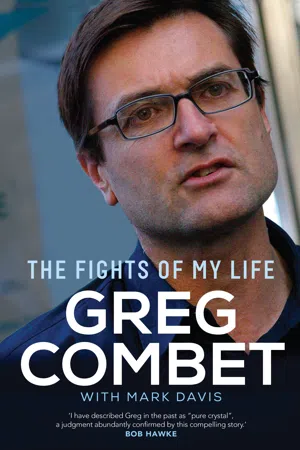
Greg Combet has been central to some of the biggest public struggles of our time - on the waterfront, the collapse of an airline, compensation for asbestos victims, the campaign against unfair workplace laws and then climate change. From an idyllic childhood on the Minchinbury estate in the western suburbs of Sydney, Combet's world changed dramatically with the early death of his wine-maker father. The shy child was uprooted to the suburbs and an uncertain future. A scholarship allowed him to study engineering and saw him appreciate first hand the role of unions in the workplace.
He rose to lead the Australian trade union movement and become a senior minister in the Rudd and Gillard Labor governments. Along the way he has battled his own struggles, with political ideology, the impact of work on families and the loneliness of the parliamentary life. His story is not just a personal memoir; it is an insight into how power works in Australia, who holds it, how it is used and the ruthless ways in which it is snatched.
The Fights of My Life is the story of a man who faces up to the power structures of politics, big business and the media. His latest target is the labour movement, arguing that the Labor Party and the trade unions must democratise to engage the next generation of activists to fight the good fight: to achieve a more fair and just Australia.
- 372 pages
- English
- ePUB (mobile friendly)
- Available on iOS & Android
eBook - ePub
The Fights of My Life
About this book
Information
1
THE END
Alone, I opened the heavy soundproof door to the empty Cabinet Room. I wanted one last look around.
I felt reconciled to the changes I was confronting. My time as a Cabinet minister would end within hours, my time as a member of parliament was almost over, and the Labor Government, of which I was a member, faced certain electoral defeat.
Like many of my ministerial colleagues, I had spent so many hours, so many long days and long nights, in that windowless room. My preparations for Cabinet meetings often started on Sundays with as many as ten submissions, some of about eighty to a hundred pages each. On Monday nights, dinner was provided in an area outside the Cabinet Room before we started the meeting at 6.45 p.m. There would be no advisors present. Cabinet ministers were rightly expected to have done the work beforehand. We needed to be able to make our arguments and defend our positions on our own.
This room is where I had thrashed out the contentious carbon pricing policy that had so dominated recent politics. It is where the decisions that shape our nation are debated and decided. It is a room that is home to power in our Australian democracy. It truly is an inner sanctum: a still, silent chamber in the heart of Parliament House, situated on the land axis that Walter Burley Griffin had plotted on the bush landscape when he planned the nation’s capital.
I have always liked the Cabinet Room ceiling the most. In the middle it is laminated with a beautiful, intricate timber mosaic depicting the Australian bush. Gazing up during some idle moments in a meeting, I liked to spot the cicadas among the eucalypt leaves.
The first time I visited this room was in 1988, as a young union official with the Waterside Workers’ Federation. It was a meeting with Prime Minister Bob Hawke to discuss waterfront restructuring, when Parliament House was new, freshly commissioned. Bob showed us the little buttons under the lip of the huge, oval-shaped table, located directly below a small, square, white timber inlay on the table surface. In those days, if you pressed a button an attendant would emerge through a door with a cappuccino in hand. Bob thought it was a hoot, and so did we. We all pressed the nearest button. Pretty soon Tas Bull, John Coombs and the rest of the hard, tough wharfie union officials were sipping cappuccinos while we debated waterfront work practices with the Prime Minister.
Two decades after that first visit, I was privileged to serve as a Cabinet minister in a Labor government that introduced reforms to make Australia a better and fairer nation. The Cabinet Room was where the Gillard Government’s school reforms were debated—billions of dollars in extra education funding with a strong focus on the needs of disadvantaged students and schools. As we discussed the criteria for matching school funding to the needs of individual students, I remember thinking about kids going to the schools I had attended as a child, and how this would give them better chances in life.That was immensely important to me. Even though the Gillard Government’s school funding changes were not contentious in the Cabinet, these were some of the most emotional discussions we had inside that room. Each and every one of us was proud to be in a Cabinet putting in place a set of education reforms that would help overcome the entrenched disadvantage and inequality generated by a market economy. It was hallmark Labor reform.
In that room, we made decisions on healthcare reforms, dramatically boosting surgical and community health services, improving the availability of important pharmaceutical drugs to people who until then couldn’t afford them, making decisions to extend dental treatment to teenage kids whose families could not afford to go to the dentist. We engaged in long discussions about strengthening economic growth, boosting productivity in our economy, investing in infrastructure, in transport and communications systems, and in better skills and training for the workforce, all aimed at generating the wealth and opportunity that was needed to create a fairer society.
I was particularly proud of the decision of the Gillard Government to establish the Royal Commission into Institutional Responses to Child Sexual Abuse. This is a matter of pure justice. It will ensure that victims of appalling abuse have a chance to tell their stories. It will expose how institutions failed those children, not only at the time of the abuse but in the decades afterwards, as the victims had to cope with the legacy of pain. It will help bring perpetrators of abuse and those who have protected them to justice.
These were all reforms fundamental to Labor’s values. It had been a privilege to serve as a Cabinet minister, to contribute to great and enduring changes to make our country better, but Labor had destroyed itself in government.
Cabinet is the highest level of executive power and authority in Australia’s system of government. As prime minister, Julia Gillard had been a very effective Cabinet leader.Yet now all the power had drained away from her. It was 26 June 2013 and in a couple of hours another chapter in the Kevin Rudd – Julia Gillard struggle would be written. Kevin Rudd was set to return as prime minister exactly three years after having been deposed.
In a series of discussions over the previous fortnight, Julia Gillard had asked me to stand for the leadership. She was prepared to stand down as Labor leader and prime minister and swing her support behind me against Rudd, believing this would give the Labor Party a better chance in the election that loomed. I had anticipated this proposal for a long time, felt it growing as a ball of tension inside me for possibly more than a year. It presented me with a gutwrenching, difficult decision that would determine my future, one way or the other.
I love the Labor Party. In my world, the Labor leadership is a pinnacle of achievement, an immense honour. Ordinarily I would grasp an opportunity like the one Gillard was offering, fight to make it a reality, and use it to pursue progressive change, a fairer and more decent society. The imperative for a decision came over the weekend, ahead of the last sitting week of parliament before the 2013 election.
Because I had thought about this so much for so long, it was not as difficult to reach a conclusion as I had anticipated. Personally, after thirty years full-time as an activist in the labour movement, I thought it was time for a different phase in my life to begin. I was dog-tired after so many years fighting for the cause, and a couple of debilitating health problems had been focusing my mind on leaving politics for many months. I had prioritised my work over my family and personal life, to my detriment and to the detriment of those close to me, for far too long. I needed to attend to my own wellbeing.
At a political level I also thought it was too late to institute a manoeuvre like this, to spring a new leadership candidate on the caucus and the community. The momentum for Rudd’s return was too strong. And I was fed up with the disloyalty and the disunity within the Labor caucus, the sheer, ruthless bastardry. I’d had a gutful of the caucus members who thought it legitimate to denigrate their colleagues to journalists, to undermine their own political party and leader in the media, all from the safety of anonymity.
For both personal and political reasons I decided against Julia’s proposal. And, having decided against it, I resolved that it was time for me to leave parliament altogether. I still had passion for the great cause of the labour movement, for the good fight, the fight for fairness and justice. But I understood from my experience that unless I was in the best of health, possessed of the most positive and determined mindset, and with strong personal support, I couldn’t responsibly stay in parliament and play a senior role in the necessary rebuilding of the Labor Party.
Every day I attended parliament I was conscious of the immense privilege it was for someone like me, who started out in Rooty Hill in western Sydney, to serve as a senior member of a Labor government, translating Labor values into action. I was always conscious of it. So now that it was ending, I wanted to spend one last time in the Cabinet Room on my own just to look, to remember. I wanted to reflect on the honour I had experienced there. Every opportunity I’ve had, I’ve owed to the unions and Labor. I felt it very strongly. The gravity was compounded by my decision to knock back the chance to stand as leader.
I had waited until no-one else was around, and then went in. There was a feeling that afternoon throughout all of Parliament House that everything was about to shift. I had informed my staff of my intentions. It was a quiet but emotional meeting with them. As a consequence of my decision they were about to lose their jobs, and I was pretty torn up about this. I also felt a profound sadness for the Labor Party, which at times in its history has been its own worst enemy. There were lots of whispered conversations. There was an air of gloom.
I lingered in the Cabinet Room for ten minutes or so, my mind drifting over events, feeling proud of what had been achieved. As I closed the Cabinet Room door and headed off to the leadership ballot, I reflected upon the long and difficult, but immensely rewarding, years behind me.
2
THE BEGINNING
In 1966 a small primary school on the semi-rural western fringes of Sydney was celebrating its centenary. I was eight years old, anxious and nervous. Chosen to speak on behalf of the children of Eastern Creek Public School, my task was to deliver an address welcoming a distinguished visitor, the Honourable Robert Askin, and reflecting on the school’s history and achievements. This was my first brush with public speaking—and my first encounter with a significant political figure. It was not an easy experience. Shy by temperament and isolated by family circumstance, speaking to an audience that included the premier of New South Wales was a task seemingly designed to cause me intense discomfort and distress. Those sensations were something of a shortcoming for someone heading for a life of political activism.
Over the decades since Eastern Creek, I have delivered hundreds of speeches: addressing mass meetings of striking workers, presenting submissions to industrial tribunals, spelling out the bottom line in negotiations with employers, speaking in parliamentary debates and international forums, delivering rallying cries for the faithful, denouncing political opponents, and advocating for those without power in our society. Yet for a long time public speaking remained a frightening experience for me. It was an obligation to be endured, rather than a talent that came readily.
It was my father who coached me to deliver that first speech as an exercise in bringing out his withdrawn son. He was also very shy, and had forced himself to speak publicly at local Rotary meetings, drawing on the books of the American self-improvement writer Dale Carnegie, because he wanted to play an active role in his community. I was proud of this about my father and I wanted to be like him. He drilled me to learn the discipline needed to overcome shyness and to stand up to achieve things. It was hard work. We rehearsed and rehearsed and rehearsed. In the end, I delivered the short speech perfectly—so perfectly it’s a wonder I can’t still recite it today—yet I was utterly terrified with every word.
My life as a political activist, a trade union leader and a Labor politician has been a vocation but it was not preordained. I did not set out on this path from the outset. Time and again I needed to find the courage to take on the fight, and the story of my formative years is one of a number of painful transitions. My father played a critical role in my development—first by his presence and then by his absence. My fundamental values come from my family, my mother and father and their parents.
Five years after that primary school speech, my father died. We knew this terrible event was approaching, and that had generated anxiety and insecurity in the lead-up to it. When his death came, it precipitated significant change in our lives. We were thrust from a semi-isolated existence into a wider world. Without this event, my life would likely have unfolded in a different direction, probably into winemaking.
Following the shock of Dad’s death, further shifts were to come, the result of internal changes of heart and external changes in direction. Navigating these early transitions was how I found my way. I learned about the fear of financial insecurity, the fundamental value of work and opportunity, and about social class and the nature of power in modern Australian society. Justice and fairness became my passion, which gave me an appetite for social and economic reform, and a commitment to the role of unions and the Labor Party in protecting the vulnerable in society. It is why I committed to a life of political activism, to the great cause of the labour movement, because I believe wholeheartedly that the best thing about Australia is our capacity to look after each other, to stand up for basic decency.
Minchinbury
It has been written that the past is another country, where things are done differently. My childhood is not so much another country as a small island, a time and place separate and self-contained, yet also part of the larger whole. While it has receded over the years, it remains ever-present, an emotional touchstone.
I grew up on Minchinbury Estate, a 300-acre winery owned by the Penfolds Wine company, where my father worked as a winemaker. This was not only a workplace and a home; for a boy it was also an entire realm: a collection of paddocks, gardens, creeks, vines, livestock, sheds, cellars hewn out of the rock, and all the agricultural and industrial paraphernalia of winemaking.
We were part of the wider community of Rooty Hill on Sydney’s western fringes. Back then it was a district of working-class housing plots, small farmers, market gardens and migrant settlers from postwar Europe, a poor and ethnically diverse area. At the time, the Housing Commission was planning and developing new public housing at nearby Mount Druitt. As I grew up in the 1960s, there was an awareness of the great social and political changes taking place in Australia. Yet while it was not completely isolated, for me Minchinbury was a place apart, a site for my own adventures where I could roam alone or work as my father’s helper in the winery.
Penfolds bought the estate in 1912, and Minchinbury Champagne, made according to the French méthode champenoise, became one of the company’s bestselling brands. Penfolds continued making champagne along with other table wines at Minchinbury until 1978, when it closed the winery.1 Some of the historic buildings and cellars were heritage listed but they were destroyed by fire in 1987.These days the estate is long gone, subdivided for housing, and Minchinbury is now a City of Blacktown suburb, south of Rooty Hill between the Great Western Highway and the M4 Western Motorway. The suburb has streets named after my family—Combet Place, Tod Place and Ivan Street, to name a few.
When I was growing up, you turned off the Western Highway and entered the property through an archway. Near this entrance was an aircraft ploughing nose first into the ground with the reassuring sign, ‘Don’t Crash, Drink Penfolds’—a marketing gimmick referring to the (possibly apocryphal) story that Rooty Hill had been the site of Australia’s first plane crash. You reached the winery at the end of a long road lined with olive trees that had been planted by Leo Buring.
The cellars and older parts of the winery had been carved out of stone, and there was a large factory-style building for wine production. It had ancient stairways and passages, ladders ascending to lofts, dimly lit underground cellars with musty nooks and crannies and rows of shaking tables, spiders imported from France that ate insects attacking the champagne corks, and numerous oak casks, large and small, with scents of vintages past. Outside, the winery was surrounded by tall palms, which were many decades old, hedges, and walls covered with ficus climbers.
My family had an association with the wine industry and Minchinbury that spanned generations. My great-grandfather Alexandre Ivan Combet was a French immigrant. He had learned about wine and champagne making near Lyon while training as a seminarian with the Marist Brothers. Seeking life as a missionary in the South Pacific, he sailed to Sydney, ending up at St Joseph’s College at Hunters Hill, which in those days had a vineyard. His letters home reveal a struggle between the lure of ordinary married life and devotion to his calling. Ultimately he fell in love with a nun, Marie-Antoinette, who had also travelled from Lyon.They left their orders, moved to the Hunter Valley and married in 1902.
Alex Combet planted vineyards and worked in winemaking in the Hunter before the family moved to Minchinbury around 1919. He became head winemaker in 1941 and, in the French tradition, passed on the skills to his son, my grandfather Leon Ivan Combet, who took over as manager and head winemaker in the late 1940s. In his retirement my great-grandfather returned to the Hunter region and started a wine bar near Cardiff, where I was to eventually establish my parliamentary electorate office.
When I was born in 1958, my father, Ivan Louis Combet, known as Tod, was also a winemaker at Minchinbury. We—my father, mother, older sister Jennifer and I—lived in a cottage just inside the arched entrance on the Great Western Highway. My mother, Aida Nardi, was the daughter of a cattle farmer from Nimbin in far northeastern New South Wales. She had come to Sydney at the age of seventeen and worked as a secretary in a bank before marrying my father and settling at Minchinbury. Her father was the descendant of Italian immigrants who had come to Australia in the late nineteenth century, and ...
Table of contents
- Cover
- Title
- Copyright
- Contents
- Acknowledgements
- 1 The end
- 2 The beginning
- 3 Union life
- 4 Here to stay
- 5 A hard landing
- 6 The asbestos fight
- 7 Victory
- 8 Coming to power
- 9 A turbulent climate
- 10 Renewal
- Notes
- Index
- Pic Section
Trusted by 375,005 students
Access to over 1.5 million titles for a fair monthly price.
Study more efficiently using our study tools.
Frequently asked questions
Yes, you can cancel anytime from the Subscription tab in your account settings on the Perlego website. Your subscription will stay active until the end of your current billing period. Learn how to cancel your subscription
No, books cannot be downloaded as external files, such as PDFs, for use outside of Perlego. However, you can download books within the Perlego app for offline reading on mobile or tablet. Learn how to download books offline
Perlego offers two plans: Essential and Complete
- Essential is ideal for learners and professionals who enjoy exploring a wide range of subjects. Access the Essential Library with 800,000+ trusted titles and best-sellers across business, personal growth, and the humanities. Includes unlimited reading time and Standard Read Aloud voice.
- Complete: Perfect for advanced learners and researchers needing full, unrestricted access. Unlock 1.5M+ books across hundreds of subjects, including academic and specialized titles. The Complete Plan also includes advanced features like Premium Read Aloud and Research Assistant.
We are an online textbook subscription service, where you can get access to an entire online library for less than the price of a single book per month. With over 1.5 million books across 990+ topics, we’ve got you covered! Learn about our mission
Look out for the read-aloud symbol on your next book to see if you can listen to it. The read-aloud tool reads text aloud for you, highlighting the text as it is being read. You can pause it, speed it up and slow it down. Learn more about Read Aloud
Yes! You can use the Perlego app on both iOS and Android devices to read anytime, anywhere — even offline. Perfect for commutes or when you’re on the go.
Please note we cannot support devices running on iOS 13 and Android 7 or earlier. Learn more about using the app
Please note we cannot support devices running on iOS 13 and Android 7 or earlier. Learn more about using the app
Yes, you can access The Fights of My Life by Greg Combet, Mark Davis in PDF and/or ePUB format, as well as other popular books in Social Sciences & Social Science Biographies. We have over 1.5 million books available in our catalogue for you to explore.