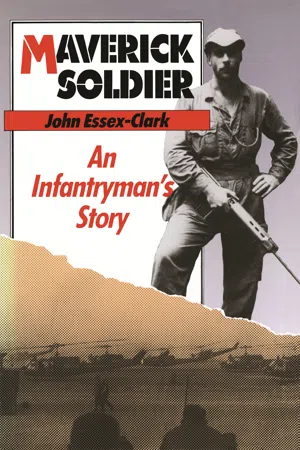
Maverick Soldier is the forthright, nuts-and-bolts account of John Essex-Clark's unmatched experience as a warrior, leader and teacher. Its telling is all of a piece with the man himself—bluff, astute, no-nonsense.
In the course of stumbling, as he puts it, from the rank of private to brigadier, Essex-Clark has fought in wars with the Australian, British, United States and Rhodesian armies, and has led in battle Malay, South African, Rhodesian, Vietnamese, British, New Zealand, United States and Australian soldiers. In peacetime came tours of duty in North America and Western Europe.
Nicknamed 'Digger' by the Rhodesian Army and 'The Big E' in the Australian, he led by force of personality, drive, common sense and self-confidence.
Military readers and armchair witnesses to war will be challenged by his trenchant and timely views on army obsession with technology and the paucity of subtle tactical thinking. Various controversies are aired: whether we were 'pussyfooters' in Vietnam; bastardization at Duntroon; how best to conduct counter-terrorism. He is angered by what he sees as a 'surfeit of military dilettantes and budding bureaucrats and a dearth of warrior-chiefs'.
Always one to lead from the front and to trust the courage and good sense of the ordinary infantryman, his interests have been strategy and battle tactics, leadership and training. He writes particularly for today's young soldier whom he loves with an old fashioned generosity, and to whom he can declare with conviction, 'I have no angst about being a soldier'.
- English
- ePUB (mobile friendly)
- Available on iOS & Android
eBook - ePub
About this book
Trusted by 375,005 students
Access to over 1.5 million titles for a fair monthly price.
Study more efficiently using our study tools.
Information
1 Jungle Stoush, 1956
The gloomy and misty jungle is dangerously quiet, the faint dripping from last night’s rain the only sound. Five metres in front of me the forward scout is frozen in mid-step. He slowly raises his left arm, fist clenched and thumb down, signalling ‘Bandits near’. We smoothly stop and drop. Muddy green statues melt into the ground. He points downwards in the vague polite way of a Bantu while warily scanning the jungle around him. Cautiously I creep next to him and see the footprints in the composting leaf mould at the side of the track.
‘How many, Matias?’ I whisper to the hawk-eyed old Nyasa.
‘Three; move fast; big packs.’
‘When?’
‘Ten . . . twenty minutes.’
Damn! In ten minutes they can cover a kilometre, changing direction irregularly. We track forward quickly following the spoor for about fifty metres. I cover Matias, looking for danger around him as he carefully casts ahead seeking further ‘sign’ which can tell us how far apart they are moving and how often they halt to check for the presence of security forces: us. Corporal Tabuya covers me. We confirm there are three. Matias is trying to see if they halted for a rest so that we can determine what weapons they have from imprints and scrape marks. The others in my platoon, twenty-seven tough askari from the Ndebele, Shona, Barotse and Nyasa tribes of central Africa, have sheered off the overgrown track and are crouched and tensed: weapons ready, scenting, listening and their eyes piercing the dense Malayan jungle enveloping us. Someone out there wants to kill us. Our job is to hunt down and kill them.
Pisayi, my Platoon Warrant Officer and second-in-command, slips beside me. He is a short, wiry and quick-witted Shona. He murmurs, ‘Ho Lung?’ Comrade Ho Lung commands 32 Independent Platoon of the Malayan Races Liberation Army. They are one of many communist terrorist groups of experienced and ruthless jungle fighters and assassins that we have been chasing in north Johore for months. Ho Lung had attacked and murdered police and civilians in the rubber estates recently but no security forces had bested him.
Ho Lung is believed to be moving east to cross the Sungei Palong (Palong River) before slithering into one of his many boltholes in the Segamat Wild Life Sanctuary which is a vast area of mountainous primary jungle. Once his platoon gets away we might never know where they are until they debouch again to wreak havoc. We have been dispatched to destroy him and his platoon and have been waiting for them on the Palong, patrolling by day and ambushing by night, for the past week.
‘I don’t think these are Ho Lung’s people, sar’major. They’re probably CT couriers working with the Min Yuen.’ We abbreviate the term ‘communist terrorist’ to CT in singular or plural.
We study our maps and realise that we’ll never catch them. They are too far ahead, the creeks are flooded and the late afternoon monsoon rain will soon wash out their footprints. The fact that they are using the trail means that they want to move fast and do not suspect that we are near. Though setting up for a high frequency radio message will slow us down I decide to inform my Battalion Headquarters.
We finally get through, faintly. I am in some disfavour: a not unusual occurrence. It’s Captain John Shaw, our clever but pompous and bossy Intelligence Officer, speaking to me from his comfortable operations room some fifty-four kilometres away: ‘Four-two, where the hell have you been!’ He pithily gives me some information about Ho Lung’s expected movements. He could have at least wished me luck.
To catch Ho Lung before he crosses the Palong on a derelict foot bridge near the deserted village of Jerong Subang, twelve kilometres to our north, at ‘sparrow-fart’ tomorrow we’ll have to move fast and use the old trail we are on. It is already midday. None of us look forward to slogging on an overgrown jungle track with heavy chafing pack on our backs, wearing soaked trousers and shirt and carrying a rifle, shot-gun, machine-gun or carbine. The temperature will be about 32 degrees Celsius and a tropical rain storm will hit us in the late afternoon. Add clambering over fallen logs, avoiding thorns, vines and clumps of bamboo and wading chest deep through countless flooded creeks. For more spice there could be some experienced and ruthless killers waiting to ambush us, but we’d practised our drills for that.
The spirit and enthusiasm of youth rather than the cautious wisdom of experience dominates my decision. I feel that the quicker we move the more surprise we will gain. But the supreme influence on my decision to take risks is the euphoria of command. My Company Commander, Major Bill Godwin, is absent on short local leave; the second-in-command, Captain Dudley Rowell, had reluctantly departed a few days ago with a raging fever, appropriately on Guy Fawkes day. I had just been promoted from second lieutenant to the exalted rank of lieutenant and am proudly, but very temporarily, commanding a company of ninety-one good and true infantrymen.
The three fleet-footed CT couriers would be well away from us by now and, even if they try to warn him, Ho Lung is probably well west of the river which is still rising. That is if they even know where Ho Lung is, which is unlikely. So I warn my platoon to prepare to move fast on the trail. It is already too late to try anything too clever that evening. We’d be lucky even to get across the Palong. But I must not let Ho Lung take the initiative. I must get close to him quickly.
We speed north less than cautiously. The overgrown trail is east of the Palong and is now used by elephant, sambar deer and wild pig and, infrequently, by the occasional Sakai (Malay aborigine) fisherman or the CT. From the depth of the water in the streams across our path we realise the river is still rising. We are crossing them with water up to our chests when normally they’d be only ankle deep.
My thoughts often ramble while walking fast on a track: a stupid pastime when on patrol. I think about the ‘Brits’ and the French who parachuted into the Suez area a week ago. The evening news on the radio was still full of it. I hope it won’t start a third world war. Johnny Ray’s ‘Walking in the rain, getting soaking wet. . .’ jingles in my mind as we move quickly and rhythmically. My big bergen pack sways with my stride, my water-bottles slosh, my machete slaps my thigh, the pistol grip of my sub-machine-carbine is comfortably tucked into my belt, my palm covering the breech opening. Now, when I win the £1000 Rhodesian sweep. . .
Urgently Matias halts us again on the lip of another swollen creek. Muddy footprints with suspended sediment show where the terrorist group ahead of us has come back onto the trail and cut saplings to help them get across. It must have been very deep and swampy upstream for them to have to come back west to the trail. Matias is agitated. The spoor is less than five minutes old. The leading section of my men smoothly deploy off the trail but we had been moving so fast that the rear of the column concertinas into us. I’ve shown poor leadership. My platoon in single file must have had difficulty keeping up with me. Streams, vines and fallen logs had impeded us, but surely not that much. I have a flash of post-failure brilliance: I remember my rule that after crossing an obstacle I must not move any faster than the speed it took me to cross it, for a distance equal to the length of the column. I’d moved too fast. I’d exhausted the lads to the rear who had become part of a frenzied concertinaring shambles rather than a controlled well-spaced single file. Most of my platoon is now crowded on the edge of the stream. We scramble all over each other trying to take cover quickly and then wriggle into firing positions. ‘Bloody idiot!’ I say to myself—my askari are not impressed with me either. My Platoon Sergeant, Gondocondo, his muscles swelling his shirt befitting an Ndebele boxer of renown, smiles hugely. He’s enjoying himself and has come forward from the back of the platoon column to see our mad antics.

8 Platoon’s leaders. Standing, from left: Corporal Tabuya, Sergeant Gondocondo, self, Warrant Officer Pisayi, Corporal Taderera. Kneeling: Lance Corporal Kenneth, Corporal Jere, Lance Corporal Muchembere.
Two rifle shots thump-thump behind us: one shot knocks down Taswivinga who is standing next to me. It had hit his pack. We answer with a fusillade of rifle and Bren gun fire. The alert askari from the lead section, led by Corporal Tabuya, scramble and charge in the direction of the shots. But we chase blind and slow as there is no easy spoor to follow.
To chase or not to chase? What are the priorities? Should I waste more valuable time setting up the radio to advise headquarters? My decision is made for me by the whims of the jungle. Corporal Taderera’s men around me burst apart like an exploding grenade with shouts of ‘Mago! Mago!’ echoing through the trees: wasps! Worse than terrorists! We thrash through jungle with our arms over our faces and hands over our ears to get far away from the nest quickly. To see a soldier blunder blindly into the jungle for no apparent reason is an ridiculous sight, until the wasps make you do the same.
We had wasted more time and there is now no doubt that Ho Lung must be the priority. We’d already mucked around enough at this creek. The three couriers will have fled to the east. I’d already reported their direction of movement. Leave them be and get Ho Lung. But more carefully, more tactically and with more common-sense. Thank heavens he won’t have heard the shooting.
The river is still rising. I wonder what Ho Lung’s thoughts are. When and where will he base-up for the night? What time will he start tomorrow morning and where will he go? He’d know from experience that the Palong will be up. What difference will that make to his plans? Will the old foot-bridge at Jerong Subang still be there? How hard will he fight?
As we reach Jerong Subang we cautiously fan out and check it for an ambush. It is now unrecognisable as a once inhabited village of happy Malay and hard-working Chinese families. They must have been resettled many years ago. It is now overgrown with belukar, lalang and bamboo. We see the Sungei Palong properly for the first time in about four hours. It is a deep, swollen and treacherous muddy torrent about thirty metres across. I put out sentries and send clearing patrols along the near bank. There is no foot-bridge, only a broken line of leaning rotten posts.
My fellow Platoon Commander, Yvo de Bruyn, a wiry, unflappable and strong swimmer, and myself, a fairly mediocre swimmer who does not want to be outdone or lose face, strip naked, link fifty metres of our askari’s toggle ropes, tie them to belts around our waists, go upstream and swim boldly across the river to the admiring throaty ‘Eeehs’ from our askari. Most askari, having been brought up near water ever-menaced by crocodiles or bilharzia, never learn to swim and, worse, have a morbid fear of deep muddy water. They sensibly leave us to it.
We stretch across another fifty metres of linked toggle rope ten metres downstream as a safety line. Then, with either Yvo or me standing by as a life-guard to rescue any lost souls, we take it in turns to ferry each of our askari across the river. There are dramatic moments as some of our non-swimmers lose confidence while crossing the torrent.
Suddenly a strong wind thrashes the canopy above us and moments later the rain sheets down. The continuous rain makes it hard to hear, smell or see but I’m pleased because it drowns out the shouts of encouragement, false warnings and laughter from those already across who have not been deployed to secure the crossing. We just can’t stop their excitement. They are enjoying both the euphoria of being across the river and the terror of their friends on the other bank.

The Palong contacts—first skirmishes with communist terrorists in November 1965.

Warrior friends. The platoon commanders of Godwin’s Company—Freddy Harrison, Yvo de Bruyn and self—standing in front of a Ferret armoured car.
Ho will be thinking about bedding down for the night not too far to our west about now. How relaxed or nervous will he be? If he’s under cover he’ll be enjoying the heavy rain and using it to cover the noise of his mens’ basing-up and to dampen down the smoke and smell from his cooking fires. I hope he is calm, comfortable and supremely confident. I don’t want to bump into testy, tetchy, twitchy and highly alert CT tomorrow. So eat and sleep well, my friend; relax.
Once we are all across the river, with the rain still pelting down, we dispatch our security patrols and, as it is about an hour from last-light and evening stand-to, I decide that Yvo and I will have a two-platoon base. Pearce brings me a welcome mug of hot sweet tea. I relax too and think ahead.
Then, unexpected, I am called to the radio to hear the gruff voice and ‘err’ing speech of my Commanding Officer, Jock Anderson. He gives me the startling message that Ho Lung could base-up for the night at an old CT camp which is probably less than three kilometres from me and could cross the Palong early tomorrow morning. It is too late to find and attack Ho Lung’s group that evening, particularly as his camp will be cleverly sited and well defended. However, I will now have to choke his eastward movement options by closing the distance between us that evening. This will enable me, at first light the next day, to site multiple ambushes both closer together and closer to him. We need to start now and move quickly. In heavy rain, hoping it will cloak any noise we make and keep Ho Lung’s terrorists in the dry comfort of their bashas, we scramble westward in a single line of two platoons.
It is still raining as we stop on an eastern slope after covering about 1500 metres. We immediately, quietly and automatically shake out into our patrol base. We prepare for the night. I tell my men that there is to be no cooking, no use of noisy aluminium mess tins, no smoking, no washing, no smelly insect repellent, no lights, silent cleaning of weapons, no clearing patrols, no radio communications and no cutting of trees, vines or tracks. We put waist-high nylon parachute cord around the perimeter. We have two sentry positions only. All are warned that we will move to engage Ho Lung’s platoon at 5.45 a.m. tomorrow and that we will fight by section patrols.
Evening stand-to starts late, well after dusk. I normally walk around the perimeter and talk quietly with my askari. But we are all dog-tired this evening and they had seen enough of me during that day. After we stand-down, Yvo, our warrant officers, sergeants and our six corporal section commanders assemble at the centre of our base. I give my orders for the next day. My plan is to spread a fairly loose tripwire of six ambush positions across about 300 metres of Ho Lung’s probable route by 6.30 a.m., then wait thirty minutes to ambush Ho’s group moving east towards the river. If we don’t catch him by then, each section will patrol west, parallel to each other, towards the area of Ho Lung’s night base. Because our patrols were so close I’ll not allow unco-ordinated follow-up after contact. Fred Harrison, lea...
Table of contents
- Maverick Soldier
- Contents
- Illustrations
- Foreword
- Preface
- ‘Digger’
- 1 Jungle Stoush, 1956
- 2 The Die Cast
- 3 Fighting Askari
- 4 Congo Cauldron
- ‘The Big E’
- 5 Back to Taws
- 6 Yanked into Vietnam
- 7 Set a Thief . . .
- 8 Donnybrooks
- 9 Hunters and Stalkers
- 10 A Warrior’s Dues
- 11 Tribal Elder
- 12 Terror Australis
- 13 Pushing Uphill
- Postscript
- ABBREVIATIONS AND MILITARY TERMS
- CONVERSIONS
- Index
Frequently asked questions
Yes, you can cancel anytime from the Subscription tab in your account settings on the Perlego website. Your subscription will stay active until the end of your current billing period. Learn how to cancel your subscription
No, books cannot be downloaded as external files, such as PDFs, for use outside of Perlego. However, you can download books within the Perlego app for offline reading on mobile or tablet. Learn how to download books offline
Perlego offers two plans: Essential and Complete
- Essential is ideal for learners and professionals who enjoy exploring a wide range of subjects. Access the Essential Library with 800,000+ trusted titles and best-sellers across business, personal growth, and the humanities. Includes unlimited reading time and Standard Read Aloud voice.
- Complete: Perfect for advanced learners and researchers needing full, unrestricted access. Unlock 1.5M+ books across hundreds of subjects, including academic and specialized titles. The Complete Plan also includes advanced features like Premium Read Aloud and Research Assistant.
We are an online textbook subscription service, where you can get access to an entire online library for less than the price of a single book per month. With over 1.5 million books across 990+ topics, we’ve got you covered! Learn about our mission
Look out for the read-aloud symbol on your next book to see if you can listen to it. The read-aloud tool reads text aloud for you, highlighting the text as it is being read. You can pause it, speed it up and slow it down. Learn more about Read Aloud
Yes! You can use the Perlego app on both iOS and Android devices to read anytime, anywhere — even offline. Perfect for commutes or when you’re on the go.
Please note we cannot support devices running on iOS 13 and Android 7 or earlier. Learn more about using the app
Please note we cannot support devices running on iOS 13 and Android 7 or earlier. Learn more about using the app
Yes, you can access Maverick Soldier by John Essex-Clark in PDF and/or ePUB format, as well as other popular books in History & Military & Maritime History. We have over 1.5 million books available in our catalogue for you to explore.