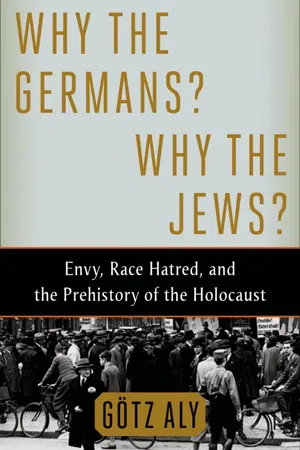
Why did the Holocaust happen in Germany, of all places? How did a country known for its culture and refinement turn so rabidly anti-Semitic? Why did a nation where Jews had full civil rights and many opportunities—a place that Jews had eagerly flocked to in the early twentieth century to escape racist persecution in Poland and Russia—turn upon them so violently just a few decades later? Countless people have grappled with these questions, but few have come up with answers as original and perceptive as those of German historian Götz Aly. Tracing the prehistory of the Holocaust—from the 1800s to the Nazis' assumption of power in 1933—Aly shows that German anti-Semitism did not originate with racist ideology or religious animosity, as is often supposed. Instead, through striking statistics and economic analysis, he demonstrates that it was rooted in a more basic emotion: material envy. As Germany made its way through the upheaval of the Industrial Revolution, the largely agrarian, mostly illiterate German majority found itself floundering in the rapidly modernizing world. On the other hand, the urban, well-educated Jewish minority enjoyed great success. Less than thirty years after they were freed from the ghettos, more than half the Jews were firmly middle class, and a sizable proportion of them were in the upper-middle classes. Envying this success, Germans embraced compensatory theories of Jewish racial inferiority. And the growing resentment pervading society provided fertile ground for Hitler and his genocidal politics. Aly's groundbreaking account of this fatal social dynamic opens up a new vantage point on the greatest crime in history and is sure to prompt heated debate for years to come.
On August 6, 1806, the Holy Roman Empire of the German Nation disappeared from the face of the earth. It had survived for a thousand years, but in the end it collapsed with barely a whimper under the pressure of the French Revolution and the Napoleonic Wars. Goethe succinctly noted: “Despite everything, [its death] produced a sad sensation in me.” Contemporaries didn’t know it at the time, but they were standing on the threshold of a stormy epoch. Before long, people would be ripped out of the usual patterns of their lives, and age-old knowledge, artisan skills, and established customs would become worthless. Hundreds of small duchies and autonomous territories would be dissolved with the stroke of a pen. Interdependence established over generations would cease. Common people would become less and less religious, and the church’s influence on everyday society would fade.
Secularization proceeded rapidly in the south and west of German-speaking Europe. The dismantling of religious institutions such as monasteries would later be described as a “benevolent [form of] violence” and seen as part of the Enlightenment reform movement, a view that ignored the countless and sometimes crude cases of disappropriation benefiting university libraries, portrait galleries, and state coffers—as well as ordinary people. In Bavaria, tradesmen and farmers built spacious houses from the bricks of demolished convents, monastery chapels, and other buildings. At the same time, enlightened aristocrats and the bourgeois modernized legal codes and advanced economic change. The Vienna Congress of 1814–15 temporarily put the brakes on innovation, shored up traditional authorities, and protected agricultural, artisanal, and patrician conservatism in the face of Western European modernism. Yet this only delayed the Industrial Revolution in Germany, and when it did get under way, it was all the more turbulent, sealing the demise of many older traditions.
Compared with progress in the the Habsburg Empire and Russia, the emancipation of German Jews began early. Yet unlike in France, this emancipation was not enacted on a single day but rather was drawn out over the span of more than a hundred years, from 1806 to 1918. What was particularly German about this process was that Jewish emancipation remained a topic of debate for so long. German society took one step back for every two steps forward. There was also a discrepancy between the legal situation and the reality, especially when it came to government and military service. In a certain limited sense, this stop-and-go process can be compared to the emancipation of African Americans during and after the Civil War in the United States. Things were made immeasurably more complex, however, by the fact that Germany did not even exist as a nation-state until 1871. Rules and regulations governing Jews differed wildly in the thirty-seven individual states that made up the German Confederation, as well as within the (partly overlapping) Kingdom of Prussia and from city to city.
Prussia exemplifies both the drawn-out nature of Jewish emancipation and the reasons why the general population often greeted it with resistance. After Prussia came under Napoleonic domination, the Cities Ordinance of November 19, 1808, lifted guild restrictions and guaranteed all citizens the right to pursue the trades of their choice, regardless of class, birth, or religion. Laws drafted by Prussian reformer Karl August von Hardenberg and enacted on November 2, 1810, and September 7, 1811, bolstered those rights. Such laws were aimed at unleashing entrepreneurial spirit, encouraging competition, and mobilizing capital, yet according to historian Friedrich Meinecke they “were vehemently opposed by those who were supposed to benefit from them.”1 Far from welcoming the reforms, most German Christians considered them “a plague.” Jews, however, seized upon their new freedom to practice trades of their choice and to better themselves economically.
Longstanding prejudices barred Jews from running apothecaries or operating public scales, but those trades turned out to be less and less significant as time went on. Thus, even at this early stage, a peculiar situation arose. Most Jews were enthusiastic about change, while most Christians viewed it with hesitancy. Traditionally submissive to feudal lords and clergymen, German Christians were far less able to exploit the state’s encouragement of personal initiative than their Jewish peers.
The contrast between Jewish entrepreneurial spirit and Christian readiness to obey authority was similar to that between Jews’ desire for freedom and Christians’ fear of it. Taking risks is part of freedom, and precisely that frightened the Christian majority. Old certainties collapsed under the massive force of economic freedom and the Industrial Revolution, and most Germans experienced legal and material progress as personal loss. By contrast, Jews had little to lose from the dissolution of the old world of guilds and castes, pastors and patricians, the mob and the aristocracy—and everything to gain from a new, wide-open future. Despite starting from a position of material poverty, they put their faith in their intellectual assets and attained material success with admirable speed. To speak in everyday language: they got somewhere in life.
On March 11, 1812, as Prussia was preparing to enter the military coalition that would eventually throw off the yoke of Napoleon, King Friedrich Wilhelm III signed an edict, drawn up by Enlightenment intellectual Wilhelm von Humboldt, entitled “Concerning the Civic Relations of Jews.” Against “the stubborn resistance of the monarch,” his chancellor of state, Karl August von Hardenberg, pushed through the reform and was “pleased” to announce it to the Jews of Prussia. They, in turn, somewhat optimistically saw the new law as “a complete declaration of liberty” and celebrated it “with ceaseless jubilation.” 2 The edict granted Jews citizenship and the right to serve in Prussia’s armed forces. It also reaffirmed that they could work in trades of their choosing and could own property. But Jews remained excluded from the officer ranks in the military and were restricted in the governmental and electoral functions they could perform. Paragraph 3 of the law also mandated that they adopt last names. Some chose traditional Jewish tribal and caste names (Levi, Cohn); other used the places from which they hailed (Bamberger, Sinzheimer); others were simply given animal designations (Wolf, Katz, Kuh) by Prussian bureaucrats with a fondness for the “cruel popular humor of the Germanic tribes.” No small number of Jews followed romantic fashion and took names that paid tribute to the beauties of nature (Feilchenfeld, Silberklang, Rosenzweig, Lichtblau, or Blumenthal).3
If we compare Jewish emancipation in Germany not with France but with neighboring Russia, which encompassed much of what is today Poland, progress was quick. For Jews living in the Russian Empire, who were restricted in their freedom of movement and subject to recurring pogroms, post-1812 Prussia was a near paradise of legal guarantees and social opportunity—even though advances there were not without setbacks. During the post-Napoleonic Restoration, starting with the Congress of Vienna in 1814, the Prussian government retightened some of the restrictions. In 1822, for example, Jewish citizens were prohibited from teaching school “because of the infelicities that have been shown when they do so.”4 Still, in the unrest from 1830 to 1849, Prussia again reversed course and loosened some of the constraints.
In some German-speaking states, the first steps toward full equality for Jews under the law began only after 1860. On July 3, 1869, the Alliance of Northern German States adopted the Law concerning the Equality of Confessions, and it was binding for the united German nation created in 1871. Its two key sentences read: “All still-existing restrictions on civic and citizenship rights based on differences of religious creed are hereby revoked. In particular, eligibility for participating in local and national political representation and holding public office is declared to be independent of religious creed.”5
Consequently, the 1870s saw some movement toward accepting Jews into public service and the higher ranks of the military, though it diminished by 1880. Ten years later, Paul Nathan—one of the leading Jewish political activists in the late Wilhelmine period—determined that most government administrations no longer had any Jewish members. In 1901, Prussian minister of justice Karl Heinrich Schönstedt was called before parliament to explain why he had yielded to conservative pressure and was no longer appointing any Jewish notary publics. He justified himself by claiming the judicial administration was “the only one that hired Jewish assessors at all.” “All other state administrations,” he said, “refuse to take on Jewish gentlemen.” At that juncture, there was not a single Jewish career officer in the Prussian military, nor had any Jew been promoted to officer rank in the reserves since 1886. In 1911, the secretary-general of the Association of German Jews, Max Loewenthal, again tried in vain to find a single Jewish officer in the Prussian army. A scandal comparable to France’s Dreyfus affair was impossible in Germany. There were no such Jewish officers whom German anti-Semites could have denounced, degraded, and hounded from the service.6
As documents from the various parliaments and governmental administrations amply demonstrate, tacit discrimination had become part of the German civil service, even though it officially contradicted the letter of the law. Those in power during the Wilhelmine era (1870–1918) publicly denied discriminating against Jews, even as they encouraged the practice everywhere in the everyday running of government offices. Here and there, they may have tolerated a “concessional Jew”—a term that was actually used. But as a rule, they behaved as the city fathers in the town of Ueckermünde did in 1904, when they failed to fill a vacant teaching spot. In the words of the town chronicle: “No appropriate candidate answered the announcement, only a Jew. As this was not desired, the town faced a desperate situation.”7
Still, as hesitant as Christians were to accept Jews as full-fledged fellow Germans, Jews were protected from violence and economic discrimination. That aided their rise between 1810 and 1870 from underprivileged subjects to active and successful citizens. One powerful symbol of Jews’ increasing status was the New Synagogue in the central part of Berlin. The building was completed well before full legal emancipation was achieved, and its golden dome complemented those of the royal palace and the still rather modest Protestant cathedral. No other major European metropolis featured a comparable architectural expression of Jewish self-confidence. (“The biggest and most splendid ‘church’ in the German capital is a synagogue!” hissed Heinrich von Treitschke in 1870.) The royally appointed architect August Stiller had overseen the beginning of its construction in 1859, and the opening ceremony on September 5, 1866, was attended by city and state elites, including Prussian prime minister Otto von Bismarck. It was an uplifting and inspiring ceremony, with only one prominent, and telling, absence: His Christian Majesty King Wilhelm I. Judaism was not deemed equal to the Christian faiths, as it was, for example, in the Netherlands. Nor would it be granted the status of a Religionsgemeinschaft—a kind of state sanction for religions deemed to be legitimate—until after 1918. From 1871, German legislation guaranteed individual Jews equality before the law. But as a group bound by their religion, they were still only tolerated.
SELF-EMANCIPATION VIA EDUCATION
The start-and-stop emancipation of Germany’s Jewish minority matched the sluggishness of German reforms in general. Yet in contrast to the majority of Christians, who tended toward passivity, German Jews actively emancipated themselves, and they did so with remarkable speed, identifying and using what opportunities there were as they became available. With its halfhearted reforms, its slow economic growth before 1870, and its strong legal protections, Germany was a place that rewarded individual initiative and the spirit of entrepreneurship.
Unlike in the agrarian past, when people’s social status usually remained constant, modern men needed curiosity, inventiveness, cleverness, adaptability, social intelligence—and, above all, education. From the very beginning of the nineteenth century, it was obvious that Jewish pupils had a relatively easy time acquiring the skills that would be necessary in the new culture: reading, writing, and mathematics. Unlike most Christians their age, Jewish boys learned to read early on, even if it was usually religious texts in Hebrew. They were born, so to speak, not with a silver spoon in their mouths but with an intellectual legacy. “A village without a school should be abolished,” reads the Talmud. Thus, in 1911, Arthur Ruppin could write of impoverished Eastern European Jews: “Even among the poorest classes in Eastern Europe, the necessity of learning and knowledge, at least for a family’s sons, is so accepted that there are thousands of poor artisans and merchants in Galicia who spend one-tenth to one-sixth of their weekly income (from one to six guilders) on the melamed (teacher of Hebrew and other basics).”8
The thirst for knowledge was a by-product of the Jewish religion and a response to centuries of legal disempowerment. Young Jews learned how to think abstractly, pose critical questions, and ponder various possibilities. They honed their intellects on books, by communally reading, interpreting, and debating Holy Scripture. The practice of their religion was a form of mental exercise, and thus they became mature in Kant’s political sense. In addition, most Jews could speak two or three different languages with various forms of grammar and expressive subtleties, and they frequently used both the Hebrew and the Latin alphabets. Young men who had been schooled this rigorously possessed a broad, expandable intellectual basis that allowed them to use education to climb the social ladder. In 1743, as a fourteen-year-old boy growing up in the city of Dessau, the philosopher Moses Mendelssohn not only knew how to read and write but was fluent in Yiddish, Hebrew, Aramaic, and German. In the fall of that year, Mendelssohn moved to Berlin, following his beloved teacher, Rabbi David Fränkel. Legend has it that when the watchman who admitted him to the city asked what he intended to do in Berlin, his reply was: “Learn.” (The watchman, for his part, noted: “Today six oxen, seven pigs, and a Jew passed through Rosenthal Gate.”) Mendelssohn went on to achieve wealth as a silk manufacturer and fame as a man of letters.9
Representatives of the Jewish community were quick to realize how important systematic instruction would be for future generations. They placed great emphasis on Jewish children’s learning good German and founded commercially oriented Jewish schools in cities like Berlin, Breslau, Hamburg, Dessau, Seesen, and Frankfurt am Main. These institutions shared the main goal of “reducing the misery and contempt under which we suffer and sigh.”10
The attitude of Christian clergymen was very different. They emphasized rote memorization of canonical beliefs, dismissed debate as Satan’s work from which they had to protect laymen, and rarely showed much interest in the systematic education of members of their flocks. A Christian family of peasants, in which few members could read and write, would typically need two or three generations of elementary education before the first member would succeed in gaining an academic degree, and even then it would be decades before that person and his offspring would feel comfortable with their new social position. As late as the twentieth century, it was still common for Christian parents to warn their offspring: “Reading is bad for your eyes!”
In contrast to Jewish educational institutions, German public schools long lacked a solid material and intellectual foundation. Friedrich Wilhelm I may have introduced compulsory education in Prussia in 1717, but the initiative, underfunded, would not bear any real fruit until the second half of the nineteenth century. Classrooms were overcrowded, and incompetent teachers were int...
Table of contents
WHY THE GERMANS? WHY THE JEWS?
CONTENTS
ACKNOWLEDGMENTS
INTRODUCTION THE QUESTION OF QUESTIONS
1 JEWISH EMANCIPATION
2 THE ANXIETY OF GERMAN NATIONALISM
3 ANTI-SEMITISM AS A POLITICAL FORCE
4 THE MAINSTREAM’S DANGEROUS INDIFFERENCE
5 WAR, DEFEAT, AND JEW HATRED
6 WEAK MASSES, STRONG RACE
7 THE NATIONAL SOCIALIST PEOPLE’S PARTY
EPILOGUE A STORY WITH NO END
NOTES
BIBLIOGRAPHY
INDEX
ABOUT THE AUTHOR
Trusted by 375,005 students
Access to over 1.5 million titles for a fair monthly price.
Study more efficiently using our study tools.
Frequently asked questions
Yes, you can cancel anytime from the Subscription tab in your account settings on the Perlego website. Your subscription will stay active until the end of your current billing period. Learn how to cancel your subscription
No, books cannot be downloaded as external files, such as PDFs, for use outside of Perlego. However, you can download books within the Perlego app for offline reading on mobile or tablet. Learn how to download books offline
Perlego offers two plans: Essential and Complete
Essential is ideal for learners and professionals who enjoy exploring a wide range of subjects. Access the Essential Library with 800,000+ trusted titles and best-sellers across business, personal growth, and the humanities. Includes unlimited reading time and Standard Read Aloud voice.
Complete: Perfect for advanced learners and researchers needing full, unrestricted access. Unlock 1.5M+ books across hundreds of subjects, including academic and specialized titles. The Complete Plan also includes advanced features like Premium Read Aloud and Research Assistant.
Both plans are available with monthly, semester, or annual billing cycles.
We are an online textbook subscription service, where you can get access to an entire online library for less than the price of a single book per month. With over 1.5 million books across 990+ topics, we’ve got you covered! Learn about our mission
Look out for the read-aloud symbol on your next book to see if you can listen to it. The read-aloud tool reads text aloud for you, highlighting the text as it is being read. You can pause it, speed it up and slow it down. Learn more about Read Aloud
Yes! You can use the Perlego app on both iOS and Android devices to read anytime, anywhere — even offline. Perfect for commutes or when you’re on the go. Please note we cannot support devices running on iOS 13 and Android 7 or earlier. Learn more about using the app
Yes, you can access Why the Germans? Why the Jews? by Götz Aly in PDF and/or ePUB format, as well as other popular books in Geschichte & Weltgeschichte. We have over 1.5 million books available in our catalogue for you to explore.