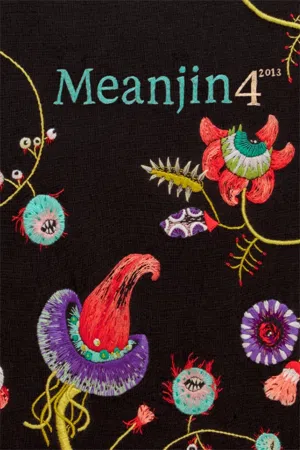
Helen O'Neil takes us inside the development of Labor's long-awaited Cultural Policy, and the future of the policy under a new government. Rebecca Harkins-Cross brings us the first in a series on new media art in Australia with an essay looking at the revolutionary ways Indigenous Australian artists are using video. Jennifer Mills quits poetry and ponders the peculiar life of the self-declared poet while Rebecca Giggs takes us into the wide blue yonder in pursuit of a mysterious giant eyeball.
Lesley Harding and artist Rebecca Mayo walk the Merri Creek wearing some very special garments and Hilary McPhee undertakes the fraught process of archiving the past. Journalist Jill Jolliffe contemplates her eventful visits to war-torn Angola in the early 1990s and Ellena Savage takes us to Bougainville and an uneasy adjustment to tropical living.
There's new fiction from Briohny Doyle, Mireille Juchau and Anika Quayle and sparkling poetry from Eileen Chong, Elizabeth Lawso, Chris Mansell, Kate Middleton and many more.
eBook - ePub
About this book
Trusted by 375,005 students
Access to over 1 million titles for a fair monthly price.
Study more efficiently using our study tools.
Information
Kuri Island Village
WE WALKED ALONG THE DUST ROAD as twilight hung in the air. The walk felt like a procession; as John and I passed the tin and weatherboard shopfronts where brightly dressed women sold betel nut, acquaintances stopped us to chat. We saw almost everyone we knew along the road that evening, which was strange, because we had only just decided to leave Bougainville. My two-month visa was set to expire in a week, and I had failed to acquire a new one. The courier company had simply forgotten to send my passport to Moresby the previous week.
A sweet-looking man with bovine eyelashes hovered nearby as we chatted with acquaintances. As we turned around to leave, he stepped in front of us and asked if we knew how to identify a diamond.
‘I can. I’d have to see it, though,’ John said. I rolled my eyes at his American self-belief. ‘How big is it?’
The man indicated with his fingers the size: around an inch in diameter.
‘How much, you think?’ he asked.
If it were a diamond, we told him, it’d be worth a lot of money. He hesitated and asked again how much. A lot, we confirmed. He settled on trusting us, and took us to a grassy patch behind a shop. Turning his back to us, the man rummaged through his canvas backpack searching for its secret place. He faced us and opened his palm. In it was a scratched, bubble-filled, glass marble. John and I paused for a thoughtful while. For a split second I wondered if it might be my ability to identify diamonds that was off. ‘I can’t be sure,’ I said to him. ‘But I don’t think that’s a diamond.’
He didn’t seem to believe that it wasn’t a diamond, so we talked about it for another five minutes. As we stood there, passers-by gathered to watch our secretive exchange.
‘It probably wouldn’t have so many scratches if it were a diamond,’ John said.
The man then pulled out a yellow marble from the same bag.
‘What about this one?’
I still don’t know if we were being had, or if that man really thought the marble was a diamond. John told me that during his previous trips to the island to collect linguistic data, he’d had similar encounters. I came to see that it summed up my time in Bougainville: being marked as an outsider and burdened with unwanted authority because of it. Yet also being trusted and indulged, charmed and then, possibly, laughed at.
Two months earlier John’s cheek pressed against mine, both of us peering out the plane window as we approached the island. Below us Buka Passage, the narrow strait separating Buka Island from Bougainville Island, sparkled sapphire. I scanned the surface of the water for sharks. The small aircraft bounced gently on the runway before coming to a halt and allowing us to descend a set of aluminium stairs onto a coconut-girt runway. The wet heat and the crowd enveloped us. There were many large men with red eyes and red-stained teeth in velvet-brown faces. I didn’t yet know what betel nut looked like. It is the mild natural drug widely used in Bougainville and the Solomons, which, chewed up with a nibble of mustard stick and limestone powder ground from coral, creates a frothy scarlet soup in your mouth, which must be spat out. It stains teeth red and dots the ground with splatters of what looks like fresh blood. Waiting at the airport, in my starchy purpose-bought cargo shorts and hiking boots, I felt like an idiot: an uncomfortable girl amid a crowd of rubber-thonged comfort.

The author in Bougainville, photograph by John Olstad, 2012
We hadn’t made plans, not really. We assumed that things would work themselves out, we’d just slip easily into life here. John had been in Buka on previous fieldwork trips over the years of his PhD, and he had made this seem like a reasonable expectation. He left me to mind our luggage while he searched the crowd for friends. As I stood there, I breathed through my mouth, hoping no-one would recognise that I was trying to block out the stench of Buka: a pungent blend of copra, river funk, fresh mud, and body odour. I watched dumbly as an Air Niugini employee threw my bike bag off the back of a ute onto the muddy ground; ‘Fragile’ stickers flashed as it hit.
A friend of John’s drove us into town. Buka is the capital city of Bougainville. The temporary capital, rather. The old capital city, Arawa, is on Bougainville’s main island, on the other side of the passage. It was captured by rebels during the conflict in the 1990s, and has not yet been restored to its status as capital. Before the conflict, Buka Town was just a small port with five or six buildings, but it has rapidly expanded; new buildings of varying structural integrity appear weekly. It houses a fluctuating population of three to five thousand, with many more passing through for trade and governance. On the south shore, directly across the passage from Buka, is Kokopo, another village whose population has exploded since the conflict. Refugees from the southern end of the island have taken up residence in order to escape the lingering dangers of weapons and militarisation.
The truck pulled over at Destiny, the guesthouse we were to stay at for a few nights. I jumped from the trailer into the squishy mud below, and looked at the guesthouse. It comprised a row of handsome wooden huts capped by an arching blue tin roof. The rooms sat on the edge of Buka Passage, their balconies overhanging the water. By most measures, Bougainville is a poor place. But these airless rooms cost A$180 a night.
While I was mesmerised by the beauty around me, I couldn’t remember what I was doing there, aside from pursuing this man I was with. The previous year I had received a cheque in the mail. It was small enough to be a regular Australian person’s weekly or fortnightly salary, but large enough for an underemployed, underpaid single woman like me to use as a down payment on my next trip. With the cheque I bought a one-way airfare to London from the kind of airline that makes you pay extra to use the toilet, and a pair of expensive sunglasses. I continued to buy my wine boxed, and ignored the sole missing from my right shoe. I had at least six months to generate the funds required to travel from London to Istanbul, after which I would make it up as I went.
But on the last night of a writers festival I met John. An American linguist, he had been presenting on his current research project: documenting a climateendangered Melanesian language spoken on a Bougainvillean atoll. We met briefly while navigating the streets of Newcastle to a party, exchanged email addresses, and promptly lost one another in a fog of dubstep and cask wine. A few days later he emailed me from the States. A few emails after that, he recorded a song for me. By November he was in my home town, Melbourne. He spent Christmas with my family in Sydney, and we were becoming serious, I suppose, when it came time to book his ticket back to Bougainville and finish his fieldwork. Would I like to join him?
I sold my piano, my clothes, my books, everything, and bought a ticket to Bougainville. I threatened the original airline with litigation should they not refund my London ticket. They refunded my ticket. And so I found myself in Buka, a totally alien town in an unfamiliar country with a man I had only known for a few months.
We had arrived at Destiny guesthouse during a blackout, and with just one small window, our room was unbearably hot. So for a silent hour, we sat on the balcony overhanging the water, astonished at the beauty before us. I had read Bougainville described as one of the most beautiful islands in the world, and now I understood that impossible claim. Every tree dripped with flowers, lush fruit, or velvet greenery, a Florence Broadhurst wet dream. Zebra-striped reef fish swam against the passage’s current, their stripes disappearing in the black and white braids of the water’s glassy surface.
On the far side of the passage, the bush looked more like a colonist’s sketch of paradise than the real view from my room. Handmade canoes manned by tiny children hung at the shoreline, bouncing and swaying as the kids jumped off and climbed back on, throwing sea stars at one another like ninjas. The beauty was not pristine, though, not plastic. The white sea floor is made of abrasive coral and sharp rocks, scattered with sea urchins and deadly cone shells. The jungle is wild and dense.
A few days after we arrived, a friend of John’s joined me on the balcony as we drank cans of Coke. ‘Look over there, at that green house.’ He pointed at a house next to the mangroves. ‘Last year, that was where they found a crocodile victim.’
Crocodiles bury their victims in the mud, and wait for the flesh to disintegrate before feasting on them. As I searched the water for signs of crocodiles, a highway boat zoomed past, loaded with passengers on their way home to the nearby islands.
Most of the boats don’t have lighting, so if you sit by the shore after dark, you’ll hear the din of a distant lawnmower approaching and see the pale blue light of a phone skimming across the water, held by a young man on the bow of the boat, guiding the way. Life jackets are expensive and cumbersome, and many boats don’t have them. The vessels are often very small businesses, just a man and his boat taking passengers where they need to go for cash, even on five- or six-hour journeys to distant Pacific islands. There’s no central coordination.
In the first week in Buka, I followed a saga that was unravelling in the Post Courier. A dinghy ran out of fuel en route to a distant island, and began to drift. The skipper and first mate disembarked, attempting to swim to shore, presumably to seek help. While the boat, full of passengers, eventually floated to safety, the two men were still missing. Sightings of them were reported by passengers on other highway boats, saying they had refused to pick the two of them up, because they thought they had been pirates, or ghosts. These men had been made alien by their bizarre choice to leave the safety of the vessel.
As soon as John and I found ourselves out of range of the cool breeze off the passage, heat swelled thick against our skin. I thought I would acclimatise at some point, but I didn’t. It’s one of those myths of travel: you’ll just pick up the language! You just adapt to the climate! ‘Acclimatisation’, I discovered, is learning not to collapse from heatstroke, adopting tactics that minimise sun contact. And although still infatuated with one another, John and I began to minimise our physical contact. As the intimacy between us grew, we drifted apart from each other’s bodies.
We looked for long-term accommodation, or a home-stay, but it is hard as an outsider in Bougainville. Most Bougainvilleans observe traditional land rights, and are born owning a parcel of land on which to subsist. The cash economy means that those with native title in Buka now lease their land, housing workers in shipping containers with no sanitation. We were not workers, and our skin denoted an affluence we didn’t possess. There was nowhere for us to stay.
A friend, Sonia, offered her house for a couple of weeks while she visited her daughter in Brisbane. It was a beautiful house on the passage, with grass-mat floors and a dark verandah with thick ferns in pots. Each afternoon I spent hours sitting on a cement wall at the shoreline with John, reading. The water slapped against the stone steps, splashing our ankles. When the sun finally set, we cooked in a semi-outdoor kitchen by the verandah, and ate our made-up Bougainvillean vegetarian meals: rice, pumpkin tops, steamed eggplant with ginger, and sweet-potato chips—until the mosquitoes ravaged our ankles. There was a rhythm to our peace; it was a fortnight of a ...
Table of contents
- Contents
- Editorial
- Perspectives
- Meanjin Papers
- Essays
- Encountering the Black Screen
- On Quitting Poetry
- The Future that never Took Place: Exploring Detroit’s Abandoned Buildings
- The Strangeness of the Dance: Kate Grenville, Rohan Wilson, Inga Clendinnen and Kim Scott
- The Souvenir Genre
- Desert Whales and a Fishing Village
- The Eye in the Sand: On Creative Remoteness
- Gallery
- Fiction
- In Season
- The Weather Inside
- Eighty Thousand Calories
- Memoir
- Toys
- Kuri Island Village
- Sending Papers up the Hume
- The Tyranny of Distance
- Contributors
- Index
Frequently asked questions
Yes, you can cancel anytime from the Subscription tab in your account settings on the Perlego website. Your subscription will stay active until the end of your current billing period. Learn how to cancel your subscription
No, books cannot be downloaded as external files, such as PDFs, for use outside of Perlego. However, you can download books within the Perlego app for offline reading on mobile or tablet. Learn how to download books offline
Perlego offers two plans: Essential and Complete
- Essential is ideal for learners and professionals who enjoy exploring a wide range of subjects. Access the Essential Library with 800,000+ trusted titles and best-sellers across business, personal growth, and the humanities. Includes unlimited reading time and Standard Read Aloud voice.
- Complete: Perfect for advanced learners and researchers needing full, unrestricted access. Unlock 1.4M+ books across hundreds of subjects, including academic and specialized titles. The Complete Plan also includes advanced features like Premium Read Aloud and Research Assistant.
We are an online textbook subscription service, where you can get access to an entire online library for less than the price of a single book per month. With over 1 million books across 990+ topics, we’ve got you covered! Learn about our mission
Look out for the read-aloud symbol on your next book to see if you can listen to it. The read-aloud tool reads text aloud for you, highlighting the text as it is being read. You can pause it, speed it up and slow it down. Learn more about Read Aloud
Yes! You can use the Perlego app on both iOS and Android devices to read anytime, anywhere — even offline. Perfect for commutes or when you’re on the go.
Please note we cannot support devices running on iOS 13 and Android 7 or earlier. Learn more about using the app
Please note we cannot support devices running on iOS 13 and Android 7 or earlier. Learn more about using the app
Yes, you can access Meanjin Vol. 72, No. 4 by in PDF and/or ePUB format, as well as other popular books in Literature & Literary Essays. We have over one million books available in our catalogue for you to explore.