People comprise the backbone of any military force. But what happens when the stress of operations becomes overwhelming and those people fail to cope? Stress can have negative consequences for the individual, the organisation, and even for overall combat effectiveness. The Australian Defence Force has spent many years researching how to maximise individual resilience and performance in the face of extreme stress. For the first time this wealth of knowledge and experience has been brought together in one volume. This work examines the impact of highly stressful events, such as combat and peacekeeping operations, on individual troops and leaders, with a particular focus on factors that build resilience and maximise performance under stress.Managing stress is an important issue not only for the military, but equally for other high-risk professions such as the police and emergency services. This work provides a unique synthesis of a wide range of research, and clinical and personal experience, providing a coherent, integrated approach to the subject. Of particular use to mental health professionals, it will also be of interest to general readers of military and psychology books.
eBook - ePub
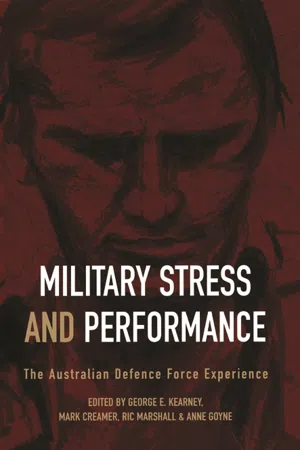
Military Stress And Performance
The Australian defence force experience
- English
- ePUB (mobile friendly)
- Available on iOS & Android
eBook - ePub
Military Stress And Performance
The Australian defence force experience
About this book
Trusted by 375,005 students
Access to over 1.5 million titles for a fair monthly price.
Study more efficiently using our study tools.
Information
1 The stress of deployment
The most negative experience for me? The usual stuff: mass graves, death and destruction, sick and injured, run-ins with Rwandan Patriotic Army troops. The general day-to-day of my job.
An Australian Corporal reflecting on his service with
UN peacekeeping forces in Rwanda, 1994–95.
UN peacekeeping forces in Rwanda, 1994–95.
It IS THE ERA of peace support operations. While the nature and duration of these contemporary operations often appear to differ significantly from the traditional experience of war, the personal impact of deployment remains profound in many cases. By its very nature, any military service poses potentially high risk of exposure to psychological and physical threat. In a study of Canadian Forces personnel (Murphy & Gingras, 1997), 55 per cent of a sample of respondents reported that their life had been threatened at least once during service, and 78 per cent reported having ‘seen or experienced things that (had) really disturbed or upset’ them. Not surprisingly, personnel who had been deployed on peace support operations were more likely to have faced serious threats: 70 per cent of these respondents reported that their life had been threatened at least once during service compared with 29 per cent of respondents without experience of peacekeeping. Preliminary findings from research on Australian Army troops who had returned from East Timor reveal that 75 per cent had regularly seen widespread destruction, 84 per cent had witnessed widespread suffering (57 per cent regularly), and 52 per cent had seen dead bodies (Murphy, 2001b; Murphy & Skate, 2000). Of this small sample (n = 297), 41 per cent believed that their life had been threatened during military service, and 44 per cent had been disturbed by their experiences. Nevertheless, 61 per cent of respondents felt that the experience of the deployment to East Timor ‘had a positive effect on me overall’.
Fortunately, there is growing acceptance within many Western military organisations of the need to prevent the detrimental impacts of operational service. This interest in preventing serious stress reactions stems from a number of concerns: operational effectiveness, humane regard for the wellbeing of personnel, retention, and legal considerations such as compensation (Dean, 1997). Much of this preventive effort is delivered in the form of stress inoculation or stress exposure (Chapter 2), stress management training, support programs for families, and a variety of reactive interventions such as debriefing that contain a preventive element. These efforts strive to enhance the abilities of personnel and their families to manage the various stressors of deployment by fostering intrinsic skills for coping with stress and providing external supports. However, to have maximum effect, these preventive programs and strategies must be based on a sound understanding of the human response to serious and chronic stress, and an awareness of the stressors inherent in operational service.
Psychological trauma
It has become clear that serious threat and traumatic experience can lead to adverse psychological sequelae (Raphael, 1986a). These problems can impact on the individual, their family, wider social relations, and performance and commitment at work. In the military, this impact has been illustrated by combat stress casualties and other stress syndromes during all major conflicts of the twentieth century (Craig, 1988; Gabriel, 1987), and Stretch (1995) has reviewed the adjustment problems of veterans after their return home. However, the acceptance of traumatic stress reactions as genuine continues to be challenged for social and political reasons (van der Kolk, McFarlane & Weisaeth, 1996). It is ironic that the military has often been reluctant to accept the effects of trauma as authentic, because it is an occupation routinely exposed to traumatic experience and has provided many past researchers with their greatest source of traumatised subjects for study.
The issue of support for veterans was fixed in the public eye by the politicisation of the postwar difficulties of American veterans of the Vietnam War. Formal recognition of posttraumatic stress disorder (PTSD) as a distinct clinical syndrome occurred in 1980 with its inclusion in the third edition of the Diagnostic Statistical Manual of Mental Disorders (DSM-III; American Psychiatric Association, 1987). This recognition ensured that a degree of legitimacy was accorded the problems experienced by veterans. It also triggered extensive research into the psychological status of veterans. The study of traumatic stress thereafter became a credible field of research.
The diagnostic criteria for PTSD are a complex constellation of re-experiencing, avoidance, numbing and arousal symptoms, which must persist for at least a month and cause significant distress or marked impairment in important areas of functioning such as social and occupational behaviour. Another component of the diagnostic criteria is the occurrence of an event—witnessed or experienced—that involves serious threat and that elicits an intense emotional response. More recently, there has been speculation in the literature that a distinct traumatic event may not be the only catalyst for PTSD. It has been suggested by Scott and Stradling (1994) and Friedman (2000) that chronic stress may cause the stress reactions normally associated with traumatic experience. This is relevant to the military because, as Dobson and Marshall (1997) suggest, an operational deployment could be considered a chronic stressor itself. This may explain instances of veterans who were not involved in combat or specific traumatic experience while serving in an operational theatre, yet have been diagnosed subsequently with PTSD (Southward, 1992). Indeed, research on US Vietnam veterans by King, King, Gudanowski and Vreven (1995) concluded that low-magnitude stressors of the operational environment may contribute more to PTSD than critical incidents such as combat exposure.
Other characteristics of PTSD are noteworthy from a postdeployment perspective. The symptoms can be delayed (Solomon, Mikulincer & Waysman, 1991)—that is, they may occur after a period of apparent symptom-free functioning following an incident. The period of this delay may be hours, days, or even years. PTSD symptoms can also persist or cycle in severity for decades. In a study of Australian outpatient veterans of World War II, 45 per cent were found to have active PTSD forty-six years after the war (Kidson, Douglas & Holwill, 1993). These characteristics of the traumatic stress response suggest the need for long-term monitoring of the health status of military veterans.
Another issue that is often overlooked by experts and novices alike in the field of psychotraumatology is that PTSD is not necessarily the most common nor the most conspicuous long-term reaction to debilitating stress. PTSD, however, has tended to become a catch-all for the range of adjustment difficulties that some veterans of war and peace support operations experience. This prominence is in some respects unfortunate, as it may deflect attention from the many other serious disturbances associated with extreme stress. These other reactions include acute stress reaction, depression, hostility, substance abuse, family violence, anxiety disorders, antisocial behaviour and adjustment disorder (see Rundell & Ursano, 1996, for a review).
At the other end of the symptom spectrum are numerous subclinical reactions that are widespread among returned soldiers and are generally considered normal reactions to the stressors of deployment. Typical subclinical reactions include difficulty sleeping, vivid dreams, tiredness, irritability, lack of impulse control (particularly anger), mild physical complaints, preoccupation with certain thoughts and memories, and a tendency to need time alone. It is often the duration of these symptoms that distinguishes whether they are considered normal or abnormal reactions. Hence, sub-clinical reactions to the stress of deployment warrant attention: not only are they disruptive to wellbeing, but they can also crystallise into chronic stress reactions.
Perhaps the most potentially useful finding from the substantial literature on traumatic stress studies is that the behavioural and psychological responses to disaster and other traumatic experiences frequently have predictable features that take a typical course. Although for most individuals posttraumatic symptoms are transitory, for some the impact of such experience persists and develops into a debilitating disorder (Ursano, Grieger & McCarroll, 1996). It would appear that the degree of human cruelty involved in a stressful incident might be a key determinant in the development of serious disorders such as PTSD (Grady, Woolfolk & Budney, 1989; Truscott, 1997). Due to the nature of war and peace support operations—where abusive violence is commonly witnessed—it may be postulated that service personnel are likely to be prone to postdeployment problems of adjustment. The experience of the Australian Defence Force (ADF) with the postdeployment adjustment problems of personnel who served in Rwanda provides strong evidence of the hypothesised link between the witnessing of human malice and subsequent stress reactions (Chapter 10).
Stress disorders in veterans of war
Historically, there has been a great deal of denial within the military—and the wider society—about the psychological impact of war on military personnel. Commanders and medical officers, who take primary roles in the management of stress casualties, have often promoted expectations that military personnel are immune to the impact of exposure to traumatic experience and label those who experience significant stress reactions as weak, cowardly or malingerers (Ireland & Bostwick, 1997; Moore, 1974). Because of these prevailing attitudes, lessons in the management of both the psychological casualties of combat and returning veterans have had to be repeatedly relearned, at great personal cost to service personnel affected by the stress of war.
The symptoms associated with traumatic stress reactions have been observed for centuries. For example, in Shakespeare’s King Henry TV the character Lady Percy describes, with uncanny accuracy, numerous symptoms consistent with PTSD in her husband Hotspur after his return from battle.
Tell me, sweet lord, what is’t that takes from thee
thy stomach, pleasure, and thy golden sleep?
Why dost thou bend thine eyes upon the earth,
and start so often when thou sit’st alone?
Why hast thou lost the fresh blood in thy cheeks,
and given my treasures and my rights of thee
to thick-ey’d musing and curs’d melancholy?
Shakespeare, Henry TV, First Part, II, iii
During the twentieth century, names for the postwar adjustment problems of veterans have included ‘war neurosis’, ‘war sailor syndrome’, ‘survivor syndrome’ and ‘concentration camp syndrome’. Current diagnostic nomenclature now identifies many of these disorders as chronic PTSD (Rundell & Ursano, 1996).
Symptoms of traumatic stress have been identified in veterans from World War II (see White, 1983), the Korean War (Thienes-Hontos, 1982), the conflicts in the Middle East (Solomon, 1993), the conflict in the Falklands (Jones & Lovett, 1987) and the Gulf War (Vaitkus & Martin, 1991). In a sweeping review of the post-service adjustment of veterans from the two world wars and the conflicts in Korea and Vietnam, Stretch (1995) demonstrated that war service could cause serious problems in subsequent adjustment in the areas of work, marital relations, family, the community, and general social involvement. War service was also associated with increased mortality and psychiatric disability in veterans. Released prisoners of war are at increased risk of such problems (Garton, 1996; Page, Engdahl & Eberly, 1997; Tennant, Goulston & Dent, 1986).
In what is probably the most comprehensive epidemiological investigation into the mental health of veterans, the National Vietnam Veterans Readjustment Study found that 15 per cent of all male veterans who were involved in active operations had current symptoms consistent with PTSD, and a further 11 per cent displayed partial symptoms (Kulka et al., 1990). These symptoms were present nineteen years after the war. A more recent study of American veterans from the Gulf conflict showed that, eighteen months after the war, 11 per cent of male respondents in a sample of 1700 had psychometric symptom scores indicative of PTSD (Wolfe, Keane & Young, 1996). Several variables significantly predicted the emergence of PTSD, including higher war-zone exposure, avoidant coping behaviours, less social support and poorer family cohesion. A comprehensive Canadian study of Gulf War veterans, using prevalence odds ratios, noted higher incidence of PTSD and other conditions including chronic fatigue, depression, anxiety and alcohol abuse among veterans compared to a matched control group of service personnel (Goss et al., 1998).
King, King, Foy, Keane and Fairbank (1999) analysed data from the National Vietnam Veterans Readjustment Study for pretrauma risk factors, war-zone stressors and posttrauma resilience-recovery variables associated with PTSD. Direct links were found between PTSD and all three predictive categories, with postwar variables accounting for a relatively high proportion of influence, behind war-zone factors, on the posited structural model. The most striking finding in terms of the focus of this paper was that postwar variables were most salient in accounting for PTSD symptoms in female veterans.
Epidemiological studies clearly demonstrate that serious adjustment problems exist in veterans from all major conflicts the twentieth century. Rates of PTSD appear to be substantial, though it is emphasised such severe morbidity tends to be the exception rather than the rule (McFarlane & de Girolamo, 1996). What epidemiological research does not generally report is the range of subclinical symptoms and problems that veterans experience and how long these symptoms persist. A clear shortcoming of much of the epidemiological research is that most studies have been conducted years, or even decades, after the cessation of hostilities. Furthermore, despite the evidence of a link between exposure to warfare and subsequent adjustment problems, surprisingly little is known about the causal mechanisms of PTSD, the postdeployment phase of readjustment, and individual differences in the course of serious stress reactions and syndromes (Wolfe et al., 1996).
Stress disorders in veterans of peace support operations
Although a significant amount of research has addressed the stress of war and its psychological sequelae in veterans, little has been published on the stress and psychological impact of peace support operations. The relatively benign nature and scarcity of peacekeeping missions during the Cold War explains this dearth of research. With the dramatic expansion and evolving nature of these missions in the 1990s, there are signs that this lack of research is simply a lag. For example, at a NATO Partnership for Peace workshop entitled ‘Psychological readiness for multinational operations: Directions for the 21st century’ held in Heidelberg, Germany, in July 1997, there were fifteen presentations from eight countries related directly to research on psychological aspects of peace support operations (Mangelsdorff &Bartone, 1997).
It is generally thought that conventional war has a greater impact on service personnel than operations other than war. This notion, however, is beginning to be challenged. There is growing evidence that the stress of peace support operations can be as psychologically damaging as conventional warfare (Bartone, Vaitkus & Adler, 1994; Laffittan & Biville, 1997; Litz, 1996; Mylle, 1997; Schade, 1997). This is not surprising in view of the demands and conditions of some operations in recent years, especially in the former Yugoslavia in the early 1990s (Cian & Raphel, 1996). This changing nature of peace support operations is reflected in the expanding lexicon: ‘peacekeeping’ has been joined by ‘peacemaking’ and ‘peace enforcement’ (Evans, 1993).
Nevertheless, the complex, dynamic and often ambiguous nature of peace support operations makes it difficult to generalise. While many peace support operations may be qualitatively different from warfare, the end result—in terms of psychological impact—may be similar. Many stressors for military personnel are present in any operational deployment, for example, separation from family, harsh environmental conditions and organisational tensions. Research with New Zealand peacekeeping personnel led Pugsley (cited in Phare, 1994) to suggest that peace support operations may result in even more stress and frustration than conventional combat. For instance, there is often ambiguity about the role of military personnel on peace support missions, which is typically absent during war. Other unique stressors of such operations include constraints on the use of force, even when confronted with threats; constraints on active involvement, even when witnessing atrocities; and tasks that military personnel may not be trained or adequately prepared for, such as tactical negotiation in t...
Table of contents
- Military Stress and Performance
- Foreword
- Contents
- Acknowledgements
- Introduction
- The stress phenomenon
- 1 The stress of deployment
- 2 Psychological preparation for the battlefield
- 3 Managing stress in deployed operations
- Enabling resilience
- 4 Psychological support to Australian Defence Force operations: a decade of transformation
- 5 Stress resilience and combat: Should gender be an issue?
- 6 Command at sea in war and peace
- 7 Critical incident stress management and the pastoral imperative
- Health and welfare after deployment
- 8 Providing support in long-term hostage incidents: a case study of CARE Australia personnel
- 9 Postdeployment support
- 10 Postdeployment predictors of traumatic stress: Rwanda, a case study
- 11 Assessment of posttraumatic stress
- 12 Long-term effects of traumatic stress
- Caring for casualties
- 13 Constructs of recovery and prevention following trauma in navy veterans
- 14 The treatment of chronic posttraumatic stress disorder
- Reflections on managing stress
- 15 Stress and the military: What have we learned?
- Contributors
- Abbreviations
- Bibliography
- Index
Frequently asked questions
Yes, you can cancel anytime from the Subscription tab in your account settings on the Perlego website. Your subscription will stay active until the end of your current billing period. Learn how to cancel your subscription
No, books cannot be downloaded as external files, such as PDFs, for use outside of Perlego. However, you can download books within the Perlego app for offline reading on mobile or tablet. Learn how to download books offline
Perlego offers two plans: Essential and Complete
- Essential is ideal for learners and professionals who enjoy exploring a wide range of subjects. Access the Essential Library with 800,000+ trusted titles and best-sellers across business, personal growth, and the humanities. Includes unlimited reading time and Standard Read Aloud voice.
- Complete: Perfect for advanced learners and researchers needing full, unrestricted access. Unlock 1.5M+ books across hundreds of subjects, including academic and specialized titles. The Complete Plan also includes advanced features like Premium Read Aloud and Research Assistant.
We are an online textbook subscription service, where you can get access to an entire online library for less than the price of a single book per month. With over 1.5 million books across 990+ topics, we’ve got you covered! Learn about our mission
Look out for the read-aloud symbol on your next book to see if you can listen to it. The read-aloud tool reads text aloud for you, highlighting the text as it is being read. You can pause it, speed it up and slow it down. Learn more about Read Aloud
Yes! You can use the Perlego app on both iOS and Android devices to read anytime, anywhere — even offline. Perfect for commutes or when you’re on the go.
Please note we cannot support devices running on iOS 13 and Android 7 or earlier. Learn more about using the app
Please note we cannot support devices running on iOS 13 and Android 7 or earlier. Learn more about using the app
Yes, you can access Military Stress And Performance by George E. Kearney, Mark Creamer, Ric Marshall, Anne Goyne in PDF and/or ePUB format, as well as other popular books in Psychology & History & Theory in Psychology. We have over 1.5 million books available in our catalogue for you to explore.