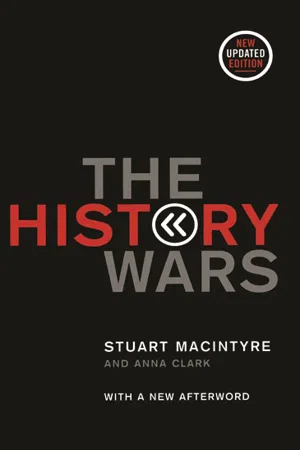
The nation's history has probably never been more politicised than it is today. Politicians, journalists, columnists, academics and Australians from all walks of life argue passionately — and often, ideologically — about the significance of the national story: the cherished ideal of the 'fair go', the much contested facts of Indigenous dispossession, the Anzac legend, and the nation's strategic alliance with the United States. Historians have become both combatants and casualties in this war of words. In The History Wars, Stuart Macintyre and Anna Clark explore how this intense public debate has polarised the nation and paralysed history departments. This edition includes a new afterword by Stuart Macintyre which recounts, with rueful irony, the outbreak of controversy that followed the book's original publication, and the further light it shed on the uses and abuses of Australian history.
- English
- ePUB (mobile friendly)
- Available on iOS & Android
eBook - ePub
The History Wars
About this book
Information
Publisher
Melbourne University Press DigitalYear
2013Print ISBN
9780522851281
Edition
2eBook ISBN
9780522863772
CHAPTER 1

‘One of the more insidious developments in Australian political life over the past decade or so has been the attempt to rewrite Australian history in the service of a partisan political cause.’ The speaker was John Howard, and he spoke in the aftermath of his electoral triumph in 1996.
The new prime minister was brooding over his tribulations in opposition when he had lost the 1987 election, then the party leadership, until in 1995 a desperate Liberal Party turned to him once again. He could now settle accounts with those who had written him off as an outmoded traditionalist clinging to a Dreamtime in the 1950s when the family was secure behind the white picket fence, when Robert Menzies guided the nation’s destinies with patrician dignity and a young Queen Elizabeth embodied a stable moral order.
Paul Keating had been the chief tormenter. He had taunted Howard in 1992 as yesterday’s man who yearned to turn the clock back to an era of the Morphy Richards toaster, the Qualcast mower, the Astor TV console and the AWA radiogram, armchair and slippers. Howard now accused Keating of having sought to ‘demean, pillory and tear down many great people of Australia’s past who had no opportunity to answer back’.
John Howard was also looking forward to the devices that he would employ as he consolidated his national leadership. The campaign slogan in 1996 was ‘For All Of Us’, but that had captured a bare majority of voters. Once the Coalition was in office, the ‘us’ needed clarification. An early designation was ‘the mainstream’, but this was hardly more expressive.
Howard then hit upon ‘the battlers’, the ordinary Australians who made no claim for special attention and wanted nothing more than a fair go. His avowed intention was that they should feel ‘relaxed and comfortable’ as they enjoyed a respite from the hectoring pyrotechnics of his predecessor’s ‘big picture’. An earnest of intentions was his scrapping of the principal multicultural agencies. In the following year he dashed hopes for reconciliation with Indigenous Australians. Then the government refused to agree to an international agreement on greenhouse emissions. Then the republic was despatched, and later the refugees were turned away.
These and other decisions marked out a strategy of refusal, but threaded together they formed more than a necklace of negatives. Each one of them combined conviction and calculation. Howard spoke from the heart but his script was informed by constant measurement of public opinion and careful political management. His government acted in the national interest but with a shrewd appreciation of wedge politics. It erased the components of Keating’s Big Picture, one after another, dismissing each one of them as pandering to the interests of a selfish minority.
Keating had painted his Big Picture in the speeches he delivered while prime minister. An aggressively demotic speaker, at his best and worst in impromptu invective, Keating was a more diffident and awkward presenter of prepared addresses; but he appreciated the importance of such statements and developed a close rapport with his speechwriter, the historian Don Watson. He placed particular emphasis on the commemoration of historic sites—Winton for the centenary of ‘Waltzing Matilda’ and Corowa for that of its federal conference, as well as the Western Front, the Kokoda Track, Changi and Hellfire Pass—and he put new places on the map of Australian history, such as Redfern Park.
At home and abroad he built up a story of a people who had suffered but overcome. They had triumphed over their tribulations and prejudices to embrace diversity and tolerance with an egalitarian generosity that would enable them to engage with their Asian neighbours and flourish in the open, globalised economy. This was the national story that held together the Big Picture and it came under immediate attack from John Howard. Speaking in the Commonwealth parliament in October 1996, the prime minister declared: ‘I do not take the black armband view of Australian history . . . I believe that the balance sheet of Australian history is overwhelmingly a positive one.’
The Black Armband epithet had been minted three years earlier by the historian Geoffrey Blainey. He used it to characterise what he thought was an excessive emphasis in recent historical writing on past wrongs. This mournful view of Australian history, he suggested, had arisen among a younger generation of historians as a reaction to an earlier ‘Three Cheers’ view, but the pendulum had swung too far and the Black Armband historians gave an unduly negative account of history’s balance sheet.
Mixing Blainey’s metaphor further, Howard claimed that ‘the balance sheet of Australian history is a very generous and benign one’. While allowing that there were some ‘black marks upon our history’, he warned of risks if discussion was confined to ‘the shortcomings of previous generations’. The risk was increased when ‘highly selective views of Australian history’ were used for ‘endless and agonised navel-gazing about who we are or, as seems to have happened over recent years, as part of a “perpetual seminar” for elite opinion about our national identity’.
The argument moved here from Keating’s appropriation of Australian history to the ‘elites’ who created such tendentiously self-indulgent accounts of the past and the present. The elites provided Howard with a foil for the battlers, whose achievements and sentiments they blackened. It was a nebulous category and an odd term of opprobrium from a man who held the highest national office and who mixed regularly with the wealthy and powerful. These elites variously comprised commentators of progressive sympathy, champions of minority groups, middle-class do-gooders and especially the intellectuals who articulated their concerns.
A synonym, ‘the chattering class’, became especially popular among the conservative pundits who pontificated incessantly in the op-ed pages of the national press and intoned indignandy on talk-back radio. They demanded to be liberated from political correctness—another catchphrase Howard employed freely as he felt his way into his role—while he purged the nation’s institutions of those who dissented from the new orthodoxies.
These heretics had been described earlier as ‘whingeing intellectuals, busily manufacturing episodes in the nation’s past to complain about’, and this activity had created a ‘guilt industry’ that prosecuted ‘a campaign which has been designed above all to delegitimise the settlement of this country’. Howard’s former adviser Gerard Henderson asserted in 1993 that ‘Much of our history is taught by the alienated and discontented. Australia deserves better. It is time to junk guilt and alienation.’ His final rallying-cry, ‘Down with the falsification of Australian history’, had the ring of a Stalinist ideologue calling down the wrath of the people on dissident intellectuals.
John Howard did not create the anxiety about Australian history but he raised it to a higher level of national prominence. Before he gained office the champions of patriotic history operated as lonely knights errant who challenged the dragons that roamed through the corridors of Australian universities. They sallied forth from conservative fortresses such as Quadrant and the IPA Review, sometimes cheered on in the press or parliament, only to retire discomfited from the conflict.
They sought in vain a champion who would rid them of the most frightening of the monsters, Manning Clark, who had escaped into the public realm to spread discord and confusion. They welcomed an academic martyr, Geoffrey Blainey, who planted his standard in 1984 at Warrnambool in defence of the old Australia; and they essayed an assault during the Bicentenary of 1988. But the company of the Black Armband held the field, reaching out into the country’s schools, its cultural institutions, courts and the public conscience.
Since 1996 the insurgents have enjoyed official patronage. They have been appointed to the governing bodies of the ABC, the National Museum and other public agencies that present history to the public. They are awarded consultancies to advise on school curricula. They have redoubled their campaign to discredit Manning Clark with a reckless assertion that he was an agent of influence for the Soviet Union—the Brisbane Courier-Mail ran an eight-page spread just seven weeks after the prime minister denounced the rewriting of history. They publicise their views freely through a sympathetic press, and enjoy favourable publicity as they seek to discredit Aboriginal land claimants, deny that the Stolen Generations were taken from their families, and insist that the European occupation of Australia was remarkably peaceful.
And in all of this they condemn the history profession for its refusal to tell the truth about Australian history. The history departments of the country’s universities are said to be dominated by ‘tenured radicals’ who cling to the discredited liberation struggles of the sixties, who collude in each other’s shoddy scholarship, and suppress anyone who challenges their orthodoxies.

Historians are no strangers to political surveillance. In 1953, when Russel Ward began his doctoral research at the new Australian National University, a security file accompanied him to Canberra. Until 1949 he had been a member of the Communist Party and the Australian Security and Intelligence Organisation kept close watch on such intellectuals. ‘I am sure that you will readily appreciate’, its director-general wrote to the prime minister in 1952, ‘the inadvisability of employing, in any University, lecturers who are likely to infest students with subversive doctrines’. He ordered his regional offices to vet all universities: they compiled staff lists, compared them to their own security dossiers and identified all those of suspect loyalty.
These dossiers were compiled on the basis of press clippings, surveillance, phone taps, infiltration and cultivation of informants. Ward’s application for a driver’s licence went onto the file to provide a record of his handwriting. He was observed to have joined the Fellowship of Australian Writers; to have attended parties at the home of Don Baker, a lecturer in history, while the cars of known communists were parked at the same address; to have visited the house of Bob Gollan, ‘the leading Communist in Canberra’, and also that of Manning Clark.
A visit to Alec Hope was noteworthy because ASIO believed this eminently conservative poet and professor of English to have had contact with Vladimir Petrov, the defector from the Soviet Embassy. ASIO even noted that Ward visited the home of his supervisor, Laurie Fitzhardinge, who had appeared before the Petrov inquiry.
At the end of 1955, as Ward completed his doctoral thesis, he applied for a lectureship in history at the New South Wales University of Technology. He did so at the invitation of Max Hartwell, the professor of economic history and dean of the Faculty of Humanities; and the selection committee unanimously recommended his appointment. He learned from Hartwell that the vice-chancellor had rejected the appointment on the grounds that Ward ‘had been active in seditious circles in Canberra’. He also learned that the chancellor was involved in the decision. The chancellor, Wallace Wurth, was the chairman of the New South Wales Public Service Board.
Hartwell, no sympathiser with Ward’s politics, was appalled by this infringement of academic principle, fought it unsuccessfully and resigned to take a post in Oxford. While ASIO denied that it had provided information to the university, it sent the prime minister a report on the matter, kept watch over the ensuing arguments at Kensington and noted that Ward ‘was of such character and reputation that no Australian university could or would possibly employ him’.
Ward appealed to leading historians for public support and was advised to go quietly. He returned to high school teaching in New South Wales and ASIO recorded that ‘he is very bitter as he considers his Communist background has been held against him in his application for several positions’. The University of New England, to its credit, offered him a post and he accepted it in early 1957. That too was noted by ASIO with no further comment.
The Ward affair came to national attention three years later when Max Hartwell told of it. After criticism in parliament from the Labor Party, Menzies stated that ‘the Commonwealth security organisation did not supply any information at all in relation to these matters’. In fact, the director-general of ASIO’s minute recorded that Ί don’t think we ever vetted Ward for anything. Sometimes Wurth asked us about specially important appointments but I don’t think he did so in this case.’ For good measure, ASIO recorded that in 1946 Max Hartwell had addressed a meeting of the Sydney University Labour Club.
The Ward affair was an episode in the Cold War. The suspicion attached to his communist past and his continuing association with communists and others of suspect loyalty. The fact that these friendships with Manning Clark, Don Baker, Eric Fry, Bob Gollan, Margaret Kiddle and others arose from shared interests in Australian history seems to have escaped the ASIO officers, as did the possibility that a visit to the home of Laurie Fitzhardinge might have been a necessary expedient for someone seeking guidance from this notoriously lax supervisor.
Ward’s involvement in the progressive Fellowship of Australian Writers was significant along with his membership of the Australian Folk Lore Society because of the radical reputation of such bodies rather than their relevance to his doctoral thesis. There is not a single reference in ASIO’s records to Russel Ward’s thesis, which he worked into a book in 1958. That book, The Australian Legend, would not only reorient Australian history, it would also undermine the whole scheme of values on which the security regime of Menzies and ASIO rested.
Security agencies no longer compile dossiers on historians of suspect loyalty, or if they do the information no longer determines university decisions. Political sympathies are still of concern to government, but they now affect its appointments to councils of museums, libraries, archives and other public bodies that preserve and present the past. The current invigilation of academics is conducted in the media and it goes beyond their political associations to what they write and teach and say about Australian history. It is a public surveillance, without the clandestine character that made Russel Ward so bitter, but no less intimidating. This is the History Wars.
The Wars are not restricted to this country. When Margaret Thatcher set out to restore pride in Britain’s past, she took a particular interest in school history. So too did her counterparts in the United States, who reacted with indignation to the appearance of national standards in school history in 1994. The conservative commentator Rush Limbaugh told his radio audience that ...
Table of contents
- PRAISE FOR THE HISTORY WARS
- THE HISTORY WARS
- CONTENTS
- FOREWORD
- ACKNOWLEDGEMENTS
- CHAPTER 1 HISTORY UNDER FIRE
- CHAPTER 2 WHAT DO HISTORIANS DO?
- CHAPTER 3 WHAT DO THEY SAY?
- CHAPTER 4 THE HISTORIAN UNDER FIRE: MANNING CLARK
- CHAPTER 5 THE HISTORIAN BETRAYED: GEOFFREY BLAINEY
- CHAPTER 6 BICENTENARY BATTLES
- CHAPTER 7 ‘RELAXED AND COMFORTABLE’
- CHAPTER 8 FRONTIER CONFLICT
- CHAPTER 9 WHAT DO THEY TEACH OUR CHILDREN?
- CHAPTER 10 WORKING THROUGH THE MUSEUM’S LABELS
- CONCLUSION
- AFTERWORD
- SOURCES
- INDEX
Trusted by 375,005 students
Access to over 1.5 million titles for a fair monthly price.
Study more efficiently using our study tools.
Frequently asked questions
Yes, you can cancel anytime from the Subscription tab in your account settings on the Perlego website. Your subscription will stay active until the end of your current billing period. Learn how to cancel your subscription
No, books cannot be downloaded as external files, such as PDFs, for use outside of Perlego. However, you can download books within the Perlego app for offline reading on mobile or tablet. Learn how to download books offline
Perlego offers two plans: Essential and Complete
- Essential is ideal for learners and professionals who enjoy exploring a wide range of subjects. Access the Essential Library with 800,000+ trusted titles and best-sellers across business, personal growth, and the humanities. Includes unlimited reading time and Standard Read Aloud voice.
- Complete: Perfect for advanced learners and researchers needing full, unrestricted access. Unlock 1.5M+ books across hundreds of subjects, including academic and specialized titles. The Complete Plan also includes advanced features like Premium Read Aloud and Research Assistant.
We are an online textbook subscription service, where you can get access to an entire online library for less than the price of a single book per month. With over 1.5 million books across 990+ topics, we’ve got you covered! Learn about our mission
Look out for the read-aloud symbol on your next book to see if you can listen to it. The read-aloud tool reads text aloud for you, highlighting the text as it is being read. You can pause it, speed it up and slow it down. Learn more about Read Aloud
Yes! You can use the Perlego app on both iOS and Android devices to read anytime, anywhere — even offline. Perfect for commutes or when you’re on the go.
Please note we cannot support devices running on iOS 13 and Android 7 or earlier. Learn more about using the app
Please note we cannot support devices running on iOS 13 and Android 7 or earlier. Learn more about using the app
Yes, you can access The History Wars by Stuart Macintyre, Anna Clark in PDF and/or ePUB format, as well as other popular books in History & World History. We have over 1.5 million books available in our catalogue for you to explore.