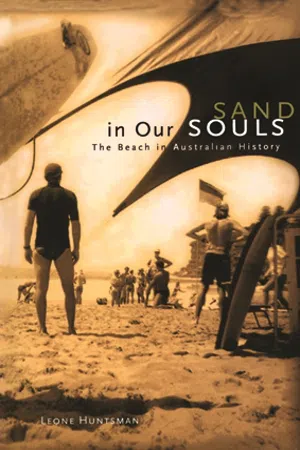
Images of 'the beach' pervade Australian popular culture. However the deeper significance of the experience of 'the beach', and its influence on Australian culture generally, have not yet been seriously explored. How, why and when did the beach become part of the Australian way of life?In Sand in our Souls Leone Huntsman describes the forces and pressures that encouraged or impeded Australians' enjoyment of sand and surf, from early enjoyment of bathing, through nearly a century of repressive restrictions, to freedom won in the face of drawn-out opposition. The ways in which artists, writers, film-makers and the advertising industry have depicted the beach are examined for the light they throw on the beach's significance. She traces the development of a distinctively Australian way-of-being-at-the-beach, suggesting that the beach experience has been absorbed into our emerging culture and continues to shape it in subtle ways.Huntsman's provocative arguments will stimulate debate on the concept of 'national identity' appropriate for a new Australian century, and promote a deeper understanding of an aspect of life in Australia that is cherished by many of those who live here.
eBook - ePub
Sand In Our Souls
About this book
Trusted by 375,005 students
Access to over 1.5 million titles for a fair monthly price.
Study more efficiently using our study tools.
Information
PART 1 The Evolution of the
Australian Beach

1
First Impressions
Brief encounters: the beach and culture contact betore tirst settlement
In EXPLORING THE HISTORY of crosscultural conflict between Europeans and the inhabitants of the Marquesas Islands in the Pacific, Greg Dening uses an overarching metaphor—introduced in the title of his book, Islands and Beaches—to understand and to explain the process of culture contact itself. An ‘island’ is the culture constructed by a people; a ‘beach’ is the boundary between cultures. As newcomers cross that boundary, bringing with them all the cultural meanings and phenomena from their own ‘island’, they change the culture of the newly entered ‘island’ forever.1
The ships of European explorers can hardly be said to have penetrated the ‘island’ of the Australian continent before 1788. They skittered along the coastlines, the explorers and their crews viewing the native inhabitants on the beach and never penetrating far beyond it. But to their perceptions of the new land they brought the values of their ‘island’—of cultural and moral superiority, imperial rights to exploration and acquisition, appraisal of opportunities for exploitation and profit, and the Enlightenment ideal of the advancement of knowledge through the observation and recording of new phenomena.
Thus first impressions were filtered through existing preconceptions, starkly revealed in Sir Joseph Banks’s description of the people seen from Captain James Cook’s Endeavour when it first touched on the Australian continent in 1770:
In the morn we . . . [discerned] 5 people who appeared through our glasses to be enormously black: so far did the prejudices which we had built on Dampier’s account influence us that we fancied we could see their Colour when we could scarce distinguish whether or not they were men.2
Here Banks refers to William Dampier’s unfavourable accounts of West Australian Aboriginal people in published accounts of his landings in 1688 and 1699, and reveals his own awareness of the extent to which perception was influenced by expectation.
We have no corresponding account of the Aboriginals’ interpretation of the ships and strangers they saw from the beach. While Banks and his scientific colleagues meticulously catalogued ‘facts’ about Aboriginal people in the same way as they named and classified new plants and animals, the meaning of the Aboriginals’ behaviour on the beach eluded them. They observed three main kinds of response to their presence: attempts to repel them by threatening gestures and displays of weapons; apparent indifference as the people went about their daily tasks of carrying wood or spearing and cooking fish; and ignoring them, running away or melting into vegetation beyond the beach.
Was this behaviour cowardice, as Banks chose to label it—or a prudent withdrawal from contact until more understanding of the newcomers’ motives could be gleaned or these unsettling apparitions disappeared for ever? Whatever the reason, no relationship between newcomers and inhabitants could be established during these fleeting encounters. The Europeans were baffled by the Aboriginal people’s indifference to the goods they brought with them. They threw beads, ribbons and cloths as presents into a ‘house’ near the beach, only to find the next day that every individual thing they had thrown there was left behind, untouched. There was an apparent refusal on the part of the Aboriginal people to accept any offerings that would have established a relationship of reciprocity between the two peoples. On the other hand, the Europeans had no qualms in taking with them all the ‘lances’ (spears) that they found in one of the houses, an early indication of their assumed right to appropriate whatever was of interest or profit to them.
The early and sometimes unfavourable judgements of the Aboriginal people expressed by early explorers co-existed with a rather wistful envy of their carefree way of life as contrasted with that of effete Europeans—a sentiment influenced by another cultural belief in the virtues of the Noble Savage. Thus Captain James Cook wrote:
From what I have said of the Natives of New-Holland they may appear to be some of the most wretched people upon Earth, but in reality they are far more happier than we Europeans; being wholly unacquainted not only with the superfluous but the necessary Conveniences so much sought after in Europe, they are happy in not knowing the use of them. They live in a Tranquillity which is not disturb’d by the Inequality of Condition: the Earth and the sea of their own accord furnishes them with all things necessary for life, they covet not Magnificent Houses . . . they seem’d to set no Value upon any thing we gave them . . . this in my opinion argues that they think themselves provided with all the necessarys of Life and that they have no superfluities.3
Before the first settlement was established in Port Jackson, Governor Phillip noted on 22 January 1788 that he had named one of the harbour’s inlets Manly Cove because of the confidence and manly behaviour shown by the natives there—thereby naming the place that later became part of one of Sydney’s premier beach resorts.
The brief encounters on the beach only dramatised the difference between the two peoples. Each remained an enigma to the other. Dening’s ‘beach’ was more of a chasm than a boundary, a seemingly unbridgeable gap in understanding between the two cultures that was to have tragic consequences in the years to come.
The early years: 1788 to the 1830s
After THE First Fleet had landed on ‘the fatal shore’, 4 the earliest interactions between the new settlers and Aboriginal people took place around the beaches of Port Jackson, Botany Bay, Pittwater and Broken Bay. The newcomers observed that the natives subsisted mainly on the fish and shellfish that they drew from the waters surrounding the settlement. The early diarists described in some detail the different functions of men and women with respect to fishing: the way they broiled the fish they had caught over little fires in their canoes; the fashioning of fishhooks and the construction of canoes. Joseph Lycett’s painting Aborigines Spearing Fish, Others Diving for Crayfish, a Party Seated Beside a Fire Cooking Fish shows a division of labour between the sexes, with women catching fish from the canoes, swimming or diving, the men spearing fish from the rocks. Cook had also observed this separation between the roles of men and women in the ‘primitive’ societies encountered during the voyage—in Tierra del Fuego, Tahiti, New Zealand, and now, it was evident, in New South Wales. In this one respect at least, the settlers must have been reassured that the natives, in other ways so alien, were like them.
The Eora people living around Port Jackson were proficient swimmers. In 1791 Bennelong and several others swam out to rescue a group of settlers whose boat had overturned in Farm Cove; they returned those rescued to shore and dried out their clothes over a fire. The name ‘bogie hole’, derived from an Aboriginal word meaning to bathe or swim, was often used until quite recent times for a swimming-place. When I was a child we called the smaller rock pool at the northern end of Bondi beach the bogie hole, and in his Oxford Dictionary of Australian Colloquialisms G. A. Wilkes notes the first recording of the word in an utterance by Colbee, one of the Aboriginal people captured by Governor Arthur Phillip.5

Joseph Lycett (c. 1775-1828), Aborigines Spearing Fish, Others Diving for Crayfish, a Party Seated Beside a Fire Cooking Fish, c. 1817. Watercolour, 17.7 × 28 cm
Source: ‘Drawings of the natives & scenery of Van Diemans [sic] Land’, National Library of Australia, R5686. By permission of the National Library of Australia
Early bathing and swimming
There is considerable evidence, scattered and fragmentary though it is, that the settlers greatly enjoyed bathing in the waters of the harbour. Early records suggest that convicts, soldiers and early colonists needed no urging to follow the example of the Aboriginal people and to enter the water—in fact, they persisted in doing so, despite officialdom’s efforts to discourage them.
Lack of familiarity with the water meant that few of those who lived in Britain or Ireland could swim, so one might assume that this applied also to the colonists. The evidence, however, suggests that the ability to swim was widespread. It is likely that some learnt the skill (and the pleasure to be derived from swimming) by watching the original inhabitants enjoying themselves in the water. The historian Michael Cannon conjectures that ‘no doubt the hotter climate, combined with easy access to beaches and rivers [and bay and harbour shores] encouraged a good deal of bathing simply for the sake of coolness in summer’.6 Most of the First Fleet diarists allude to the heat of that first summer, Watkin Tench noting that it ‘felt like the blast of a heated oven . . . it was allowed by every person, to surpass all that they had before felt, either there or in any other part of the world’.7
By 1803 bathing was so common that Governor King apparently felt it necessary to restore some decorum, possibly using the dangerous creatures lurking in the water as an excuse for what may have been an attempt to uphold propriety when he issued a government dispatch published in the Sydney Gazette on 20 October of that year:
This Bay and Harbour in general,—being unfortunately full of Voracious Sharks and Stingrays only, it is recommended to the Convicts not to go into the water without the utmost precaution and they are positively prohibited from bathing in front of the Encampment.
Whether or not the convicts heeded this injunction, the Fig Tree, overlooking Woolloomooloo Bay, remained a very popular bathing spot, providing trees and rocks for shade, for diving, and for concealment while changing. (This was the site of what was to become the Domain Baths, first enclosed in 1860, opened as the Domain Baths in 1908, renamed the Andrew ‘Boy’ Charlton pool in 1968, and still in use today.) The Ben Bolt, an abandoned hulk, was sunk near the shore, and wooden fences built out to it to form the sides of an enclosure, supposedly as some protection against sharks (but since one could dive and swim underwater around the submerged sides of the hulk ou...
Table of contents
- Contents
- Illustrations
- Acknowledgements
- Introduction
- PART 1 The Evolution of the Australian Beach
- 1 First Impressions
- 2 The Triumph of Respectability
- 3 Writers and Artists, the Bush and the Beach
- 4 Beginnings: A New Century, a New Nation and the Struggle for the Beach
- 5 The Achievement of Freedom on the Beach
- 6 The Australianising of the Beach
- 7 The Beach from the Mid-twentieth Century to the Present
- PART 2 Representations of the Beach in the Twentieth Century
- 8 EARLY representations and emerging themes
- 9 Childhood and the Beach
- 10 The prominence o f Nature: Diverse Connections
- 11 The Beach and Popular Culture
- 12 The Serene and the Sinister: Contrasting Aspects of the Beach
- 13 Reflections on Representations of the Beacn and Immersion in Place
- PART 3 Influences of the Beach in Australian Culture
- 14 The concept of national Identity
- 15 Meanings of the Beach, and the Shapinq of an Australian Culture
- 16 Balancing Acts
- 17 Present and Future Challenges
- 18 In Conclusion
- Notes
- Bibliography
- Index
Frequently asked questions
Yes, you can cancel anytime from the Subscription tab in your account settings on the Perlego website. Your subscription will stay active until the end of your current billing period. Learn how to cancel your subscription
No, books cannot be downloaded as external files, such as PDFs, for use outside of Perlego. However, you can download books within the Perlego app for offline reading on mobile or tablet. Learn how to download books offline
Perlego offers two plans: Essential and Complete
- Essential is ideal for learners and professionals who enjoy exploring a wide range of subjects. Access the Essential Library with 800,000+ trusted titles and best-sellers across business, personal growth, and the humanities. Includes unlimited reading time and Standard Read Aloud voice.
- Complete: Perfect for advanced learners and researchers needing full, unrestricted access. Unlock 1.5M+ books across hundreds of subjects, including academic and specialized titles. The Complete Plan also includes advanced features like Premium Read Aloud and Research Assistant.
We are an online textbook subscription service, where you can get access to an entire online library for less than the price of a single book per month. With over 1.5 million books across 990+ topics, we’ve got you covered! Learn about our mission
Look out for the read-aloud symbol on your next book to see if you can listen to it. The read-aloud tool reads text aloud for you, highlighting the text as it is being read. You can pause it, speed it up and slow it down. Learn more about Read Aloud
Yes! You can use the Perlego app on both iOS and Android devices to read anytime, anywhere — even offline. Perfect for commutes or when you’re on the go.
Please note we cannot support devices running on iOS 13 and Android 7 or earlier. Learn more about using the app
Please note we cannot support devices running on iOS 13 and Android 7 or earlier. Learn more about using the app
Yes, you can access Sand In Our Souls by Leone Huntsman in PDF and/or ePUB format, as well as other popular books in History & Australian & Oceanian History. We have over 1.5 million books available in our catalogue for you to explore.