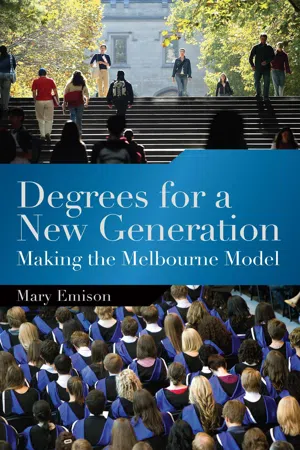
Degrees for a New Generation charts an extraordinary journey undertaken by the University of Melbourne. In 2005, the University agreed on a broad notion of curriculum reform; by 2008 it had the first intake of students into its new 'Melbourne Model' undergraduate courses; by 2011 the first cohort had graduated and the University shifted its professional programs to graduate-level entry. It was a massive, at times controversial, transformation of an old and large institution, which ultimately has left no aspect of the University untouched.
Mary Emison's detailed, insightful account of the making of the Melbourne Model highlights the processes, people and groups involved in planning, implementing and managing these radical changes. It traces the story from the consultative beginnings, led by Vice-Chancellor Glyn Davis, through the assiduous work of course design and transition led by Peter McPhee, involving generous commitments of time, energy and reflection from a great many professional and academic staff. Emison shows that academic structures in a large university can be transformed to offer a flexible approach to tertiary education that fits with a changing global environment.
- 326 pages
- English
- ePUB (mobile friendly)
- Available on iOS & Android
eBook - ePub
Degrees for a New Generation
About this book
Information
Topic
EducationSubtopic
Education GeneralPart I Origins 2004–05
1
The Birth of the Melbourne Model
The origins of the Melbourne Model can be found in 2004 when Melbourne University appointed a new vice-chancellor, Professor Glyn Davis. His role in developing a proposal to make significant changes to the course and curriculum structure of the University of Melbourne was crucial. The first part of this book traces how the proposal to review and revise the curriculum grew from a discussion paper – Growing Esteem: Choices for the University of Melbourne – released in July 2005 to become an integral and primary part of a new strategic plan. Growing Esteem: The University of Melbourne Strategic Plan 2006 was published in February 2006 and endorsed by the University Council in March 2006. In less than a year after taking up his post, Professor Davis had proposed a radical change to how courses might be offered at the University of Melbourne and this proposal had been discussed by the University community, fleshed out by working groups and taskforces and endorsed by the University Council. In a move that introduced similarities to higher education structures in the United States and Bologna, the many existing undergraduate degrees would be reduced to six generalist degrees and professional qualifications offered only at graduate level. At the same time, adminis-trative structures and student service provision would be reviewed for improvement.
There had been some discussion during the 1980s and 1990s, and occasionally before, about the university changing its profile to include a higher proportion of postgraduate students, but there had been nothing suggested along the lines of an extensive, University-wide move to a completely different model. But that’s what the Growing Esteem papers did, in inspiring what would come to be called the Melbourne Model. What follows is the story of how this model was conceived, designed and put into place.
A new vice-chancellor: 2003
In July 2003 the serving vice-chancellor, Professor Alan Gilbert, tendered his resignation from the University of Melbourne to become Vice-Chancellor of the University of Manchester. His resignation was to take effect from January 2004. On 11 August 2003, the University Council agreed to establish a selection committee for the position of vice-chancellor, with a decision to take place early the following year.1
Professor Davis, then vice-chancellor at Griffith University, was interviewed for the position on 16 January 2004. His memories of that interview are less than perfect, but he does recollect arguing in broad terms that the University of Melbourne had an opportunity to offer a distinctive form of education, with a focus on graduate training in professions. He continued:
This nods toward – but is a long way from – details of what became ‘the Melbourne Model’. My aim was simply to signal a view that Melbourne occupied a unique position in Australian higher education, and should use this to break out of the existing institutional mould.2
Council adopted the selection committee’s recommendation for the appointment of Professor Davis as vice-chancellor on 23 January 2004.3 Professor Davis remained at Griffith until he took up his appointment at Melbourne in January 2005. Professor Kwong Lee Dow was appointed vice-chancellor for 2004.
The appointment was pivotal. Professor Davis would arrive at the University with clear ideas about what the University community expected of him and a sense of how he would go about helping shape its future. He brought a distinctive, US university, presidential-style approach to developing strategies for the University that contrasted significantly with how such tasks had been undertaken in the past. He engaged consultants from outside the University – and the higher education system – to write about possible future directions for the institution, and chose people to discuss the issues and work with him in developing strategies on the basis of their fresh eyes and approach rather than their deep personal experience of the University. That is not to say he went out on his own. There was wide consultation with the University community during the planning process and the widely publicised opportunity for submissions in response to the discussion paper. The University’s structures and well-developed planning and accountability framework provided a range of opportunities for the Vice-Chancellor to feed his ideas into the annual cycle of activities. These included the 2005 February Deans and Heads Conference and the Council Planning Conference, the annual performance reviews of the budget divisions in May 2005, and other components of the University’s normal operations and activities at that time.
Getting to know the University of Melbourne: 2004
In May 2004, Vice-Chancellor Elect Professor Davis, after discussion with Professor Lee Dow and Senior Vice-Principal Ian Marshman, commissioned three reviews as a due diligence exercise. These reviews were to provide an independent stocktake of three key activities of the University: administration and finances; teaching and learning; and research and research training. They were conducted independently of each other, by people or agencies outside the University: Phillips KPA for administration and finance; Professor Gregor Ramsey for teaching and learning; and Professor Vicki Sara for research and research training.4 The reviewers were well known within higher education circles at the time. Professor Sara had recently retired (on 30 June 2004) as CEO of the Australian Research Council (ARC), and had previous experience as Dean of Science at Queensland University of Technology. David Phillips and Peter Wade are experienced directors of Phillips KPA Consultancy, which provides services to the education and training sectors. Dr Ramsey was at that time an independent consultant who had previously held posts with federal and state governments, including as managing director of the NSW TAFE Commission.
The Office of the Senior Vice-Principal managed these reviews. A large volume of background documentation was provided for each by relevant sections of the University, and significant numbers of staff and students were interviewed. The three final reports were presented to the University in October 2004. The ‘Report on Due Diligence Reviews’ was circulated as background reading for the February 2005 Deans and Heads Conference. The accompanying paper stated, ‘the reviewers were to report on the status quo; they were not asked to make recommendations for change or improvements’.5 Nevertheless, a number of issues were raised that needed attention and or debate and some recommendations were made.
The review of teaching and learning activities was particularly noteworthy for the issues raised rather than conclusions drawn. These included:
How should the University position itself in relation to the balance between undergraduate and graduate students ... is the aim of the University to become increasingly a research-focused graduate university?
and
The University has developed a set of ‘attributes of the Melbourne Graduate’ ... should the first years of undergraduate programs be a common program, which aims to provide a general education developing those graduate attributes?6
These questions were particularly pertinent to the University’s subsequent decision to undertake an extensive review of its entire curriculum. The report on research and research training activities also raised the question that would become central to that curriculum review: ‘What is the University’s preferred balance between graduate and undergraduate load?’7
February 2005
Deans and Heads Conference
An abbreviated version of the ‘Report on Due Diligence Reviews’ had been circulated as background reading for the 2005 Deans and Heads Conference, which took place from 7 to 9 February.8 Since its origins when Professor David Penington was vice-chancellor, the annual February Deans and Heads Conference, originally held in the seaside town of Lorne, has been a popular and important event in the University’s strategic planning and accountability program.9 It provides an opportunity early in the year for the University’s academic and professional leaders to come together as colleagues in an informal setting to consider major issues for the University and to share their experiences. The 2005 conference theme was ‘Realising the Vision: Positioning Melbourne for a Changing Higher Education Environment’. It was an appropriate event at which to introduce the ideas that would lead to such significant changes at the University.
For Glyn Davis, starting his vice-chancellorship in the first few months of the year had certain advantages. One was that the February conference provided him with an early opportunity to meet and interact with a significant population of the University. The University Council had agreed with Vice-Chancellor Lee Dow’s recommendation in 2004 that the University would continue with the ‘Melbourne Agenda’ (the strategic policy adopted by the University in 1996, during Alan Gilbert’s first year as vice-chancellor) as its blueprint for 2005, and an operational plan for the year had been finalised on that basis. The strategic plan and budget for the year had also been determined before the end of the previous year. This allowed Professor Davis to take up his position, accepting operations as they were without any immediate need for major statements about the changes and new directions he may have believed were appropriate.
This does not mean he hadn’t been considering the possibilities deeply. Professor Davis recalls that 2004, the interim year during which he was vice-cha...
Table of contents
- Foreword
- Contents
- Part I Origins 2004–05
- Part II Design 2006
- Part III Transition 2007
Trusted by 375,005 students
Access to over 1.5 million titles for a fair monthly price.
Study more efficiently using our study tools.
Frequently asked questions
Yes, you can cancel anytime from the Subscription tab in your account settings on the Perlego website. Your subscription will stay active until the end of your current billing period. Learn how to cancel your subscription
No, books cannot be downloaded as external files, such as PDFs, for use outside of Perlego. However, you can download books within the Perlego app for offline reading on mobile or tablet. Learn how to download books offline
Perlego offers two plans: Essential and Complete
- Essential is ideal for learners and professionals who enjoy exploring a wide range of subjects. Access the Essential Library with 800,000+ trusted titles and best-sellers across business, personal growth, and the humanities. Includes unlimited reading time and Standard Read Aloud voice.
- Complete: Perfect for advanced learners and researchers needing full, unrestricted access. Unlock 1.5M+ books across hundreds of subjects, including academic and specialized titles. The Complete Plan also includes advanced features like Premium Read Aloud and Research Assistant.
We are an online textbook subscription service, where you can get access to an entire online library for less than the price of a single book per month. With over 1.5 million books across 990+ topics, we’ve got you covered! Learn about our mission
Look out for the read-aloud symbol on your next book to see if you can listen to it. The read-aloud tool reads text aloud for you, highlighting the text as it is being read. You can pause it, speed it up and slow it down. Learn more about Read Aloud
Yes! You can use the Perlego app on both iOS and Android devices to read anytime, anywhere — even offline. Perfect for commutes or when you’re on the go.
Please note we cannot support devices running on iOS 13 and Android 7 or earlier. Learn more about using the app
Please note we cannot support devices running on iOS 13 and Android 7 or earlier. Learn more about using the app
Yes, you can access Degrees for a New Generation by Mary Emison in PDF and/or ePUB format, as well as other popular books in Education & Education General. We have over 1.5 million books available in our catalogue for you to explore.