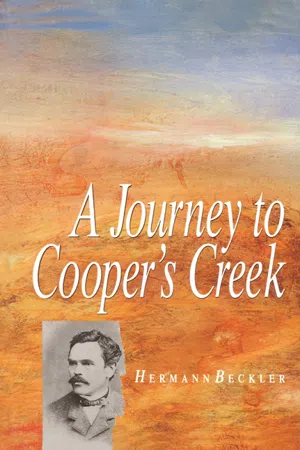
First-hand accounts of the myth-laden Burke and Wills expedition are remarkably few, in contrast to the reams of subsequent commentary and conjecture. Wills's journal and statements by others in the party were published at the time, but little more.Hermann Beckler, botanical collector and doctor to the expedition, wrote the only other substantial account, in his native German. The manuscript remained with his family for nearly a century. It is now published for the first time.This highly readable account, with drawings and maps, offers insights into the causes of the expedition's failure-an ill-chosen leader and route, and inappropriate and excessive supplies. In increasingly desperate conditions Beckler collected and identified the native flora, and recorded vivid and positive descriptions of the landscape and the Aboriginal people. His acute observations indicate what might have been achieved had the expedition pursued its scientific brief.
- English
- ePUB (mobile friendly)
- Available on iOS & Android
eBook - ePub
A Journey To Cooper's Creek
About this book
Trusted by 375,005 students
Access to over 1.5 million titles for a fair monthly price.
Study more efficiently using our study tools.
Information
A Journey to
Cooper’s Creek
Contents
Editor’s Preface
Introduction
Sources and Notes
Expedition Report
Foreword
Part One
Introduction
I From Melbourne to Swan Hill on the Murray
II From Swan Hill to Bilbarka
III From Bilbarka to Menindee
IV Camp at Menindee and the first journey to Duroadoo
Part Two Mr Wright’s Journey
Introduction
I From the Darling to the Mountains: Mutanié Ranges
II From Mutanié to Duroadoo
III From Duroadoo to Mudplain Camp, and our sojourn there
IV From Mudplain Camp to Bulla
V Bulla
VI Return journey
Editor’s Notes
Appendix 1 Beckler’s reply to Dr William Wills
Appendix 2 Beckler’s application to the Royal Society
Appendix 3 Directions from the Exploration Committee
Appendix 4 Beckler’s letter of resignation to Burke
Index
Illustrations
Unless otherwise identified, all illustrations are the work of Hermann Beckler, and are reproduced from the Becker Sketchbook, La Trobe Collection, State Library of Victoria.
Plates
Portrait of Hermann Beckler
By courtesy Royal Botanic Gardens, Melbourne
View of a distant range of mountains
View of a gully with rocky waterholes
Grotto at the entrance of a gully
Drawings
Darling River
Junction of Pamamero Creek and Darling River
Valley in the Mootwanji Ranges
Dry Lake Bodurga
Swamp at Duroadoo
Duroadoo
Bulla or Koorliatto
Balrumatti Creek
Maps
Route from the Darling River depot to Mootwingee camp
Route from Mootwingee camp to Yellowintchee Creek
Route from Yellowintchee Creek to Torowoto Swamp
August Petermann’s map of 1862 showing the route of the Burke and Wills expedition inside back casing
Editor’s Preface
NO authoritative or complete history of the Burke and Wills expedition was published in the nineteenth century. The journal of William Wills and statements by other members were published at the time, but due to its failure little more was written by those involved or by the Royal Society’s members. The Society failed to interest a writer in an official history. A historical curiosity, the only substantial account prepared by an expedition member, was, however, to remain in family possession until it was deposited in a local museum in southern Germany in 1967. It is an impassioned account written by a young Bavarian doctor, Hermann Beckler, who had emigrated to Queensland in 1856 and who returned to Germany in 1862. Written by an experienced botanical collector, his account can be read as a carefully constructed narrative in its own right. Beckler tells in detail of the problems which prevented the supply party, of which he was a member, from reaching Coopers Creek; he shows why Burke’s expedition had to end in failure. At the same time he has attempted to describe the vegetation he encountered in the interior of what was a still largely unexplored continent.
Beckler gave his manuscript the somewhat misleading title Burke’s Expedition: A Journey to Central Australia. He wanted to inform a German readership, ignorant of discussions in the Australian press, of the circumstances surrounding the disastrous outcome. To this end, he supplemented his account with a translation of Wills’s journal and his own drawings, and a copy of the widely distributed map prepared from Wills’s sketches. For Australian readers of the late twentieth century, who have access to the principal English language sources and to valuable recent research, this book, entitled Journey to Cooper’s Creek, concentrates on Beckler’s account itself. The translation should contribute to a more serious assessment of the supply party’s actions. Beckler is able to shed light on important aspects of the planning and leadership of the expedition whilst confronting us with the reality that exploration in the nineteenth century was frequently painstaking and difficult rather than heroic.
Considerable variation exists in the place names recorded by various members of the expedition parties. Those given by Wills in particular have tended to become accepted. In this translation the place names are left as Beckler recorded them; they represent his attempt to recreate in phonetic German those sounds which he had carefully noted. Thus he writes Mutanié (and also Motuanje, Motwongee) for Mootwingee, Duroadoo for Torowoto, Bulla for Bulloo etc. The map prepared from Wills’s material and included by Beckler is not reproduced here as it gives insufficient detail of the route taken by Wright’s party. Greater detail is to be found in Beckler’s own maps prepared for the Royal Society and in the fine map prepared by the cartographer B. Hassenstein for August Petermann’s geographical journal that was in published in Germany in 1862.
In his intended publication Beckler had included 35 drawings now held in Germany. Regrettably they cannot be included here as their present condition makes them unsuitable for reproduction. Unquestionably, they warrant further study, but such a project lies outside the scope of this book. The La Trobe Library possesses, in their original condition, a number of Beckler’s drawings and maps which, with the drawings of Ludwig Becker, were deposited there by the Royal Society of Victoria in 1874; it is appropriate to include these in a book sponsored by the La Trobe Library.
I would like to acknowledge help given by the following institutions and people:
The text of Beckler’s account is reproduced from the Beckler manuscripts located in the Museum, Höchstàdt a. d. Donau, by permission of the Bürgermeister. The present publication has proceeded with the support and encouragement of the administation of the Stadt Höchstàdt. In particular, Herr Georg Strobel, Heimat- und Archivpfleger der Stadt Höchstàdt a. d. Donau, has provided valuable help in addition to making the manuscripts available for transcription and for microfilm reproduction. A very great debt is owed to Dr Michael Renner of the Bavarian State Archives, Munich. Dr Renner located the Beckler manuscripts in Höchstädt, pursued actively a large number of matters concerning Beckler’s circumstances in Bavaria and undertook the transcription of the expedition account and Beckler’s Australian correspondence for the La Trobe Library.
Beckler’s readers have cause to be grateful to Dr Marjorie Tipping for identifying the significance of Dr Renner’s find and for pursuing the manuscripts whilst undertaking her own research on Ludwig Becker. Publication of this translation marks the end of a project initiated by the former Principal State Librarian, Margery Ramsay. Without her initiative and interest, publication would not have been possible. Miss Ramsay pursued contacts in Germany and obtained transcriptions of the manuscripts for the collections of the La Trobe Library. The publication of Beckler’s account was also pursued by former Publications Officer, Betty Foord. I have drawn frequently on substantial but unpublished research undertaken by Dr Renner, Miss Ramsay and Miss Foord. The present translation is based on the translation prepared for the La Trobe Library by Dr Michael Kertesz, Zürich.
I wish to thank the Library Council of the State Library of Victoria and the Publications Committee of the Library and its Executive Officer, Mr Derek Whitehead, for giving me the opportunity to work on Beckler’s manuscripts. Beckler’s correspondence reveals him as one of the most articulate of the German travellers who visited Australia in the nineteenth century. The La Trobe Librarian, Dianne Reilly, and the staff of the Manuscripts Collection, especially Jock Murphy, Margaret Burnett, Ann Cahir and Gerard Hayes, have provided assistance whenever requested.
Help relating to Beckler’s collections was given by Professor and Mrs Peter Martin, Adelaide. Dr David Symon of the Botanic Gardens and State Herbarium, Adelaide, and Dr J. H. Willis, formerly of the National Herbarium, Melbourne, have given detailed answers to questions concerning Beckler’s specimens. I am especially grateful for assistance given by Dr Willis who, on the occasion of the Burke and Wills centenary, was the first person to undertake a systematic assessment of Beckler’s collections. I also owe thanks to Mrs Doris Sinkora of the National Herbarium for information concerning Beckler and Ferdinand von Mueller and to Helen Cohn, Librarian at the National Herbarium, Melbourne. The photographic portrait of Beckler, taken in September 1861, is reproduced with permission of the Royal Botanic Gardens, Melbourne.
I owe special thanks to Dr Geoffrey Série who read the manuscript and made valuable comments. Professor A. G. L. Shaw made suggestions regarding an early draft of the text. I am grateful to Michael Clyne for drawing my attention to the Beckler manuscripts, to Walter Veit for comments and for verification of detail from German sources, and to Leslie Bodi who gave encouragement as well as reading and making suggestions regarding the translation.
My task was made easier by Ian McLaren’s bibliographical research. Mrs Henriette Roberts and Mrs Klara Doroszlay answered questions. Dr E. M. Wilkinson provided much needed technical assistance with the preparation of the manuscript. Finally, I owe thanks to Ann Jeffries for her patience and support.
Stephen Jeffries
Introduction
ROBERT O’HARA BURKE, in October 1860, split his exploration party at Menindee, and not at Cooper’s Creek as directed by the Exploration Committee. After the fate of the explorers became known, their ‘successful but fatal feat’ was widely praised,1 but the activities of the supply party and its leader, William Wright, were criticized. The Royal Commission of Inquiry censured Wright severely for failing to give an adequate explanation of the delays which prevented him from reaching Cooper’s Creek.2 Hermann Beckler (1828–1914), botanical collector and doctor on the expedition, was not criticized directly by the Commission. But he too was censured on the grounds that he had resigned from the expedition without sufficient cause. The Victorian press claimed that he had not given the expedition his full support and that his courage had given way before the awe-inspiring solitude of the wilderness’.3 A revision of this attitude towards Beckler has occurred only with the recent appearance of Marjorie Tipping’s study of Ludwig Becker (1979) and Tim Bonyhady’s work, Burke and Wills: From Melbourne to Myth (1991).4
Hermann Beckler left Australia to return to Germany in January 1862 in order to pursue a career in medicine. But the publication in London in 1863 of Dr William Wills’s work, A Successful Exploration through the Interior of Australia, from Melbourne to the Gulf of Carpentaria, provoked him to anger. In that scurrilous account, Dr Wills, father of the explorer, vilified those who criticized Burke. He attacked Beckler as ‘neither a man of courage, energy, nor of medical experience’. Wills wrote disparagingly: ‘Now there is no mistake, Dr Beckler is an honest little fellow, and well-intentioned enough, but he is nothing of a bushman, although he had had so much travelling’.5 Beckler felt the charges deeply—believing he had been made a scapegoat. Dr Wills referred to his son’s statement of 16 October I860: ‘but that Dr Beckler had been foolish enough to follow his [Landells’s] example, for no better reason than that he did not like the way in which Mr Burke spoke to Mr Landells, will I think rather astonish you’.6 As Beckler recognized, he had been subjected to ‘accusations of a lack of courage, of ignorance and a passion for intrigues’, not to mention ‘even more serious but ill-defined charges’.7 He believed that Dr Wills had failed to address the reasons enumerated in his letter of resignation to Burke and repeated before the Royal Commission of Inquiry in December 1861.
If Beckler was unable to refute directly the charges of Dr Wills, whom he regarded as an unreliable witness, another avenue was open to him. He had long wanted to describe to a German readership what he saw as unique about the Australian interior. By narrating the story of the supply party’s and his own actions he could set the record straight. As Dr Wills had noted, Beckler’s given reason for his resignation—an objection to Burke’s misuse of his authority—did not in itself give an adequate explanation for his behaviour. In order to show that Dr Wills’s charge that he resigned ‘for a poor reason’ was unjustified, Beckler needed to state why he wanted to make botanical collections in central Australia and to give his account of the difficulties which prevented the supply party from reaching Cooper’s Creek.
Beckler intended to supplement his account with a translation of the journal of the explorer William Wills, which had been published in J. H. Francke’s Melbourne German-language newspaper, Germania in November 1861.8 However, Beckler’s report was not published in the nineteenth century. Some accounts of the expedition’s progress were available to German-language readers in authoritative geographical periodicals, but they do not mention Beckler’s report. Its existence was first revealed in 1954 with the publication in Germany of Josef Heider’s biographical article about Beckler and his part in the expedition.9 It was only when Marjorie Tipping’s Ludwig Becker: Artist and Naturalist with the Burke and Wills Expedition appeared in 1979 that information about the fate of Beckler or the existence of his report became known in Australia.10
In the context of German participation in scientific exploration in Australia, Beckler’s activity cannot be compared with the outstanding achievements of either the explorer Ludwig Leichhardt or collectors like Ludwig Preiss or Amalie Dietrich. His opportunities to undertake serious botanical collecting were few and he never travelled into uncharted territory. But throughout his stay in Australia from 1856 to 1862 he was an enthusiastic and careful observer. His expedition report is far from being a story of cowardice. Rather, it tells of someone who showed great bravery when confronted with adverse circumstances. An articulate writer on Australian matters, he wanted to communicate his fascination with Australia as well as to vindicate the actions of his leader William Wright and his fellow countryman William Brahe, who had had the misfortune to depart from Cooper’s Creek on the very day that Burke and Wills had returned there from the Gulf of Carpentaria. Underlying Beckler’s report is reproach of the Exploration Committee that greater scientific gains might have followed if the expedition had proceeded slowly and systematically.
Hermann Beckler was born on 28 September 1828 in the southern German market town of Höchstädt on the Danube in Bavarian Swabia. His father, Kaspar Beckler, was cantor and second teacher at the local elementary school; his mother, Franziska Speth, was the daughter of a medical practitioner from nearby Günzburg. Together with his brother Carl, born on 19 December 1829, he attended the classical Gymnasium in neighbouring Dillingen, site of the very influential Jesuit university which had been dissolved in 1804. He obtained excellent passes on matriculation. After ...
Table of contents
- A Journey to Cooper’s Creek
Frequently asked questions
Yes, you can cancel anytime from the Subscription tab in your account settings on the Perlego website. Your subscription will stay active until the end of your current billing period. Learn how to cancel your subscription
No, books cannot be downloaded as external files, such as PDFs, for use outside of Perlego. However, you can download books within the Perlego app for offline reading on mobile or tablet. Learn how to download books offline
Perlego offers two plans: Essential and Complete
- Essential is ideal for learners and professionals who enjoy exploring a wide range of subjects. Access the Essential Library with 800,000+ trusted titles and best-sellers across business, personal growth, and the humanities. Includes unlimited reading time and Standard Read Aloud voice.
- Complete: Perfect for advanced learners and researchers needing full, unrestricted access. Unlock 1.5M+ books across hundreds of subjects, including academic and specialized titles. The Complete Plan also includes advanced features like Premium Read Aloud and Research Assistant.
We are an online textbook subscription service, where you can get access to an entire online library for less than the price of a single book per month. With over 1.5 million books across 990+ topics, we’ve got you covered! Learn about our mission
Look out for the read-aloud symbol on your next book to see if you can listen to it. The read-aloud tool reads text aloud for you, highlighting the text as it is being read. You can pause it, speed it up and slow it down. Learn more about Read Aloud
Yes! You can use the Perlego app on both iOS and Android devices to read anytime, anywhere — even offline. Perfect for commutes or when you’re on the go.
Please note we cannot support devices running on iOS 13 and Android 7 or earlier. Learn more about using the app
Please note we cannot support devices running on iOS 13 and Android 7 or earlier. Learn more about using the app
Yes, you can access A Journey To Cooper's Creek by Hermann Beckler in PDF and/or ePUB format, as well as other popular books in History & World History. We have over 1.5 million books available in our catalogue for you to explore.