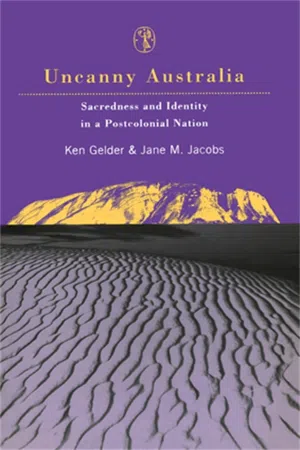
Aboriginal claims for sacredness in modern Australia may seem like minor events, but they have radically disturbed the nation's image of itself. Minorities appear to have too much influence; majorities suddenly feel embattled. What once seemed familiar can now seem disconcertingly unfamiliar, a condition Ken Gelder and Jane M. Jacobs diagnose as 'uncanny'.In Uncanny Australia Gelder and Jacobs show how Aboriginal claims for sacredness radiate out to affect the fortunes, and misfortunes, of the modern nation. They look at Coronation Hill, Hindmarsh Island, Uluru and the repatriation of sacred objects; they examine secret business in public places, promiscuous sacred sites, ghosts and bunyips, cartographic nostalgia, reconciliation and democracy, postcolonial racism and New Age enchantments. Uncanny Australia is a challenging and thought-provoking work that offers a new way of understanding how the Aboriginal sacred inhabits the modern nation.
- English
- ePUB (mobile friendly)
- Available on iOS & Android
eBook - ePub
Uncanny Australia
About this book
Information
Uncanny Australia
Contents
Acknowledgements
Introduction: On Discourses of the Sacred, Minorities and Fair Deals
1 The Modern Sacred: On the New Age of a Postcolonial Nation
2 The Postcolonial Uncanny: On Reconciliation, (Dis)Possession and Ghost Stories
3 The Sacred (in the) Nation: On Boundaries, Aboriginal Bureaucracy and the Arbitrariness of the Sign
4 Where is the Sacred? On the Reach of Coronation Hill
5 The Return of the Sacred: On Repatriation and Charisma
6 Authorising Sacredness: On Storytelling, Fiction and Uluru
7 Promiscuous Sacredness: On Women’s Business, Publicity and Hindmarsh Island
Conclusion: On Wik, Postcolonial Democracy and Other Matters
Notes
Bibliography
Index
Illustrations
Figure 1 Aboriginal Australia
Figure 2 Contemporary land use in Australia
Acknowledgements
WE GRATEFULLY acknowledge institutional support which has helped us gather much of the material for this book, and more besides. The Australia Research Council was generous to us in 1992 and 1993, as was the University of Melbourne’s Faculty of Arts in early 1996 and 1997. We also thank Tanja Luckins, Mary Quilty, Sue Jackson and Fiona Nicoll for their excellent research assistance, and Chandra Jayasuriya for her wonderful cartographic skills. Thanks to those who read parts or all of the manuscript and offered helpful comments: Tim Rowse, Dipesh Chakrabarty, Simon During, Barry Hill and Kerryn Goldsworthy. Thanks, also, to Teresa Pitt and Gabby Lhuede from Melbourne University Press and our editor, Lee White, for their support for and work on this book. Finally, we are ever grateful to Hannah and Christian for giving us the time and space to put Uncanny Australia together.
We would like to thank Routledge for their permission to reproduce a long passage from Bill Readings, Introducing Lyotard: Art and Politics (1991).
Introduction
On Discourses of the Sacred,
Minorities and Fair Deals
Minorities and Fair Deals
THIS IS A BOOK which analyses how the Aboriginal sacred has been talked about. We take indigenous claims for sacred sites and sacred objects over the last twenty years as crucial in the recasting of Australia’s sense of itself. But let us be clear that our book is not about the Aboriginal sacred as some kind of thing-in-itself; we shall not be delving ‘anthropologically’ into the content of Aboriginal sacred beliefs and practices. Rather, our concern is with what we might call the ‘discourses of the sacred’: that is, the ways in which Aboriginal sacredness manifests itself in the public domain of a modern nation. We can see these discourses as an effect of the Aboriginal sacred, which can draw various parties indiscriminately into the mix: some in sympathy, some in opposition, some directly (Aboriginal people themselves, politicians and bureaucrats, mining personnel, pastoralists, anthropologists, journalists, conservationists, and so on), and some who become affiliated to the Aboriginal sacred under the most indirect and tangential circumstances imaginable.
The indirect—but no less important—aspects of this latter kind of affiliation were brought home to us when we visited the Old Swan Brewery site (Goonininup) in Perth in 1993 as part of a research trip. There had been Aboriginal opposition to planned redevelopment at the site since 1986, most visibly through on-site protests organised by a local Nyunga group called Fringe Dwellers of the Swan Valley who were concerned about protecting a resting place of the Dreamtime creature, Waugal. But when we arrived at the Old Swan Brewery site one morning, the Aboriginal protesters and their various non-Aboriginal sympathisers had gone. All that remained was one man and his car, above which was hoisted an upside-down Australian flag. This man was not Aboriginal, but he had been protesting alongside the Fringe Dwellers because he, too, wanted to stop development and see the Brewery demolished. Yet the reason behind his protest could not have been more different. He told us that the building itself transgressed the sanctity of the foreshore on which it was situated—because that foreshore, for him, uncannily resembled what he called the ‘beachhead’ of Anzac Cove. The Brewery was situated between the King’s Park War Memorial and the Swan River: it broke up the connection between these two sites, interfering with the symbolic resonance (as he saw it) between monument and topography. What was fascinating about this man’s protest—and he had written many times to local newspapers and relevant government departments about his concerns—was that it was consistent with the interests of the Aboriginal protest (they both wanted the same outcome), and yet at the same time absolutely incommensurable with those interests. His sympathies appeared to be with the Fringe Dwellers, but he had no direct interest in protecting the sites of Waugal. The protesters did not compete with each other, but neither did they converge. So his affiliation with the Fringe Dwellers is entirely incidental: he is ‘with’ them, but in a certain sense he doesn’t ‘see’ them. Indeed, this man’s protest was utterly idiosyncratic, since it spoke for nothing more or less than his own interests: even the local Returned and Services League (RSL) had disdained him, for example. Yet at the same time, the form of his protest invoked the nation itself. He talked reverently of the Anzac tradition, yet he flew the Australian flag upside-down. He invoked the nation because he felt it, too, had disdained him—making him ‘marginal’ enough to come out in sympathy with Aboriginal protesters.
The Aboriginal sacred always throws up questions to do with who is ‘marginal’—who is empowered enough to claim to represent the nation, and who feels as if the nation has disdained them. Can a wealthy multinational mining company become ‘marginal’ in contemporary Australia? Can pastoralists—the most powerful of all social groups to emerge out of colonial Australian conditions—feel suddenly embattled, as if no one is listening to them? Can previously obscure parties suddenly become prominent and influential while the prominent and influential find themselves becoming obscured? In which case, who can claim to represent the nation? To put this another way: how can we tell the difference between the idiosyncratic and the emblematic?
In our view, Australia is in a predicament in which these distinctions can never be settled properly. Even majorities can feel that they are precariously placed. In a response to an appeal by the Wik and Thayorre people of Cape York, the High Court in December 1996 ruled, in a 4:3 majority, that pastoral leases do not extinguish native title. Is a 4:3 majority really a majority? For pastoralists in the area who felt unexpectedly overruled by this outcome and fought tooth and nail to change it, apparently not. And yet Australians are governed under a similar ratio, through the rise of a ‘convergence politics’ that sees the two major political parties increasingly resembling each other and drawing similarly proportioned endorsements from the voting public. So in this sense, the Wik decision is quite properly reflective of Australia’s contemporary political condition. But whereas a political electoral outcome of 4:3 means a settled majority under which we are then governed, a legal decision of the same proportions in relation to Aboriginal claims brings with it only unsettlement. Such outcomes always seem to require further clarification: decisions are appealed against, claimants are interrogated, testimonies are required, other avenues are actively sought. The intention, it would seem, is to try to clarify the distinction between the ‘minority’ and the ‘majority’. In the process, however, new levels of visibility are attained, new affiliations are made, a kind of amplification occurs, and the boundaries dividing ‘minorities’ from ‘majorities’ are often unsettled all the more. Is to become a ‘minority’ then to be in a position of loss—or gain? Can it actually be helpful to claim an identity as a ‘minority’ under these conditions? It can seem to be so. This is, no doubt, why conservative forces in Australia continually invest in the notion that, in the wake of innumerable so-called ‘single interest’ claims on the nation’s attention, the ‘mainstream’ has been forgotten: that ‘all of us’ have, in fact, become a ‘minority’ which can then only imagine itself (as minorities so often do) as embattled.
We take the Aboriginal sacred—the claims made about it, the effects it has on others, on democratic rights (‘equal opportunities’, ‘justice for all’, etc.), on the nation itself—as a sign of a predicament in modern Australia which we can characterise as postcolonial. This is not just because Aboriginal people have gained some power as a political force in this country over the last twenty or more years, which enables them actually to make a claim for sacredness and expect it at least to register. It is also because of what a claim for Aboriginal sacredness puts into motion: the not-always-predictable character of the affiliations and alliances, the unruly nature of the outcomes and the strange inversions that these claims activate, whereby, for instance, a ‘majority’ can very well represent itself as a ‘minority’ and, conversely, a ‘minority’ can very well end up speaking on behalf of the nation. Our book is also concerned with another consequence of Aboriginal claims for sacredness which we can note here: to turn what seems like ‘home’ into something else, something less familiar and less settled. This is one meaning of the term ‘uncanny’, which we shall elaborate in detail in Chapter 2. Our book thus charts modern Australia’s entanglement with its sacred sites and sacred objects: willing or unwilling, as the case may be. We want to look at what effects the Aboriginal sacred in its modern context unleashes across the nation (enthralment, irritation, downright anxiety), and how certain people, in turn, variously talk it up or try to close it down; or rather, as so often happens in the case of some of these people, talk it up even as they try to close it down. Our book may appear to map modern Australia through specific sites over which Aboriginal claims have been made, such as Coronation Hill, Uluru, Kow Swamp and Hindmarsh Island. But, in fact, these sites are never just discrete ‘sites’ (just as minorities are never just ‘minorities’), because of the claims and counter-claims made upon them by various affiliated parties. The very exclusivity claimed for these sites makes them somehow radiate across the nation and beyond, so that to speak about Coronation Hill a few years ago was also to speak about Canberra, as well as global business interests which operated in Australia as well as elsewhere.
Who can be drawn into the frame of the Aboriginal sacred? Who can make proper, or improper, use of provisions for Aboriginal claims over (for example) land? Let us note one more strange manifestation of the current predicament in order to demonstrate simply just how unpredictable these affiliations can be. In October 1996 the Melbourne Age reported that William Hollier, a man of non-Aboriginal descent, was planning to lodge a claim for Deal Island in Bass Strait under the Native Title Act.1 Hollier is an environmental scientist who has lived on the island with his family, as the sole occupants, for the past four years—not long in the Aboriginal scheme of things. Nevertheless, with no evidence of prior Aboriginal occupation of the island, Hollier felt enabled enough, or indigenous enough,...
Table of contents
- Uncanny Australia
Trusted by 375,005 students
Access to over 1.5 million titles for a fair monthly price.
Study more efficiently using our study tools.
Frequently asked questions
Yes, you can cancel anytime from the Subscription tab in your account settings on the Perlego website. Your subscription will stay active until the end of your current billing period. Learn how to cancel your subscription
No, books cannot be downloaded as external files, such as PDFs, for use outside of Perlego. However, you can download books within the Perlego app for offline reading on mobile or tablet. Learn how to download books offline
Perlego offers two plans: Essential and Complete
- Essential is ideal for learners and professionals who enjoy exploring a wide range of subjects. Access the Essential Library with 800,000+ trusted titles and best-sellers across business, personal growth, and the humanities. Includes unlimited reading time and Standard Read Aloud voice.
- Complete: Perfect for advanced learners and researchers needing full, unrestricted access. Unlock 1.5M+ books across hundreds of subjects, including academic and specialized titles. The Complete Plan also includes advanced features like Premium Read Aloud and Research Assistant.
We are an online textbook subscription service, where you can get access to an entire online library for less than the price of a single book per month. With over 1.5 million books across 990+ topics, we’ve got you covered! Learn about our mission
Look out for the read-aloud symbol on your next book to see if you can listen to it. The read-aloud tool reads text aloud for you, highlighting the text as it is being read. You can pause it, speed it up and slow it down. Learn more about Read Aloud
Yes! You can use the Perlego app on both iOS and Android devices to read anytime, anywhere — even offline. Perfect for commutes or when you’re on the go.
Please note we cannot support devices running on iOS 13 and Android 7 or earlier. Learn more about using the app
Please note we cannot support devices running on iOS 13 and Android 7 or earlier. Learn more about using the app
Yes, you can access Uncanny Australia by Jane M Jacobs, Ken Gelder in PDF and/or ePUB format, as well as other popular books in Social Sciences & Sociology. We have over 1.5 million books available in our catalogue for you to explore.