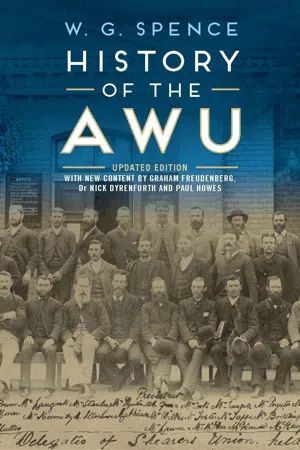
History of the AWU is a first-hand account of the making of a union and the makings of a nation. It depicts the industrial and political struggles of workers in the late 19th century, and explains the motivations behind the people who forged Australia's most powerful and enduring blue-collar union.
W. G. Spence was not only an observer of momentous events, he was also a leading participant in those events. With that in mind, Spence's book is more than just a record of the circumstances that led to the creation of the AWU. It is also an expression of the ideals that inspired the Australian labour movement and a manifesto for future generations of Australian unionists.
With a foreword by Paul Howes, an introduction by Graham Freudenberg and a biography of Spence by Professor Nick Dyrenfurth, the updated History of the AWU is essential reading for everyone interested in how Australia came to be the country that it is today.
Spence's history is the story of how misery and despair was transformed into hope and progress in Australia.
Paul Howes Those of us who believe that a strong union movement is vital to the future success of the Australian Labor Party will welcome this new edition of History of the AWU by William Guthrie Spence.
Graham Freudenberg Spence's histories blazed a trail for later scholars. Indeed, no serious student of the labour movement can avoid his giant contribution.
Nick Dyrenfurth
- English
- ePUB (mobile friendly)
- Available on iOS & Android
eBook - ePub
The History of the AWU
About this book
Trusted by 375,005 students
Access to over 1.5 million titles for a fair monthly price.
Study more efficiently using our study tools.
Information
CHAPTER I
‘Raddle’
When visitors enter the drawing room of a certain fine homestead on a large station between the Murrumbidgee and the Darling rivers, they invariably note a peculiar-looking article under a glass globe on the mantelpiece. On inquiry they learn that it is a piece of ‘raddle’, and the station manager will tell them it is kept there as a reminder that it was a liberal use of ‘raddle’ which paid for the construction of the woolshed. ‘Raddle’ is a harmless substance used for putting a mark on the sheep’s wool just as you would use a red or blue pencil on paper. Its too liberal use during shearing time was one of several causes which led to the formation of the Amalgamated Shearers’ Union in 1886.
Shearing being paid for at so much per hundred sheep shorn, each shearer has a pen which holds a considerable number, into which he turns out each sheep after he has taken the wool off. As the quality of the work affects the result very materially, both in quantity and value, the employer or his representative naturally demands good workmanship. This is right and proper, but in many of the agreements which men had to sign in pre-union days, a clause gave power to the employer to refuse to pay anything at all for a sheep which he considered had not been properly shorn. He therefore ‘raddled’ such sheep by putting a mark on it, and it would not be counted. Some of the squatters went one better than this, and if they found one sheep badly done they condemned the whole penful, and would not pay for any of them.
The manager of the station referred to boasted of having raddled 40,000 sheep in his time, so one can understand his reverence for ‘raddle’. Another nice little game they had was to provide for power – to deduct half-a-crown and in many cases three shillings per hundred for all sheep shorn before paying a man off in cases where they discharged him prior to completion of shearing. Seeing that the ‘boss of the board’, as the man in charge of operations was termed, was sole judge, it was to the interest of one not over-burdened with honesty to find fault with a man in order to get rid of him and thereby save £5 by doing so.
The agreements signed by the shearer may be termed the specifications for the work, as well as a binding contract under which a man is a prisoner until he finishes the shearing. If he leaves he is liable to fine or imprisonment and forfeiture of all his earnings. In pre-union days he was little better than a slave. The employer dictated the terms and was sole judge as to their fulfilment, and if an appeal was made to law it would be a squatter who would sit as magistrate to decide the matter in dispute. The following is a copy of an agreement of which I hold the original. It is a very fair sample of those common at that time:
An Agreement made the 24th day of September, 1886, between the undersigned Chas. Robertson (hereinafter referred to as the employee) of the one part, and the undersigned Mr Walter Laidlaw (hereinafter referred to as the proprietor), of the other part; whereby the employee agrees with the proprietor to shear sheep for him during the season 1886, and to commence shearing when required, and to continue shearing from day to day (excepting upon days when the sheep may be wet, or from other unavoidable causes they may not be put in the shed) until all the sheep on Melville Forest and Wootong Vale stations shall be shorn or until this agreement shall be determined as aforementioned. And the employee hereby agrees to observe, perform, abide by, and submit to the conditions and regulations hereinafter set forth, that is to say –
Conditions
Each sheep to be carried from the pen and put quietly down on the floor, and to be thoroughly well shorn, to the entire satisfaction of the proprietor, or of the person or persons who may be placed in charge of the shed.
The crutch, brisket, and points to be properly trimmed, and the belly wool to be detached from the fleece and put aside without injuring the fleece by twice cutting.
In opening the fleece at the neck both blades of the shears to be kept under the wool and close to the skin, so as to avoid twice cutting.
The employee will not be allowed to run his shears through the fleece so as break it down the centre or back.
The employee to clear the fleece from the doorway before turning out any sheep so as to avoid tearing or soiling the fleece.
No after-cutting allowed, except on the points.
The employee shall not ill-use or injure any sheep, nor cut the teat of any ewe or ewe lamb, or pizzle of a wether or ram, and if the employee acts in contravention of this present clause and the death of the animal shall ensue, or the animal be permanently injured in consequence thereof, he shall pay proprietor the sum of ten shillings (10s.) in respect of each sheep, wether, or lamb; and the sum of one pound (£1) in respect of each ram ill-used, injured, or cut as aforesaid.
The employee shall not turn out a sheep with a cut insufficiently tarred, and in the event of his doing so shall at once bring it back to the shearing floor and tar the wound.
★ ★ ★
Rules and Regulations
Working hours as directed by manager.
One smoko of twenty minutes will be allowed in the morning, and two of similar duration in the afternoon, and no sheep to be caught after the manager calls the time for smoking, or meals, or for knocking off.
Any sheep caught and shorn prior to the signal being given to start, or after the signal has been given to knock off, will not be counted.
Any sheep carelessly shorn, or cut, will not be paid for, and the employee will be liable to lose the pen of sheep into which such sheep is turned.
The employee will not be allowed to catch any sheep while his pen is being filled.
Shearers will draw lots for their pens, and after the pens have been allotted the employee will not be allowed to change without the consent of the manager. The manager to have the right at any time to make any changes he may see fit. No bad language or disorderly conduct allowed in the shed. The employee shall not absent himself from his work without permission from the manager and if he does he shall pay to the proprietor the sum of one shilling (1s.) for the first quarter of an hour he is absent, and sixpence (6d.) for every succeeding quarter of an hour; such sums to be paid by the proprietor to some hospital.
If the employee shall be found not to be a competent shearer, he shall forfeit whatever may be due to him under this agreement and be liable to be prosecuted for a breach of contract.
If the employee shall bring grog on to the station or be seen drunk he shall be discharged, and all moneys due to him for shearing may be forfeited.
The proprietor reserves the right to engage and employ any number of shearers he may think fit.
The proprietor will not make cross entries from one employee to another, nor cash orders, or book raffles, nor will the employee be entitled to payment until all the sheep are shorn.
If the employee shall fail to observe, perform, abide by, and submit to the foregoing agreement and the several conditions, rules and regulations hereinbefore contained, or any of them, the proprietor, or the manager, may determine this agreement, and in the event of such determination taking place in consequence of a strike, the employee shall have no claim whatever on the proprietor in respect of any sheep already shorn by him, but in the event of such determination taking place otherwise than in consequence of a strike the employee shall be paid in respect of the sheep shorn by him at the rate of ten shillings per hundred.
All money payable by the employee under any of these clauses hereinbefore contained may be deducted by the proprietor out of any moneys due, or to become due to the employee under this agreement.
If the employee shall faithfully observe, perform, abide by, and submit to the foregoing agreement and the several conditions, rules and regulations hereinbefore contained, the proprietor shall pay to the employee at the rate of twelve shillings and sixpence in respect of all sheep shorn by him.
As witness the hands of the said parties,
C. ROBERTSON,
Employee
WALTER LAIDLAW,
per J. E. L., Proprietor
Witness: W. A. HUNTLY
A cursory glance at the above will show how far short it falls of containing that essential principle of fair play known as mutuality. Everything is in favour of the proprietor. The latter takes power to do just as he likes. There is no limitation of hours. Three ‘smoke-ohs’ are provided for, but otherwise he has full control. In quite an ingenious way his lawyer has devised a variety of methods of robbing the shearer of his hard earnings. If one sheep is badly shorn in the opinion of the boss, he can refuse to count the whole penful no matter how well done they all are, nor how many may be in the pen. If a man starts work and shears quite a number of sheep, the boss can take it into his head to get rid of him and send him away as incompetent without paying him a penny for the work done. He can also prosecute him and possibly obtain damages in addition. If a shearer has hold of a cantankerous sheep and swears at it he breaks the rules, and 2s. 6d. per hundred is deducted. If he joins in a bit of fun or has a row with anybody, he loses half-a-crown per hundred for disorderly conduct. When he is sick and fails to go to work, if the boss chooses to say that he is shamming he is fined 16s. 6d. for eight hours, and the boss gets a great name from hospital committees for the money he gives which has been raised in this way. If the shearer visits the nearest pub, and some friend of the boss’s puts a bottle of grog surreptitiously in his pocket on his way back, he forfeits all he has earned. If the boss gets a friend to make the shearer drunk, the poor fellow loses all, and if a strike is worked up by some friend of the proprietor, the latter collars all that is due to the men. To make sure of securing all deductions provided for under this precious agreement, he takes special care that no money is payable until the shearing is finished. It does not trouble him as to how a poor man’s wife and children are to get along meanwhile. The 2s. 6d. reduction was a widespread condition in agreements. It was known as ‘second price’, and men have often been discharged during the last week of shearing and paid off at the lower rate, though the whole of their previous work has been fully approved.
★ ★ ★
I have a copy of an old agreement of twelve clauses, which was printed in large type and posted at Mount Eba shed, in South Australia, in 1887. The man in charge of the shed was sole judge of everything, and if a shearer was discharged he had to forfeit six days’ shearing money and return shears and ‘any articles got from the store.’ Clause 6 reads: ‘Singing, whistling, swearing and noise prohibited.’ The boss could sack a man when he liked, but unless the shearer went right through he forfeited all his earnings. Clause 12 read: ‘Payment to be made by money order drawn by the overseer on master, and payable in Adelaide.’
Just try and grip the unreasonableness of this clause. There was no payment at all till cut out, and then it was by money order payable in Adelaide, which in this case was only 750 miles away.
I have a copy also of an agreement worked under at ‘Prince Royal’ shed. No money till cut out. Price 12s. per hundred, with a bonus of three shillings per hundred if you went through. If the shearer did less than average of fifty per day during working days he was charged 10s. per week for his tucker. If there was any sign of drink on him he was fined 10s. for a day or any part of a day. Under an agreement used in Moralina shed in 1888, shearers were liable to a fine of 2s. 6d. and also to be discharged for ‘bad or improper language.’ The price was 14s., with a bonus of 3s. if the shearer cut out the shed. Rail fare was deducted if the shearer was discharged before finishing the contract, and all other cost to station also deducted from his earnings. If a man failed to average over fifty sheep per day he was charged five shillings per week for his ‘grub’. By the way, this latter was the word actually printed in the agreement.
In each of these sheds engagements had been made in Adelaide – in the former case in ‘Snell’s’ shed and in the Moralina case at ‘Hittman’s’ Labor Agency. Fees varying in amount had to be paid, and it was notorious that in many cases from one to five pounds h...
Table of contents
- Foreword
- Introduction
- William Guthrie Spence
- Preface
- Chapter I ‘Raddle’
- Chapter II The Birth of the ASU
- Chapter III Fighting Days
- Chapter IV Organisation in Queensland
- Chapter V The Industrial Fight in Queensland
- Chapter VI The Battle of 1894
- Chapter VII Catching Scabs
- Chapter VIII The Dark Days of 1895–97
- Chapter IX Arbitration and the Bogus Union
- Chapter X A Continent Conquered
- Appendix: List Of Executive Officers
Frequently asked questions
Yes, you can cancel anytime from the Subscription tab in your account settings on the Perlego website. Your subscription will stay active until the end of your current billing period. Learn how to cancel your subscription
No, books cannot be downloaded as external files, such as PDFs, for use outside of Perlego. However, you can download books within the Perlego app for offline reading on mobile or tablet. Learn how to download books offline
Perlego offers two plans: Essential and Complete
- Essential is ideal for learners and professionals who enjoy exploring a wide range of subjects. Access the Essential Library with 800,000+ trusted titles and best-sellers across business, personal growth, and the humanities. Includes unlimited reading time and Standard Read Aloud voice.
- Complete: Perfect for advanced learners and researchers needing full, unrestricted access. Unlock 1.5M+ books across hundreds of subjects, including academic and specialized titles. The Complete Plan also includes advanced features like Premium Read Aloud and Research Assistant.
We are an online textbook subscription service, where you can get access to an entire online library for less than the price of a single book per month. With over 1.5 million books across 990+ topics, we’ve got you covered! Learn about our mission
Look out for the read-aloud symbol on your next book to see if you can listen to it. The read-aloud tool reads text aloud for you, highlighting the text as it is being read. You can pause it, speed it up and slow it down. Learn more about Read Aloud
Yes! You can use the Perlego app on both iOS and Android devices to read anytime, anywhere — even offline. Perfect for commutes or when you’re on the go.
Please note we cannot support devices running on iOS 13 and Android 7 or earlier. Learn more about using the app
Please note we cannot support devices running on iOS 13 and Android 7 or earlier. Learn more about using the app
Yes, you can access The History of the AWU by William Guthrie Spence in PDF and/or ePUB format, as well as other popular books in History & World History. We have over 1.5 million books available in our catalogue for you to explore.