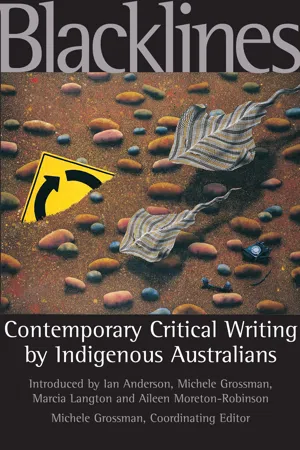
Written by established and emerging Indigenous intellectuals from a variety of positions, perspectives and places, these essays generate new ways of seeing and understanding Indigenous Australian history, culture, identity and knowledge in both national and global contexts. From museums to Mabo, anthropology to art, feminism to film, land rights to literature, the essays collected here offer provocative insights and compelling arguments around the historical and contemporary issues confronting Indigenous Australians today.
- English
- ePUB (mobile friendly)
- Available on iOS & Android
eBook - ePub
About this book
Information
PART I
Critical discourses: identities, histories, knowledges
Introduction: the Aboriginal1 critique of colonial knowing
Ian Anderson
IN MARCH 1847 a petition was presented to Queen Victoria’s Secretary of State for the Colonies signed by eight Tasmanian Aborigines then living at the Wybelenna settlement on Flinders Island in Bass Strait. The signatories were among the small number of Aboriginal people who had survived the ‘conciliated’ removal from the Tasmanian mainland by George Augustus Robinson.2 The program of forced relocation had been put into effect from 1830 to 1834 following a significant escalation in the violence of the conflict between Aboriginal people and the colonial invaders over the prior decade. Since their removal to Flinders Island, Aboriginal survivors continued to die as a consequence of the social deprivations experienced there. This petition was drawn up to protest the anticipated return of a particularly unpopular administrator and concluded: ‘We humbly pray your Majesty the Queen will hear our prayer and not let Dr Jeanneret any more to come to Flinders Island’.3 The opening paragraphs of the document provide an insight into the ways in which these Aboriginal people understood their circumstance and political position:
The humble petition of the free Aborigines Inhabitants of Van Diemen’s Land now living upon Flinders Island … That we are your free children that we were not taken prisoner but freely gave up our country to Colonel Arthur then the Governor after defending ourselves.
Your petitioners humbly state to your Majesty that Mr Robinson made for us and with Colonel Arthur an agreement which we have not lost from our minds since and we have made our part of it good.
Your petitioners humbly tell Your Majesty that when we left our own place we were plenty of people, we are now but a little one …4
The Aboriginal authors of this document acknowledged that they were once ‘plenty of people’ … ‘now but a little one’. Yet they also saw themselves as a free people, who had defended their country until the time when it became clear another strategy was needed. The historian Henry Reynolds investigated the historical circumstances of the development of this petition. He dismissed, with convincing evidence, the view that the Aboriginal signatories were co-opted by non-Aboriginal people who assisted in drafting the document, as if Aboriginal people at this time could not know their own minds.5
In referring to this particular incident I want to make a fairly straightforward point. The written text has been employed by Indigenous Australians as a mode of political and cultural self-representation from quite early in colonial history—it is not a new phenomenon. Contemporary Aboriginal critical writing, such as the work presented in this part, has its historical foundations in a much longer history of Aboriginal political and cultural critique. The slogan sometimes used to describe the focus of postcolonial studies, ‘The empire writes back’, would more accurately read: ‘The empire has already written back’. Despite the depth of this historical context, I will focus in this essay on the more recent historical and intellectual context in which an Indigenous critique of ‘western’6 theory and knowledge has developed. In particular I would like to draw out some of the key themes of this writing and position it within the broader context of current Aboriginal politics in Australia.
Contemporary Aboriginal politics and intellectual critique
Political historians generally locate the emergence of the contemporary Aboriginal movement in the decade of the 1960s. Events such as the 1967 referendum on the racial discrimination clauses in the Australian Constitution,7 and the establishment of the Aboriginal Tent Embassy on the lawns of the national parliament in 1972,8 have been used to illustrate the arrival of a new era in Aboriginal politics. This political movement began to consolidate around values such as sovereignty, self-determination and community control in an arena of social action that included a focus on land rights and cultural heritage issues, as well as responding to aspects of Aboriginal disadvantage such as health, education and housing. From a local movement that developed in response to colonialism, this social movement has itself developed international alliances and global strategies of action, such as those described by Michael Dodson in Chapter 1.
Assessing the impact of Aboriginal political action over the last thirty years is not a straightforward task. One analysis, made in the context of a broad study of the impact of various political struggles on Australian political culture, concluded that ‘Aboriginal notions of sovereignty, and the complex political-economic and cultural relations this concept entails, ha[ve] not achieved a great deal of success (despite numerous struggles) beyond a mixture of slogans and general demands’.9
When I first read this I was angered by this view. I saw it as a fairly narrow reading of the intent of Aboriginal politics that also failed to acknowledge the significance of some apparent achievements to Indigenous Australians. Yet even at the time, I had to agree that in some respects this analysis was correct. It was true that—despite some real gains in terms of land justice—these tended to be significantly limited both geographically and legally.10 Further, progress on many of the usual indicators of social equity, such as educational participation, health status, employment, housing, etc. had been very patchy and frustratingly slow.
On the other hand, it seemed at the time that there had been significant shifts in the politics of representation and identity since the 1970s. The flourishing of Aboriginal art, literature and other forms of cultural activity throughout the 1970s and 1980s seemed to indicate this. Cultural debate within the academy, the metropolitan press and other cultural institutions had also begun to promote a new vision of Australian identity—particularly by the late 1980s.11 Critical writing by both Aboriginal and non-Aboriginal people contributed to this broader debate by calling into question colonial constructions of Aboriginality and Australian history. Indeed, it was in this context that some of the pieces reproduced in this section were written. In addition, over the last thirty years, Australian governments have adopted a more liberal administrative definition of Aboriginality. This in itself has been significant, given the devastating impact on Aboriginal life experience during earlier colonial periods of the use in social policy of legislative definitions of Aboriginality based on a mix of biological and/or cultural characteristics.12 Taken in sum, all these developments suggested a shift towards control by Indigenous Australians over cultural processes of self-representation. It might even have been tempting to think that the power of the Australian state to control the symbolic agenda within which the social identity of Aboriginal people developed had in fact diminished.
Since that time, I have come to the view that some elements of my assessment were, if not hopeful, a bit simplistic. It would be naïve to think, for instance, that Australian governmental structures have not continued to be actively involved in the process of defining Indigenous identities. Philip Morrissey, for instance, argues in Chapter 3 that Australian governments have in fact reformulated the definition of Aboriginality within the context of ‘welfare colonialism’ as a ‘corporatist’ identity. Others have also noted that the previous focus within colonial administration on the regulation of individual cultural practice and reproduction has not simply vanished, but instead has shifted to focus increasingly on the regulation of Aboriginal collective structures.
Furthermore, the Australian political climate had shifted significantly towards the end of the final decade of the twentieth century. The election of the Howard Coalition government in 1996 and the subsequent rise of Pauline Hanson’s One Nation Party marked the rise of a renewed conservatism in Australian cultural policy. This cultural conservatism called into question the emergence of new ways of envisioning Australian nationalism (evident, for example, in the republican movement, or in attempts to redefine Australian identity within an Asia-Pacific regional context). In a relatively short space of time, the cultural possibilities of new, more inclusive forms of nationalism seemed to dissipate. In this conservative ideology it was the (white) ‘Aussie battler’ who had become the ‘endangered species’ or the dispossessed.13 It was as if ‘mainstream’ Australia had bunkered down and required political protection. To this end, proponents of this conservative vision of Australia have frequently used labels such as ‘political correctness’ or the ‘black armband view of history’ as strategies for deflecting dissenting views.14
In revising my sense of Aboriginal achievements in the cultural arena over the last thirty years, I would still point to the strong Indigenous presence in most forms of cultural production in Australia as evidence of some success. I do not want to overstate this: I am also aware that there are many problems in the political economy of Aboriginal art that continue to disadvantage Aboriginal people. Nevertheless, there are opportunities in the visual arts, writing and other forms of cultural performance for Aboriginal people that did not exist for earlier generations. Alongside this I would also argue that the growing body of cultural critique written by Aboriginal people is a significant development. This body of writing is not just being generated from within the ‘academy’—although it does address academic representations of Aboriginality. It draws together a broad range of critical writers, and has emerged as a series of interventions in cultural debate by Aboriginal writers who could be more usefully seen as ‘public intellectuals’ rather than ‘discipline-bound’ academics.
Contemporary Aboriginal critique
I would like to illustrate some of the contours of this contested territory by referring to two of the most significant recent debates in academic literature in which Aboriginal and non-Aboriginal intellectuals have engaged on issues of representation. Some of the critical written pieces generated within the context of these debates are included within this collection.
The first is best described through the words of Aileen Moreton-Robinson (see Chapter 5):
In Australian feminism in 1989 something interesting happened. Indigenous women challenged in public one of Australia’s leading feminist anthropologists, denouncing her claim that she and everyone else had the right to speak about rape in all Indigenous communities. The debate is still perceived as being about who could speak for whom, and a blanket of silence conceals the contention which remains unresolved …
[Diane] Bell defines her position on writing about Indigenous women in the following way: ‘I did not speak for, nor did I merely report, but rather my task was to locate issues of gender and race within a wider perspective’.15 Nelson [Bell’s Aboriginal informant/co-author], according to Bell, responded to the audience by stating it was the quality of the relationship between women that was important when white women write about Black women …
What remained invisible to the white women in the audience was the way they exercised their white race privilege to represent Bell’s work as morally correct and our position as less morally sound. Our objections about use, ownership and control of knowledge were reduced to a purely moral issue. They were not perceived as having epistemological and intellectual value.
Debates such as this one often get stuck on the issue of ‘authority’—that is, who may represent Aboriginal people, and in what contexts? As Moreton-Robinson argues, this may not be the point. Rather, a more fundamental question might be asked: ‘how’ is it possible for non-Aboriginal academics to ‘know’ Aboriginal people and issues in order to constructively and truthfully represent them? In this sense it is not enough for an anthropologist to claim that he or she ‘did not speak for … nor merely report’, as if it were possible to surgically excise political representation from cultural representation. Nor does it seem appropriate to use larger agendas, such as the task of locating issues of gender and race in a wider perspective, as an excuse for not addressing local concerns over strategies in representation. What is needed is an active engagement with some of the core issues raised by Indigenous critical writers who have called into question the basis of traditional systems of ‘western’ knowledge.
The second debate began when Bain Attwood, a non-Aboriginal historian, published a critique of the construction of Aboriginality in Sally Morgan’s 1987 autobiographical text My Place in Australian Historical Studies.16 The resulting exchange was complex, and a complete analysis is beyond the scope of this essay. Nevertheless, My Place had been hailed by some as a watershed in Aboriginal writing. Not surprisingly, Attwood’s article resulted in a number of written responses in a subsequent edition of the journal by Aboriginal writers including Jackie Huggins, Tony Birch, Isabel Tarrago ...
Table of contents
- Cover
- Title
- Contents
- Contributors
- Acknowledgements
- Introduction After Aboriginalism: power, knowledge and Indigenous Australian critical writing
- Part I: Critical discourses: identities, histories, knowledges
- Part II: Imaging Indigeneity: art, aesthetics, representations
- Part III: Knowledge in action: politics, policies, practices
- Afterword Moving, remembering, singing our place
- Notes
- Bibliography
- Index
- Copyright
Trusted by 375,005 students
Access to over 1.5 million titles for a fair monthly price.
Study more efficiently using our study tools.
Frequently asked questions
Yes, you can cancel anytime from the Subscription tab in your account settings on the Perlego website. Your subscription will stay active until the end of your current billing period. Learn how to cancel your subscription
No, books cannot be downloaded as external files, such as PDFs, for use outside of Perlego. However, you can download books within the Perlego app for offline reading on mobile or tablet. Learn how to download books offline
Perlego offers two plans: Essential and Complete
- Essential is ideal for learners and professionals who enjoy exploring a wide range of subjects. Access the Essential Library with 800,000+ trusted titles and best-sellers across business, personal growth, and the humanities. Includes unlimited reading time and Standard Read Aloud voice.
- Complete: Perfect for advanced learners and researchers needing full, unrestricted access. Unlock 1.5M+ books across hundreds of subjects, including academic and specialized titles. The Complete Plan also includes advanced features like Premium Read Aloud and Research Assistant.
We are an online textbook subscription service, where you can get access to an entire online library for less than the price of a single book per month. With over 1.5 million books across 990+ topics, we’ve got you covered! Learn about our mission
Look out for the read-aloud symbol on your next book to see if you can listen to it. The read-aloud tool reads text aloud for you, highlighting the text as it is being read. You can pause it, speed it up and slow it down. Learn more about Read Aloud
Yes! You can use the Perlego app on both iOS and Android devices to read anytime, anywhere — even offline. Perfect for commutes or when you’re on the go.
Please note we cannot support devices running on iOS 13 and Android 7 or earlier. Learn more about using the app
Please note we cannot support devices running on iOS 13 and Android 7 or earlier. Learn more about using the app
Yes, you can access Blacklines by Michele Grossman in PDF and/or ePUB format, as well as other popular books in Social Sciences & Ethnic Studies. We have over 1.5 million books available in our catalogue for you to explore.