Sensational reporting by the media has led to attitudes that racialise Muslims and frame them as potential threats to national security, placing them outside the circle of trustworthy citizenship. Muslims in the West are increasingly confronted with the pressure of conforming to dominant core values and accepting 'mere tolerance' from society, or else risk exclusion and even hostility when exercising their rights to maintain diverse cultural norms and religious practices.
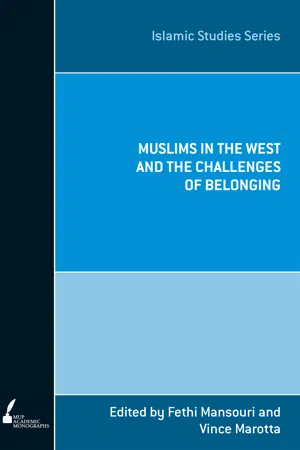
Muslims in the West and the Challenges of Belonging offers not only rigourous accounts of current difficulties, but also new thinking and deeper understanding about race relations and intercultural engagement in multicultural societies. It explores the increasing visibility of Muslim migrants in the West and the implications this has for multicultural co-existence, cultural representations, belonging and inclusive citizenship.
- 252 pages
- English
- ePUB (mobile friendly)
- Available on iOS & Android
eBook - ePub
About this book
Trusted by 375,005 students
Access to over 1.5 million titles for a fair monthly price.
Study more efficiently using our study tools.
Information
Topic
Theology & ReligionSubtopic
Islamic TheologyPart I Belonging and Identity among Australian Muslims
1 Muslim Migration to Australia and the Question of Identity and Belonging
Introduction
The encounter between Islam and Western civilisation is not a recent phenomenon. Certainly it is not solely a product of recent migratory movements, though twentieth-century migration has accelerated the pace of Muslim migration to the West. Indeed, Muslim civilisation reached the southern parts of Europe as early as the seventh century and is still strongly entrenched within Europe today in the form of independent states such as Bosnia Herzegovina and significant Muslim minority groups in the case of France, Germany, the UK, Holland and other states. Therefore, the current negative discourse towards Islam and Muslims living in the West is not only linked to recent political developments but can be traced to a history of confrontations that stretches from the crusades in the twelfth century to Napoleon’s expedition into Egypt more than five centuries later. But history and historical events alone cannot account for the current impasse that characterises the relationship between Muslims and the West. In fact, the years following the events of September 11 have witnessed a number of incidents that once again generated strong exclusionary discourses towards Islam and Muslims in general, and those present in Western societies in particular. As this chapter will argue, in the case of Australia, this discourse has been framed in the context of local threats to Australia’s national security and social cohesion symbolised by the perceived influx of the ‘boat people’, the spread of ‘Lebanese gangs’ in Australian suburbs and the associated fear of ‘global terrorism’. The historical and empirical insights from recent research illustrate that these new discursive tendencies cannot be overcome by means of a strictly normative citizenship approach.1
Despite the adoption of the policy of multiculturalism, and a general acceptance of migrant groups since the 1970s2, Australia has recently been described as a country where exclusionary discourses and practices are now notable, most obviously towards Arab and Muslim minority groups.3 In fact, the Human Rights and Equal Opportunity Commission (HREOC) report findings corroborated the views of several studies regarding the social concerns held by Arab and Muslim Australians and the subsequent threat this poses to intercultural relations.4 The HREOC inquiry reported growing levels of discrimination and xenophobia experienced by Arab and Muslim Australians since the September 11 and Bali terrorist attacks.5 While respondents confirmed that the majority of non-Muslim Australians uphold multicultural ideals regardless of the changed international political atmosphere, the interviews conducted as part of HREOC’s research exposed disturbing reports of individual acts of discrimination and/or racism in contemporary Australia. The incidents cited ranged from verbal abuse to examples of personal attacks (such as being spat upon or Muslim women forcibly having their veils removed), or the destruction of both private and public property.6
More recently, research on social cohesion in Australia has revealed an increased shift in negative attitudes towards immigration.7 The research found strong and persistent negative attitudes towards asylum seekers in the range of 60–70 per cent, as well as an increase in the negative attitudes towards immigration intake from 35 per cent in 2009 to 47 per cent in 2010.8 Most interestingly, and in terms of attitudes towards migrants from particular ethnic backgrounds, the study found that the negative attitudes are almost six times higher from immigrants from the Middle East (19.9 per cent) than they are for either English-speaking (3.5 per cent) or European (3.2. per cent) immigrants.9
Against this backdrop, this chapter discusses the historical presence of Muslim migrants in Australia and explores their current social experiences and the impact of recent global and domestic political events on their representations in political and public discourses. This chapter uses historical accounts as well as current empirical research on attitudes towards Muslims and Islam in Australia. Drawing on pre-Federation as well as contemporary debates on national identity, citizenship and belonging, I argue that perceptions and images of Muslims in contemporary Australia cannot be viewed as solely the product of recent global politics. Instead, they are also the consequence of government social policies such as restrictive asylum seeker policies and related negative media coverage that still echo exaggerated pre-Federation anxieties about the security threats of migrants from Asia and the Middle East.10
While it is not always evident that historical continuities regarding the discursive representation of any particular group can persist across decades, even centuries, as Said shows in his influential book Orientalism, the Western skewed view of Islamic and Arab culture has been sustained by stereotypes, misconceptions and an assumption of cultural superiority.11 Within the Australian context, recent research shows a persistent—if not increasing—level of discrimination and racial vilification experienced by Muslim Australians, in particular in the aftermath of the September 11 and Bali terrorist attacks.12 Despite the relatively successful adoption and implementation of multiculturalism since the 1970s13, Australia has recently been described as a country where exclusionary nationalist discourse is increasingly prevalent, most notably vis-à-vis Muslim migrants.14
Recent research findings corroborated the views of several earlier studies15 regarding concerns held by Muslim Australians and the implications of this for their social integration and wider intercultural relations. These concerns included the provision of adequate legal protection from discrimination; the lack of culturally relevant education at both the secondary and tertiary levels; the problematic approach of the media to Islam and (by association) the various Muslim minority groups; scepticism regarding equitable law enforcement practices; and the re-emergence of exclusionary media discourses.16
Muslim Migration to Australia
The earliest presence of Muslims in Australia can be traced back to fishermen from Makassar in the east-Indonesian archipelago who had been visiting the north coast of Western Australia, the Northern Territory and Queensland from as early as the seventeenth century.17 Later and during the early white settlement, ‘names of Muslim sailors, convicts and settlers can be found listed in various records, however evidence of their continued settlement in Australia is absent’.18 Surprisingly, little research has been undertaken to place this early presence within the social and economic framework of nation-building that shaped post-Federation Australia. Despite the recent publication of a number of studies on Arab and Muslim Australians, early Muslim settlement in Australia remains a neglected topic in mainstream historical studies.19 This dearth of academic inquiry is further illustrated in the lack of seminal studies being carried out on early Muslim settlement along the lines of the extensive historical analyses undertaken on the representation of Chinese and Asians in Australia prior to Federation. Indeed, numerous historical studies have focused on the racialised representation of Asians and other migrants in literary and media discourses (see, for example, Walker 1999), while similar studies of Muslim migrants in pre-Federation Australia have yet to be undertaken in a rigorous way though Stevens’s study (1989) of Afghan migrants remains an exception in this regard.20 But given that many European explorations across the Australian outback were guided by thousands of Afghan camel drivers in the nineteenth century21, the issues connected to their early experiences still need to be explored in a more systematic manner to uncover the level of racial and physical abuse they endured at the time.
For example, and as a result of the economic tension arising from the introdu...
Table of contents
- Author Biographies
- Introduction
- Part I Belonging and Identity among Australian Muslims
- 1 Muslim Migration to Australia and the Question of Identity and Belonging
- 2 Young Australian Muslims: Social Ecology and Cultural Capital
- 3 Islam and Indigenous Populations in Australia and New Zealand1
- Part II Muslims and the Challenges of Inclusion
- 4 Social Cohesion and Social Capital: The Experience of Australian Muslim Families in Two Communities
- 5 ‘Hoops’ and ‘Bridges’: Muslims and the ‘Australian Way of Life’
- 6 Discursive Integration and Muslims in Australia
- Part III Muslim Representations in Public Discourse
- 7 The Islamic Veil and the Limits of Legislative Intervention
- 8 The Vicious Cycle of Stereotyping: Muslims in Europe and Australia
- 9 How Muslims and Islam Are Perceived in Australian Public, Private and Religious Schools: A National Survey
- Bibliography
- Index
Frequently asked questions
Yes, you can cancel anytime from the Subscription tab in your account settings on the Perlego website. Your subscription will stay active until the end of your current billing period. Learn how to cancel your subscription
No, books cannot be downloaded as external files, such as PDFs, for use outside of Perlego. However, you can download books within the Perlego app for offline reading on mobile or tablet. Learn how to download books offline
Perlego offers two plans: Essential and Complete
- Essential is ideal for learners and professionals who enjoy exploring a wide range of subjects. Access the Essential Library with 800,000+ trusted titles and best-sellers across business, personal growth, and the humanities. Includes unlimited reading time and Standard Read Aloud voice.
- Complete: Perfect for advanced learners and researchers needing full, unrestricted access. Unlock 1.5M+ books across hundreds of subjects, including academic and specialized titles. The Complete Plan also includes advanced features like Premium Read Aloud and Research Assistant.
We are an online textbook subscription service, where you can get access to an entire online library for less than the price of a single book per month. With over 1.5 million books across 990+ topics, we’ve got you covered! Learn about our mission
Look out for the read-aloud symbol on your next book to see if you can listen to it. The read-aloud tool reads text aloud for you, highlighting the text as it is being read. You can pause it, speed it up and slow it down. Learn more about Read Aloud
Yes! You can use the Perlego app on both iOS and Android devices to read anytime, anywhere — even offline. Perfect for commutes or when you’re on the go.
Please note we cannot support devices running on iOS 13 and Android 7 or earlier. Learn more about using the app
Please note we cannot support devices running on iOS 13 and Android 7 or earlier. Learn more about using the app
Yes, you can access ISS 10 Muslims in the West and the Challenges of Belonging by in PDF and/or ePUB format, as well as other popular books in Theology & Religion & Islamic Theology. We have over 1.5 million books available in our catalogue for you to explore.