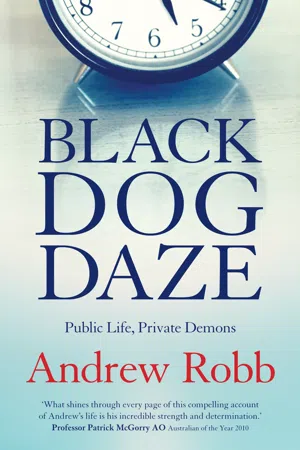
Andrew Robb lived with an unspoken fear that what he passed off as 'not being good in the mornings' was something darker: a black dog whose daily visit lasted longer as the years passed. Worried about stigmas and letting people down, he avoided confronting the problem for four decades, the adrenaline of high-pressure and high profile jobs offering the ideal antidote. Ultimately, realising his ambitions meant having to face up to this very private demon.Andrew Robb's battle with the black dog has touched a chord with many Australians. His memoir explores the challenges of managing depression, political ambition and life in the Liberal Party.Andrew Robb's career has been devoted to the Liberal cause—as Federal Director of the Liberal Party, as Executive Director of the National Farmers Federation, during seven years in the Packer business empire, and now in parliamentary politics. His memoirs document the private struggle and the public life of the Liberal Party's chief political strategist. It offers readers an insight into one man's lifelong battle with a private demon amidst the drama and tumult of contemporary Australian politics.
- 192 pages
- English
- ePUB (mobile friendly)
- Available on iOS & Android
eBook - ePub
About this book
Information
Print ISBN
9780522858570
11
The ‘Betrayal’ Election: 1996
As one of the architects of our loss in 1993, I felt a responsibility to put my head up in the media in the weeks following the election. Being forced to confront what went wrong turned out to be quite cathartic and allowed me to keep running on adrenaline for a little bit longer. Maureen said it delayed my personal reaction to the defeat, and that after the early burst I seemed somewhat depressed for quite some time.
I regained my enthusiasm after being included in a political exchange to Japan, with eight or nine others drawn from the various political parties. The current Victorian premier, Ted Baillieu, was a member of the group, and was a constant source of entertainment with his dry and quick wit. The visit covered Tokyo, Kyoto and Kobe, and was extremely well organised and informative—a ten-day introduction to the Japanese political process and to key political and industry players, as well as discussion of major areas of policy. I made Japanese friendships that continue to this day.
My sense of perspective about the election loss was restored. While we were licking our wounds and regrouping, Labor was celebrating. These celebrations of Labor’s win, labelled the ‘victory of the true believers’ by Paul Keating, concluded with a gala ball in Parliament House. A touch of hubris must have clouded someone’s judgement, as the media were allowed to film the champagne flowing and the exuberant Labor politicians dancing the night away.
Given what was to follow in the Budget a few months later, we were able to use that footage, featuring a very smug-looking Gareth Evans, to very telling effect three years later when seeking to ram home how arrogant and out of touch the Keating government had become. What was in store for the electorate in the federal Budget proved to be the political turning point of the next three years, and it occurred just six months after the March 1993 election.
In that year the federal Budget was brought down on 17 August. This time the centrepiece of Labor’s Budget was an increase in wholesale taxes of over $10 billion. Given that Paul Keating had convinced the electorate that the world as we knew it would end if the GST were introduced, it seemed the height of hypocrisy to turn around six months later and massively increase indirect taxes.
I asked our Director of Research, Mark Textor, to carry out comprehensive qualitative research on community reaction to the Budget. The findings were toxic for the Keating government. We dubbed it the ‘betrayal’ research, given the profound sense of betrayal identified in every state. The government never recovered, nor did it regain the trust of the electorate.
I have felt the parallels with the first few months of the Gillard government. Despite Julia Gillard promising in the dying weeks of the 2010 election campaign that ‘there will be no carbon tax under a government I lead’, post-election she broke the promise in order to secure the necessary support of the Greens and the crossbenchers. Again, the sense of betrayal was palpable.
The flip side of Paul Keating’s strength, his arrogance, had prominently entered the political frame in the second half of 1993 and it never left. We had something powerful to work with. However, while Paul Keating was increasingly on the nose in the electorate, our leader, John Hewson, was not faring much better.
John had effectively positioned himself as someone not in the mould of the traditional politician. As such, his decision to recontest the leadership, after he had promised to resign if he lost the election, didn’t sit comfortably with many in the electorate. Nor did his ditching of his GST as Coalition policy within twenty-four hours of the election loss. John struggled to recover politically. In time, his colleagues came to the conclusion that he was unlikely to lead us to victory, and a number of members were starting to plan his replacement.
This planning was pre-empted by the leaking of a very private and disparaging piece of market research about John to the 7.30 Report. It was leaked from my offices at the federal secretariat. John was justifiably furious. He called a leadership spill in an attempt to pre-empt a move against him. His tactic nearly succeeded, but the dynamic young duo of Alexander Downer and Peter Costello were elected by a handful of votes as leader and deputy leader, respectively.
Although many, especially John, thought I had been responsible for the leak, it was revealed in a book, The Victory, written by Pamela Williams after the subsequent 1996 election, that a trusted media adviser, employed by me on a part-time consulting basis, had decided to take things into his own hands.
The morning of the leadership contest was a tense one for me. I was in my office, located two blocks down the hill from Parliament House, with a view of the parliament building. Ron Walker had joined me. If John had retained the leadership I would have been banished, as he was convinced that I was culpable for the leak.
It seemed to take an interminable time, waiting for the phone call announcing the result. It felt like watching for the ‘puff of smoke’ from the Vatican when a new Pope is elected. At one stage, Ron suggested that I ‘stop all the heavy breathing’. I was betraying my tension, something I had learnt not to do, usually, as Campaign Director.
Sadly, the second experiment with younger, less experienced leaders also failed. Alexander Downer is exceedingly bright, somewhat mercurial in nature, but a very effective politician; he’s also a good fellow. Alexander’s intellect bred complacency at times, and his wicked sense of humour could fire loose cannons. These traits led to a number of early blunders, by which Paul Keating successfully defined Alexander in a highly damaging way. Our colleagues feared that Paul might call an early election to capitalise on these blunders. I shared this view and had very advanced campaign plans in case of such an eventuality.
At the same time, I conducted some very private research that convinced Tony Staley and I that, in the short term, Alexander was unelectable. It was a very awkward trip to Adelaide to brief Alexander on these findings, but he showed remarkable good grace and realism in the circumstances.
Over the subsequent three months, a smooth transition to John Howard occurred. The strength of our win in 1996 owed much to these selfless actions of Alexander and it was a great pleasure to see his subsequent outstanding success as Australia’s Minister for Foreign Affairs.
The re-emergence of John Howard was a fascinating political study. In the previous moves to John Hewson as leader, and then to Alexander Downer, the mood of the parliamentary party had been to go to the next generation after nearly a decade of toing and froing between the old guard of Andrew Peacock and John Howard. In both those contests, there was no real support for staying with, or returning to, the old guard. Yet when Alexander stepped down, despite the very high regard for Peter Costello’s skills and potential leadership qualities, the immediate instinct of the Liberal parliamentary party was to go to John Howard, a safe pair of hands.
The smooth transition was preordained to the point that on the Friday, three days before the Tuesday partyroom meeting to elect the leader, Alexander kindly consented to me giving John a detailed strategic briefing on where the campaign preparations were at.
After the change of leader, we still feared that Paul Keating might try to take advantage of our weakened position and go to an early election—he should have, just as Kevin Rudd should have in 2010, two months after Tony Abbott took the leadership from Malcolm Turnbull. As a consequence, we had a full campaign organised twelve months out from the election.
For three hours that Friday, I talked John through all the seats, the proposed strategy, the positioning of ourselves and our opponents, the themes and messages, and how we sought to exploit and expose the weaknesses we planned to attack. As it turned out, the strategy was such a good fit with John that 90 per cent of the final campaign strategy was what we considered that day.
John and I had a rocky start when he took over as leader. He had only been in the job a week when Paul called a by-election for the seat of Canberra, as Ros Kelly (of sport rorts and whiteboard fame) had resigned. The candidate for the Labor Party had taken what many people would see as extreme public positions on certain social issues. We did some standard benchmark market research asking what people thought of the candidates.
To get a handle on community priorities, we asked people what was of most concern: the Labor candidate’s views on social and other issues, or Labor’s inaction on jobs and high interest rates. We also looked at the strengths and weaknesses of our candidate, local newsagent Brendan Smyth.
Canberra is a small town, and one of the 400 people our market research company rang copied down some of the questions they were asked, including those regarding some of the more extreme positions of the Labor candidate. On the Sunday afternoon, one of the newspapers alerted us to a story they were going to run, saying we had been caught out ‘push polling’ defamatory propositions about the Labor candidate.
Push polling is when someone rings thousands of people at the end of a campaign under the pretext of market research, and puts a proposition to plant a negative idea about their opponent. It usually involves a twenty-second call, not a ten- to twelve-minute detailed interview of just 400 people out of a possible 85 000 voters, nor would it be carried out at the beginning of a campaign. Nevertheless, this is politics, and facts sometimes get in the way. The Labor Party asserted it was grubby push polling, the ABC jumped all over it and the story got legs.
I viewed it as our usual confidential research that we used to guide our thinking and approach. I had seen the questionnaire and had authorised it. The irony was that our research showed that people couldn’t care less about the Labor candidate’s views, but they were very angry about Labor’s poor management of the economy.
But it became a distracting and significant issue. Parliament was sitting that week and it dominated Question Time. Paul Keating was demanding that I be sacked. A lot of my own parliamentary members were angry about the issue, and I sent a 17-page letter explaining events to take the steam out of it internally.
Each day in Question Time, Paul was lambasting John for being weak and for lacking integrity by not sacking me. It was John’s first week in parliament as the new parliamentary leader and here I was, his Campaign Director, cruelling his pitch and dominating events. I think John fully accepted that I had authorised the research in good faith, but nonetheless, it was an unwarranted diversion. On this Friday morning I got two phone calls: one was from a senior Shadow Cabinet member and the other was from another Shadow Cabinet member’s chief of staff. Both were friends, and they said, ‘Look, the word is around up here at Parliament House that John is going to publicly ask for your resignation today’. I thought he was quite entitled to begin thinking that way, given the circumstances, but he had not raised it with me. I also knew that when John took the leadership he had asked several people, including the party president Tony Staley, whether I was trustworthy because I was friendly with John Elliot and had been Chief of Staff to Andrew Peacock. Again, none of this was raised directly with me, yet my tenure was being reconsidered. Fair enough.
I could understand the problem—my area of responsibility had caused a problem for which I may pay the price—but I didn’t feel I’d been negligent and I thought that there should be some discussion with me before I got the chop. So I got my back up and called a press conference for one o’clock, didn’t ring John, and walked in with Vince Woolcock—a longstanding and respected employee of the Federal Secretariat—by my side. Vince always had the capacity to make me feel a foot taller. He was telling me where the cameras were and checking there were no exit signs near my head, and we shared a joke.
The room was packed with journalists, all expecting me to announce my resignation. I expressed deep regret for how it had turned out, took full responsibility, but advised that if anyone wanted me to go they would have to sack me—that under no circumstance would I resign.
As is often the case in politics, like a firecracker, the issue shone very brightly and then quickly disappeared; life moved on the next week, and John never mentioned my press conference.
John campaigned very strongly in the by-election, which we went on to win with a massive swing of 16.1 per cent, including swings of up to 22 per cent in some traditionally strong Labor booths. A month or two after the Canberra by-election win, things were going smoothly and I was looking for a break from all the campaign preparations. A three-day weekend policy retreat was occurring in the Gold Coast hinterlands at a lovely resort called Gwinganna Lifestyle Retreat, owned by a prominent publisher. The attendees included fifteen or twenty Chinese officials, together with a similar number of Australians drawn from business, politics and the media.
I was interested to meet one member of the Australian delegation from Queensland, the recently preselected Labor candidate for the seat of Griffith, a former diplomat and former chief of the Queensland Government’s Cabinet policy office: a fellow named Kevin Rudd.
I had been involved in the campaign that saw the unexpected demise of the Goss Labor government and had heard of Kevin, though I had no real preconceived views. I found Kevin spoke so quickly that my brain struggled to keep up. He subsequently modified that trait. And I didn’t warm to the odd phrase or three of Mandarin being spoken at breakfast, particularly when the Chinese were not present. It was all a bit try-hard. I thoroughly enjoyed the weekend’s exchange with the Chinese and other attendees, but I found Kevin to be very pleased with himself, and somewhat aloof.
I returned to my responsibilities and announced to my staff that I was expanding the number of target seats by one—we would appoint a campaign officer to cover the seat of Griffith and would increase that campaign budget by $40 000. I said to my team, ‘I don’t think Australia deserves Kevin Rudd in the federal parliament’. I felt some quiet satisfaction on election night seeing the seat of Griffith topple to us, with Rudd suffering a 7.4 per cent swing in a seat that had previously had a 5.4 per cent margin in Labor’s favour.
I didn’t see Kevin Rudd again until...
Table of contents
- Contents
- Introduction
- The Problem
- A Plan’s the Thing
- Going Public
- Getting a Balance
- When Mornings were Bright
- Upheaval
- Dookie
- Inhaling Without Smoking
- Seeking a Hit
- Liberal Man
- The ‘Betrayal’ Election: 1996
- Life with the Packers (and Others)
- Yes Minister
- Howard’s End
- A New Era
- An Act of Treachery
- Getting Better
- Where to find help for mood disorders
- Acknowledgements
Trusted by 375,005 students
Access to over 1.5 million titles for a fair monthly price.
Study more efficiently using our study tools.