A decade on from the 2001 terrorist attacks on the United States, Australians are embroiled in one of the nation's longest military conflict-the war in Afghanistan.
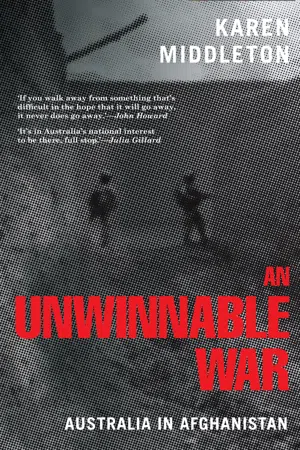
An Unwinnable War charts the motives, ambitions and negotiations that carried Australia into Afghanistan: from the then Prime Minister John Howard's presence in Washington DC on September 11, 2001 to the 'transition' plan to hand security to Afghan forces - all played out in the wake of increasing casualties.
Based on interviews with key political and military figures in Australia and abroad, An Unwinnable War lays bare the tensions between political and military decision-making, the nature and potency of the US alliance and the influence of individual personalities in charting Australia's course in what was once dubbed the 'good war'.
- 304 pages
- English
- ePUB (mobile friendly)
- Available on iOS & Android
eBook - ePub
About this book
Trusted by 375,005 students
Access to over 1.5 million titles for a fair monthly price.
Study more efficiently using our study tools.
Information
1
TUESDAY MORNING
In room 418 of the Willard Hotel in Washington DC, September 11 2001 was never going to be a jolly day. By the time the mobile phone alarm did its job, 8 am was already closing in and the rude, bright light of late summer was forcing its way through the cracks in the curtains. I was not feeling well. We were only three days into Prime Minister John Howard’s working visit to the United States but, behind the elegant hotel’s fourth-floor doors, a few of us among the travelling media were in varying stages of inelegant regret. It seems somehow fitting that the day which would eventually see Australia carried off to a long and messy war should begin, for some, with a nasty hangover.
A prime ministerial news conference loomed at 9.20 am, scheduled by a note stuffed under those same doors. Howard had a busy day ahead and this would be our one chance for questions. Caffeine and codeine were being liberally administered.
By rights, this should have been yesterday’s headache. Two nights earlier, we’d been at a spectacular Sunday barbecue in Howard’s honour in the grassy grounds of the Australian ambassador’s residence. The travelling journalists, photographers and camera crews were a little bit thrilled to queue for lamb and salad in the cool of the evening alongside the likes of Vice President Dick Cheney, Defense Secretary Donald Rumsfeld and Secretary of State Colin Powell, even if the feeling wasn’t entirely mutual. When The Age correspondent, Louise Dodson, and I introduced ourselves to Powell, he seemed taken aback to be rubbing shoulders with the fourth estate.
Australia’s ambassador, Michael Thawley, had pulled out all the stops and the careful informality was as striking as the guest list. US President George W. Bush wasn’t there but all the president’s men—his most senior associates and staff—were. Within two days, hosts and guests alike would look back on the breezy warmth of that night on the front lawn as being from another time. Howard would later describe it as ‘the idle hill of summer’, like A.E. Housman’s war poem of the same name. There wouldn’t be another soirée like it again, not for the next decade at least.
After an upbeat few hours, some among the fourth estate would have kicked on but for the confounded obligation on reporters everywhere to spend some time actually reporting. Deadlines and common sense prevailed.
The next day would bring Howard’s first official talks with President Bush at the White House, and later we would delight in the added newsiness of a surprise private dinner between Howard and News Ltd chief, Rupert Murdoch. By the time Monday night rolled around we were ready for a beverage.
And so it was that some of us found ourselves facing a particularly crusty Tuesday, thanks to an over-indulgence in conviviality and under-indulgence in sleep. Of all the mid-week mornings to wake feeling sideways, this was not the ideal choice.
*
Several floors up, the Prime Minister surfaced considerably earlier and in much better shape, beginning his day in the usual way—brusquely, in a tracksuit and outdoors.
Howard particularly enjoyed walking along the US capital’s wide boulevards and past its impressive monuments. He ventured out, the globe over, in all but the worst weather, and this morning provided no barometric obstacle. The sky was flawless. It would become something remarked upon down the years by those who were there on that day—how the events of later that morning came, so literally, out of the blue.
As the city was waking, Howard and his chief media adviser, Tony O’Leary, and other besneakered members of his travelling party headed south towards the National Mall, veering west through Constitution Gardens to the Vietnam Memorial. These morning walks regularly doubled as informal planning meetings: a chance to toss around the upcoming schedule, discuss the day’s media message and generally shoot the breeze.
When they reached the Lincoln Memorial the group looped back, heading north until they got to the White House. They turned right along Pennsylvania Avenue and passed the postcard view of the big white building and its famous sprawling South Lawn. Within hours, this driveable thoroughfare would be permanently closed to motor traffic, and in future this would be the only way to get close to the presidential home—on foot.
The Prime Minister had been at the White House the previous day, sitting in the Oval Office, pleased at the chance to confer in these surroundings with kindred conservative George W. Bush. It had never been thus with Bush’s predecessor, Bill Clinton, who once kept him waiting, sitting in his car at the White House gate, in the rain. (Clinton had a reputation for being less than punctual and Howard always professed not to have been much bothered.)
This time it was different. The gathered journalists had shouted questions from the Rose Garden as he and Bush had strolled along the portico to the residence for lunch. ‘Prime Minister, how have you found the talks so far with Mr Bush?’ the Ten Network’s Deborah Knight called out to a beaming Howard.
‘Very good,’ he replied. ‘We are very close friends … It’s a great opportunity to reinforce what a deep friendship it is. And the President and I have got a great similarity of views on many issues. And it’s a great experience to be able to exchange them with somebody who has the views he does.’
Bush called it an ‘honour’ to host his Australian friend. ‘I look forward to the Prime Minister’s continuing advice,’ the President said. ‘We’ve had a great discussion about the Far East and his advice is very valuable for our foreign policy. There’s nothing like a friend who’ll tell the truth.’
*
But walking that next morning, Howard’s mind was quickly back on home. Ansett Airlines was about to collapse and the government was preparing its response. Heading for the hotel, he spoke by phone to the Treasurer, Peter Costello, who was in Canberra trying to help sort through the Ansett mess. Costello relayed a conversation he had had with the airline’s liquidators. They said they needed $200 million to keep Ansett afloat. When Costello asked how long that would last, they told him: ‘Two days’. In their phone call, the two men confirmed their resolve not to bail out Australia’s second air carrier. In a footnote to history, each recalled that it was the other who phoned that morning. At any rate, the conversation was brief.
As Howard walked into the hotel lobby, he was met by a clutch of travelling correspondents hoping for some early words, and mindful that in the southern hemisphere the clock was much further around the dial. The Prime Minister declined their invitation to preempt his own news conference and went upstairs to have breakfast. He was due to speak to them an hour or so later in the John F. Kennedy suite, which doubled as a press conference venue and media working room.
Just before 9 am Howard’s chief media adviser, Tony O’Leary, had walked into the official party’s working rooms to find the Secretary of the Department of Prime Minister and Cabinet, Max Moore-Wilton, watching CNN.
‘A plane’s just flown into the World Trade Center,’ Moore-Wilton told him. When O’Leary went on to Howard’s suite he mentioned what he had just been told. Both believed it was probably a horrible accident. O’Leary went back to his room and recalls phoning home to tell his family what had happened in New York. Father and son were watching television together on opposite sides of the world as a second plane struck the twin towers. O’Leary sprinted back to Howard’s suite and the Prime Minister flicked on the television.
They both knew then that this was no accident.
*
Downstairs in 418, my self-inflicted suffering prompted a departure from the morning routine. I threw myself into the shower to wash away the bass beat in my skull and did not switch on the unbearable cheeriness of America’s morning television presenters.
So when the news arrived just before 9 am that would make this one of the most dramatic journalistic days, it didn’t come live on CNN but via the jangle of that confounded mobile phone and the insistent voice of a colleague on The West Australian’s news desk in Perth. ‘Are you in New York yet or still in Washington?’ he asked, with puzzling urgency.
‘Washington,’ I told him, a bit irritated at pointless morning questions. The Prime Minister had meetings set for late the following day at the World Financial Center, below the World Trade Center’s twin towers, but first he was to give an address to a joint meeting of Congress here in Washington. The news desk had the itinerary. ‘We go to New York tomorrow. Why?’
His explanation did what medication, caffeine and hot running water had not yet managed. A plane had hit the Trade Center. I grabbed the remote control and saw the billowing smoke.
Two of my friends, New Yorkers Liz Johnson and Greg Weber, had been at the bar on the 107th floor of the Center’s north tower the night before. The manager of the audaciously named The Greatest Bar on Earth had finally persuaded Johnson, a food-writer, and her journalist husband to come and do his cocktail-mixing course. They had been planning to take me there. Twenty-four hours later, she would pen a poignant piece for their newspaper, The Journal News, under the headline ‘The Last Night at The Greatest Bar on Earth’.
A few minutes later, a second plane ploughed into the south tower, live against the brilliant September sky. I was well awake now as adrenaline drowned the headache. This was going to be some day.
*
When Howard walked into his news conference, his secret service detail looked more serious than usual, if that was possible. The unfolding events in New York had stunned the travelling correspondents and the room was quiet.
‘Could I just say before I start on any domestic things how horrified I am at what I have just heard regarding what’s happened in New York,’ Howard began. ‘I don’t know any more than anybody else, but it appears to be a most horrific, awful event that will obviously entail a very big loss of life.’
The Prime Minister’s voice cracked slightly on the last few words and his face set in the way it often did when he knew the news would be grim.
‘What was your reaction when you saw those pictures?’ asked Channel Seven correspondent Glenn Milne.
‘Oh, dreadful. Just appalling.’ Howard paused. ‘Awful.’
Milne continued: ‘Will it affect the New York leg of …’
Howard interrupted him. Milne had wanted the cameras to film Howard walking in past the television images of the blazing buildings. Fearing their boss would be accused of capitalising on the horrific incident, the Prime Minister’s staff had refused. Howard had come in another door.
‘I don’t know,’ Howard responded. ‘It’s relatively unimportant. Compared with what’s at stake in something like that. I don’t know.’
Milne persisted. ‘But will you be reviewing that?’
‘Well, it’s too early to say. I’ve only just heard, you’ve only just heard. It’s only just happened. And obviously the authorities here will be responding accordingly. And I’ll let you know.’
Milne tried once more. ‘Will you be taking advice from the US administration?’
‘I’ll be doing whatever is the sensible thing, Glenn, but it’s only happened quarter of an hour ago.’
Howard himself had no more to go on than those gathered in front of him. ‘I was still trying to assimilate it,’ he recalled. ‘I sensed that it was a planned terrorist attack … I don’t think at that point I had started to think, you know, who would it be?’
Nobody among the fourteen reporters in the room came up with anything else to ask regarding the events in New York. My own mind was racing. I kept thinking of my friends and their friends, some of whom worked in downtown Manhattan. I would discover later that one of them had been doing contract work on the lower floors of one of the towers that morning. He had escaped from the building and walked all the way home to Brooklyn, one of the thousands who fled Lower Manhattan, streaming across the famous...
Table of contents
- Dedication
- Contents
- Map
- Quotes
- 1 Tuesday Morning
- 2 All the Way
- 3 Rule Number 12
- 4 On the Ground
- 5 Sticker Shock
- 6 The Short Haul
- 7 Game-changer
- 8 On Two Fronts
- 9 Cause and Effect
- 10 Out by Christmas
- 11 The Call
- 12 Going Dutch
- 13 The Loyalty Card
- 14 The Red Line
- 15 God Moments
- 16 Turning Point
- 17 Afghanistan
- 18 Capture or Kill
- 19 2020 Vision
- Acknowledgements
- Notes
- Index
- Imprint
Frequently asked questions
Yes, you can cancel anytime from the Subscription tab in your account settings on the Perlego website. Your subscription will stay active until the end of your current billing period. Learn how to cancel your subscription
No, books cannot be downloaded as external files, such as PDFs, for use outside of Perlego. However, you can download books within the Perlego app for offline reading on mobile or tablet. Learn how to download books offline
Perlego offers two plans: Essential and Complete
- Essential is ideal for learners and professionals who enjoy exploring a wide range of subjects. Access the Essential Library with 800,000+ trusted titles and best-sellers across business, personal growth, and the humanities. Includes unlimited reading time and Standard Read Aloud voice.
- Complete: Perfect for advanced learners and researchers needing full, unrestricted access. Unlock 1.5M+ books across hundreds of subjects, including academic and specialized titles. The Complete Plan also includes advanced features like Premium Read Aloud and Research Assistant.
We are an online textbook subscription service, where you can get access to an entire online library for less than the price of a single book per month. With over 1.5 million books across 990+ topics, we’ve got you covered! Learn about our mission
Look out for the read-aloud symbol on your next book to see if you can listen to it. The read-aloud tool reads text aloud for you, highlighting the text as it is being read. You can pause it, speed it up and slow it down. Learn more about Read Aloud
Yes! You can use the Perlego app on both iOS and Android devices to read anytime, anywhere — even offline. Perfect for commutes or when you’re on the go.
Please note we cannot support devices running on iOS 13 and Android 7 or earlier. Learn more about using the app
Please note we cannot support devices running on iOS 13 and Android 7 or earlier. Learn more about using the app
Yes, you can access An Unwinnable War by Karen Middleton in PDF and/or ePUB format, as well as other popular books in History & Australian & Oceanian History. We have over 1.5 million books available in our catalogue for you to explore.