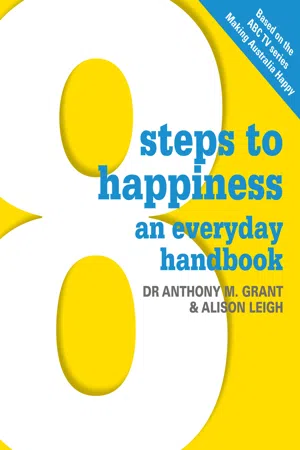
Based on the hit ABC TV series Making Australia Happy, this practical, everyday handbook shows you how to become a happier person in just eight weeks. The simple exercises and activities in 8 Steps to Happiness are profoundly effective and scientifically proven, and can lead to measurable physiological changes, from improved immune function to better sleep and increased physical strength. The 8 steps program gives you no-nonsense tools to make real change in your life.Using these techniques, you too can be on the road to a happier, healthier and more fulfilled life. And be warned: happiness is contagious!
- 176 pages
- English
- ePUB (mobile friendly)
- Available on iOS & Android
eBook - ePub
About this book
Information
Topic
Personal DevelopmentSubtopic
Self ImprovementPart 1: Getting Started

Becoming happy

The habit of happiness
It’s hard to be happy. It’s hard to be really happy. To stay happy. Just when you think you’ve got it all worked out and it all seems in balance—just when you think, ‘This is it!’—the feeling slips away. Optimism and contentment dissipate. Anxiety returns. We get downhearted. We give up.
It’s easier to go shopping, to the movies, to eat nice food, to go on the internet, check Facebook, other distractions. It feels good. But the hedonic treadmill—the vicious cycle of searching for material things to make us happy and ease our disquiet—is just that, a treadmill. We end up coming back time and again to the same place: discontentment. How can we break this cycle?
Positive change is possible. It is relatively easy to improve our levels of happiness on a daily basis. There is now a considerable body of scientifically validated techniques that improve well-being, that can bring increased happiness and meaning into our lives. People can change. You can change. You can do it.
But here’s the rub. The inconvenient truth. You have to do it. And you have to do it yourself. And you have to get into the habit of doing it. Positive change works—but you have to work at it.
It would be nice if we could outsource our own personal development, to get someone else to do the work of change, but unfortunately there is no real short-cut. There is no magic bullet—but there is science.
What we have done in this book is to put together a set of simple, science-based strategies that have been shown to be truly effective at developing the habit of happiness. There is no bullshit. No sleight of hand. No magic tricks.
That’s what is so useful about the Eight Steps to Happiness program. The eight steps in this book are all scientifically validated ways of improving happiness and well-being. They are designed to keep you engaged in the process over time. They offer new and varied experiences to help you move from insights to actions, from actions to habits.
It’s easy to do something once. It’s harder to do it twice, and even harder to stick at it over a period of time until it becomes a habit. The TRICK is to stick at it.
What is happiness?
Think of the word happiness and you might well visualise the ubiquitous yellow cartoon smiley face that has become synonymous with so-called positive thinking and the happiness industry. But what does being happy really mean to you?
Happiness is a state of mind characterised by experiences of contentment, satisfaction, love or joy. Happiness feels good. It feels worthwhile. Happiness is pleasurable.
But is pleasure alone enough? There is considerable enjoyment to be had in activities like shopping, eating, drinking, self-gratification and the pursuit of pleasure of the senses. But unfortunately these are often followed by feelings of emptiness and meaninglessness. We all love hedonistic pursuits of this kind. And they can certainly boost our enjoyment levels. But on its own the pure pursuit of pleasure, the purely hedonistic life, is ultimately disappointing. There is a lack of richness and depth.
The pleasurable life is only one part of happiness. The engaged life and the meaningful life are equally important. The engaged life is about owning your life. It’s about feeling that you are purposefully involved in life activities such as work, relationships and recreational activities. The meaningful life is about having a sense of purpose, living a life that is coherent and consistent with one’s values, a life that is a source of satisfaction.
Happiness comes from having a balance between pleasure, engagement and meaning. It is not one or the other. The lines between hedonistic pleasure and engagement in meaningful pursuits should not be drawn too tightly. In fact each influences and enhances the other. The research shows that having positive feelings tends to increase our sense of meaning, which in turns makes us feel good, and that this is further enhanced when we are engaged in the pursuit of meaningful goals in our lives.
There is a considerable amount of solid scientific evidence from philosophy, psychology, sociology, biology and recently from neuroscience to show that we can indeed improve our happiness. And there is good research to show that we can apply these techniques in our daily lives.
Take a moment to think about a time when you were truly happy. Chances are that you thought about times when you felt good, when you experienced pleasure, felt engaged and had a sense of being connected.
The happiness pie
Three factors—genetics, life circumstances and choice—make up the ‘happiness pie chart’. But which is most influential in determining happiness?
The research from large-scale, population-level studies show that genetics—heritable factors such as temperament—generally accounts for about 50 per cent of the difference between individuals. Life circumstances—how much money we have, where we went to school, where we live—generally accounts for about 10 per cent of the difference between individuals. Which leaves as much as 40 per cent of the difference in levels of happiness for intentional activities—the choices we make on a day-to-day basis about how we live our lives.
Each of these factors is important. The relative contribution of each section of the pie to one’s happiness is going to be different for everyone and this is because individuals vary. Nevertheless, the happiness pie chart provides a very useful reminder that our happiness is not pre-determined.
Choice counts. We can choose to do things that will improve our happiness.
Eight steps
The Eight Steps to Happiness program is designed to make change as easy as possible. The program starts with the end in mind. In step 1 you will write your own eulogy—a challenging but inspirational task. We then put the focus on other people in step 2 by looking at how acts of kindness can help other people and boost our own mental and physical well-being at the same time. Because we spend so much of our lives on autopilot, going mindlessly from task to task, in step 3 we explore the role of mindfulness in happiness.
Having developed our ability to be mindful, in step 4 we bring our attention to strengths and solutions—and the positive energy that they bring. Step 5 is about gratitude and appreciation, which are vital parts of the happiness equation: if we can’t appreciate our lives and share that appreciation with others, then what have we gained? But we need to be open to other people if we are to make meaningful connections. Resentment and bitterness are toxic barriers to happiness. So in step 6 we learn about letting go of resentment and practising forgiveness. For some, this is a tough step. But we don’t have to do it alone. Happiness is not a solitary pursuit. We are social animals—and happiness is contagious. So, in step 7, we look at the social determinates of happiness and develop social connections that will help us sustain our gains. Finally, in step 8 we take the time to reflect on what we have learnt, review our progress and renew ourselves in order to consolidate and truly develop.
You do not have to change your whole life to reap the very real benefits of this program. You only have to do a little bit at a time—one step a week is fine. And science is on your side.
Making changes

Five domains
If we want to improve our well-being, be happy or create any positive change, there are five domains of human experience that we need to take into account in order to maximise our chances of success.
First, and most obviously, we need to know what to do—we need to make changes to our behaviour. Second, we need to have thoughts that support us in making change—constantly doubting our ability to make changes could stop us from even beginning to move towards our goals. Third, our feelings or emotions are powerful factors in motivating change—high levels of anxiety would not be helpful. Fourth, the situation or the environment that constitute the social context we live in...
Table of contents
- Title
- Contents
- Introduction
- Part 1: Getting Started
- Becoming happy
- Making changes
- Diet and nutrition
- Sleep
- Before you start
- Part 2: 8 Steps to Happiness
- Step 1: Goals and values
- Step 2: Altruism and kindness
- Step 3: Mindfulness
- Step 4: Strengths and solutions
- Step 5: Gratitude
- Step 6: Forgiveness
- Step 7: Social networks
- Step 8: Reflect, review, renew
- Part 3: The Science
- Behind the Eight Steps program
- Biochemical markers
- Metabolic markers
- Final thoughts
- The Happy 100 Index
- Bibliography
- Acknowledgements
- imprint
Trusted by 375,005 students
Access to over 1.5 million titles for a fair monthly price.
Study more efficiently using our study tools.
Frequently asked questions
Yes, you can cancel anytime from the Subscription tab in your account settings on the Perlego website. Your subscription will stay active until the end of your current billing period. Learn how to cancel your subscription
No, books cannot be downloaded as external files, such as PDFs, for use outside of Perlego. However, you can download books within the Perlego app for offline reading on mobile or tablet. Learn how to download books offline
Perlego offers two plans: Essential and Complete
- Essential is ideal for learners and professionals who enjoy exploring a wide range of subjects. Access the Essential Library with 800,000+ trusted titles and best-sellers across business, personal growth, and the humanities. Includes unlimited reading time and Standard Read Aloud voice.
- Complete: Perfect for advanced learners and researchers needing full, unrestricted access. Unlock 1.5M+ books across hundreds of subjects, including academic and specialized titles. The Complete Plan also includes advanced features like Premium Read Aloud and Research Assistant.
We are an online textbook subscription service, where you can get access to an entire online library for less than the price of a single book per month. With over 1.5 million books across 990+ topics, we’ve got you covered! Learn about our mission
Look out for the read-aloud symbol on your next book to see if you can listen to it. The read-aloud tool reads text aloud for you, highlighting the text as it is being read. You can pause it, speed it up and slow it down. Learn more about Read Aloud
Yes! You can use the Perlego app on both iOS and Android devices to read anytime, anywhere — even offline. Perfect for commutes or when you’re on the go.
Please note we cannot support devices running on iOS 13 and Android 7 or earlier. Learn more about using the app
Please note we cannot support devices running on iOS 13 and Android 7 or earlier. Learn more about using the app
Yes, you can access 8 Steps To Happiness by Alison Leigh, Dr Anthony M. Grant in PDF and/or ePUB format, as well as other popular books in Personal Development & Self Improvement. We have over 1.5 million books available in our catalogue for you to explore.