In 2005, the Australian Federal Police referred eight Islamic books to the Australian Classification Board. The goal was to secure a ban of the books, all of which were alleged to advocate 'terrorist acts'. After nearly a year of review, and intense public debate, two of the books were refused classification and effectively banned in a move that would have severe repercussions for librarians, scholars, authors and the state of free speech in Australia.
Banning Islamic Books in Australia examines the cultural and political contexts that led up to the ban, and the content of the books themselves in an attempt to determine what it was that made them seem so dangerous. It also documents the unintended consequences of the ban on library collections and academic freedom, and how this in turn affects free speech in contemporary Australia.
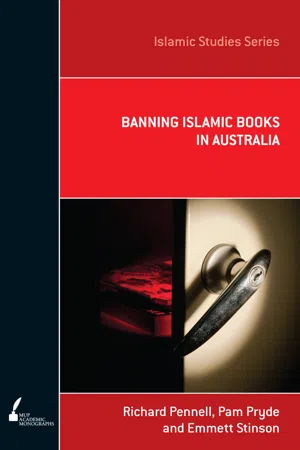
- 194 pages
- English
- ePUB (mobile friendly)
- Available on iOS & Android
eBook - ePub
ISS 9 Banning Islamic Books in Australia
About this book
Trusted by 375,005 students
Access to over 1.5 million titles for a fair monthly price.
Study more efficiently using our study tools.
Information
1
After 11 September 2001 both the Australian Government and public opinion concluded that the challenge of Islamist terrorism faced them too. Many Australians were killed in Bali in 2002, and although there were no subsequent attacks on Australian territory, the sense of danger grew with the bombings in Spain in 2004. Then came the bombs in London in 2005: Britain had quite intimate fascination for many Australians, and the Prime Minister, John Howard, in particular.1
Behind the heated reaction to these terrorist incidents, many non-Muslim Australians expressed a feeling that there was a moral distance between their society, the liberal democracies and the West, and the sort of societies that extremist Muslims wanted. It was more than a political or even a cultural difference. A feeling that Islam was innately violent, both in its politics and its social structures, merged the political with the personal and cultural. And a feeling that Islam was sexually aberrant shaded the cultural off into the personal and the political. Popular and official mistrust of ‘fundamentalist Islam’ had two main sources. One was immediate and proximate: the terrorist danger. The other was a long-term, deep-rooted and general feeling that Islam was alien in its social and cultural bases.
This characterisation was not all-exclusive, nor were these themes constantly expressed. Multiculturalism has a generation’s worth of history in Australia. Until John Howard’s government, elected in 1996, started to reverse it, a state-sponsored multiculturalism identified tolerance as a political virtue that defined a culturally egalitarian vision of Australia. Liberal Australian nationalists defined their national identity as moving from the intolerance of White Australia to the tolerance of Multicultural Australia.2
To some extent this was a legislated tolerance, an expression of the dominant groups in society.3 Acceptance into a multicultural society took the form of granting an identity, or a legal citizenship—as Ghassan Hage put it4—rather than paying much attention to the cultures that were being tolerated. The Australian legal core, for instance, remained resolutely monocultural, and the fundamental assumptions of the common law were unchallenged. Claims for differential treatment based on ethnicity could not compete with a liberal discourse based on equality and universality.5 That was just as true for lawmakers, judges and lawyers, those who operate the law, as for wider public opinion that attaches a fundamental sense of identity to law. Those who challenged deep-seated identities broke the law in a fundamental way, offending not only personal security but also calling into question their ultimate loyalty to Australian society.
Between 1990 and 2005, war against tyrannical states like Iraq, and then against Islamic terrorists, undermined the bases of tolerance. The enemy was not an illusion: both Iraq and al-Qaeda (or Saddam and Usama Bin Ladin) really did reject the legal, cultural and political bases of the liberal democracies. Once Australian governments had committed themselves to join the fight against them, there was a social and cultural reaction against those who apparently supported them.
The proximate and immediate roots
During the Gulf War in 1991 and again in the aftermath of the terrorist attacks on New York ten years later, questions of loyalty often involved misunderstood cultural identities. Populist journalists and radio hosts confused the ‘Arabic’ and ‘Islamic’ communities and called upon their leaders to declare their allegiance to Australia and denounce Saddam Hussein or Usama Bin Ladin. Groups of white hooligans accosted women wearing Muslim dress and threatened them sexually. Cases of actual violence were quite rare, but during the first Gulf War an ‘Anglo’ woman ripped the headscarf off a Muslim woman in a Sydney supermarket screaming abuse, and another ‘Anglo’ woman in Melbourne deliberately drove her own vehicle into one containing a Muslim woman in traditional dress and abused her, accusing her of being an ‘Iraqi terrorist’.6 The confusion of categories was clear—all Muslims were Arabs (or the other way round) and there were no differences between secularised and religious people (except perhaps that openly religious people were more authentically dangerous than more secularised ones). Even a Sikh man was vilified, apparently because hooligans assumed that his turban was Islamic dress.
Between the war of 1991 and the terrorist attack on New York in 2001 another threat preoccupied the government and some of its right-wing supporters. Refugees began arriving by boats in increasing numbers. They came from different countries, but mostly from Iraq and Afghanistan. Once again, identities were confused. Politicians and journalists did not distinguish between Afghan groups, or between Afghans and Iraqis, or between Sunni and Shi’i Muslims. A blurred, generic picture of ‘asylum seekers’ created hostility towards ‘bogus’ refugees and ‘queue jumpers’. This did not go unchallenged: advocacy groups set up to help the refugees, backed by lawyers7, focussed attention on the individual circumstances of the refugees. But it was overall numbers that was the political issue. Political language rapidly moved from a concern with fairness to a focus on criminality—to a belief that the refugees threatened national security.
The end of the cold war had set off a global movement of refugees, and the governments of developed countries found it hard to manage using the existing international agreements: several immigration ministers suggested the 1951 Refugee Convention was outdated and unworkable.8 In Australia, the minister was Philip Ruddock, who, before he took office in 1996, had been known as a small ‘l’ liberal, who had opposed the use of race and ethnicity as criteria to select migrants.9 But now he changed the rules to reduce the overall numbers of immigrants and their economic cost by capping the number of unproductive family members allowed in, and barring migrants from receiving welfare payments during the first two years.10 While the motivation was economic, humanitarian refugees were affected because they were now included in the total numbers of migrants allowed in every year. When boat arrivals greatly increased from 200 in 1998 to 3740 in 199911, the government called them ‘queue jumpers’, and held them in detention centres under mandatory detention rules that dated back to the previous Labor government.12
To ‘queue jumpers’, the government added an association with criminality by labelling refugees who came by boat as ‘illegal’.13 A general election was due in November 2001 and the question became very fraught. In August, a Norwegian container ship, the Tampa, rescued 400 asylum seekers from a sinking boat that was taking them from Indonesia to Christmas Island, which is Australian territory. The government refused to let the captain land them, and sent troops to board his ship when he entered Australian waters. In October, an Australian naval vessel tried to tow another ship full of asylum seekers back into international waters. This boat was unseaworthy and some of the refugees were accused of throwing their children overboard to blackmail the naval personnel. This ‘children overboard’ allegation turned out to be quite untrue, but the Prime Minister, John Howard, believed it and repeated it.14
Shortly after the Tampa incident came the terrorist attack on New York on September 11. Anti-Muslim hate crimes increased: the Australian Arabic Council ran a racial hatred telephone hotline, and in the month following the attack it registered twenty times the rate of complaints of the month before.15 Howard avoided directly linking the issues of terrorism and illegal boats, but his Defence Minister, Peter Reith, said, ‘You’ve got to be able to control that [refugee arrivals by sea] otherwise it can be a pipeline for terrorists to come in and use your country as a staging post for terrorist activities’.16 The Liberal coalition won the election, and the Labor Party received its lowest first preference vote since 1934. Populist opponents of Muslims, and more generally of multiculturalism, beat up on xenophobic stereotypes, and the re-elected government introduced new laws to deter unauthorised refugees by processing their applications ‘offshore’. It also instituted ‘anti-terror’ measures, backed by ethnic targeting of supposedly likely groups of opponents.
Over the next two years, Muslims became quite unpopular in some parts of public opinion. In 2002, coinciding roughly with the first anniversary of September 11, the Sydney Daily Telegraph published two articles, one about the sale of halal beefburgers in McDonalds, the other about a gym set up only for Muslim women. Much of the subsequent comment on talk-back radio and in letters-to-the-editor columns expressed strident objections to ...
Table of contents
- Half title
- MUP ISLAMIC STUDIES SERIES
- Title page
- Contents
- Introduction: Two censorships
- 1
- 2
- 3
- 4
- Bibliography
- Index
- Imprint
Frequently asked questions
Yes, you can cancel anytime from the Subscription tab in your account settings on the Perlego website. Your subscription will stay active until the end of your current billing period. Learn how to cancel your subscription
No, books cannot be downloaded as external files, such as PDFs, for use outside of Perlego. However, you can download books within the Perlego app for offline reading on mobile or tablet. Learn how to download books offline
Perlego offers two plans: Essential and Complete
- Essential is ideal for learners and professionals who enjoy exploring a wide range of subjects. Access the Essential Library with 800,000+ trusted titles and best-sellers across business, personal growth, and the humanities. Includes unlimited reading time and Standard Read Aloud voice.
- Complete: Perfect for advanced learners and researchers needing full, unrestricted access. Unlock 1.5M+ books across hundreds of subjects, including academic and specialized titles. The Complete Plan also includes advanced features like Premium Read Aloud and Research Assistant.
We are an online textbook subscription service, where you can get access to an entire online library for less than the price of a single book per month. With over 1.5 million books across 990+ topics, we’ve got you covered! Learn about our mission
Look out for the read-aloud symbol on your next book to see if you can listen to it. The read-aloud tool reads text aloud for you, highlighting the text as it is being read. You can pause it, speed it up and slow it down. Learn more about Read Aloud
Yes! You can use the Perlego app on both iOS and Android devices to read anytime, anywhere — even offline. Perfect for commutes or when you’re on the go.
Please note we cannot support devices running on iOS 13 and Android 7 or earlier. Learn more about using the app
Please note we cannot support devices running on iOS 13 and Android 7 or earlier. Learn more about using the app
Yes, you can access ISS 9 Banning Islamic Books in Australia by Richard Pennell, Pam Pryde, Emmett Stinson in PDF and/or ePUB format, as well as other popular books in Social Sciences & Sociology. We have over 1.5 million books available in our catalogue for you to explore.