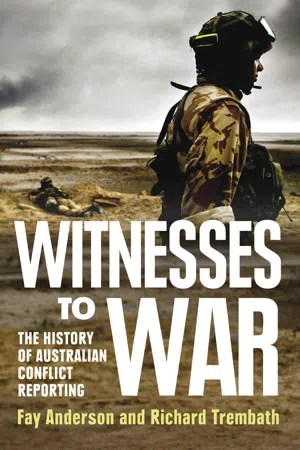
Witnesses to War is a landmark history of Australian war journalism covering the regional conflicts of the nineteenth century to the major conflicts of the twentieth: World War I, World War II, Vietnam and Bosnia through to recent and ongoing wars in Iraq and Afghanistan. Fay Anderson and Richard Trembath look at how journalists reported the horrors and politics of war, the rise of the celebrity journalist, issues of censorship and the ethics of 'embedding'.Interviews with over 40 leading journalists and photographers reveal the challenges of covering wars and the impact of the violence they witness, the fear and exhilaration, the regrets and successes, the private costs and personal dangers. Witnesses to War examines issues with continued and contemporary relevance, including the genesis of the Anzac ideal and its continued use; the representation of enemy and race and how technology has changed the nature of conflict reporting.
eBook - ePub
Witnesses To War
The History Of Australian Conflict Reporting
- 512 pages
- English
- ePUB (mobile friendly)
- Available on iOS & Android
eBook - ePub
About this book
Information
1
Colonial Conflicts
From the New Zealand Wars to the Boer War
On Friday 20 November 1863, a battle took place in the Waikato region of the North Island of New Zealand. British troops under the command of General Duncan Cameron assaulted a position at Rangariri held by their Maori opponents. Howard Willoughby, special correspondent of the Melbourne newspaper the Argus, was there to describe the fighting:
The most brilliant engagement of the war took place at Rangariri, on Friday the 20th inst. with a result which renders the triumph of the British army secure. General Cameron assaulted the enemy’s fortified position, and, after a heavy loss of 130 men killed and wounded, captured the stronghold. The event has taken the public here by surprise; but despite the price paid for it, the victory has been gladly hailed, for the hope that it may save further effusions of the blood of our countrymen.1
Willoughby thus has the honour of being Australia’s first war correspondent.
In 1863, the profession of war correspondent was not only new to the Australian colonies; it was new to the rest of the world. It was less than a decade since the Irishman William Howard Russell had reported from the Crimean War for The Times of London and had, according to a twentieth-century successor, Max Hastings, ‘almost single-handedly’ invented the art of war journalism.2 The combination of greater literacy, expanded newspaper readerships and the spread of the telegraph cable brought the press to the battlefield, if not for the first time then in a new and intimate relationship with conflict. By the time of the Third China War of 1860, the presence of a reporter—in this case, Bowlby of The Times—seems to have been accepted as normal.3 Seven years later, several British correspondents and HM Stanley of the New York Times (later to ‘rediscover’ the explorer David Livingstone) accompanied General Sir Robert Napier’s expedition to Abyssinia.4 War journalism was established and producing celebrities.5
In reporting on the colonial conflicts of the late nineteenth century, Australian journalists celebrated both empire and, increasingly, a nascent Australian nationalism. During this period, the first Australian war correspondents followed the same work practices as their international counterparts; these included getting timely reports back to their offices, conveying as vividly as possible for their domestic audience what it was like to be ‘there’, commenting on the course of the campaign and highlighting individual acts of bravery. In addition, Australia’s early war journalists were intent on showing how the colonies were contributing to the imperial project and were making their entrance on the world scene, and how their contributions were valued by the mother country. Where appropriate, ‘special’ Australian characteristics—qualities that made Australians keen and useful soldiers—were emphasised in their reporting.
At the time when Willoughby went to New Zealand, the Australian newspaper industry was expanding. Between 1848 and 1886, the number of dailies published in Australia grew from eleven to forty-eight.6 Although many colonial newspapers were ephemeral, some of the country’s most enduring dailies were established by 1863: the Age, the Argus, the Sydney Morning Herald and the Melbourne Herald. The publication of overseas stories was inevitably tied to the arrival of ships, newspapers sending staff to Sydney Heads or the Melbourne docks to obtain the news as soon as a clipper from Europe arrived. Despite the extraordinary reduction in shipping times during the nineteenth century, in the 1860s, news from London could be between ten and fourteen weeks old. As RB Walker wrote, once the ships had arrived, colonial readers ‘gorged like a boa constrictor on one good feed and then fasted for weeks until the next repast was offered and swallowed whole’.7 Timely reporting of international conflicts such as the Crimean War was very difficult.8 A short, sharp conflict like the Austro-Prussian War of 1866, which lasted for less than two months, was not mentioned in Australian newspapers until it was over.9
The tyranny of distance, however, was soon challenged by the telegraph. Melbourne was connected to Adelaide in 1859, and by 1861 the link had extended to Sydney and Brisbane. The all-important imperial link with Britain followed in 1872, though in the early years line failures and outages were common. The telegraph was a true communications revolution, and the cable link with Britain was one factor in the growth of imperial consciousness in Australia in the last quarter of the nineteenth century. What happened in London was known in Melbourne or Sydney shortly afterwards. As Walker expressed it, ‘periodicity had changed; the world spun faster; the boa constrictor was dead’.10 Willoughby did not have the advantage of the telegraph in reporting from New Zealand in 1863–64—the link between that country and Australia was not established until 1876—but the distance across the Tasman from Auckland to Melbourne was at least shorter than the clipper route from London.
The First Steps: Howard Willoughby in New Zealand
The main reason for Willoughby’s trip to New Zealand was to observe the campaign in Waikato, part of what is now called the Third New Zealand War (1863–66). Willoughby’s time in Waikato was just one stage in a distinguished career, in which he rose to become editor of the Argus.11 On his death, in 1908, that newspaper hailed him as ‘the most remarkable journalist who has yet appeared in Australia’.12 The only time he served as a war correspondent was during the Third New Zealand War.
It was the Australian colonies’ first venture overseas in an imperial war. The Waikato campaign of 1863–64 was one in a series of military conflicts in New Zealand involving imperial troops, local levies, settlers and Maori.13 The first of these struggles occurred between 1846 and 1847; the last to be designated a ‘war’ ended in 1866, though some would argue that armed conflict did not cease until later. The Waikato campaign was a protracted struggle against the Maoris, who possessed marked defensive skills and were fighting on home ground. Imperial commanders were anxious to secure as much manpower as practicably possible. Troops were drawn from various parts of the empire, including the Australian colonies. The bait was the offer of land to those who served in Waikato; the hitch in this offer (besides the obvious ones of being killed or so incapacitated that one could not take up the grant) was that the land in question had first to be taken from the Maori. Victorian troops were also in New Zealand as private volunteers, not as members of an official Victorian regiment; they formed a major component of the Australian forces of about 2450 volunteers. The presence of so many volunteers from Victoria may well have been dictated by the unsettled economic situation prevailing on the colony’s central goldfields. Over twenty Australians were killed in action, approximately thirteen more dying in accidents or from illness. The land scheme was not a success, and many disillusioned Australians eventually returned home.
Willoughby left on the Himalaya, which was also taking the 50th Regiment from Ceylon to New Zealand. He sent his first letter back on 16 November 1863, publication occurring three weeks later.14 Before Willoughby’s departure, the Argus had been depending on messages brought at intervals from New Zealand newspapers or from the unidentified New Zealand correspondent of the Sydney Morning Herald. On a number of occasions, the gap between events and their publication was lamented. The Sydney Morning Herald correspondent in October 1863 stated, for instance, that it was ‘very unfortunate that, from the fact of the Claud Hamilton sailing tomorrow morning, you are likely to be kept in total ignorance of the results of the general’s attack upon the Meremere until the next opportunity of communication with this port’.15 Although Argus editorials noted the colony’s pride in its contingent and ‘how their country will have an eye to watch their achievements, and a pen to celebrate them’, the assessment of the troops was more muted in other reports.16 In a description of the departure of 405 Victorians from Williamstown in August 1863, echoes are found of traditional prejudice about the class of men who volunteered to be soldiers: ‘Although the volunteers included many specimens of the genus “loafer”, they were altogether a fine body of men, and, if well drilled and well officered, are not at all likely to reflect shame on the colony they are leaving’.17
There were several significant features in Howard Willoughby’s reporting. Despite being an enthusiastic supporter of British sovereignty over the Maori, Willoughby admired aspects of the Indigenous culture, chiefly those to do with martial prowess. He was at times a critic of the methods used by the military authorities in the conduct of the campaign. Notably, his desire for the Australian colonists to prove themselves worthy members of the British race foreshadowed how later Australian war correspondents interpreted key aspects of the country’s participation in war.
Willoughby diluted the virulent racism of his editor at the Argus, who wrote that the Maori character was ‘degenerating into the proportions of unmitigated savagery’ with all ‘the instincts of the brute’.18 In his first dispatch from the battlefield, Willoughby expressed his admiration of the Maoris’ skill at preparing defensive works, commenting that ‘the wonder is, not that our loss was so heavy, but that our troops accomplished what they did’.19 The personal beauty of some Maori, especially the women, was another quality he noted. A young Maori girl of thirteen who had been sent to General Cameron as a hostage was described as ‘decidedly good looking, albeit … possessed of lips of an extreme thickness’.20 Willoughby also wrote that the Maori showed forbearance in not destroying captured British property, whereas one British officer defied Cameron’s orders and carried out a ‘whare-burning expedition’.21 Another Argus correspondent also stated that the Maori thoroughly reciprocate...
Table of contents
- Title
- CONTENTS
- ACKNOWLEDGEMENTS
- LIST OF ABBREVIATIONS
- INTRODUCTION
- 1 Colonial Conflicts
- 2 World War I
- 3 Between Two Wars
- 4 World War II
- 5 War on the Doorstep
- 6 Cold War Conflicts
- 7 'From Our Correspondent'
- 8 'Shock and Awe'
- APPENDIX
- ENDNOTES
- BIBLIOGRAPHY
- INDEX
- imprint
Trusted by 375,005 students
Access to over 1.5 million titles for a fair monthly price.
Study more efficiently using our study tools.
Frequently asked questions
Yes, you can cancel anytime from the Subscription tab in your account settings on the Perlego website. Your subscription will stay active until the end of your current billing period. Learn how to cancel your subscription
No, books cannot be downloaded as external files, such as PDFs, for use outside of Perlego. However, you can download books within the Perlego app for offline reading on mobile or tablet. Learn how to download books offline
Perlego offers two plans: Essential and Complete
- Essential is ideal for learners and professionals who enjoy exploring a wide range of subjects. Access the Essential Library with 800,000+ trusted titles and best-sellers across business, personal growth, and the humanities. Includes unlimited reading time and Standard Read Aloud voice.
- Complete: Perfect for advanced learners and researchers needing full, unrestricted access. Unlock 1.5M+ books across hundreds of subjects, including academic and specialized titles. The Complete Plan also includes advanced features like Premium Read Aloud and Research Assistant.
We are an online textbook subscription service, where you can get access to an entire online library for less than the price of a single book per month. With over 1.5 million books across 990+ topics, we’ve got you covered! Learn about our mission
Look out for the read-aloud symbol on your next book to see if you can listen to it. The read-aloud tool reads text aloud for you, highlighting the text as it is being read. You can pause it, speed it up and slow it down. Learn more about Read Aloud
Yes! You can use the Perlego app on both iOS and Android devices to read anytime, anywhere — even offline. Perfect for commutes or when you’re on the go.
Please note we cannot support devices running on iOS 13 and Android 7 or earlier. Learn more about using the app
Please note we cannot support devices running on iOS 13 and Android 7 or earlier. Learn more about using the app
Yes, you can access Witnesses To War by Fay Anderson, Richard Trembath in PDF and/or ePUB format, as well as other popular books in Social Sciences & Media Studies. We have over 1.5 million books available in our catalogue for you to explore.