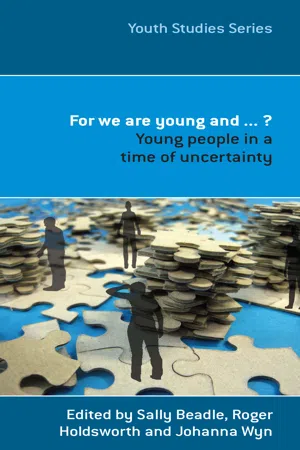
For we are young and...? offers a provocative perspective on Australia's young people against a global and local backdrop of uncertainty and change. It asserts the importance of a critically informed and positive approach to youth, moving beyond seeing young people through the lens of shortcomings and problems tobe solved. For we are young and...? draws directly on the work of the Youth Research Centre at The University of Melbourne and its legacy of innovative and significant research on young Australians. Opening with the theoretical context of youth research, the book draws on contemporary examples to discuss new conceptual and research approaches; the ways in which young people participate in change and the challenges and possibilities that are presented by current conditions. For we are young and...? identifies emerging issues and future directions for youth research, policy and professional practice.
- 256 pages
- English
- ePUB (mobile friendly)
- Available on iOS & Android
eBook - ePub
About this book
Trusted by 375,005 students
Access to over 1 million titles for a fair monthly price.
Study more efficiently using our study tools.
Information
Part I
Living in a Changing World
The challenge is always to ask the right questions. For we are young and … ? questions the nature and meaning of youth and what kinds of adulthoods are possible by exploring the nature of contemporary social change and its implications for young people. It features work of the Youth Research Centre at The University of Melbourne, which has been researching these questions for over two decades.
This first part provides an introduction to key questions about living in changing and uncertain times that have inspired, focused and framed recent work at the Youth Research Centre. It stresses the importance of having shared ideas and language in order to pose the right questions. Taking a sociological perspective, Dan Woodman, Helen Stokes and Johanna Wyn navigate the reader through concepts of risk, social change, the individualisation of biography, inequality, identity and social generations. These concepts are then employed in subsequent chapters, asking key questions about young people today. What kinds of identities are young people shaping? How is inequality being refigured across traditional divisions of gender, class, race and location? What subject positions are available and for what groups of young people? What kinds of transitions are young people making—and is transition a useful concept?
The answers, the contributors suggest, require a rethink about the conceptual tools that we use to understand the relationship between young people and society. In the contributions that follow, we extend an invitation to our readers to keep an open and critical mind about the conceptual tools used to analyse young people’s lives.
In Part I, we start by identifying social change as one of the fundamental questions that youth researchers face—and that young people must contend with. In Chapter 1, Woodman and Wyn provide new insights into the implications of uncertainty for young people today. Their discussion goes to the heart of debates about the extent to which social changes over the last quarter of a century have affected the experience and meaning of youth. They take issue with the way in which theories of social change by Ulrick Beck, Anthony Giddens and Zygmund Bauman have tended to be opposed to theories of social reproduction, such as that of Pierre Bourdieu.
Woodman and Wyn argue that existing social theories have a lot to offer our understanding of the significance of social change on young people’s lives and that a careful reading of these theories provides an effective framework for exploring the complex interplay between institutional processes and individual lives. They also reflect on the need to be critical about the use of policy-oriented terms such as ‘mainstream’, ‘at risk’ and ‘prevention’. These terms, they argue, are generally framed by discourses that direct attention to deficits within individuals as the causes of problems (such as early school leaving, homelessness or drug abuse). Focusing on individuals as the problem deflects attention from the social relations that systematically create inequalities and problems.
Chapter 2 by Woodman examines approaches to ‘generations’. Woodman argues that by taking up the question of generational change, youth research becomes more visible in the public realm, which enables this field to make a contribution to shaping, instead of simply responding to, social change. He argues that a social generations approach is a useful analytical tool because it enables researchers to ask the questions about what kinds of adulthoods are possible and under what circumstances. A social generations approach, which has a long tradition within the sociology of youth, enables the balance to be restored between the emphasis on broad social patterns and processes and the emphasis on individual lives. It provides a conceptual lens that can assist analysts to understand how social, political, environmental and economic conditions shape, but do not determine, what is possible for individuals.
In Chapter 3, Helen Stokes illustrates the implications of social change for young people’s identity formation. Focusing on secondary school students, she reveals the different strategies that they use to navigate their way through the different institutional logics of school and work. She uses the term ‘identity work’ to highlight the extent to which the ‘project of the self’ is a conscious and time-consuming activity at this stage of their lives. (This issue is further explored in chapters 8, 9 and 11.) She also shows how young people go beyond (and sometimes in contradiction to) school-based resources in order to build the basis for their next steps. Her chapter shows the processes of individualisation in young people’s lives, and raises questions about the extent to which secondary schools help or hinder young people’s attempts to take their next steps. Her work also looks at the role of educational institutions in a time of change and uncertainty.
Many of the ideas suggested in the three opening chapters offer a form of conceptual renewal—crossing boundaries and bridging taken for granted divisions. These chapters provide readers with a sound understanding of current directions in youth research, frame the question of uncertainty, open up uncertainties and possibilities within theoretical debates, and lay the basis for ideas and research presented in the rest of this book.
1
Youth research in a changing world
Notions of change and uncertainty have played a major role in youth studies in recent decades. Why have these ideas been so important?
The notion of an uncertain future has been central to much research in the sociology of youth in the past two decades. How institutions, collectives and individuals relate to a future that is less and less predictable has been the starting point for numerous recent studies. In fact the notion of an open but uncertain future has been more central to the sociology of youth than other sociological sub-disciplines. This preoccupation can in part be traced through a history of the sociology of youth.
Understanding youth in a changing world
Many of the central theories on human subjectivity in the last century saw youth as a time during which the basis for an adult identity was established. Adolescence was seen as particularly future oriented, about building the core of the identity that people would take with them throughout adult life; it was also seen as representing a time to experiment, a time of risk-taking and exploration. Erikson, for example, saw the period of youth as a time for experimenting with possibilities, before settling on a stable (adult) identity.1 This association between young people and the future is often mirrored in wider popular and policy debates in which youth is a site for the expression of anxiety about the future and about social change, as well as for myth making about an idealised past. Discussions about youth in the popular media frequently express concerns about the demise of traditional, normative attitudes and ways of living.2
The tendency to view young people as primarily adults in the making is a consistent criticism within the youth studies literature. This view has been regarded as inadequate for regarding young people as being of interest (only) because they will become adults, denying them a place of value in their communities, in schools and in the political process. Known as futurity, this approach is closely associated with a deficit view of youth in which young people are positioned as incomplete, vulnerable and at risk (see Chapter 6 for further discussion).3 Futurity positions youth as, at best, a transient and risky stage of life that will be terminated with the onset of adulthood. It informs many youth-related policies that have the primary aim of speeding up and smoothing out the transition into a normative adulthood (for example, the transition from school to work). It supports adult-centric assumptions about what is relevant to young people, what is good for them and what should be done to them, and it provides a rationale for adult-centric modes of communication and processes of participation that inevitably alienate and marginalise young people (see Chapter 3).
The lives of young people are intensely scrutinised as they come to represent an uncertain future. This is often expressed as anxiety about the possibility that social change will make existing social institutions and political processes less relevant to young people. Youth as a site for anxiety is also expressed through concerns about the kinds of adults they will become. Indeed, we have previously suggested that young Australians who were born after 1970 have already shaped a ‘new adulthood’ that differs in significant ways from the adulthood shaped by the baby boomer generation.4
The recent focus on social change and uncertainty in social theory has also had a significant influence on youth studies. Many theorists have argued that Western societies in the late decades of the late twentieth century have witnessed an accelerating burst of social change. This shift has resulted in changes to people’s relationship to the future. Following Lyotard’s suggestion that there has been a weakening of utopian meta-narratives of the predictable and controllable unfolding of the future, a legion of theorists has examined the consequences of a more open and uncertain future for the institutions of modernity. Others have focused on human subjectivity and action, or the speed at which everyday life is lived.5
Many youth researchers have been inspired by these claims of large-scale change and its impact on our relationship to the future. Against this backdrop, and drawing on contemporary empirical research, youth researchers have identified changes in the broad structuring of the youth stage of the life course, suggesting extended, delayed, emerging, arrested, on-hold, yoyo or non-linear transitions to adulthood.6 Others have focused on the impact of this change on people’s subjective sense of themselves in time. This second research focus has explored whether young people treat their future as open and amenable to personal shaping or whether is it now more difficult to orient to the future in this changing world.7 Of course, either theoretically or empirically, most researchers have an interest in both questions even when focusing on one. Much of the research on changing transitions and on attitudes to the future draws on the notion of individualisation.
The individualisation of biographies
Discussions of uncertainty in the sociology of youth usually revolve around a constellation of ideas about large-scale shifts in the organising principles of society driven by global processes over which nation states have relatively little control.8 Uncertainty emerges as the institutions of modernity are forced to recognise, and to deal with (or actively deny), the challenge of gaining effective control over the environment and economic progresses. The complexity of environmental and economic processes, as well as the speed of change, makes control seem less and less possible. This recognition means that previously taken-for-granted boundaries, such as what constitutes a family, are challenged or at the very least need to be actively maintained. Institutions such as the family, employment, religion and communities of residence potentially become more fragmented, and life less predictable and less amenable to control by individuals or by governments.
To conceptualise this shift, many authors argue for the emergence of qualitatively new forms of social organisation. Giddens argues that we have entered a stage of late modernity that is an intensification of modernity’s inherent requirement for reflexive action on the part of individuals, as the strictures of tradition are weakened. Beck argues that we are shifting from a first to a second type of modernity characterised as a ‘structured relative plurality’ within which organisations and individuals struggle to find compromises between contradictory positions. Bauman has made the most epochal claims, arguing for the emergence of a logic of liquidity structuring contemporary social relations. He points to a world that is continually changing, breaking down and reforming social structures that has left the comparatively static structures of earlier phases of modernity in its wake.9
Beck, Giddens and Bauman all argue that these processes of institutional change put increased demands on people to actively shape their lives (or biographies).10 For Giddens, the personal biography becomes more open to conscious decision making, while at the same time people’s reliance on numerous expert, and abstract, systems becomes greater than ever. 11 For example, although young people are faced with the need to make their own decisions about their futures, participating in post-secondary education has become...
Table of contents
- Title page
- Contents
- Contributors
- Preface
- Part I Living in a Changing World
- 1 Youth research in a changing world
- 2 A generations approach to youth research
- 3 Young people and identity work
- Part II Research Approaches
- 4 Researching young people’s perspectives
- 5 Researching youth transitions
- Part III Making Change
- 6 Young people’s engagement in education and community
- 7 Young people in rural communities
- 8 ‘If anyone helps you then you’re a failure’
- 9 Managing risk and marginality
- Part IV Possibilities and Questions
- 10 Learning partnerships
- 11 The changing nature of civic engagement
- 12 Young people and the future
- Part V Da Capo
- A historical perspective on the Youth Research Centre
- Index
- Imprint
Frequently asked questions
Yes, you can cancel anytime from the Subscription tab in your account settings on the Perlego website. Your subscription will stay active until the end of your current billing period. Learn how to cancel your subscription
No, books cannot be downloaded as external files, such as PDFs, for use outside of Perlego. However, you can download books within the Perlego app for offline reading on mobile or tablet. Learn how to download books offline
Perlego offers two plans: Essential and Complete
- Essential is ideal for learners and professionals who enjoy exploring a wide range of subjects. Access the Essential Library with 800,000+ trusted titles and best-sellers across business, personal growth, and the humanities. Includes unlimited reading time and Standard Read Aloud voice.
- Complete: Perfect for advanced learners and researchers needing full, unrestricted access. Unlock 1.4M+ books across hundreds of subjects, including academic and specialized titles. The Complete Plan also includes advanced features like Premium Read Aloud and Research Assistant.
We are an online textbook subscription service, where you can get access to an entire online library for less than the price of a single book per month. With over 1 million books across 990+ topics, we’ve got you covered! Learn about our mission
Look out for the read-aloud symbol on your next book to see if you can listen to it. The read-aloud tool reads text aloud for you, highlighting the text as it is being read. You can pause it, speed it up and slow it down. Learn more about Read Aloud
Yes! You can use the Perlego app on both iOS and Android devices to read anytime, anywhere — even offline. Perfect for commutes or when you’re on the go.
Please note we cannot support devices running on iOS 13 and Android 7 or earlier. Learn more about using the app
Please note we cannot support devices running on iOS 13 and Android 7 or earlier. Learn more about using the app
Yes, you can access For We Are Young And ... by in PDF and/or ePUB format, as well as other popular books in Social Sciences & Development Economics. We have over one million books available in our catalogue for you to explore.