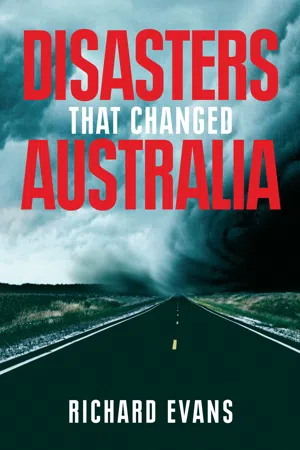
Australian history is full of disasters. Some are natural but many more are man-made, results of individual or collective stupidity, reckless decisions, or greed. In Disasters that Changed Australia, Richard Evans nominates the worst disasters in an engrossing, insightful account of what happened and why. Picture British General, Douglas Haig through sheer arrogance and determination sending thousands of Australian men into swampy, disease-ridden enemy territory for no strategic gain. Or a feral legion of rabbits let loose on the environment, turning furry friends into an uncontrollable plague. Including Cyclone Tracy, Black Friday, the Snowy Mountains Scheme and the destruction of megafauna thousands of years ago, these are just many of debacles that have defined Australia. Richard Evans goes beneath the familiar stories and myths, and urges us to rethink how we respond to disasters to avoid making the same mistakes again.
- 208 pages
- English
- ePUB (mobile friendly)
- Available on iOS & Android
eBook - ePub
Disasters That Changed Australia
About this book
Information
Topic
Histoire1 DIVINE WIND: CYCLONE TRACY, 1974
Darkness. Complete darkness, and the roar of the wind. These were the overwhelming memories of the survivors of Cyclone Tracy. Darkness, rarely experienced in the modern world, of a mineshaft, or a grave. And the roar: some people compared it to a thousand freight trains, or a jet engine in the lounge room.
In the small hours of Christmas morning, 1974, most of the 43 000 people who lived in Darwin found themselves in shrieking blackness, their roofs and walls being peeled away by the storm, soaked to the skin by torrential rain, wondering if they were going to live. Decades later, one survivor recalled: ‘We learned to pray’.
+++
Half a century ago, the writer Ernestine Hill called Darwin ‘the crazy little capital of the land of lost endeavour’. That land was the Northern Territory, the ‘problem child of empire, land of an ever-shadowed past and an ever-shining future, of an eternal promise that never comes true’.
The Northern Territory was an afterthought. During the nineteenth century, as the colonies of Queensland, South Australia and Western Australia were formed, arbitrary lines were drawn on the map, cutting across vast reaches of arid land—much of it still unknown to Europeans—with the careless authority of the imperial age. The Northern Territory was the bit that was left, up the top and in the middle, which no-one much wanted. Its boundary with Western Australia was finally decided in 1921.
There are people who love Darwin—Ernestine Hill was one of them—but there are a great many others who hate it. Roland Herman Milford, a gloomy ex-soldier who worked there in the late 1920s, was scathing in his portrayal:
A sweating, soaking day in December. Many of the living corpses of Darwin in a comatose state of alcoholism. Blacks, half-castes, pearlshell-divers, government officials … and others—all stagger or lurch unevenly about in the poisoned air as [if]each movement of their bloated, beer-soaked bodies was going to be their [last] … a vague atmosphere of immorality pervading everything.
Milford was a bit of a whinger. In 1932 he drove a car right around Australia and wrote a travel book about the trip in which he complains about almost every place he visits. The malaise he describes in Darwin, however, was real enough.
Darwin is one of those places which exists because of where it is—for strategic reasons. It has played a vital role in Australia’s communications and defence. As a result it has, for the whole of its history, been a place where people are posted: by government agencies, or large companies, or the defence forces. This is not true of the Aboriginal population, of course, but for most other inhabitants, Darwin remains quasi-colonial, a sort of transit lounge for nation builders from the populated southern cities. People come, work for a few years, and then leave.
Ernestine Hill again: ‘In its glorious setting, Darwin was unloved and unlovely. Apart from a few faithfuls, there were only two classes—those paid to stay and those without … money to go’.
The tipping point is 27 degrees Celsius. When seawater reaches this temperature, tropical cyclones can form.
Part of the problem is the weather. For half the year it is hot and dry, while for the other half it is hot and wet. The weather forecast for Darwin has become something of a national joke: during winter it is ‘32 degrees and sunny’, during summer it’s ‘32 degrees, humid, late storms’. To many Australians accustomed to the more moderate southern climes, the wet season especially is enervating and oppressive. In the days before air conditioning, in a society which insisted on dress that covered all but the head and hands, the level of discomfort was extreme.
And then there was the potential for weather like nothing a temperate climate could produce: the tropical cyclone.
The tipping point is 27 degrees Celsius. When seawater reaches this temperature, tropical cyclones can form. What is needed is a warm sea and relatively still air, thick with moisture. The heat makes the air rise and as it does so, the water vapour condenses into droplets, forming clouds. When water changes from a gas to a liquid, energy is released that further heats the air, which continues to rise. The column of rising air draws in more moist air and the cycle continues, building up huge thunderheads crackling with electricity.
Usually the result is a heavy dumping of afternoon rain, a clockwork occurrence in the tropical wet season. But if, at high altitude, a strong cross-wind whips away the top of the rising column of hot air, then the inflow of air continues and the formless masses of heavy rain clouds are pulled into a tightening vortex. Like a rotating ice-skater, speeding up as she pulls in her arms, the wind gathers speed. Around a centre of very low air pressure, the ‘eye’, ever stronger winds spiral in, pulling moist air from over the surrounding sea, releasing water vapour, giving off staggering amounts of energy and powering an extreme weather system. This is what is called a typhoon in Asia, a hurricane in North America, and, in Australia, a tropical cyclone.
Like a rotating ice-skater, speeding up as she pulls in her arms, the wind gathers speed.
Once it has formed, a cyclone will begin to move, like a coin spinning on a table. The usual course for a cyclone in the southern hemisphere is a slow southerly curve, heading west at first, then looping back to the east. However, the course can be erratic and is very difficult to predict.
About thirty cyclones will form in a typical year, with about three of those in Australian waters. Many peter out after a few hours or days, and bring little more than heavy rain. But some retain their intensity. If they hit a coastal city, the damage and loss of life can be immense. In 1876, a cyclone off the coast of modern Bangladesh caused flooding which drowned 100 000 people; as many died from disease in the storm’s aftermath. The low-lying Texas city of Galveston was hit by a hurricane in 1900 that killed 6000 people. Japan is periodically affected by cyclones. In 1934 a cyclone struck Osaka, destroying more than 45 000 houses and killing 3000 people.
Cyclones have a special place in Japanese history. In 1281 AD, a huge Mongol fleet attacked the islands, landing an army in Kyushu. A cyclone struck the fleet and almost completely destroyed it. In gratitude for what they saw as a miracle, the Japanese called the storm ‘the Divine Wind’, or ‘kamikaze’.
CITY OF NINE LIVES
The crash of buildings and the rattle of iron and timber falling about, combined with the blinding rain and the roaring of the tempest, was an experience those who underwent it will never forget to their dying day. Strongly built houses collapsed like houses of cards; roofs blew bodily away; lamp and telegraph posts were bent or torn up; immense beams of timber were hurled away like chaff; trees were uprooted; in many instances large houses were lifted bodily from their foundations and deposited ten and twelve feet away; and in short, the night was one of terrifying destructiveness that made the stoutest heart quail.
This is a description of a cyclone that destroyed Darwin, written by a journalist at the NT Times. The winds were so terrific that only a few buildings escaped destruction and even they lost their roofs or were otherwise seriously damaged. The fury of the storm almost defied comprehension: a flagstaff, which was set in three feet of concrete, ‘was blown out of the ground, concrete and all’. This was not Tracy but a cyclone which hit Darwin on the night of 6 January 1896. The number of people killed is uncertain, but may have been as many as sixty.
The South Australian Government, which then adminstered the Northern Territory, was both slow and niggardly. The shortage of liveable accommodation in Darwin led to overcrowding—most people had been left homeless—and as the wet season continued, disease began to spread among the inhabitants. A full year after the cyclone, public servants were still trying to work in offices which leaked every time it rained. Not for the last time, the people of Darwin felt abandoned by masters in a distant capital.
In March 1937, the town was again hit by a cyclone. This storm was less severe—there was only one recorded death—but significant damage was still caused. Again the town was rebuilt—Ernestine Hill called it ‘the place of nine lives’—only to be again destroyed, this time by Japanese bombs during World War II.
The first Japanese bombing raids on Darwin, on 19 February 1942, have an unusual place in Australian memory, not least because they were the subject of a massive cover-up.
The attacks, which involved more than 180 aircraft, came as a complete surprise. The raiders had been seen passing Bathurst Island and the RAAF station at Darwin was alerted by radio telephone. However, the commander there thought the planes were probably American, and did not pass the warning on or sound the alert. In two waves, one beginning at 10 a.m. and the second just before noon, Japanese bombs and machine guns caused terrible damage to the town, the airfield, and shipping in the harbour. Eight ships were sunk, including a US Navy destroyer, and three others were badly damaged. Much of the harbour wharf was destroyed. Most of the public buildings in town were wrecked. The RAAF base suffered badly: nine military aircraft were smashed on the ground; the airfield’s hangars and repair shops were ruined; a dump holding 300 000 rounds of ammunition exploded. In all, 243 people were thought to have been killed, but the true total may have been greater; more than 300 people were wounded.
In two waves, one beginning at 10 a.m. and the second just before noon, Japanese bombs and machine guns caused terrible damage to the town, the airfield, and ship ping in the harbour.
The legend of Aussie courage under fire took a battering that day in Darwin. Some people behaved bravely. The crews of anti-aircraft guns, most of whom had never seen action before, stayed at their stations and put up the only effective resistance to the raids. The nurses at the hospital, which was itself attacked, showed great devotion to their duty. Other individuals, including a prisoner in Fanny Bay Gaol who was released to help with the rescue effort, were later singled out by a royal commission for their courage and sacrifice.
As a whole, though, the response to the raid was a debacle. In the wake of the bombing, rumours swept the town that a Japanese invasion was imminent. Civil order broke down: there was looting and panic. About half the civilian population sought to flee south by any vehicle available—even the municipal sanitary carts were used—or on foot. The royal commissioner who investigated the raids, Charles Lowe, reported: ‘I myself observed in the Darwin Hotel tables upon which drinks remained half-consumed, letters started but not finished … and other signs of a very hasty exit’.
Most embarrassing was the number of military servicemen who joined the rout. Many RAAF personnel, in particular, abandoned their posts and the airfield was soon practically deserted. Many fled into the bush, others headed for towns further south. One man, in what Lowe dryly called ‘an extreme feat’, turned up thirteen days later in Melbourne. The whole affair, he wrote, was ‘deplorable’.
The response of the Australian authorities was to cover it up. Newspaper accounts gave the death toll as seventeen, vastly overstated the Japanese losses, and concealed the panic altogether. The affair remained a sensitive topic for decades: Lowe’s report remained closed to public access until the 1960s.
In the wake of World War II, Australia consciously set about the task of nation building. It was the era of the Snowy Mountains Hydro-Electric Scheme and mass migration, the fostering of heavy industry and universities, and the vast expansion of Australia’s cities. Darwin was one obvious place to set to work. Old timers like Ernestine Hill hated the whole thing: ‘Let them sing anthems to that mythical new Darwin, model tropical bungalows, air-conditioned suburbs, poinciana parks and palatial hotels, a garden city cut and dried, Front Gate of Australia that never yet came true’.
What eventuated was both less impersonal and less well-built than Hill’s imagined model city. Darwin remained sleepy. Many of the new suburbs, built to house the public servants who mostly stayed only for a few years, had a fair amount of the shabby, jerry-built ‘old Darwin’ about them. Most houses were raised on posts to take advantage of the breeze. The windows were glass louvres that allowed air to flow through, the roofs were corrugated iron, the walls made of sheets of fibrocement. Below the house might be a laundry block of hollow concrete bricks. Though plain, the buildings were set in the lush gardens that tropical climate encouraged, and were pleasant enough to live in.
Many were poorly built. Even those builders who were skilled and conscientious were creating buildings completely unsuitable for a city which had twice been hit by tropical cyclones and which, in 1974, was about due for another.
‘VERY DESTRUCTIVE WINDS’
On 1 December 1974, about 350 kilometres north-west of Darwin in the Timor Sea, a low pressure system developed into Tropical Cyclone Selma. Selma moved directly towards Darwin and two days later was only 100 kilometres away. The Bureau of Meteorology issued a steady stream of alerts, warning the people of Darwin to prepare for a potentially devastating storm. But at 10 a.m. on 3 December, Selma changed direction, swinging north and then west away from the city. There had been a lot of rain and some trees had been brought down, but nothing too alarming.
It is a common pattern in disasters: the near miss which causes complacency. When authorities warn of a serious danger which does not eventuate, people can become fatally sceptical. One Darwin resident recalled an early conversation about whether Tracy was a real threat: ‘We had had Cyclone Selma only a few weeks before … Everyone was sick of talking about cyclones—and besides, Christmas was here’.
Everyone was sick of talking about cyclones—and besides, Christmas was here’.
On 21 December, a large cloud mass that had been forming in the Arafura Sea, some 700 kilometres to the northeast of Darwin, began to revolve and the winds at its centre reached high velocities. At 10 p.m. the system started to move and it was officially designated a tropical cyclone, and given the name Tracy.
Another resident recalled that like most people, he was concerned that bad weather would spoil Christmas. At Christmas Eve parties, the consensus was that Tracy would do what Selma had done on approaching Darwin, what every cyclone for decades had done: veer away. The police were in touch with the Weather Bureau and had followed standard procedures to prepare for an emergency. But no-one was really worried. ‘It was still being taken lightly’, one officer recalled. ‘It was “just another blow”.’
By noon on 24 December, the picture was clearer, and alarming. Tracy was 110 kilometres north-west of Darwin and was headed south-east—straight for the city. The winds inside the storm were extreme. At 12.30 p.m. the Tropical Cyclone Warning Centre issued a formal alert:
VERY DESTRUCTIVE WINDS OF 120 KILOMETRES PER HOUR WITH GUSTS TO 150 KILOMETRES PER HOUR HAVE BEEN REPORTED NEAR THE CENTRE AND ARE EXPECTED IN THE DARWIN AREA TONIGHT AND TOMORROW.
Some people took precautions: putting masking tape on windows, tying down loose objects, checking that they had a battery torch and radio in case the power went out. Others attended Christmas parties, got drunk, and went to bed.
What then unfolded was a slow-building nightmare. As evening drew into night, power was lost, the wind rose, and kept rising, and the torrential rain forced its way into houses. At first, people tried to protect carpets and valuables, but such thoughts were soon f...
Table of contents
- Cover
- Title
- Contents
- Introduction
- 1 Divine Wind: Cyclone Tracy, 1974
- 2 ‘Just Slaughter’: Flanders, 1917
- 3 Destroying the Promised Land: The Great Resource Crash, c. 40 000 Bc
- 4 The Tasmanian Genocide: 1804–1838
- 5 Feralnation: Rabbits, 1859 To the Present
- 6 Black Friday, 1939 and Beyond
- 7 The Depression: 1930–1939
- 8 The Great White Elephant: The Snowy Mountains Scheme, 1949–1974
- 9 Fool‘s Gold: Montreal Olympic Games, 1976
- 10 The Great Drought: 2002 To the Present
- Sources and Further Reading
- Acknowledgements
- Copyright
Trusted by 375,005 students
Access to over 1.5 million titles for a fair monthly price.
Study more efficiently using our study tools.
Frequently asked questions
Yes, you can cancel anytime from the Subscription tab in your account settings on the Perlego website. Your subscription will stay active until the end of your current billing period. Learn how to cancel your subscription
No, books cannot be downloaded as external files, such as PDFs, for use outside of Perlego. However, you can download books within the Perlego app for offline reading on mobile or tablet. Learn how to download books offline
Perlego offers two plans: Essential and Complete
- Essential is ideal for learners and professionals who enjoy exploring a wide range of subjects. Access the Essential Library with 800,000+ trusted titles and best-sellers across business, personal growth, and the humanities. Includes unlimited reading time and Standard Read Aloud voice.
- Complete: Perfect for advanced learners and researchers needing full, unrestricted access. Unlock 1.5M+ books across hundreds of subjects, including academic and specialized titles. The Complete Plan also includes advanced features like Premium Read Aloud and Research Assistant.
We are an online textbook subscription service, where you can get access to an entire online library for less than the price of a single book per month. With over 1.5 million books across 990+ topics, we’ve got you covered! Learn about our mission
Look out for the read-aloud symbol on your next book to see if you can listen to it. The read-aloud tool reads text aloud for you, highlighting the text as it is being read. You can pause it, speed it up and slow it down. Learn more about Read Aloud
Yes! You can use the Perlego app on both iOS and Android devices to read anytime, anywhere — even offline. Perfect for commutes or when you’re on the go.
Please note we cannot support devices running on iOS 13 and Android 7 or earlier. Learn more about using the app
Please note we cannot support devices running on iOS 13 and Android 7 or earlier. Learn more about using the app
Yes, you can access Disasters That Changed Australia by Richard Evans in PDF and/or ePUB format, as well as other popular books in Histoire & Histoire de l'Australie et de l'Océanie. We have over 1.5 million books available in our catalogue for you to explore.