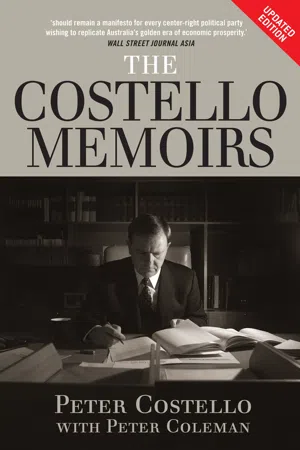
In a political career spanning more than eighteen years, Peter Costello, Australia's longest serving Treasurer, steered the Government through some of its greatest economic and political challenges, paying off Government debt, introducing the GST and fighting five elections. The Costello Memoirs charts the victories and defeats in one man's very public life.
- 416 pages
- English
- ePUB (mobile friendly)
- Available on iOS & Android
eBook - ePub
The Costello Memoirs
About this book
Information
1
WHAT WENT WRONG?
The night before the 2007 election we met in a popular restaurant in Melbourne’s Chinatown. It was Friday 23 November. We knew in our bones we were defeated. We joked and tried to look on the bright side. You never give up hope.
Twenty or so of us—mostly aged under thirty but some older— sat around a large table. We had different ethnic backgrounds and different religions. Some had grown up on farms, some in the cities. Some were married, some were in established relationships, some had children. When you work together in a political office seven days a week and travel together and eat together, you all live the same highs and lows. You become family.
This was my last chance to thank my team for all they had done in our doomed campaign and for their personal sacrifices over our eleven and a half years in Government. Our press team began at 5 a.m. each day. We were running on adrenalin. My wife Tanya came to thank them. Our son, Seb, joined us, down from the country after he had finished his regional radio program.
Our talk turned to a host of ‘what if?’ issues. What if the party had made the leadership transition? How would we have done things differently? What if John Howard had stood down after APEC in September? Would there have been enough time to turn around Labor’s lead at that late stage?
We talked about the speech I had prepared over the APEC weekend in the event that Howard decided to go. It was designed to set a new direction for a fresh Government. We talked about some of the policy ideas we had included in that speech: ratifying the Kyoto Protocol, family and housing initiatives, new ways to deal with the water crisis. Would these have captured public attention and turned things around?
Then we talked about the disaster of the past forty-eight hours, when Liberal campaign workers in the New South Wales seat of Lindsay, including the husband of member Jackie Kelly, had been caught with a bogus leaflet trying to use anti-Muslim sentiment against Labor. How could anyone be so stupid?
My mind went back to the 1996 election when ‘the forged letters affair’ had blown up in Labor’s face in the last forty-eight hours before it was thrown out of office. That incident had added several seats to our majority. I had no doubt that the Lindsay affair would add several seats to Labor’s majority. It looked so crook, so desperate. It had dominated the media from the minute of Jackie Kelly’s fateful interview on ABC Radio’s AM program the day before. It had obliterated John Howard’s last appearance at the Press Club that day, my message on the ABC’s PM program that night and Howard’s message on AM the next morning.
Kelly was a Howard favourite, the kind of member Howard loved. Swept into Parliament in 1996, she had no background in the Liberal Party. Her loyalty was to Howard. He had promoted her and made her a Minister—even giving her the plum appointment of Minister for Sport during the Sydney Olympics.
I could not remember a worse interview than Kelly’s that morning two days before the election. Listening to it in the car, I reached out to switch off the radio. But it was so awful that my hand froze in mid-air. Kelly giggled and described it all as ‘a bit of a Chaser-style prank’. After several more excruciating minutes she asked the interviewer: ‘Where is this conversation going?’ ‘Right down the gurgler,’ I muttered to no one. ‘Why do these people do interviews?’
After dinner that Friday night I delivered my last speech of the campaign. I spoke about the Coalition’s achievements in office. Over eleven and a half years we had delivered the most successful period of economic management in Australian history. We had lowered interest rates, brought unemployment to historic lows, eliminated Commonwealth net debt and managed the longest period of uninterrupted growth our country had ever known. We had turned Australia from the ‘sick man of Asia’ into a respected regional leader. We had built an Age of Prosperity. That would be the verdict of history. It was a record of which we could all be proud.
It was the best team I had ever had. The senior members were veterans of the GST campaign a decade earlier. Many of the staff in other Ministers’ offices had drifted off as the parliamentary term wore on and the polls showed a looming disaster. But this team had fought out the campaign and done well. The polls showed that the Coalition parties were judged the best able to manage the economy—by a margin of 53 to 29. I told the team:
It was a textbook campaign. Not a hitch. Not a loose word. No mistakes, by us at least. We stayed focussed and on-message throughout. Voting will begin in ten hours. It will be glory or death. But if we lose, it won’t be on the issue of economic management. Everyone here can hold his or her head high. You will look back on these years in Government as the greatest days of your lives.
Phil Gaetjens also spoke. He was my chief of staff. He had been hit by a car in Canberra five months earlier and lay in intensive care in a coma for several weeks. My press secretary David Gazard, my adviser David Alexander and I had sat by Phil’s bed while he was unconscious, willing him to recover and looking for signs. ‘We’ll know he’s back when he can tell us the marginal tax rates and the tax thresholds,’ Gazard said. Phil’s brush with death had shaken all of us. He had not yet fully recovered and although he was still frail he came back to work on the campaign for restricted hours.
Phil spoke about what it meant to him to have these colleagues, these friends, stand by him throughout his gruelling experience. He spoke of the campaign. It had helped him. He was getting stronger. ‘Tell us the rates and thresholds, Phil!’ Gazard called out when Phil had finished speaking.
My personal assistant, Gabrielle Brennan, spoke of the friendships we had made for life.
I was up at six the next morning. As always I toured the polling booths in my electorate of Higgins, one every quarter-hour. Arrive, shake hands with the poll workers, speak to the voters, then on to the next booth. Ten minutes to drive between booths, five minutes to talk, thirty-seven booths in ten hours. David Alexander was the driver. My son Seb was with me all day. So was a federal policeman!
When Tanya and I voted at the Church of Christ, Camberwell, the television cameras were ready to record my last message. I asked voters to think about economic management, jobs and interest rates. Don’t risk it all, our Age of Prosperity. ‘You can’t wake up on Monday morning and say: Oh I didn’t mean that,’ I said.
A posse of five journalists and two photographers trailed us in cars throughout the day. They recorded every conversation and photographed each handshake at the booths. They were looking for an incident, for colour, for movement, maybe a confrontation. Once or twice we gave them the slip but they always found us. It was a cat-and-mouse game. They trailed off in the afternoon.
The reception around the electorate was enthusiastic and positive, one of the best receptions I have had. My son was stunned by the warmth of it all. I was returned with a substantial majority. In my electorate there was a two-party preferred swing of 1.7 per cent against the Liberals. The national swing was 5.5 per cent. If we could have held the national swing to 1.7 per cent the Coalition would have been returned.
The western end of my electorate in Prahran usually delivers a majority for Labor. As I was walking down to a polling booth at a kindergarten, I heard a woman scream out from a balcony above the street: ‘Peter, Peter, I love you, I love you!’ A woman came racing out of her house and gave me a huge kiss. Then she demanded that her boyfriend come out and give me a hug. She called out to two of her girlfriends to come and give me a kiss. Never before had I experienced a reception like this on a polling day!
When it was all over we went to my office to wait for the results— Tanya, our children Sebastian and Phoebe, and the staff. (Our daughter Madeleine was in Kilkenny, Ireland, working at a school for a year.) The Australian Electoral Commission website was posting results as they came in. We could see early on that the news was going to be bad. The two Tasmanian seats we had won from Labor in 2004 were going back to Labor. We held up well in Victoria, where we lost only two seats—Corangamite and Deakin. But in New South Wales we were in trouble in Eden-Monaro, Robertson, Dobell, Macquarie, Parramatta, Lindsay and Bennelong—John Howard’s own seat. In South Australia it was expected that we would lose two seats we had picked up in the 2004 election—Wakefield and Kingston. The good news was we were holding in Boothby and Sturt. Queensland was an hour behind New South Wales and Victoria. We would need a miracle to hang on there. Labor needed a total of thirteen seats to form a majority. When the Queensland results came in, there were double-digit swings against the Coalition. We lost seats that were not even marginal. In total we lost nine seats in Queensland and seven in New South Wales. By nine o’clock it was all over.
I wanted to go to the St Andrew’s Uniting Church Hall, where my friends and supporters had gathered, to thank them and console them. I rang John Howard at Kirribilli House. I asked him whether he had spoken to Kevin Rudd and when he proposed to make his concession speech. He had not yet rung Rudd. He said he would do that, then drive across the Harbour Bridge to the Wentworth Hotel and concede the loss of the election and the defeat of the Government. We had a brief discussion about his electorate of Bennelong. I could see he had lost it. He was not conceding. He asked: ‘What will you do?’ I said: ‘I’m inclined to move on. I won’t make an announcement until I’ve thought about it overnight.’
I hopped into the car with Tanya, Sebastian and Phoebe to join friends and several hundred supporters, led by my campaign manager, Andrea Coote, at St Andrew’s Church Hall. Everyone was in a state of shock but they gave us a tremendous reception. We had run a great local campaign. I thanked them all for the time and energy they had volunteered on that day and over the years. My concluding words were:
I want to say two things about our country. Our ambitions for our country should be as large as the country itself. As I flew from Brisbane to Perth after our national campaign launch and I saw our broad and vast and expansive country, I thought to myself I want a country with ambitions as big as the continent itself. The second thing I want to say is that I believe in the future of Australia. The best years of our country are in front of us. We are young and we have boundless opportunity.
We were home by about midnight. Friends, colleagues and party officials were still ringing. I rang Madeleine in Kilkenny. It was morning there. She had been following the election on the internet. She was sad and disappointed. We all were. We went to bed about 2 a.m. and got up again at 6 a.m. Tanya and I talked about the announcement I had to make that day. We had already thought and talked a lot about what I would do if the Liberals lost. It had been my view for the past year that, if we lost, the best thing for me would be to make a break from politics. I had been the Deputy Leader of the party for more than thirteen years. I was conscious of the frustration people would suffer if opportunities for career advancement were not available. There would be other people in the party who had not yet had their opportunity to assume a major leadership role. They deserved a go. Tanya told me: ‘You make whatever decision you think is right.’
So we went into my office. The staff were there already, cleaning out the offices, sorting documents, feeding the shredder bins. The phones were running hot. The press wanted to know whether I would take the party leadership. Colleagues were ringing to urge me to nominate. Some were making public endorsements. It was gathering momentum. I could not let this run. It had to be dealt with cleanly and immediately so that others could make their decisions and step forward if they wanted to lead the party. I spoke to each one of my staff individually and told them I did not intend to seek the leadership of the Liberal Party. I told them I would help them find other jobs. It was a shock. Most of them had hoped that I would stay on and do something after this terrible defeat we had all suffered. Philippa Campbell, my office manager, burst into tears.
Then I called in the press and made a statement. I congratulated Kevin Rudd and the Labor Party, thanked the millions who had voted for the Coalition, and paid a tribute to John Howard: ‘I had the privilege of serving alongside him. I said in a recent interview that, with the possible exception of Sir Robert Menzies, John Howard is Australia’s greatest Prime Minister.’ But the principal purpose of the news conference was to make an announcement about my future:
I have served the Liberal Party for seventeen years as a Member of Parliament, the first six years in Opposition, and whilst we were in Opposition I was elected the Deputy Leader, a position that I have held now for thirteen and a half years. Of course, for the last eleven and a half years I have served as Treasurer. I have given every waking hour to Government and to the people of Australia over those years.
It has been a great privilege to serve with some wonderful people and I want to thank my wonderful colleagues with whom I have served, many of whom have asked me in the last twelve hours to become the Leader of the Liberal Party.
I have discussed this with my family and my wife Tanya, and we have decided that the time has come for me to open a new chapter in my life. I will be looking to build a career post-politics in the commercial world.
As a consequence of that, I will not seek nor will I accept the leadership or deputy leadership of the Liberal Party. I want to spend more time with my family and do something for them. They have paid a heavy price for [my] eleven and a half years as Treasurer.
I believe in generational change in the Liberal Party. I came in as part of an Opposition, we took the Opposition up to the Hawke–Keating Government, we were elected and we formed Government. Now it is time for a new generation in Opposition to take the fight up to the Rudd Labor Government and to form the next Liberal Government.
It is time for the young people of talent and ability, of whom there are many, to be given their go in the Liberal Party. Just as I was given my go in the early 1990s, I think it is time for them to have their go and I am going to reprise my trust in the talented young members of the Liberal Party.
The achievements of recent years have been absolutely outstanding. I have personally been the longest serving Treasurer in Australia’s history. I have brought down twelve federal Budgets. The incoming Treasurer will not inherit a situation that I did with a $10 billion deficit and $96 billion worth of debt. The incoming Treasurer will have a balanced Budget. There will be no Commonwealth debt, we are saving $9 billion a year in interest payments alone. We have reformed the tax system and introduced a broad base consumption tax, 2.2 million more Australians are in work and young people have a better opportunity for work than they have in a generation. We have established a Future Fund which now has $61 billion to provision for Australia’s future ...
I want to pay tribute to other Members of Parliament, particularly those that have lost their seats in this most recent election. It may well be t...
Table of contents
- Cover
- Title
- Preface
- Contents
- Author’S Note
- 1 What Went Wrong?
- 2 The Making of a Politician
- 3 From Confectionery to Canberra
- 4 Defeat from the Jaws of Victory
- 5 Out of the Wilderness and into Government
- 6 Balancing the Books: Setting Monetary Policy
- 7 Unchain My Heart: A New Tax System
- 8 Second Term Blues: 1998–2001
- 9 Meltdown: The Asian Financial Crisis
- 10 War and Terrorism: The Third Term
- 11 From Mabo to Mal: Indigenous Australia
- 12 Leadership: From Memo to Madness
- 13 Bringing Home the Bacon: The Fourth Term
- 14 Going Cactus: The 2007 Election
- 15 Unfinished Business
- 16 Spin and Substance in a Time of Instability
- Postscript
- Appendices
- Index
- Copyright
Trusted by 375,005 students
Access to over 1.5 million titles for a fair monthly price.
Study more efficiently using our study tools.
Frequently asked questions
Yes, you can cancel anytime from the Subscription tab in your account settings on the Perlego website. Your subscription will stay active until the end of your current billing period. Learn how to cancel your subscription
No, books cannot be downloaded as external files, such as PDFs, for use outside of Perlego. However, you can download books within the Perlego app for offline reading on mobile or tablet. Learn how to download books offline
Perlego offers two plans: Essential and Complete
- Essential is ideal for learners and professionals who enjoy exploring a wide range of subjects. Access the Essential Library with 800,000+ trusted titles and best-sellers across business, personal growth, and the humanities. Includes unlimited reading time and Standard Read Aloud voice.
- Complete: Perfect for advanced learners and researchers needing full, unrestricted access. Unlock 1.5M+ books across hundreds of subjects, including academic and specialized titles. The Complete Plan also includes advanced features like Premium Read Aloud and Research Assistant.
We are an online textbook subscription service, where you can get access to an entire online library for less than the price of a single book per month. With over 1.5 million books across 990+ topics, we’ve got you covered! Learn about our mission
Look out for the read-aloud symbol on your next book to see if you can listen to it. The read-aloud tool reads text aloud for you, highlighting the text as it is being read. You can pause it, speed it up and slow it down. Learn more about Read Aloud
Yes! You can use the Perlego app on both iOS and Android devices to read anytime, anywhere — even offline. Perfect for commutes or when you’re on the go.
Please note we cannot support devices running on iOS 13 and Android 7 or earlier. Learn more about using the app
Please note we cannot support devices running on iOS 13 and Android 7 or earlier. Learn more about using the app
Yes, you can access The Costello Memoirs by Peter Coleman, Peter Costello in PDF and/or ePUB format, as well as other popular books in History & Historical Biographies. We have over 1.5 million books available in our catalogue for you to explore.