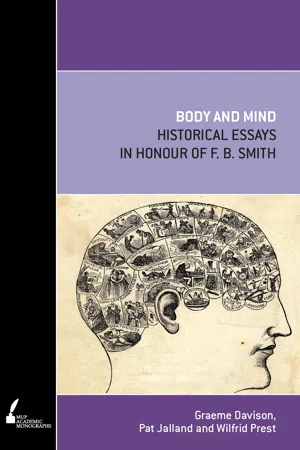
Body and Mind pays tribute to one of Australia's most outstanding and influential historians, F. B. (Barry) Smith. Barry has made pioneering contributions to the political, social and cultural histories of Britain and Australia, and these essays range across the fields he made his own, especially the interconnected histories of medicine (body) and ideas (mind).
The editors bring together several generations of Barry's admirers, colleagues, friends and pupils, including Joanna Bourke writing on war and industrial trauma, Peter Edwards on the Agent Orange controversy, Pat Jalland on death in the London Blitz and Phillipa Mein Smith on the idea of Australasia. Body and Mind is a salute to the inestimable work, and the life and times of F. B. Smith.
eBook - ePub
Body and Mind
Historical Essays in Honour of F.B. Smith
- 256 pages
- English
- ePUB (mobile friendly)
- Available on iOS & Android
eBook - ePub
About this book
Information
Subtopic
Historical BiographiesIndex
History1
Sociology and Self-Knowledge: James Phillips Kay and the Manchester Cotton Masters 1828–1835
‘Self-knowledge is a precept no less appropriate to societies than to individuals’, declared James Phillips Kay in the introduction to his famous pamphlet The Moral and Physical Condition of the Working Classes employed in the Cotton Manufacture in Manchester (1832).1 In the early 1830s Manchester was a city in crisis, its industrial districts convulsed by disease, poverty, industrial and political unrest.2 Kay, a 29-year-old physician, was promoting a new form of self-knowledge, social statistics, to diagnose its multiple ills. As physician to the Ardwick and Ancoats Dispensary, he was conversant with the physical and social condition of working class families in the city’s main factory district. And as a member of the Manchester Board of Health (1831–32), secretary of the Manchester Provident Society (1833–35) and the Manchester Statistical Society (1833–35), he led an ambitious local program of social investigation and reform. His pamphlet would become a landmark in the history of urban social inquiry.3 He had already taken the first steps of a career that would make him, as the future Sir James Kay-Shuttleworth, a pillar of English liberal reform.4
Kay’s Manchester years are significant not only in launching a brilliant career but in revealing the intellectual and emotional forces that drove him. As Barry Smith showed in his penetrating study of Florence Nightingale, the mind of the reformer could often be a troubled one in which altruism and egotism, moral sensitivity and self-deception were held in unstable equilibrium. In examining the motives of the reformer, he suggests, we must guard against the assumption that ‘doers of good deeds must necessarily be good in themselves’.5 James Kay was a young man who wanted to be good, as well as to do good, but, like other social investigators, he was a complex and driven personality whose desires for social betterment were coupled with equally powerful desires for recognition and self-knowledge.6 Amidst the social convulsions of the early 1830s, Kay experienced a personal crisis so severe that it eventually forced his departure from the city. Its origins were personal and private, an unconsummated love affair, but its consequences upset Kay’s psychological equilibrium and called into question the delicate fabric of relationships—as doctor, family friend, universal secretary—on which he had built his career. Previous studies of Kay’s Manchester years have explored the links between his understanding of human physiology and his organic interpretation of the ills of industrial society.7 These links, I argue, also had an important psychological dimension. The social investigator’s understanding of the moral and physical condition of the working classes reflected, in significant ways, the moral and physical condition of the investigator himself.
In January 1834, Kay made a formal proposal of marriage to Helen Kennedy, the twenty-nine year old daughter of the late James Kennedy, cotton spinner, and his widow June Kennedy of Caledon House, Ancoats. The Kennedys were leaders of Manchester’s newly-risen Unitarian elite, their cotton mills were among the largest in the city, and their wealth undergirt the schemes of social investigation and reform served by Dr Kay. The proposal was the climax of the young physician’s growing familiarity with his rich friends. Yet, as the strained language of his declaration immediately tells us, the relationship with Helen Kennedy was far from uncomplicated.
Dear Miss Kennedy,
To lose your friendship would be the source of so much suffering to me, that I am sure you would not willingly punish me so severely. Your kindness makes me feel that I enjoy your esteem—that is, to me a most grateful reward, and to render the continuance of such a sentiment doubtful would deter me from everything but what is required by principle and duty. When I risk the possession that I prize so highly by declaring that I have long felt for you an affection to describe which friendship is much too feeble a word I feel that the presumption implied in the avowal of such a feeling may expose me to the diminution of the kind confidence with which you have regarded me. Nevertheless I can never extinguish the sentiment, nor would its extinction contribute to my happiness. One remedy alone remains—that I should avow what I have not altogether concealed, and ask you to accept the undivided affection which I offer you.
You have known me long; and of that period much more has been spent in unreserved intercourse than is usual with those who are not connected by the ties of relationship. Doubtless you have discerned faults in my character, though you have ever treated them with gentleness, but you will, I think perceive that I am of a peculiar tem-perament—having capacities for enjoyment and suffering so attuned that the disappointment of my affections, when once placed on a legitimate object, could not be, with me, a momentary feeling. As far as I am concerned this is the only plea I will prefer.
Kay admitted that ‘I am not rich, and ... have not yet been very fortunate’ but his success, he believed, was no less than to be expected of a medical man of his age. Knowing his position in society and his connections, Miss Kennedy could judge his future prospects as well as he could himself. Her mother, Mrs Kennedy, knew his feelings and had expressed no objection to him ‘personally’.8
Over the preceding eighteen months, Kay had gradually been drawn into the Kennedy’s family circle. As family physician, he had shared the sadness surrounding the death of Helen’s younger sister, and he had shared his own feelings with the hospitable Mrs Kennedy. When she learned of his growing affection for her daughter, however, the mother insisted that he say nothing to Helen, until his professional and financial standing was more secure. For a man of Kay’s temperament—ardent, ambitious, highly-strung—it was an intolerable situation. By autumn 1833, when he joined the Kennedys on holidays on Lake Windermere, he could evidently contain himself no longer. On a walking excursion, he intimated his feelings to Helen, who seems to have encouraged his hopes but urged patience. By January, however, his patience was exhausted and he arrived at the family’s house with his extraordinary letter.
By openly declaring his feelings, Kay sought to break through the reserve, and breach the social gulf, that separated him from Helen Kennedy. By risking friendship for the chance of love, Kay realised that he may have crossed a threshold from which there could be no retreat. The emotional undertones of his proposal are as revealing as its formal language. Kay presents his intentions as honourable: his declaration, he says, is required by ‘principle and duty’; yet there is an unpleasant suggestion of moral blackmail in the prediction that Helen’s refusal would ‘punish’ him. She may be the ‘legitimate object’ of his affections, but the letter is entirely focused on Kay’s own wounded ego. Its moral vocabulary and convoluted syntax are symptomatic of a mind tautly strung between opposing pains and pleasures, faults and virtues, rewards and punishments, sentiments and duties. Despite his Benthamite language, Kay is not the passive subject of some felicific calculus, but a hostage in the unending struggle between his ‘higher’ and ‘lower’ natures, a struggle from which, it seems, only Helen Kennedy can offer him release.
In nineteenth century novels the marriage proposal is often the moment when the character of the male suitor is dramatically laid bare. Kay’s letter is reminiscent of another reckless lover, Mr Bradley Headstone, the strange obsessive schoolmaster in Dickens’ Our Mutual Friend. Dickens presents him as a specimen of the mentally over-fed, but emotionally stunted, man produced by the more rigid forms of public education—exactly those which Kay-Shuttleworth the future educator would promote. ‘From his early childhood up’, Dickens tells us, ‘his [Headstone’s] mind had been a place of mechanical stowage ... He always seemed uneasy lest anything should be missing from his mental warehouse, and taking stock to assure himself ... Suppression of so much, to make room for so much, had given him a constrained manner, over and above’. Headstone falls in love with the elder sister of one of his pupils, Lizzie Hexham, and when, at last, he declares himself, his long-suppressed emotions burst to the surface in a torrent of contradictory avowals, just as Kay’s do in his proposal to Helen Kennedy. He talks incessantly about himself, blames his beloved for the suffering she has caused him before apologising and abasing himself again.
In the novel as in life, it seems, sexual love was the catalyst that precipitated an internal conflict between desire and duty in the personality of the lover. In old age, Sir James Kay-Shuttleworth wrote a memoir ‘to review the sources of the chief impulses which have governed a life without egotism’.9 This long-sustained fiction of self-abnegation, coupled with powerful strains of ambition, was a key component of the reformer’s personality. Significantly, he proceeded to narrate his life story without any reference to his parents or his childhood years. Like Mr Headstone, who also wished his origins to be forgotten, Kay was determined to be a self-made man. Yet to understand the man who proposed to Helen Kennedy we must begin with his parents.
James Kay was born in 1804 in Rochdale, a manufacturing town about 25 kilometres north-east of Manchester, where his family were engaged on a small scale in cotton manufacture. In their letters his parents reveal themselves as serious-minded, pietistic, chapel folk. After working through his teens as a commercial clerk in the family business, Kay prevailed upon his father to send him as a medical student to Edinburgh. Behind his decision we may detect the powerful influence of his mother, Hannah, who throughout her life continually fed her son’s ego and encouraged his ambition. Her letters to Kay in Edinburgh maintain a consistent theme. Nothing, she makes it clear, must be allowed to stand in the way of his advancement. Debating societies, dinner parties, midnight rambles, even the care of his patients, must all be subordinated to his studies.10 Kay was a dutiful son and, according to one of his later patrons ‘the zeal and ardour of his studies were beyond all praise’.11 His father Robert, on the other hand, seems to have exerted a more subdued altruistic influence. Dogged himself by illness and financial troubles, his letters to Kay are full of warnings against vice and dark forebodings. It was he who may have inspired Kay’s interest in schemes of practical philanthropy for, from the mid 1820s, Robert Kay spent much of his time in house-to-house visitation amongst the poor, distributing tracts and good advice.12 His influence was reinforced in Edinburgh by the inspiring example of the saintly Professor W. P. Alison, under whose tutelage Kay worked as an assistant at the Newtown Dispensary during the 1827 typhus epidemic. Torn by the competing claims of his studies and his patients, Kay’s health temporarily gave way and, in a pattern that would be repeated in later life, he was forced to take a break from work. Yet at the end of his course his exertions were rewarded and, as he reported to a friend, ‘singular good fortune has smiled on all my avocations’.13
Backed by his professors, Kay applied in 1828 for the position of Senior Physician at the Manchester Royal Infirmary. His principal rival was William Henry, a friend and fellow student in Edinburgh.14 Unlike Kay, whose supporters within the town were relatively few and uninfluential, Henry was the son of an eminent medical family and a member of the town’s powerful Unitarian elite.15 On the eve of the poll, Hannah Kay assured her son: ‘If it be for your good, you will be successful, if not it will be well-ordered by Him who sees the end from the beginning. Leave it then but use all lawful means’.16 But providence and the electors did not smile and Kay was beaten into third place. He had learned, painfully and unforgettably, where power resided in Manchester.
As a consolation prize, he was offered an appointment as physician to the Ardwick and Ancoats Dispensary, a medical charity supported by local mill owners and serving the city’s largest and most demoralised industrial district. It may have seemed an inauspicious start to a medical career but, to a young man already eager to advance by conspicuously doing good, Ancoats was a treasure house of human misery. By acquiring intimate knowledge of the ‘moral and physical condition of the working classes’ he bolstered his reputation among an industrial elite shaken by the political tumult of the reform crisis. In his anonymous Letter to the People of Lancashire (1831) Kay had extolled the sagacity and ingenuity of the commercial middle class but warned of ‘the fearful strength of that multitude of the labouring population, which, for the present, lies like a slumbering giant at their feet’.17
A new source of middle class apprehension and a new field of opportunity for the young doctor appeared towards the end of 1831 with the arrival in England of Asiatic cholera. A Board of Health, consisting of the leading key-holders and physicians, was established to carry out an inquiry ...
Table of contents
- Cover
- Title
- Contents
- Contributors
- Introduction
- 1 Sociology and Self-Knowledge: James Phillips Kay and the Manchester Cotton Masters 1828–1835
- 2 Politics and Public Health in the Age of Lord Palmerston
- 3 A ‘Cold Water Bubble’?: The Mid-Nineteenth-Century British Water-Cure and Its Adherents
- 4 The Malingerers’ Craft: Mind Over Body in Twentieth-Century Britain and America
- 5 Education, Empire and Class: Growing Up in a New London Suburb in the 1930s
- 6 The People’s War: Death in the Blitz
- 7 Retracing Australasia: The History of a British Idea
- 8 To Die Without Friends: Solitaries, Drifters and Failures in a New World Society
- 9 The Private Life of Catherine Helen Spence, 1825–1910
- 10 ‘[A] Tangle of Decency and Folly, Courage and Chicanery, but above All, Waste’
- PhD Students Supervised by F. B. Smith
- Bibliography
- Index
- Copyright
Trusted by 375,005 students
Access to over 1.5 million titles for a fair monthly price.
Study more efficiently using our study tools.
Frequently asked questions
Yes, you can cancel anytime from the Subscription tab in your account settings on the Perlego website. Your subscription will stay active until the end of your current billing period. Learn how to cancel your subscription
No, books cannot be downloaded as external files, such as PDFs, for use outside of Perlego. However, you can download books within the Perlego app for offline reading on mobile or tablet. Learn how to download books offline
Perlego offers two plans: Essential and Complete
- Essential is ideal for learners and professionals who enjoy exploring a wide range of subjects. Access the Essential Library with 800,000+ trusted titles and best-sellers across business, personal growth, and the humanities. Includes unlimited reading time and Standard Read Aloud voice.
- Complete: Perfect for advanced learners and researchers needing full, unrestricted access. Unlock 1.5M+ books across hundreds of subjects, including academic and specialized titles. The Complete Plan also includes advanced features like Premium Read Aloud and Research Assistant.
We are an online textbook subscription service, where you can get access to an entire online library for less than the price of a single book per month. With over 1.5 million books across 990+ topics, we’ve got you covered! Learn about our mission
Look out for the read-aloud symbol on your next book to see if you can listen to it. The read-aloud tool reads text aloud for you, highlighting the text as it is being read. You can pause it, speed it up and slow it down. Learn more about Read Aloud
Yes! You can use the Perlego app on both iOS and Android devices to read anytime, anywhere — even offline. Perfect for commutes or when you’re on the go.
Please note we cannot support devices running on iOS 13 and Android 7 or earlier. Learn more about using the app
Please note we cannot support devices running on iOS 13 and Android 7 or earlier. Learn more about using the app
Yes, you can access Body and Mind by Pat Jalland, Graeme Davison, Wilfrid Prest in PDF and/or ePUB format, as well as other popular books in History & Historical Biographies. We have over 1.5 million books available in our catalogue for you to explore.