In this rich and insightful collection of essays, leading anthropologist Ghassan Hage brings together academics across political science, philosophy, anthropology and sociology for an examination into the experience of waiting. What is it to wait? What do we wait for? And how is waiting connected to the social worlds in which we live?
From Beckett's darkly comic play Waiting for Godot, to the perpetual waiting of refugees to return home or to moments of intense anticipation such as falling in love or the birth of a baby, there are many ways in which we wait. This compelling collection of essays suggests that this experience is among the essential conditions that make us human and connect us to others.
eBook - ePub
Waiting
About this book
Information
Topic
PhilosophySubtopic
Philosophy History & TheoryPart I
Between Social and Existential Waiting
CHAPTER 1
Worlds of Waiting1
I wait for the Lord, I expectantly wait, and in His word do I hope. I am looking and waiting for the Lord more than watchmen for the morning, I say, more than watchmen for the morning.2
This essay explores connections between ‘waiting’ and ‘watching’ and the multiple possibilities entailed in the ‘state of being’ that may be described as ‘waiting’. I commence with ethnographic fragments from Papua New Guinea and the state of Victoria, Australia.3 I then move to depict two broad categories of waiting, comment on possible relationships between waiting and modernity and consider the place of agency with respect to waiting. In a concluding section I draw attention to a persistent dilemma of scholarship under which categories of analysis may often conceal, as they seek to reveal, the felt experiences of actors in their worlds. There must be always a sense in which each of us, as analyst, waits for later scholars to dissolve, and perhaps dispose of, the categories with which we personally engage and within which, for a time, we comfortably dwell.
Two Ethnographic Fragments
From Papua New Guinea
In 1998, with Monica Minnegal, I co-authored a paper titled ‘Waiting for Company’ that drew connections between ethos and environmental relations of Kubo people of the interior lowlands of Papua New Guinea.4 In the first instance, we had borrowed from Knauft’s account of neighbouring Gebusi. In his ethnography Good Company and Violence, Knauft described Gebusi as ‘an exuberant, warm, and friendly people. Their pervasive spirit is one of collective good will and camaraderie, and their very word for culture (kogwayay) is also their concept of “good company”’.5 Good company, Knauft reported, concerns ‘togetherness, similarity, and friendship’ and may be expressed as, for example, ‘we’re all eating together’, ‘we’re all sitting together’ or ‘being all together is good’.6 To Gebusi, good company was about communality, relaxed talk and joking; it was about warm relations with kin, co-residents and visitors.
In ‘Waiting for Company’ we wrote:
Kubo undoubtedly valued good company highly. But good company did not arise de novo. It had to be nurtured … The people waited … They waited for company to come and attempted to create circumstances in which it would come, because, when it came and for as long as it lasted, tension was alleviated and they were free of anxiety. When good company prevailed life was satisfying. ‘Waiting for company’ is our modification and extension, on behalf of Kubo, of Knauft’s notion of ‘good company’ … It underlay ties between individuals and families and the warmth of relations between communities. It underlay opportunities for forging alliances in circumstances where the vicissitudes of clan demography had reduced opportunities for marriage and it ensured that individuals who became isolated through, for example, marital separation or death were at once reincorporated within a different network of sharing and support. At [the village of] Gwaimasi in 1986– 87 people waited for their community to grow in size either through births or because others chose to join them, they waited for someone to arrive to teach the word of God and, quite literally, they waited for the return of the mining exploration company Esso Papua New Guinea.7
From Australia
To our eyes Molly K seemed an ungainly boat. She was too narrow for her length, she rode high in the water, and the wheel house perched awkwardly above the galley. Untidy coils of cable strewn about the deck and the heavy, cast-iron dredge fitted to the stern did not enhance her image. And these days, with so many constraints on access to scallop beds, she seldom fished. She was tethered, unmoving, her paint fading.
It was mid-December and, as so often, we were walking the wharves, checking boats and talking with fishermen. We spotted Niko in the wheel house of Molly K, clambered aboard and climbed the ladder to join him. He was sitting in the driving seat, slouched forward, holding the wheel, fiddling with his worry beads and staring disconsolately down the arm of water that linked the port to the ocean. He did not turn to us as we arrived. ‘Looking, looking,’ he mumbled and then fell silent.
Niko was not a happy man. He was fifty-four years old. He had been a commercial fisherman since his late teens and had participated in the boom days of the Victorian and Commonwealth scallop fisheries in the 1970s and 1980s. But those days had gone. Now, to Niko and other scallop fishermen, ever-changing policies and regulations emanating from a Canberra-based centralised bureaucracy had destroyed their industry. They were not convinced that the scallop beds had been overfished, as the scientists asserted. And, for Niko, there were other considerations. He felt shamed that his status as a successful fisherman had been undercut by events over which he had no control. In the boom years he had run five boats, employed as many as twenty crew, managed a processing business that exported scallops to Europe and, so often, extended largesse to many who were disadvantaged relative to him. Now there were few opportunities when one of his boats could fish, it was difficult to find work for others or to find reliable workers, the processing and export business had been shut down, and the state of his finances had curtailed opportunities for charitable largesse. But, in addition, and increasingly, Niko recalled the time twenty-two years earlier when the boat he was skippering had rolled on the bar and he and two crew were trapped underneath in a small pocket of air. The upside-down boat was tossed in the waves. After what seemed a very long half-hour, Niko made his decision. He and his crew had to dive, swim clear of the boat and turn for the surface. If they did not move soon they would drown. He gave his command. One man did not survive. And, as is usual among commercial fishermen, the responsibility for that fatality was assigned to and personally felt by the skipper of the boat.
When Niko sat alone in the wheel house of Molly K, seeking comfort in his worry beads and mumbling ‘looking, looking’ he was contemplating a future that had slipped beyond his control. He was ‘watching’ and ‘waiting’ for he knew not what: for the resurgence of an industry that was in the doldrums, for a re-awakening of old enthusiasms, for memories of that sad and frightening experience on the bar to fade, for being the man he imagined he once had been. But neither ‘watching’ nor ‘waiting’ offered resolution to the uncertainties that had enveloped him and which he had embodied. He had no way to move and no place to move to.
Worlds of Waiting
In a discussion of boredom, Svendsen distinguished ‘situational boredom’ as a reaction to certain things or events from ‘existential boredom’ as a state of being.8 Here I extend Svendsen’s typology of boredom to the experience of waiting. Situational waiting is ‘of the world’; existential waiting is ‘embodied’. Either, however, may be understood as reaction and as state of being.
Two images may reinforce my intention. The first is a photograph captioned ‘Waiting at belay’ (Figure 1). A woman, fully equipped for climbing, on a rock face high above the ground, is joined by a belay rope to a companion who cannot be seen in the photograph. The woman is waiting for her companion to complete a segment of the climb, secure himself and indicate that it is the other’s turn. To me—I was once a rock climber, a handy ‘second man’ on the rope but less confident in the lead—this image captures much about many expressions of ‘situational waiting’.
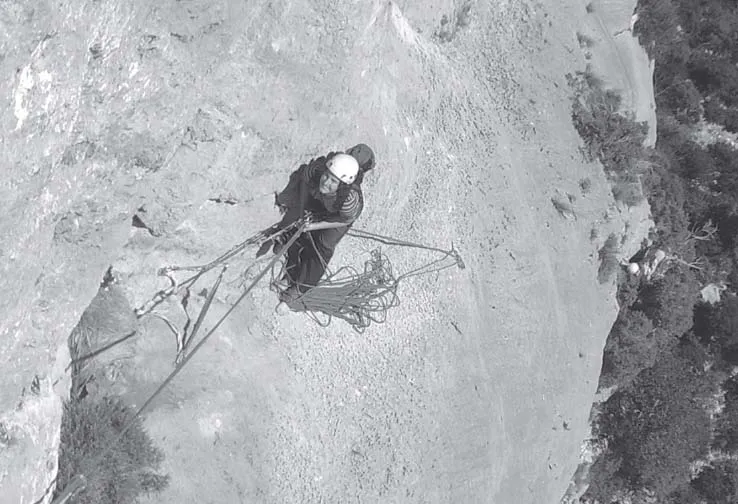
Figure 1.1: Waiting at belay [Photograph by Steve Pollard]
There should always be at least two climbers—one climbing, the other waiting, their positions alternating—linked by a rope. Often they cannot see each other and, sometimes, cannot even hear each other but must communicate through movements of the rope. On a moderate- or high-grade climb at least half the time is spent waiting. But that waiting is embedded in relationship and, in rock climbing, is never passive. There is risk and an element of danger. There may be fear and there is a necessary sense of what will be, will be. But standing waiting, tied to a rock face, there is an end point in mind that should be nurtured. As when Kubo wait for company, whatever form that ‘company’ may take, waiting at belay is of the world: it is engaged, it is situational.
The second image is a 2006 painting by Dr Hugo Heyrman that he titled Waiting (Figure 2).9 Heyrman wrote: ‘The painting shows a waiting figure … A woman protects herself from the cold. She seems to emerge from a remote distance, into our field of vision, as an unknown sign … The painting is about contemporary fragility; appearing and disappearing, becoming and vanishing’. What Heyrman did not say, but seems so striking, is that the figure in the painting appears to be ‘watching’, but neither we, nor she, knows what she may be watching. The painting offers a forceful statement of existential waiting. There is a sense of abandonment, of a self-contained world devoid of relationship, perhaps, even, devoid of engagement with all that exists beyond self. A sense of watching and waiting but with no aim in mind. Like Niko the fisherman, muttering to himself in the wheel house of his boat, the woman in the painting seems to have no way to move and no place to move to. In these contexts, waiting and watching are removed from the world. They are embodied but apart.
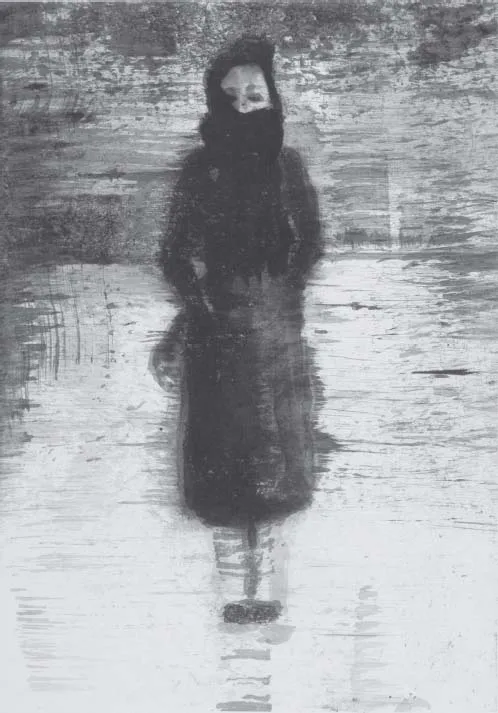
Figure 1.2: Waiting [Dr Hugo Heyrman, acrylic paint on paper]
I interpret the ethnographic fragment from Papua New Guinea as illustrative of situational waiting and the fragment from Victoria as illustrative of existential waiting. The identified difference, however, does not reflect a broader contrast between non-Western and Western experiences in the way that some scholars have suggested that boredom is a peculiarity of modernity or the ‘privilege’ of actors who dwell in ‘modern’ contexts.10 Rather, as Musharbash argued from the case of Warlpiri-speaking Australians living at the remote Northern Territory settlement of Yuendumu, boredom is elicited in particular kinds of contexts and its expression is both limited and shaped by peculiarities of local times and understandings.11 At Yuendumu, existential boredom came into being in circumstances where Warlpiri ‘ways of being in the world’ and Warlpiri conceptualisations of time were in conflict with Western ways and conceptualisations. Thus, Musharbash’s analysis of boredom is located within a frame of meanings and of possible disjunctions between different sets of meanings. Her analysis is helpful with respect to understanding the experience of waiting. It is unlikely, I suggest, that forms of existential experience—of boredom or of waiting—are likely to be prominent among people, such as Kubo, whose lives are grounded in a relational epistemology and whose daily practice, unlike that of Warlpiri, is only minimally exposed to, or encompassed by, the paraphernalia, impediments or desires entailed by Western ways of living and being.12 It is most certainly the case, however, that Westerners may be exposed to both categories of waiting. Indeed, when Niko waited beneath his upturned boat, wondering if people on the surface were planning a rescue, but knowing that eventually he might have to take the initiative, his experience was that of situational waiting. He waited. He worried. He was frightened. But without engagement in the particulars of the present his cause would be lost. Situational waiting is an experience fully embedded in time. Existential waiting is seemingly removed from time or, rather, from the meanings—linear and repetitive, yet endlessly consuming, consumed and irreversible—accorded to time in conventional Western settings. To Niko, at least, existential waiting was elicited when his whole being was encompassed by an uncertain future but, as a fisherman, his own sense of viable practice was committed to present circumstance framed in relation to past experience.
Always with Agency?
As depicted in the foregoing, situational waiting is fully embedded in time, engaged and never passive. But that account by no means covers expressions of waiting in which those who wait are quiescent—perhaps dozing—without conveying any sense to an observer that they are waiting for anything. A third image captures my intent (Figure 3).13
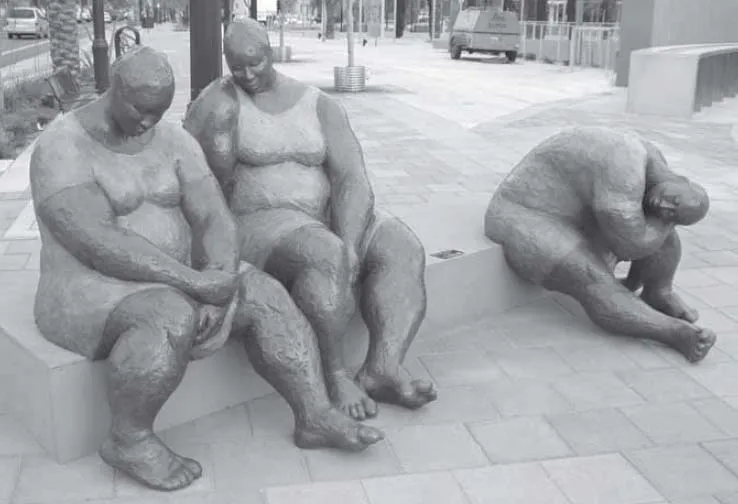
Figure 1.3: They are waiting [Sculpture by Nnamdi Okonkwo]
The sculpture They are waiting is part of a permanent display in downtown Mesa, Arizona. Nnamdi Okonkwo, the artist, said that he was inspired by life experiences: ‘It seemed like everyone was waiting for something to happen: Waiting to graduate; Waiting to get a job; Waiting to get married. In the sculpture, I use the three women to interpret this in a more universal way, showing that in life, people wait. We’ve all gone through periods of intense waiting’.
The three sculptured figures seem to be passively waiting, though, in contrast to the figure in Heyrman’s painting (Figure 2), they are comfortably in and of their surroundings. They are not apart from the world. They qualify, it seems, as an expression of situational waiting that is at a considerable remove from that revealed by either the rock climber (Figure 1) or, under my interpretation, Kubo people where, in both cases, the waiting actors participate fully in striving to bring about that for which they wait. It is not apparent from Okonkwo’s sculpture whether the women are waiting for anything in particular or are simply waiting for whatever it is that may be when they awake from their waiting state.
To the extent that situational waiting may be expressed in either active or passive ways it becomes necessary to consider the role of agency with respect to waiting. Agency, I assert, is the capacity, within the context of existing systems of relations, to act on the world rather than merely in the world. It is, as Ratner wrote, ‘intentional causal intervention in the world’, though there is no implication here that actors will necessarily achieve intended outcomes.14 Agency, then, is a universal human capacity to choose how and when to act.15 Its expressions are variable and always context-dependent. It should not, however, be seen in quantitative terms such that some actors have lots of agency, others have little and the most unfortunate have none. Such representations of agency—and they are common in the literature—confuse available options for choice, which may be quantified, ...
Table of contents
- Cover
- Title
- Preface
- Contents
- Introduction
- Part I: Between Social and Existential Waiting
- Part II: Waiting, Agency, Politics
- Part III: Waiting Affects
- Select Bibliography
- Index
- Copyright
Trusted by 375,005 students
Access to over 1.5 million titles for a fair monthly price.
Study more efficiently using our study tools.
Frequently asked questions
Yes, you can cancel anytime from the Subscription tab in your account settings on the Perlego website. Your subscription will stay active until the end of your current billing period. Learn how to cancel your subscription
No, books cannot be downloaded as external files, such as PDFs, for use outside of Perlego. However, you can download books within the Perlego app for offline reading on mobile or tablet. Learn how to download books offline
Perlego offers two plans: Essential and Complete
- Essential is ideal for learners and professionals who enjoy exploring a wide range of subjects. Access the Essential Library with 800,000+ trusted titles and best-sellers across business, personal growth, and the humanities. Includes unlimited reading time and Standard Read Aloud voice.
- Complete: Perfect for advanced learners and researchers needing full, unrestricted access. Unlock 1.5M+ books across hundreds of subjects, including academic and specialized titles. The Complete Plan also includes advanced features like Premium Read Aloud and Research Assistant.
We are an online textbook subscription service, where you can get access to an entire online library for less than the price of a single book per month. With over 1.5 million books across 990+ topics, we’ve got you covered! Learn about our mission
Look out for the read-aloud symbol on your next book to see if you can listen to it. The read-aloud tool reads text aloud for you, highlighting the text as it is being read. You can pause it, speed it up and slow it down. Learn more about Read Aloud
Yes! You can use the Perlego app on both iOS and Android devices to read anytime, anywhere — even offline. Perfect for commutes or when you’re on the go.
Please note we cannot support devices running on iOS 13 and Android 7 or earlier. Learn more about using the app
Please note we cannot support devices running on iOS 13 and Android 7 or earlier. Learn more about using the app
Yes, you can access Waiting by Ghassan Hage in PDF and/or ePUB format, as well as other popular books in Philosophy & Philosophy History & Theory. We have over 1.5 million books available in our catalogue for you to explore.