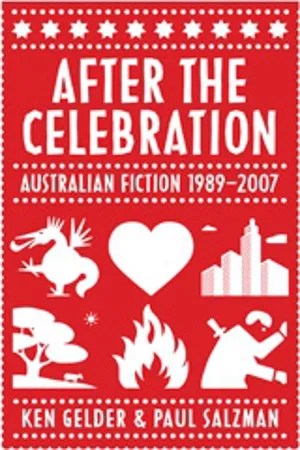
After the Celebration explores Australian fiction from 1989 to 2007, after Australia's bicentenary to the end of the Howard government. In this literary history, Ken Gelder and Paul Salzman combine close attention to Australian novels with a vivid depiction of their contexts: cultural, social, political, historical, national and transnational. From crime fiction to the postmodern colonial novel, from Australian grunge to 'rural apocalypse fiction', from the Asian diasporic novel to the action blockbuster, Gelder and Salzman show how Australian novelists such as Frank Moorhouse, Elizabeth Jolley, Peter Carey, Kim Scott, Steven Carroll, Kate Grenville, Tim Winton, Alexis Wright and many others have used their work to chart our position in the world.The literary controversies over history, identity, feminism and gatekeeping are read against the politics of the day. Provocative and compelling, After the Celebration captures the key themes and issues in Australian fiction: where we have been and what we have become.
- 296 pages
- English
- ePUB (mobile friendly)
- Available on iOS & Android
eBook - ePub
About this book
CHAPTER 1
BELONGING
In 1997 Australia’s newly elected prime minister John Howard famously said, ‘I believe that the concept of home is a compelling notion in our psyche’. This was one of those grand conservative diagnoses that seemed accurate enough at the time, even though the point was soured by the fact that at the end of Howard’s tenure as prime minister ten years later home ownership in Australia was more difficult to achieve than ever before. The investment in a ‘concept of home’, however, remained a key feature of much of the contemporary Australian fiction from the period under discussion, and this chapter will trace its various formations, its fortunes, and its misfortunes. The need to feel at home in the nation obviously suggests something about national identity itself. In the early 1990s, under Prime Minister Paul Keating in particular, reconciliation was the key: as if non-Aboriginal and Aboriginal Australians could at last come to live together and understand one another, putting the traumas of the colonial past behind them. By the late 1990s, under Howard, assimilation was the key and reconciliation was all but officially forgotten: with Australia now imagined as ‘one nation’, the role of national security dramatically heightened (this was the context for Howard’s quotation above), and the fractured trajectories of multiculturalism under sustained attack. Contemporary Australian fiction often responded to these predicaments by taking itself into the home and its environs, giving us a sense of what homeliness—settlement, domestic life and property ownership—might mean during this time. Tim Winton’s Cloudstreet (1991), Murray Bail’s Eucalyptus (1998), Andrew McGahan’s The White Earth (2004): these are novels that each dealt with themes of home and property and tied these things to an implied sense of nationhood, benignly registered in some cases (Winton and Bail), less so in others (McGahan). The ‘concept of home’ can certainly turn writers away from global paradigms and back to local issues—and to the local as a paradigm with its own particular features. Regionality becomes important all over again, linked now to issues of identity that carry with them a certain kind of politics or political disposition: on the environment, for example, or Aboriginal dispossession or the rights and extent of non-Aboriginal settlement. Family histories become important, too: important enough to make the ‘genealogical novel’ one of the primary genres in contemporary Australian literary fiction. Sometimes, the charting of genealogies works as a way of intensifying local identity and shoring up a sometimes defensive sense of homeliness in the nation. But generally speaking, the genealogical novel tends to undo localness as a construct: giving it a global dimension that cuts across a local place’s otherwise solitary disposition, showing it to be porous, constantly leaking, with people drifting in and out, some staying, but many of them transient. This, too, is an accurate enough diagnosis of what the ‘concept of home’ seemed to mean during the Howard years.
Rural Apocalypse Fiction
Nineteen-eighty-nine saw the publication of a fascinating novel that went on to win the Miles Franklin Award the following year: Tom Flood’s Oceana Fine. The title takes its name from a strand of wheat, and the novel itself is a ‘wheatbelt novel’ that relishes the irony in a character’s extravagant claim that the creation of an agricultural monoculture in Western Australia will bring with it ‘ecological salvation’.1 But Oceana Fine is also a Gothic novel, full of fables and strange occurrences, partly a family saga and partly a dark tale of murder in which a character is ‘split open like a marrow’. Carrie Tiffany’s Everyman’s Rules for Scientific Living (2005) is another ‘wheatbelt novel’, set back in the 1930s in the Mallee district in north-west Victoria, which casts a critical eye over the kind of scientific optimism that put its faith into strands of grain and superphosphates. Tiffany’s novel sees a young woman marry an idealistic scientist and move into a farm in the Mallee that—despite their investment in the best botanic developments—increasingly falls fallow, vulnerable to drought, mouse plagues and so on. Her husband is finally humiliated by the dejected locals. The wife, on the other hand, lifts her spirits with some mild erotic yearnings, not least for a Japanese man, Mr Ohno, who is later sent to an internment camp in Victoria when war breaks out. We can think about what it means for a novelist to present an eroticised, rather dreamy young woman in an increasingly ruinous rural setting presided over by men—with a stereotypically exotic ‘foreign’ character waiting in the wings. But in fact a not dissimilar predicament is played out in another Mallee district novel also set in the past, Michael Meehan’s The Salt of Broken Tears (1999). A young woman, Eileen, blows into the novel ‘like a thistle seed … clothed in nothing but the green cotton dress that flicked and chopped about her’.2 But she disappears, with the young, infatuated protagonist believing that she is travelling with a mysterious Indian hawker, Caleb Singh. Meehan’s novel is also a Gothic fable involving murder, but it relies on a couple of stereotypes to drive the narrative along: an eroticised young woman and another exoticised ‘foreign’ character, both of whom are tied metaphorically to Nature and therefore distinguished from the kind of exploitative farming that has bleached out the Mallee district, represented by the character Joe. The girl becomes a kind of mute, absent love-object that the novel continues to yearn for right up to its very last words (‘… the still voice of Eileen’). We might think that this sort of representation—a young, sensual nature-nymph in the midst of rural Australia, the fetish-object of male attention—is unusual in contemporary Australian fiction, and perhaps just a little archaic. But we shall see another version of her later on, with Holland’s daughter in Murray Bail’s Eucalyptus.
The Gothic has long been associated with rural Australia—both in literature and, over the past thirty-five or so years, in cinema, too—and it has usually been true that the more remote a place is, the more Gothic it might become. In Janette Turner Hospital’s Oyster (1996), the Queensland town of Outer Maroo has ‘kept itself off maps’, an out-of-the-way, drought-stricken place where ‘foreigners’, to the local postmistress at least, mean ‘trouble’.3 Hospital picks up on contemporary anxieties about political and religious extremism in country Australia, anticipating some of the concerns of her later novel Due Preparations for the Plague (2003). A ‘prophet’ comes to town: he ‘was like one of those bacterial forces that blindly and ruthlessly seek out the culture that will nourish them. In Outer Maroo, he found it’.4 Hospital’s novel drew on events surrounding the Branch Davidian sect under cult leader David Koresh and the siege near Waco in Texas in 1993 that led to the deaths of seventy-six sect members. It works its way towards a similarly catastrophic ending as the town is finally burnt and destroyed, with only an Aboriginal woman, Ethel, remaining behind to reclaim her land for her people. Oyster is easily identified as a ‘rural apocalypse’ novel, a genre that includes—for example—Alexis Wright’s Carpentaria (2006), where the equally remote Queensland town of Desperance is finally destroyed by a cyclone, its Aboriginal protagonist Norm Phantom also remaining behind at the end, planning to ‘rebuild on the same piece of land where his old house had been’ and ‘singing the country afresh’.5 Both Oyster and Carpentaria, each in their very different ways, equate non-Aboriginal rural settlement with ruin and failure. By contrast, their Aboriginal characters are imbued with the capacity not only to survive their dispossession but also to return to country and renew it. As we shall see with other novels discussed in this chapter, dispossession and belonging are in effect two sides of the same coin, not opposites so much as mutually implicated.
The rural apocalypse novel may not always be Gothic, of course. The last novel the eminent Queensland writer Thea Astley published before her death in 2004 was her bleakest: Drylands: A Book for the World’s Last Reader (1999). The remote town of Drylands is like Hospital’s Outer Maroo, a ‘forgotten tree-stump of a town halfway to nowhere’, ‘dying in its bootstraps’.6 The narrow-mindedness of small-town rural life in Australia has often been the target of Astley’s satirical bent as a writer. But in Drylands the satire is crude, and Astley’s literary snobbishness combines with an undisguised hatred for a younger generation that seems (to her, at least) uninterested in books, all of which lets this novel slide into a condition of unmitigated despair. Janet Deakin, a literary writer who inexplicably comes to Drylands to run the newsagency, unsurprisingly departs the town at the end, fleeing to the coast. Every vignette in the novel is a story of loss and failure. Some of the novel’s targets may well be accurate enough: the proliferation of pokie machines in country pubs, male hoon behaviour, alcohol abuse, racism and so on. But Drylands’s younger characters—boys and young men in particular—are reduced to something close to pathological, unrelentingly cruel and unforgiving. The town itself is isolated and introspective, but the novel mirrors this through its sheer intolerance for anything outside the limited range of its own metropolitan literary consciousness.
The pathologising of young boys in remote, rural settings (the opposite, perhaps, of the eroticising of young women in rural settings) is also played out in some of Sonya Hartnett’s novels, particularly Of a Boy (2002) and Surrender (2005). The latter is another Gothic story, with a mysterious wild boy who performs as a kind of village sprite, and an impressionable and deranged young boy who slaughters his parents only to become even more isolated than ever before, confined to the ‘small white tomb’ of an asylum. I have noted elsewhere just how ‘despondent’ some contemporary Australian rural novels can be, where remote country towns are imagined as parochial to the point of paranoia, behaving as if they are now permanently under siege.7 No doubt this in some way reflects Australia’s own heightened sense of ‘border consciousness’ and security during the Howard years. But in the rural apocalypse novel, these remote places are also shown to be vulnerable and porous: places where the issue of belonging, of settlement, is never quite settled. Georgia Blain’s Candelo (1998) takes its name from a desolate small country town in New South Wales, where a family’s holiday house is laden with traumatic memories. A foster child, Mitchell—another pathologised, troubled teenager—inhabits this family like an unwanted guest in the home; the more clichéd UK title of this novel, Snake in the Grass, at least precisely conveys the sense of a family undone by the presence (or absence) of an outsider. A rural apocalypse novel that more closely compares to Oyster is Carmel Bird’s Cape Grimm (2004), also built around a pathologised but charismatic cult leader called Caleb Mean, appointed as The Chosen One by the local population of a tiny, remote Tasmanian village called Skye, all of whom are then incinerated by Caleb as they gather together in the local meeting hall. ‘Once there was a fair country,’ the novel begins, ‘where the people lived in peace and prosperity until there came a time when a strange child appeared and the land was turned to dust, to dust and ashes.’8 It is difficult not to see this remarkable novel—a mixture of Gothic, fairytale, ecological lore, and Tasmanian history—as a kind of allegory for the nation itself, or at least, for a felt sense of what Australia had by this time become. Caleb is drawn as a character of mythical proportions, blown into the village just like Eileen in Meehan’s The Salt of Broken Tears—or as Bird describes it, like the effects of El Niño—a migratory figure rather than a local one, like the moonbird or muttonbird which the novel also highlights as a creature ‘that constantly wanders the earth’. Here, settlement and a kind of eternal home-lessness occupy the same site, with devastating consequences.
Rural Apocalypse Fiction 2: Andrew McGahan’s The White Earth
The rural apocalypse novel is drawn to the sorts of extreme behaviours which seem (to the novelists, at least) to flourish in remote places, some of which may well have parallels in the real world and some of which take on mythical, fantastic proportions that can make them seem like pure invention. The question of how settled local settlement might be in the midst of all this extremity—this instability—is essentially a political one, although the fantastic aspects of some of these novels can tend to smother this. Andrew McGahan’s The White Earth (2004), however, is a rural apocalypse novel that folds its Gothic visions and fantasies into a position on settlement that makes its connection to contemporary Australian political realities crystal clear. It in fact begins with an apocalypse, signalling the death of the young protagonist William’s father in a spectacular harvesting accident on the family farm in Queensland’s Darling Downs. William then goes to stay with his uncle John McIvor at Kuran House, a dilapidated stately homestead (recalling Miss Havisham’s ruinous house in Dickens’ Great Expectations) on a once-great cattle station. Property ownership and belonging are almost immediately signposted as the central themes: with the stumps of the great house ‘driven deep into the soil—but never deep enough’, and with William elated about the possibility of inheriting the property, ‘as if ownership was something that enlarged the veins and enriched the blood’.9 An elaborate genealogy is then traced in the novel, taking us back to the White family, a colonial squatter dynasty that build Kuran House and claim it as ‘a kingdom of their own’. In the meantime, John McIvor gives young William an education in Australian history. The problem is that McIvor turns out to be a rabid supporter of maverick politician Pauline Hanson’s One Nation party, and is especially incensed at the then Prime Minister Paul Keating’s support for native title: the result of the so-called Mabo decision in Queensland in 1993 that rejected the concept of ‘terra nul-lius’ (the colonial view, enshrined in law, that Aboriginal people did not, and could not, own land). He is, in other words, an outback extremist: a stock figure in the contemporary Australian rural apocalypse novel.
McIvor is also involved in a local militia, Unity Australia, which attempts to replicate—and outbid—Aboriginal claims for land by claiming that ‘Australia … is our sacred site’.10 The White Earth captures a moment when non-Aboriginal settlement in Australia—white settlement—began to panic: when the assumptions non-Aboriginal people in rural Australia, pastoralists in particular, held about their rights to ownership seemed no longer to be watertight. In a book I wrote with the cultural geographer Jane M Jacobs not long after this moment, Uncanny Australia (1998), we noted the predicament whereby pastoralists— the wealthiest group of landowners in the country—could suddenly declare themselves to be an embattled, vulnerable minority in danger of losing the land they had settled and farmed. From the late 1980s to the mid 1990s Aboriginal claims for sacred sites such as Coronation Hill and Hindmarsh Island galvanised the nation’s attention, although the success of these claims was not always guaranteed. But by 1996—the year of the so-called Wik decision (which ruled that pastoral leases do not necessarily extinguish native title), and the year in which John Howard’s Liberal coalition was elected to government—anxieties about just how much land Aboriginal people could lay claim to were being fuelled by pastoralists and farmers and a raft of conservative politicians and commentators. The Mabo and Wik decisions certainly produced their share of ‘white panic’. But they also produced their share of white mimicry. This is, for example, what underwrites the popular light comedy film The Castle (1997), directed by Rob Sitch. The narrative of The Castle is to do with an ‘ordinary’ family trying not to lose their house, but this is staged in a very particular and contemporary way, taking the protagonists all the way to Australia’s High Court with a lawyer who finally realises what to do to win the case. As we noted in Uncanny Australia, the film has a ‘white suburban family invoke the precedent of the Mabo decision to secure—in the High Court, no less—their own property rights to a home from which they are about to be dispossessed’.11 The threat of dispossession, the reliance on a Queensland court case about native title: these are not usually the things we might expect to find in narratives about non-indigenous settlement. In this chapter we shall see other, literary examples of white—or non-Aboriginal—mimicry of indigenous expressions of belonging. But for now, let me return to John McIvor, a rather defensive white property owner who takes his nephew William to a hidden-away Aboriginal sacred site precisely to perform a ritual of property ownership. ‘There are folk out there,’ he tells the boy,
who believe that the Aborigines are the only ones who understand the land, that only the blacks could have found a place like this and appreciated what it was. They think that the blacks have some magical connection that whites could never have, that we’re just stumbling around here without any idea, that we don’t understan...
Table of contents
- Cover
- Title
- Dedication
- Contents
- Acknowledgements
- Preface
- Introduction: Publishing, Publics, Themes
- 1. Belonging
- 2. Recolonising: Historical Fiction and the History Wars
- 3. Literary Fiction
- 4. Genre Fiction
- 5. Is There a Women’s Chapter?
- 6. Literary Politics
- Notes
- Bibliography
- Index
- Copyright
Trusted by 375,005 students
Access to over 1.5 million titles for a fair monthly price.
Study more efficiently using our study tools.
Information
Publisher
Melbourne University Press DigitalYear
2009Topic
LiteraturePrint ISBN
9780522855975
Subtopic
Literary CriticismeBook ISBN
9780522859218
Index
LiteratureFrequently asked questions
Yes, you can cancel anytime from the Subscription tab in your account settings on the Perlego website. Your subscription will stay active until the end of your current billing period. Learn how to cancel your subscription
No, books cannot be downloaded as external files, such as PDFs, for use outside of Perlego. However, you can download books within the Perlego app for offline reading on mobile or tablet. Learn how to download books offline
Perlego offers two plans: Essential and Complete
- Essential is ideal for learners and professionals who enjoy exploring a wide range of subjects. Access the Essential Library with 800,000+ trusted titles and best-sellers across business, personal growth, and the humanities. Includes unlimited reading time and Standard Read Aloud voice.
- Complete: Perfect for advanced learners and researchers needing full, unrestricted access. Unlock 1.5M+ books across hundreds of subjects, including academic and specialized titles. The Complete Plan also includes advanced features like Premium Read Aloud and Research Assistant.
We are an online textbook subscription service, where you can get access to an entire online library for less than the price of a single book per month. With over 1.5 million books across 990+ topics, we’ve got you covered! Learn about our mission
Look out for the read-aloud symbol on your next book to see if you can listen to it. The read-aloud tool reads text aloud for you, highlighting the text as it is being read. You can pause it, speed it up and slow it down. Learn more about Read Aloud
Yes! You can use the Perlego app on both iOS and Android devices to read anytime, anywhere — even offline. Perfect for commutes or when you’re on the go.
Please note we cannot support devices running on iOS 13 and Android 7 or earlier. Learn more about using the app
Please note we cannot support devices running on iOS 13 and Android 7 or earlier. Learn more about using the app
Yes, you can access After The Celebration by Ken Gelder, Paul Salzman in PDF and/or ePUB format, as well as other popular books in Literature & Literary Criticism. We have over 1.5 million books available in our catalogue for you to explore.