What the hell happened?
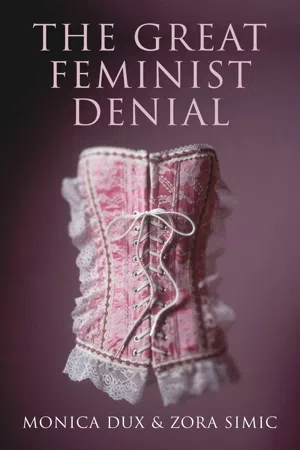
In The Great Feminist Denial the authors talk with women—feminists and non-feminists, young and old, famous and not famous, child-free and with child—and use their responses as a starting point from which to refocus the key debates.
Dux and Simic argue that, ultimately, feminism is still necessary for everyday life. Even the most cursory glimpse at the social and cultural landscape suggests an urgent need for a politics that identifies inequalities, differences and strengths specific to women as a sex.
The Great Feminist Denial puts an ailing feminist past to rest, and proposes a way forward that offers young women of today a new way of calling themselves feminists.
- 248 pages
- English
- ePUB (mobile friendly)
- Available on iOS & Android
eBook - ePub
The Great Feminist Denial
About this book
Information
PART I
Desperately seeking feminism
1
Destination feminism: Are we there yet?
On a foul, sweltering day in the middle of a protracted heatwave, Germaine Greer spoke at Adelaide Writers Week. The session was set up in her honour: ‘Germaine’s legacy: after The Female Eunuch’. Despite the murderous heat, the tent was packed.
Throughout, Greer was modest about her own achievements. ‘You owe me nothing; I owe you everything’, she insisted. Yet when she finished, the audience gave her a standing ovation.
During question time a 15-year-old girl stood up to seek Greer’s advice. She lamented the fact that the girls in her generation were highly sexualised, yet they have nothing like The Female Eunuch, no book to inspire them. What was Greer’s advice? There was a pause; then, in a characteristic Greer move, she threw it back onto the questioner. ‘Write your own book’, she told the girl, ‘for your own generation’.
However modest she might have seemed in Adelaide, the truth is that Germaine dominates the feminist pantheon. With Betty Friedan dead, and Gloria Steinem relatively well behaved, she is the most visible feminist on the planet. She has been described as the ‘queen of the soundbite’, and it isn’t hard to imagine that when she’s gone her face will end up on T-shirts, Che Guevera-like, as a symbol of the feminist revolution.
But for those of us who believe in feminism as an evolving movement with a dynamic future, it is sobering that a book published more than thirty years ago is spoken of by a 15-year-old as if it was the beginning, and perhaps the end, of feminism. Much has happened to feminism and to women since then, yet it seems impossible to separate Greer from the way in which contemporary feminism is perceived. When we started researching our book we surveyed hundreds of women, asking them for their thoughts on contemporary feminism. In all their varied responses one name popped up again and again and again: Greer. Like it or not, she persists even though the wave on which she first rode is long gone.
Greer herself has spoken of her desire to hand the baton to the younger generation, and claims that her decision to write The Whole Woman, her sequel to Eunuch, was forced on her. She never wanted to write about feminism again, but looking at the world around her, she just had to.
This book isn’t about Germaine Greer, yet throughout its writing we felt she was shadowing us. Or perhaps we were shadowing her. Like the good Christian who, when morally challenged, asks the question ‘What would Jesus do?’, we often found ourselves wondering ‘What would Germaine do?’
So, taking our cues from Greer, we started this book by looking around us, and asked: ‘Where is feminism today?’ We looked for the feminism that was manifest in newspapers, scanned our bookshops and the internet, talked to women and men, young and old. But instead of coming away with a list of feminist achievements and goals, what we found was more like a criminal rap sheet. Feminism, it seemed, had been a very, very bad girl.
The assumption underlying much of this bad press is that we have arrived at the last stop on the feminist train. We’re in a world where the feminists have ‘won’, where feminist ideals and attitudes are ingrained in everyday life, where the work is over and society is transformed. This final feminist destination is a sordid, sorry, selfish mess. All around us are poster-girls for ‘feminism-gone-wrong’: the deluded pole-dancer, a victim of false feminist ‘empowerment’; the thirty-something career woman who will miss out on babies because feminism told her she could have it all; she’s the heiress without panties; the actress with an eating disorder; the pop-star with a shaved head; the oppressed Muslim woman whom feminism ignored and abandoned.
The villain in all these narratives is ‘the feminist’, she who continues to bleat out mixed messages about what women should or should not be doing, all the while supporting her pronouncements with ridiculous arguments that can be easily cut down with common sense or a refreshing dose of anti-feminism.
On this world view, feminism is the enemy of ordinary women. Rather than citing the problems faced by women as evidence that feminism is still necessary, the scriptwriters for the feminism-gone-wrong story use them to expound another version of contemporary life: one in which feminists have had their chance and have failed.
Like all good lies, the feminism-gone-wrong story is persuasive because it is partly true. In the last thirty to forty years women’s lives really have been transformed, for better and for worse, and feminism has played a role in that transformation. The birthrate has gone down in affluent western countries, particularly among educated, white women. IVF and other fertility treatments are doing a roaring, if often futile, trade. Many women do find balancing work and family incredibly hard. Other mothers have opted out of paid work altogether. Women in Muslim countries have been forced to cover up and some have been killed in the name of family honour. Paris Hilton has made a porn video and lots of people have seen it. ‘Empowerment’ and ‘choice’, words that have been elevated to mantra status in the feminist lexicon, have been emptied of real meaning and are used to sell everything from pubic-hair removal creams to thousand-dollar shoes.
Talking about any of these phenomena in feminist terms makes sense, especially when you take into account the fact that many women from feminism’s core constituency—the white, educated, middle class—really are complaining that feminism has let them down, sold them lies and left them unhappy. Yet talking about little else other than biological clocks, pole-dancing classes and Islamic dress—along with the perennial media fodder, feminism’s ‘image problem’—is rather transparent.
Much of what we’re describing here can be understood in terms of a time-honoured anti-feminist tactic: straw feminist-bashing. Essentially, this involves setting up a caricature of feminism, built on half-truths, oversimplifications, generalisations and stereotypes, and then proceeding to beat the crap out of it. Consider this from arch-conservative US politician Pat Robertson: ‘Feminism encourages women to leave their husbands, kill their children, practice witchcraft, destroy capitalism and become lesbians.’ Of course it is true that some feminists do want to destroy capitalism, have been inspired to leave their husbands, and happen to be lesbians, or perhaps even witches. But by caricaturing feminist lives in this way, reducing them to a string of stereotypes, then adding dead children as spice, Robertson manages to draw a portrait that is guaranteed to terrify any God-fearing American who might be thinking of taking The Female Eunuch to their next book club.
Straw feminist-bashing of this kind is the traditional weapon of avowed anti-feminists. When suffragists were agitating for the vote in Australia at the turn of the twentieth century, Bulletin cartoonists were kept busy producing images of housewives invading the parliamentary chamber armed with rolling pins. Things haven’t changed that much. Feminism still challenges the status quo, so it is not surprising that those with the most to lose from the advancement of women’s rights have also been the most consistent in misrepresenting feminism, feminists and feminist arguments.
Yet, on closer inspection, contemporary feminist-bashing struck us as much more complicated than the simplistic version employed by the likes of Robertson. Instead of coming from the usual suspects— conservative guardians of the status quo—the attacks are also coming from people who claim to be speaking for feminism. People who call themselves feminists are accusing feminism of selling women lies or false dreams (journalist, and feminist, Virginia Haussegger, for example, wrote an inflammatory piece in the Age in 2002 in which she accused feminists of misleading her that fulfilment came in a briefcase, not a nappy bag). Traditional anti-feminists are claiming the feminist label, calling their new-found feminism the superior sort (a favourite trick of conservative columnists such as Miranda Devine). And commentators, some of them longstanding feminists, have accused feminism of abandoning Muslim women, refusing to help those who supposedly need them the most.
When we say ‘feminism’ we’re using an umbrella term for a political, cultural and social philosophy that aims to eradicate sexism. Real feminism assesses what ails women, and goes deep into structures and societal attitudes to try to implement change. By contrast, contemporary faux-feminist critics simply sniff out the symptoms of women’s lives in crisis and then blame feminism. This is frustrating because it turns women off feminism. It takes attention away from real feminist struggles, advances, setbacks and ideas. It supplants real feminists in their infinite variety with a single, stereotyped, monolithic ‘feminism’.
We know from personal experience that feminist blaming can be internalised—even when you know better. As women in our early thirties, the ‘feminism stole my babies’ narrative has occasionally wormed its way into our psyches, if only as a hook—we know it is not feminism’s fault if we don’t reproduce, and we know if we do have a baby (as Monica does) that feminism is not to blame for the parlous state of childcare in this country. Still, the mere fact that the ‘work-life-babies-feminism’ mash-up gets so much coverage has meant there is now a new way to ask women, many of whom are struggling with these issues, deeply personal questions such as ‘Do you value your career more than babies?’ or, Zora’s favourite, ‘Does this should-I-have-a-baby-before-it’s-too-late stuff keep you awake at night?’
There also appears to be a direct relationship between the noise made by the counterfeit feminists and the fact that real feminist spokespeople have largely disappeared from the media. Sincere politicking sells fewer newspapers and attracts fewer viewers than sensational blame-gaming; it’s basic maths, but if more space is given over to the phoneys, less remains for the genuine article. In response, many feminists have sought sanctuary on the internet, finding community in explicitly feminist blogs or in those mindful of ongoing feminist struggles.
Of course this decline in the visibility of official feminist spokespeople could be seen as evidence that feminism now belongs to everybody and not just to a select few. But such a benign reading of the situation seems less plausible when you recognise that the current boom in declaring feminism irrelevant, counterproductive, or even dead, began at exactly the same time feminism was becoming more accessible, more diverse, more plural and more fun.
But before we start sounding too conspiratorial, we want to revisit the decade in which this process began, the decade in which we ourselves first became feminists—the 1990s. Then, it was highly fashionable to be a feminist (and therefore a lesbian). Yet this phase overlapped with the suggestion that feminism had become passé. It was in the 1990s that ‘I’m not a feminist but …’ lodged itself into the vernacular, and by the end of the decade ‘post-feminism’ was presented as a self-evident truth. So, what went wrong?
Feminism for sale
It is women like us—thirty-something, educated, professional—who are the main focus of the new millennium feminist-related anxieties. It is our generation that is most often depicted as the victim of the older feminists, with their broken promises and false expectations of ‘having it all’. We’re the ones who are said to be missing out on babies, who are struggling to balance life and career, and who are in danger of ending up single and alone. But at the same time we’re also the ones who get blamed for steering things in the wrong direction, for shifting the feminist focus from practical activism to body-obsessed navel-gazing, abandoning Muslim women and others in the process.
We’re the ones who ‘betrayed’ feminism, and were also betrayed by it.
But go back fifteen years and things were very different. In the early to mid-1990s, feminism could not be denied. It could be debated, spat on, rejected, redefined and even reclaimed by men, but it was firmly entrenched as a hearty feature of contemporary life. Our generation embraced feminism more than any other, and more young women than ever discovered and claimed it for themselves. For us it was more than politics. It was fashion. It was a lifestyle.
Nowhere was this confidence more obvious than on Australia’s university campuses, which is where we first discovered feminism. By the postmodern 1990s, the focus of academic feminism had shifted: language was the new battle ground, theory was queen, and the emphasis was squarely on the triumvirate of bodies, sex and power. For us undergrads, barely out of our body-obsessed teens, this sort of politics was incredibly appealing. We were taught that language was power, so we revelled in shocking slogans and gratuitous logos. And the focus of our sloganeering was our own bodies, genitals being a special favourite. ‘I love my cunt’ was a stand-out, and both a badge and T-shirt were produced on one Melbourne campus. None of this was a gratuitous attempt to shock and confront our elders; the technical terms for what we were doing were ‘reclaiming’ and ‘subverting’.
Our brand of campus feminism melded seamlessly with grunge— Courtney Love and her dishevelled femininity, L7’s Donita Sparks, who threw a tampon at the heckling (male, we assumed) audience, and the Breeders, girls with guitars who didn’t breed. Even lightweight pop-stars like the Spice Girls were riding the feminist bandwagon, banging on about girl power and selling truckloads of CDs in the process. Feminism was ‘in’ and pop culture had come along for the ride.
But the fact that feminism had become big business also had a downside. By the mid-1990s this growing commercialisation was being described by some as a betrayal, a retreat from the serious project of structural and legislative reform that the second wave of feminism, born out of the 1960s, had delivered.
And it is at this point in the story that our villains, the unlikely duo of Helen Garner and John Howard, come into the picture.
In 1995, Helen Garner released The First Stone: Some Questions About Sex and Power, an explosive work of non-fiction in which the author despaired over the so-called ‘victim feminism’ of the younger generation, inflating a sexual harassment case in an elite university college into a campus feminist conspiracy and evidence of a ‘priggish’ feminism getting in the way of eros. The First Stone was like a bucket of ice-cold water flung through the open doors of the Wymin’s Room and aimed straight at us, the girls in the ‘I love my cunt’ T-shirts.
When Howard’s Coalition government was elected a year later, in 1996, The First Stone controversy was still raging. Howard had no official position, but feminism was in his sights. After a decade of baby-boosting policies he was able to declare in late 2006 that ‘fortunately, I think today’s younger women are more in the post-feminist period’.1 His evidence was a small rise in the nation’s birthrate. Howard’s announcement carried with it the implication that feminism had been stopping women from having sex and making babies. It followed that if they were reproducing again then feminism had obviously run its course and so he was able to perform the last rites and declare feminism dead.
Although Garner accused young university feminists of having their heads up their arses, she certainly did not set out to roll back years of women’s services. And Howard had never called himself a feminist in the first place (which is one thing the movement can thank him for). They were also hardly alone in reflecting on the state of feminism. In the 1990s, feminism was subject to regular stocktakes. Hardly surprising, since there were so many different feminisms around that even the experts were having trouble keeping track. We had femocrats, and feminist academics (such as Catharine Lumby ‘crossing over’ into the media), feminists with vibrators, modems and knitting needles (for rec...
Table of contents
- Cover
- Title
- Contents
- PART I DESPERATELY SEEKING FEMINISM
- PART II THE DEBATES
- PART III BEYOND THE DENIAL
- Epilogue
- Notes
- Bibliography
- Index
- Acknowledgements
- Copyright
Trusted by 375,005 students
Access to over 1.5 million titles for a fair monthly price.
Study more efficiently using our study tools.
Frequently asked questions
Yes, you can cancel anytime from the Subscription tab in your account settings on the Perlego website. Your subscription will stay active until the end of your current billing period. Learn how to cancel your subscription
No, books cannot be downloaded as external files, such as PDFs, for use outside of Perlego. However, you can download books within the Perlego app for offline reading on mobile or tablet. Learn how to download books offline
Perlego offers two plans: Essential and Complete
- Essential is ideal for learners and professionals who enjoy exploring a wide range of subjects. Access the Essential Library with 800,000+ trusted titles and best-sellers across business, personal growth, and the humanities. Includes unlimited reading time and Standard Read Aloud voice.
- Complete: Perfect for advanced learners and researchers needing full, unrestricted access. Unlock 1.5M+ books across hundreds of subjects, including academic and specialized titles. The Complete Plan also includes advanced features like Premium Read Aloud and Research Assistant.
We are an online textbook subscription service, where you can get access to an entire online library for less than the price of a single book per month. With over 1.5 million books across 990+ topics, we’ve got you covered! Learn about our mission
Look out for the read-aloud symbol on your next book to see if you can listen to it. The read-aloud tool reads text aloud for you, highlighting the text as it is being read. You can pause it, speed it up and slow it down. Learn more about Read Aloud
Yes! You can use the Perlego app on both iOS and Android devices to read anytime, anywhere — even offline. Perfect for commutes or when you’re on the go.
Please note we cannot support devices running on iOS 13 and Android 7 or earlier. Learn more about using the app
Please note we cannot support devices running on iOS 13 and Android 7 or earlier. Learn more about using the app
Yes, you can access The Great Feminist Denial by Monica Dux, Zora Simic in PDF and/or ePUB format, as well as other popular books in Social Sciences & Sociology. We have over 1.5 million books available in our catalogue for you to explore.