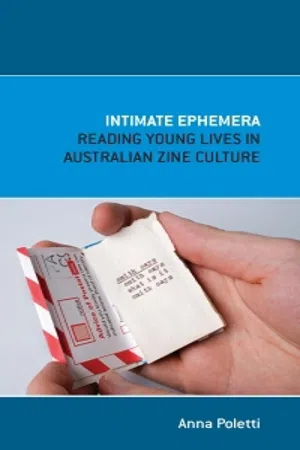
Intimate Ephemera is the first major study of autobiographical writing produced and consumed in a youth subculture. Investigating the uses of the zine form for life writing, it examines the recurrent themes in texts circulating in Australian zine culture, including depression, consumerism, popular culture and political identity.
Intimate Ephemera also examines zine culture as a unique community of life writing and reading, where handmade texts circulate in an economy of gifting and exchange utilising the postal system. The book analyses the material diversity of zines as handmade objects, examining the use of the photocopier and craft techniques in these limited edition publications, bringing a focus to the role of the text-object in communicating personal experience.
- 232 pages
- English
- ePUB (mobile friendly)
- Available on iOS & Android
eBook - ePub
About this book
Information
1
Rethinking Resistance, Authenticity and Autobiography
Theories of the zine
There is little in the way of established scholarship that constitutes a ‘field’ of zine studies. When surveying the existing literature, one finds pockets and enclaves of specific interests, and small breakaway articles. On the one hand, the scarcity of work on zines clearly illustrates Anita Harris’s suggestion that ‘there is considerable effort put in [by zinesters] to keep zines outside regulation’ (‘gURL’ 48), that zine culture continues to operate successfully ‘under the radar’. On the other hand, and more importantly, the wide variety of interest in zines points to the diversity of the publications and their uses, their applicability and interest to the fields of communications and media studies (Atton), youth studies (Harris), linguistics (Androutsopoulos), ethnography (Eichhorn), popular culture (McLaughlin), and graphic design (Triggs).
The most coherent collection of analytical articles exists in the field of youth studies and in the work of feminist sociologists working on the practices of the third-wave feminist movement known as riot grrrl. Originating in Washington DC, riot grrrl has been positioned by theorists as the epitome of third-wave feminism, and is often championed by feminist scholars as evidence of the next generation of women making feminism their own (for example, see Bail). Stemming from a critique of sexism in the independent music scenes in Washington and Olympia in the United States, riot grrrl was championed by independent bands such as Bikini Kill—whose zine Bikini Kill is often credited with publishing the first riot grrrl manifesto—and quickly developed as a grassroots political and cultural movement aimed at empowering young women as producers of independent culture (music, zines, websites) and events (Spencer 292–6). Central to the successful development and spread of riot grrrl was the formation of riot grrrl chapters, which would meet regularly in towns, suburbs and colleges to organise events, disseminate riot grrrl literature, create zines and T-shirts and form bands. While Kathy Bail claims riot grrrl as part of the movement she labels ‘DIY feminism’ which is ‘largely about individual practice and taking on personal challenges rather than group identifications’ (16), riot grrrl successfully organised, and radicalised, a section of the previous and current generations of young women through constructing a sense of solidarity among predominantly middle-class white girls and young women in countries such as the United States, Britain, Australia and parts of Western Europe.
Feminist theorists interested in the use of the zine medium in the riot grrrl movement have presented grrrl zines as an instance of ‘girls writing about their lives without an adult audience in mind’ (Schilt 73). Employing a combination of textual interpretation of zines and interviews with zine-makers, these studies focus on the use of the zine medium as a means of resisting and evading the over-determination of ‘girlhood’ in late modernity, where ageism and patriarchal ideology are seen to dominate the experiences of teenage girls (Harris ‘gURL’ 39; Leonard 115). These studies share an attendant interest in the problematisation of the concept of ‘subculture’ as it was defined in texts such as Resistance Through Rituals by focusing on the geographical distances traversed by riot grrrl texts. This process is described by Leonard as ‘using riot grrrl as a case study [to] consider how a sub-culture can maintain a sense of “community” when its participants do not meet in the collective space of a club or music venue, but are broadcast over a wide geographical area’ (101). Both Leonard and Harris prefer the use of the term ‘network’ to describe riot grrrl, arguing that its ambiguous and shifting status as public and private practice (epitomised, in their view, by the zine form) challenges the traditional gendered understanding of subcultures as predominantly masculine, street based activities (Harris ‘gURL’ 47). As we will see later in this chapter, these studies of zine culture through the lens of riot grrrl place a great deal of emphasis on zines as texts which resist external modes of regulation and definition of girls’ experience and identity (Schilt 78–9; Harris ‘gURL’ 48).
The rethinking of subculture through zines is also undertaken by Kate Eichhorn, who offers the concept of ‘textual communities’ as a means of understanding the unique practices of zine culture. In her article, ‘Sites unseen: Ethnographic research in a textual community’, Eichhorn is primarily concerned with how the ethnographic or sociological researcher can conduct research within a community which has no discernable physical sites of engagement. Eichhorn defines a textual community as constituted by people ‘brought together through a shared text, a shared set of texts, or a shared set of reading and writing practices’ and, like the theorists discussed above, places importance on ‘their ability to link people across geographic boundaries’ (566).
These discussions indicate the disciplinary affiliations of their researchers—after all, a literary or cultural studies critic does not share the same anxieties or identify the same challenges regarding the lack of physical presence in zine culture—and they also clearly demonstrate that a large portion of the (small and scattered) field of zine studies has been undertaken by researchers such as Hill and Schilt in the social sciences. Typically, these studies employ the narratives published in zines as evidence of specific subcultural practices. What we can gain from the studies on riot grrrl culture and zines is a sense of how the publications construct communities and social networks through the production and circulation of narratives.
Zine culture has also generated interest in the discipline of media and communications studies, and this discipline offers another perspective from which to think through its unique practices. In his book Alternative Media, Chris Atton approaches zines alongside other media forms from the perspective of communications theory. Primarily interested in developing a communications model which can satisfactorily depict the practices of a range of alternative media of the 1990s, Atton uses several case studies to examine how different media are used by various community and interest groups (3). Importantly, Atton argues for ‘a theoretical and a methodological framework that incorporates content as one element in an alternative media culture that is equally interested in the processes and relations that form around alternative media production’ rather than constructing a definition based on content alone (3). He constructs the following ‘topology of alternative or radical media’ as a framework for understanding alternative media:
1. Content (politically radical, socially/culturally radical); news values
2. Form—graphics, visual language; varieties of presentation and binding, aesthetics
3. Reprographic innovations/adaptations—use of mimeographs, IBM typesetting, offset litho, photocopiers
4. ‘Distributive use’—alternative sites for distribution, clandestine/invisible distribution networks, anti-copyright
5. Transformed social relations, roles and responsibilities—reader-writers, collective organisation, deprofessionalisation of, for example, journalism, printing, publishing
6. Transformed communication processes—horizontal linkages, networks. (Atton Alternative 27)
This topology offers an informative breakdown of the organisation and production of alternative media which can contribute to an understanding of how zine culture is organised, bringing attention to its horizontal organisation, the processes of deprofessionalisation, and the diversity of graphic and material modes of presentation which are used.
Atton’s interpretation of zines in his chapter ‘What use is a zine?’ also offers a sound starting point for positioning zine narratives. Examining the well-known American perzine Cometbus, Atton observes that the narration of the mundane in perzines can be interpreted:
as instances of popular production rooted in specificities of everyday life, whose authors—as active agents—project their sense of self onto cultural practices. They represent their own quotidian experiences, producing their own lives as a work. Through this they produce difference and from that difference … come social identity and social relations. (Atton Alternative 63)
Like Atton, Thomas McLaughlin dedicates a chapter of his book Street Smarts and Cultural Theory: Listening to the Vernacular to zine culture, arguing for an interpretation of zines as instances of popular cultural theorising. McLaughlin uses the example of zines to challenge the privileging of intellectual and academic modes of knowledge production in our understanding of critical thinking. McLaughlin situates his engagement with zine culture through the concept of the ‘elite fan’, which he defines as ‘following a cultural practice closely’ (23), and goes on to posit his investigation of zine culture as one which will examine the ‘overtly interpretive and theoretical activity that fans produce in the zines’, investigating ‘what issues worry zine writers when they consider popular culture, what kinds of questions they ask as critics in order to make their own sense of the text, and what kinds of theoretical insights these questions might lead to’ (55).
Elite fandom is central to McLaughlin’s interpretation of zine culture, firstly, because it allows him to position zines as a parallel to academic knowledge production, thus strengthening his overall argument that vernacular theories hold as much value as academic theories. McLaughlin resituates the obsessions of fandom, which he argues have been used to epitomise the passivity of cultural consumption (57), by asserting their similarities with academic specialisations:
A ‘fan’ who gathers expertise about early punk music or Star Trek scripts is often thought to be wasting time with debased materials and can be understood only in terms of obsession and personal emptiness. I agree that zine writers and especially publishers are obsessed … But is their commitment so different from that of the academic scholar? Certainly working on the correspondence of Victorian poets seems no less bizarre to the general public than collecting the manuscripts of early punk rockers. (McLaughlin 71)
This argument for zine producers to be recognised as critical cultural theorists is based not only upon the accumulated knowledge of the elite fan, but also on the proposition of ‘widespread fan awareness that all media culture is produced by corporate power for economic purposes’ (57).
McLaughlin’s reliance on the concept of fandom in structuring his analysis struggles to account for the diversity of topics and styles of writing in zine culture. This problem is partly brought about by the absence of a theory of audience for the zine, as the positioning of zinesters as ‘fans’ posits them as audience for the products of popular culture, and zines as an instance of the members of an audience talking among themselves (69). While this characterisation seems fitting for the publications discussed by Jenkins (who explicitly designates them as ‘fanzines’), it fails to account fully for zine culture as partly constituted by practices of reading zines, where the zines themselves construct and imagine an audience, both within and outside the subcultural context. Also, the epistemological privilege given to the status of the elite fan makes extensive knowledge and familiarity with specific cultural practices the condition of conferring the status of ‘theory’ to any zine publication, leaving the position of autobiographical zines (where one is a ‘fan’ of oneself?) indeterminable at best.
McLaughlin’s study, however, does give a strong conceptualisation of the zine form as constitutive of a critical approach to mass-produced culture, where the preference for ‘the raw rather than the cooked’ in zine texts is seen as requiring specific reading strategies which (pre)suppose a different ‘mindset’ to traditional practices of cultural consumption (75).
Kirsty Leishman indicates a useful realignment of McLaughlin’s theory of the vernacular in her discussion of Australian zine culture’s internal debates regarding the status of the form, and its relationship to institutions of cultural power (such as the academy and the mainstream press). Leishman suggests that McLaughlin’s statement, that vernacular theory ‘makes a distinctive contribution to understanding popular culture because it comes from a perspective that academic cultural theory cannot adopt’ (McLaughlin 62), facilitates the recognition that Australian zine culture’s extensive theorisation of itself ‘has contributed substantially to the understanding of the popular culture practice of zine publishing’ (Leishman 33). This repositioning of the concept of vernacular theory to include the self-conscious theorising of zine practice encourages scholars working on zines to recognise the discussions within the zine community as relevant to their critical analysis.
In these studies, the reliance on the concept of resistance can be understood as symptomatic of the highly influential interpretative frameworks introduced by the Birmingham Centre for Contemporary Cultural Studies, which initiated the study of youth subcultures beyond the prevailing models of deviance. The intractable problems of reading for resistance are well documented in the recent theorising of cultural studies (see Pile 1–5; Bennet 600-603). Andy Bennet and Keith Kahn-Harris point out that the resistance model of youth culture developed by the Centre for Contemporary Cultural Studies in Birmingham in the early 1970s overlooks a range of factors influencing how and why young people adopt particular subcultural practices. These include: overestimating the presence of collective, cohesive and static class consciousness in participants of youth subcultures such as punk; neglecting the possibility that subcultural participation can be done for ‘fun’ rather than for sustained political purposes; and overlooking the distinctions within class groups which influence why some will take up a particular subcultural positioning while others will not (6–9). The resistance approach to zines is characterised by the interpretation of zine narratives as instantiations of ideologies that stand in opposition to mainstream late capitalist consumer and media culture, and contends that zines are defined by that oppositional stance. Whether it is ‘third-wave’ feminist ideology of riot grrrl, vernacular theory (McLaughlin) or native reporting (Atton), the ideologies evidenced in zine practices are read as modes of resisting the dominant contemporary political and economic ideologies and concepts of subjectivity.
The centrality of oppositional positioning in scholarly explorations of zines is epitomised by Stephen Duncombe in his introduction to Notes from Underground: Zines and the Politics of Alternative Culture, the only book-length study of contemporary zine culture:
In an era marked by the rapid centralization of corporate media, zines are independent and localized, coming out of cities, suburbs and small towns across the USA, assembled on kitchen tables. They celebrate the everyperson in a world of celebrity, losers in a society that rewards the best and the brightest. Rejecting the corporate dream of an atomized population broken down into discrete and instrumental target markets, zine writers form networks and forge communities around diverse identities and interests. (Duncombe 2)
For Duncombe, the study of zines offers a means of analysing a mode of cultural production and consumption which is an ‘alternative … way of understanding and acting in the world that operates with different rules and upon different values than those of consumer capitalism’ (6). The practices of trade and gifting, not-for-profit cultural production and valorisation of amateur aesthetics are interpreted by Duncombe as instantiations of political resistance through cultural production, and indeed it is an interest in political resistance which structures Duncombe’s analysis of zine culture (3). Duncombe defines the study of the ‘politics of zine culture’ as interrogating the following elements of zines:
what zine writers articulate—either explicitly, or as is often the case implicitly—as being the problems of the present culture, economic, and political system; what they imagine and create as possible solutions to these problems; and what strategies and chances they have for actualising these ideals on both a small and a large scale. (Duncombe 3–4)
This interest in the political potential of zine culture interprets zine texts and the practices which surround their production and consumption as a predominantly political practice expressed through a cultural form. As an approach to a textual community, the resistance approach to zines privileges what they say, rather than how they say it. Like the studies of riot grrrl culture, vernacular theory and alternative media, Duncombe’s study (which in many ways can be seen as the nucleus of contemporary zine theory) reads the narratives of zine culture as windows into political ideology.
This interpretative dual focus—which reads both the texts and the circumstances of their production and consumption, privileging the ideological—can be understood as a response to the direct links and blurrings that zine culture practises. As the close readings of zines in this book will illustrate, zines continually reflect upon and draw attention to their status as object and text, as well as the practices that create them. To this point, analytical approaches to zines have predominantly focused on theorising the practices of zine-making and how political interests are represented in zine texts. While Harris, Schilt and Leonard extrapolate riot grrrl philosophies from particular zines, Atton and McLaughlin have constructed particular theoretical catch-alls for zine culture which focus on the alternative or popular interests expressed in zines. Similarly, Duncombe uses the concept of the political underground and the ‘bohemian diaspora’ to structure the zine-making experience (33). These theorisations attempt to take into account the diversity and multiplicity of zine cultures (in the United States, Australia ...
Table of contents
- Cover
- Title Page
- Copyright
- Contents
- Acknowledgments
- Author’s Note
- Introduction
- 1 Rethinking Resistance, Authenticity and Autobiography
- 2 Zines making Zinesters
- 3 Narrating and (Re)Figuring the Bedroom
- 4 Consuming Selves
- 5 ‘Singing Hollow Winds’: Narratives of Depression
- 6 Materialising Intimacy: Reading the Perzine as Autobiographical Object
- Conclusion
- Bibliography
- Index
Trusted by 375,005 students
Access to over 1.5 million titles for a fair monthly price.
Study more efficiently using our study tools.
Frequently asked questions
Yes, you can cancel anytime from the Subscription tab in your account settings on the Perlego website. Your subscription will stay active until the end of your current billing period. Learn how to cancel your subscription
No, books cannot be downloaded as external files, such as PDFs, for use outside of Perlego. However, you can download books within the Perlego app for offline reading on mobile or tablet. Learn how to download books offline
Perlego offers two plans: Essential and Complete
- Essential is ideal for learners and professionals who enjoy exploring a wide range of subjects. Access the Essential Library with 800,000+ trusted titles and best-sellers across business, personal growth, and the humanities. Includes unlimited reading time and Standard Read Aloud voice.
- Complete: Perfect for advanced learners and researchers needing full, unrestricted access. Unlock 1.5M+ books across hundreds of subjects, including academic and specialized titles. The Complete Plan also includes advanced features like Premium Read Aloud and Research Assistant.
We are an online textbook subscription service, where you can get access to an entire online library for less than the price of a single book per month. With over 1.5 million books across 990+ topics, we’ve got you covered! Learn about our mission
Look out for the read-aloud symbol on your next book to see if you can listen to it. The read-aloud tool reads text aloud for you, highlighting the text as it is being read. You can pause it, speed it up and slow it down. Learn more about Read Aloud
Yes! You can use the Perlego app on both iOS and Android devices to read anytime, anywhere — even offline. Perfect for commutes or when you’re on the go.
Please note we cannot support devices running on iOS 13 and Android 7 or earlier. Learn more about using the app
Please note we cannot support devices running on iOS 13 and Android 7 or earlier. Learn more about using the app
Yes, you can access Intimate Ephemera by Anna Poletti in PDF and/or ePUB format, as well as other popular books in Social Sciences & Media Studies. We have over 1.5 million books available in our catalogue for you to explore.