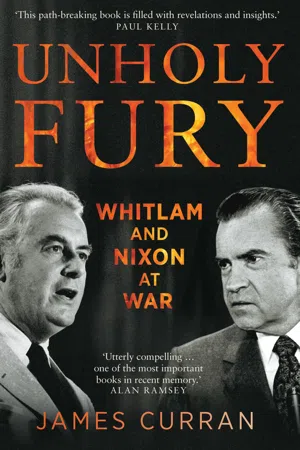
In the early 1970s, two titans of Australian and American politics, Prime Minister Gough Whitlam and President Richard Nixon, clashed over the end of the Vietnam war and the shape of a new Asia. A relationship that had endured the heights of the Cold War veered dangerously off course and seemed headed for destruction. Never before—or since—has the alliance sunk to such depths.
Drawing on sensational new evidence from once top-secret American and Australian records, this book portrays the bitter clash between these two leaders and their competing visions of the world.
As the Nixon White House went increasingly on the defensive in early 1973, reeling from the lethal drip of the Watergate revelations, the first Labor prime minister in twenty-three years looked to redefine ANZUS and Australia's global stance. It was a heady brew, and not one the Americans were used to. The result was a fractured alliance, and an American president enraged, seemingly hell bent on tearing apart the fabric of a treaty that had become the first principle of Australian foreign policy.
- 414 pages
- English
- ePUB (mobile friendly)
- Available on iOS & Android
eBook - ePub
About this book
Trusted by 375,005 students
Access to over 1.5 million titles for a fair monthly price.
Study more efficiently using our study tools.
Information
Topic
ArtSubtopic
History of Art1
‘ON THE RIGHT SIDE’:
NIXON IN AUSTRALIA
In October 1953 the United States vice president, Richard Milhous Nixon, arrived in Australia as part of an extensive tour of Asia and the Pacific. He was the most senior serving American politician ever to visit the country. Coming only eight years after the end of World War II and barely two years after the signing of the ANZUS treaty in September 1951, Nixon’s arrival served as a powerful reminder of American triumph in the battles of the Pacific and a symbol of the US commitment to Australia in a dangerous Cold War world. During a seventy-day international odyssey Nixon also called in on nineteen other countries, as well as Hong Kong and the Japanese island of Okinawa. None of these places had ever before had a visit from an American vice president or president. For a political figure whose later time in the Oval Office would come to be dominated by Asia, the trip was an unprecedented opportunity to meet many of the leaders with whom he would do business over the next two decades. It gave him a chance, he later recalled, to ‘assess Asian attitudes toward the emerging colossus of Communist China’. Nixon, who was well known for his relentless anti-communist crusade on the American home front, was now stepping onto the world stage.1
During his short time in Australia, Nixon visited Sydney, Melbourne and Canberra, meeting with Prime Minister Robert Menzies and the federal Cabinet, Opposition leader HV Evatt and a number of trade union leaders. He addressed Australian parliamentarians at a lunch in Canberra, sat in on Question Time, laid a wreath at the war memorial and visited a nearby sheep station where he saw shearers in full cry. In Melbourne, the local press badgered him for his inability to hold a cricket bat properly during a visit to the Melbourne Cricket Ground while he inspected the progress of preparations for the 1956 Olympics. ‘Oh, No, Mr Nixon, Not that way!’ blared the Argus, its reporter marvelling at the vice president’s ‘mock cricket strokes’, as he held the bat and swung it ‘violently in a baseballer’s grip over his shoulder several times’. Flattering his hosts, Nixon told Australians to ignore the criticism and inevitable wrangles that came with the organisation of a world sporting event. ‘You’ll hold the best Olympic Games ever’, he said. ‘You have the climate, the stadium and one other asset—you have a wonderfully sports-minded people’.2
The vice president was characteristically meticulous in preparing for each leg of his Asian tour. He carried with him a message of goodwill from President Eisenhower and came armed with rhetoric of reassurance for regional friends and allies. En route to Australia he read of the country’s struggle to emerge from the physical and psychological horrors of the Pacific War. The Australians had ‘not forgotten the Japanese bombing of Darwin, nor the cruelties of prisoner of war camps’. Though his hosts were concerned by the threat of Communist China and Soviet Russia, ‘the average Australian still thinks of Japan as the historic enemy’, an anxiety which was ‘but one aspect of the fear that the “teeming millions” of Asia might be attracted to the relatively empty spaces of Northern Australia’. Both political parties ‘fully realize that Australia’s security depends on firm ties with the United States … even if history, geography and the current power structure in the Pacific did not dictate that Australian foreign policy align itself closely with that of the United States, the similar democratic social institutions of the two countries would inevitably lead them to see world problems in much the same light’.3 In short, he was on the terra firma of a future staunch ally.
Nixon’s credentials as a Cold War warrior were impeccable, and he gave full voice to this ideological fervour during a live radio broadcast over the ABC. He was speaking to a society which, much like his own, believed communism posed a fundamental threat to liberal democracy, religion and property. In the face of what many perceived to be an existential threat to their values and way of life, Nixon emphasised that the United States and Australia were ‘on the right side … the side of freedom of justice’.4 His country had ‘no intention of constituting itself as the sole bastion of military strength for the free world’. In a further clarion call for western unity, he said ‘we must stand together or we will fall together … the only people concerned in dividing us are the men in the Kremlin’. Addressing the people during his nationwide radio talk, Nixon assured them of American resolve in meeting this challenge, a homily honed over many years: ‘the only major threat to the peace of the world today’, he told listeners, ‘is the international Communist conspiracy, with its power centre in the Soviet Union’. History had shown that ‘four times since they came to power in 1917 the Communists have talked peace while in reality preparing for war. We don’t want to be fooled … we cannot let down our guard’.5 It was a classic enunciation of the lessons of Munich for Cold War geopolitics. Like many of his contemporaries in America, Europe and Australia, Nixon argued that the pusillanimous response of western leaders to the rise of Hitler in the 1930s, and especially at the September 1938 Munich conference, was a catastrophic loss of nerve that caused World War II and must not be repeated. If unchecked, the Kremlin’s ambition, like Hitler’s armies, would sweep all before it. Soviet aggression had to be stopped and the spread of communism contained. ‘Appeasement’ was no longer an option.
Not all, however, were entirely enthusiastic about Nixon’s presence in Australia. Local officials in Canberra were sorely disappointed that their distinguished guest seemed oblivious to a memorial then under construction on Russell Hill: a soaring column surmounted by an emblematic eagle to mark Australian gratitude for America’s defence of the country in World War II. A surprised and somewhat embarrassed Nixon hastily inserted a line into his radio broadcast to give ‘heartfelt thanks’ to the Australian people, saying how ‘moved’ he had been by this tribute to America’s ‘fighting men’.6 The memorial still towers over the Defence Department complex in Canberra today.
A FRIENDSHIP OF MUTUAL RESPECT
American diplomats spoke glowingly of Nixon’s ‘substantive and courageous talk’ to politicians in Canberra, but the rhetoric did not soothe every ear. Menzies told the British high commissioner, Sir Stephen Holmes, that while the speech was ‘admirably phrased and produced’, he had been aghast to learn from journalists travelling with the vice president that it was Nixon’s eleventh performance of the same act. Clearly the prime minister, himself a silken orator, believed that the visiting vice president should have crafted a speech uniquely for his Australian audience. But Menzies also confided to Holmes that Nixon ‘did not have a clue’ about what being in government meant. Such a verdict on Nixon’s lack of experience in high office was, however, overwhelmed by Menzies’ ongoing doubts about America’s rapid rise to global pre-eminence, and what that meant for the role and responsibility of the British Commonwealth. In their private conversation, the prime minister told Nixon he was ‘worried that the United States had assumed responsibility with unprecedented power’, a clear indication of his ongoing unease about American credentials for world leadership. Nevertheless he added that ‘Though he was British to [the] bootheels, we must work together in the Pacific’.7 No doubt, too, Menzies was frustrated by Nixon’s handling of delicate questions put to him during the meeting with ministers, when the vice president deftly dodged the thorny topics of why American tariffs were hurting Australian farmers, and why Washington was refusing to share atomic secrets with the British government. News of Nixon’s arrival in the country had jostled for space with headlines detailing the detonation of Britain’s first atomic weapon at Woomera in the South Australian desert.
On the other hand, this Australian prime minister would not be quickly forgotten by Richard Nixon. In his private, handwritten notes from the visit, Nixon wrote warmly of Menzies being ‘big, blue-eyed and grey haired’, ‘good at cutting people to size’, and ‘nice to the common people’.8 Later, in his memoirs, Nixon added that Menzies had made an ‘indelible impression’ on him during this 1953 visit. He was convinced that, had he been born in Britain, Menzies ‘would have been a great British prime minister in the tradition of Winston Churchill’.9 An appraisal of Menzies in his subsequent book Leaders was even more glowing, Nixon describing his friend being ‘as big as all Australia in body as well as spirit and outlook’. But along with Menzies’ knack for repartee and his talent in the art of conversation—on that skill Nixon ranked him highest amongst all the world leaders he had met—there was praise for his oratorical prowess, staunch anti-communism, even his contempt for the press and big business.
A deeper current, however, flowed through their respective political lives. ‘Like so many other great leaders’, Nixon wrote, ‘Menzies was toughened by his years in the wilderness. When he took power again, he was much more confident of his abilities and sure of his goals’.10 That theme, of rejection and isolation followed by electoral redemption, was the narrative that bound these two leaders together. It was a shared experience, a tale in which two prominent political figures, both deemed finished after previous stints in leadership roles, return in triumph to dominate the stage in their respective countries. It was an experience often discussed at their meetings over that decade and into the next. No Australian leader with whom Nixon would subsequently deal—be it John Gorton, Billy McMahon or Gough Whitlam—could ever have hoped to attain the cherished place occupied by Menzies in Nixon’s pantheon of world leadership. Indeed, it would be fair to say that in Richard Nixon’s eyes, Robert Menzies was the epitome of the Australian statesman.
So began a friendship of mutual respect between the two men that was to last until the late 1970s. After this first meeting in Canberra, Nixon and Menzies were to meet regularly during the Australian leader’s trips to the United States and the two would often correspond, send each other their respective books, and swap notes on the political issues of the day. Speaking to the House of Representatives in August 1959, Menzies spoke of the ‘several long talks’ he had with the vice president on his latest trip to Washington, praising his ‘bold approach to international problems’. Menzies was referring specifically to Nixon’s visit to Latin America in 1958—where his motorcade was viciously attacked by angry rioters in Venezuela—and to the famous kitchen debate between Nixon and Soviet leader Nikita Khrushchev in Moscow, in which the two had squared off in an impromptu debate over the respective merits of capitalism and communism. The vice president’s approach, Menzies said, was one that ‘commends itself to the Australian mind. It is quite clear that [Nixon] is a great believer in going to the seat of the trouble and meeting other people freely and frankly … this seems to me to be essential in the near future of the world’.11 Although these were plaudits typical of a leader in an alliance with a great power, the compliment was returned. Nixon wrote in praise of TIME magazine’s cover story on Menzies in April 1960, saying he had been most pleased by the article’s ‘frank recognition that the conservative economic policies which your government has so courageously and effectively applied have been primarily responsible for Australia’s remarkable progress since World War II’.12 And in early February 1969, only a matter of weeks after Nixon’s inauguration as president, Menzies was the guest of honour at a specially convened White House dinner, along with Secretary of State William Rogers, National Security Adviser Henry Kissinger and former Republican presidential candidate Thomas Dewey. As Menzies recounted to his daughter, ‘the new president and all the others put questions to me and were anxious to get my views’. Writing subsequently to Nixon in appreciation, the former Australian leader expressed confidence to his long-time friend that ‘the team you have around you will be highly successful and … you will play a notable part in the administration of your great country’.13 The Nixon—Menzies relationship was much more than a link born of mutual appreciation and admiration: they were the essence of an Australian and American Cold War conservative political culture in which the way to handle the challenges of domestic politics, the region and the world tended to merge.
On the other side of Australian politics, however, it was a very different story. Before his 1953 visit to Australia, the State Department in Washington warned the vice president of ‘elements within the Labor party [which] consider the Menzies government too acquiescent to American leadership on international issues’. Nixon’s summary of Labor leader Evatt was blunt: he was a ‘difficult man’, one that the United States needed to ‘cultivate’.14 His public broadcast, however, reserved special praise for Australia’s trade unions and their ‘cleaning out [of] the Communists’, the visit coming at a time when Australia itself remained divided over the threat of internal subversion. Two years earlier, Menzies had launched an ultimately unsuccessful attempt to ban the Communist Party in Australia. Nixon later commented that the talks held with officials of the labour movement were among the most important of his brief stay.15 No matter how much this Asian trip was meant to allow him the opportunity to broaden his outlook beyond the red-baiting for which he was so well known, time and again he returned to his cherished theme: dealing with the enemy at the gates.16
But with memories of those ‘nerve-racking years’ of the Pacific war still so fresh, journalists in Australia wove the presence of the American ‘second in command’ into a ready-made narrative about wartime cooperation and shared interests in uncertain times.17 Nixon’s stay was seen as ‘eloquent testimony to America’s undiminished interest in, and friendship for, her continental neighbour in the South-West Pacific’. It was reassuring for Australians to ‘find President Eisenhower’s deputy expressing his opinion that “this great country of yours is as indispensible to our security as we are to your security”’.18 This was precisely the language that Australian leaders wanted to hear: the words of mutual reassurance, rhetoric which satisfied a deep and longstanding Australian desire for great power protection in a region seen as threatening and unstable. As one editorial stated, the vice president might have had an exacting programme, but he would certainly ‘have time to realise that the alliance means far more to Australians than a formal treaty’.19 Or, as another scribe mused, Nixon’s ‘impressions of Australia, however fleeting, are likely to become President Eisenhower’s impressions of Australia. On that basis his coming could have limitless consequences for this country’.20
That might have been nothing more than the throwaway line of an excited journalist, but in the succeeding decades, Richard Nixon was to have a major influence on Australia, its political leaders and the nation’s place in the world. And for one politician listening to the vice president’s luncheon address in Canberra during that visit, those consequences were to prove profound indeed.
A DIFFERENT VIEW OF THE COLD WAR IN ASIA
In October 1953 Gough Whitlam was not even one year into his first term in the federal parliament. Elected to the western Sydney seat of Werriwa at a by-election in November the previous year, he had only recently made his first speech to the House of Representatives on international affairs. A veteran of World War II, in which he served with the Royal Australian Air Force, Whitlam spoke a very different language to Nixon about the coming of the Cold War to Asia. He had little time for the rhetoric of fear and dread, and did not see Asian communism as an insidious kind of red lava, seeping into Australia from the north. He understood that the region around his country was changing—and quickly. The retreat of the European empires and the rise of new nations were to be welcomed: ‘The best way to deal with any red menace, as we so glibly term it, is to give [the emerging nations] self-government.’ The new Asian states, he went on, were ‘entitled to self-government within the world community of nations, the United Nations, of which Australia is one’.21 Whitlam was laying out the foundations of his own world-view, one which combined hard-headed realism—he argued consistently that the Soviet Union and China were part of the irreversible facts of great power politics—with liberal internationalism, which looked above all to foster international understanding and cooperation among nations.22
Whitlam’s first speech on these questions—one month before Nixon’s arrival in Australia—responded to a statement by the minister for external affairs, Richard Casey. Casey was reporting on the outcomes from the first ANZUS council meeting, a forum of Australian and American officials established when the treaty had been signed. The debate, Whitlam recalled, was ‘characterised by unan...
Table of contents
- Cover
- Title
- Copyright
- Contents
- 1: ‘On the Right Side’: Nixon in Australia
- 2: ‘Put on Notice’: Lessons from America
- 3: ‘Entangled’: Labor’s Cold War Dilemma
- 4: ‘The Most Generous ... Idealistic Nation’: Whitlam and the Americans
- 5: ‘Pathfinder for Nixon’: Whitlam’s China Coup
- 6: ‘An Absolute Outrage’: The Christmas Bombings
- 7: On Nixon’s ‘Shit List’: A ‘Downward Slide’ in Relations
- 8: American ‘Trouble Shooter’: Marshall Green Comes to Canberra
- 9: ‘One Hour’ in Washington: Defining the New ‘American Connection’
- 10: ‘Heating up the Crucible’: An Alliance in Peril
- Conclusion: ‘Almost Incomprehensible’
- References
- Select bibliography
- Acknowledgements
- Index
- Picture Section
Frequently asked questions
Yes, you can cancel anytime from the Subscription tab in your account settings on the Perlego website. Your subscription will stay active until the end of your current billing period. Learn how to cancel your subscription
No, books cannot be downloaded as external files, such as PDFs, for use outside of Perlego. However, you can download books within the Perlego app for offline reading on mobile or tablet. Learn how to download books offline
Perlego offers two plans: Essential and Complete
- Essential is ideal for learners and professionals who enjoy exploring a wide range of subjects. Access the Essential Library with 800,000+ trusted titles and best-sellers across business, personal growth, and the humanities. Includes unlimited reading time and Standard Read Aloud voice.
- Complete: Perfect for advanced learners and researchers needing full, unrestricted access. Unlock 1.5M+ books across hundreds of subjects, including academic and specialized titles. The Complete Plan also includes advanced features like Premium Read Aloud and Research Assistant.
We are an online textbook subscription service, where you can get access to an entire online library for less than the price of a single book per month. With over 1.5 million books across 990+ topics, we’ve got you covered! Learn about our mission
Look out for the read-aloud symbol on your next book to see if you can listen to it. The read-aloud tool reads text aloud for you, highlighting the text as it is being read. You can pause it, speed it up and slow it down. Learn more about Read Aloud
Yes! You can use the Perlego app on both iOS and Android devices to read anytime, anywhere — even offline. Perfect for commutes or when you’re on the go.
Please note we cannot support devices running on iOS 13 and Android 7 or earlier. Learn more about using the app
Please note we cannot support devices running on iOS 13 and Android 7 or earlier. Learn more about using the app
Yes, you can access Unholy Fury by James Curran in PDF and/or ePUB format, as well as other popular books in Art & History of Art. We have over 1.5 million books available in our catalogue for you to explore.