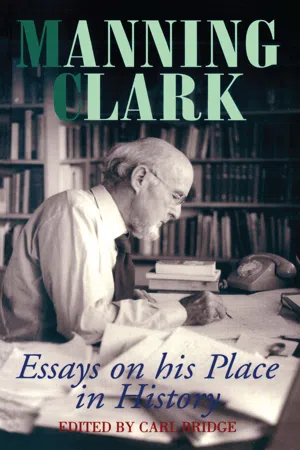
Manning Clark's work provokes violent reactions for and against. His majestic six-volume A History of Australia 'helped us to know who we are'. Yet attacks on Clark stretch back fifty years, and Peter Ryan accused him recently of writing 'gooey subjective pap, much of it false'.
These essays offer detailed, scholarly analysis of the History—its style and structure, its dominant themes, its treatment of women and Aborigines, its sense of place, its reliability. They examine Clark's place among Australian historians, artists and writers, his public role as 'the best guru in the business', his teaching methods, his philosophy of life, and his thinking on national identity.
How should we judge Manning Clark's contribution? What is his place in Australian history? This book seeks to inform opinion and to steady the debate. Its contributors include historians, political scientists, literary critics, classicists, men and women, young and old, friends and enemies.
eBook - ePub
Manning Clark
About this book
Information
Topic
HistoriaSubtopic
Historia del mundo1
Remembering Manning
The Exploration of the Human Heart
DON BAKER
It so happened that I first met two of Australia’s best known, most fluent and most influential historians when I was a schoolboy at Geelong Grammar. The first was Russel Ward who came to Corio in 1935 or 1936. He was then not much older than the senior boys in the school and I remember him walking over the playing fields to the junior school looking like a Greek god. I was never in one of his classes but nevertheless he taught me more than did several of the masters directly responsible for instructing me. For Russel was a teacher to whom a boy could talk and be understood. I remember taking to him a political cartoon from some left-wing journal, perhaps the Communist Party Tribune, and asking him why it was done so crudely. He tried to explain to me that working-class journals could not afford to pay for the best cartoonists and needed to adapt their message to their audience.
The second man I met at Corio who became a well-known historian was Manning Clark. He came to Geelong Grammar about the middle of 1940, which was my last year at the school. We were therefore together, at first, for only a few months.
But this contact, though brief, was intense. Like Russel, Manning was a man to whom a boy could talk and who was given to making the most provocative and enigmatic remarks. When talking to Manning in those days, I had the feeling that some new important truth was just beyond my grasp; that if I stretched my imagination just a little further I would comprehend some fresh aspect of reality.
For those few months Manning was one of my formal teachers and his influence on all those he taught was remarkable. He was much better informed than most of the teachers at Geelong, the average quality of whom was not high. He had a much readier wit. You were sure of good laughs in his classes. And then he was delightfully subversive of the conventional moralities which were pious, bourgeois, imperialist and boring. When told that one of the old boys of the school was joining the army, Manning asked, ‘Ah, is he going to bare his breast to the German bayonets?’ How does a school boy answer that question?
My next contact with Manning was after the war, in 1946, when he began teaching Australian history in the University of Melbourne. Indeed one might almost say he invented Australian history, at least as an accepted and respectable academic subject. Earlier there had been, here and there, in several Australian universities, a little teaching of Australian history as an appendage to modern British history or as a part, a fairly minor part, of imperial history. Manning was the first to establish Australian history as a year-long unit in its own right.
It is now difficult for us to understand what a revolutionary step he took in 1946. Very few people at that time thought that Australian history was worthy of serious study. In schools, people of my generation got a pretty thorough grounding in the three-field system of an English mediaeval village; if we learned any Australian history at all, we traced the routes of explorers on a map marked with lines of different dots and dashes. How could this possibly be an academically respectable subject?
Where were the books that university students of Australian history would use? There were some. The three names that come most readily to mind are Timothy Coghlan, Eris O’Brien and Brian Fitzpatrick. A very diverse bunch with very different training, interests, beliefs and attitudes. But one thing they had in common was their Irish heritage which placed them outside the Anglo-Imperial outlook of the Australian establishment and enabled them to see the possibilities of Australian history as a field of study. Manning, too, managed to escape the prevailing views of the Australian establishment despite his father being a priest of the Church of England and despite his years as a boy at Melbourne Grammar School. How did Manning manage to stand away from his contemporaries and look at their beliefs from outside?
Perhaps his mother was important in this respect. It is true that no-one could have been more respectable, but she proudly traced her ancestry in Australia back to Samuel Marsden and had a keen sense of the length and richness of Australia’s past. Certainly, Dymphna Lodewyckx was very important in showing Manning the richness and significance of the world beyond the confines of Englishness. Dymphna was the daughter of the Associate Professor in German at the University of Melbourne. He was Flemish and there were close Scandinavian relatives and ancestors as well. Dymphna studied European languages at the University, finding them easy to learn. She and Manning when undergraduates were friends. They married after Manning had gone to Balliol to study modern European history.
The few years, 1938 to 1940, that Manning was outside Australia were vital in his becoming fully Australian. He was appalled by the rigidity and the extremes of English class distinctions. As Ric Throssell has said from his similar experience, ‘Privilege had poisoned British society’. The talk was all of democracy; the reality was a nauseating hypocrisy which quite failed to disguise extremes of poverty and wealth which, in turn, produced the almost complete alienation of one class from another, an alienation unknown in Australia. The common assumption of Melbourne Grammar, or Toorak, or the Melbourne Argus that England was the real centre of enlightenment and democracy began to look very hollow.
Then Manning and Dymphna went to Germany. Dymphna had been to school in Munich in 1933; she knew the country and was fluent in the language. She showed Manning a great civilisation, a civilisation then being perverted by Nazi bully boys, but a civilisation rich in traditions of music, literature and scholarship. The world looked very different from central Europe. He and Dymphna also went to France. Here was another great society and one not shy about proclaiming the superiority of its culture. It became clear to him that the accepted belief of the Anglo-Australians, that England was the true centre of civilisation and enlightenment, was not readily accepted by other parts of the civilised world.
Manning saw that an Australian history of Australia was possible. But what sort of an Australian history was it to be? In many ways it would be a pessimistic history because Manning, for all his love of life and his huge sense of fun, was a deeply pessimistic man. The cruelty he had first witnessed in the dormitories of Melbourne Grammar, and which he had subsequently experienced and observed in adult life, convinced him that the human heart was always a battlefield between good and evil and that evil all too often triumphed; that cruel men and greedy, rather than meek, seemed to inherit the earth.
It would be an unconventional history for Manning was an unconventional man. Sometime after he got back from Europe he had rejected the commonly held notion that human behaviour depended on material conditions; that bad social conditions produced bad people and that good conditions would produce good people. He had read Marx extensively and carefully and had been deeply influenced by him. By the time he began his History he no longer believed, if he ever had, that all history was the history of class struggle.
It would not be a religious history—at least not in the conventional sense of that phrase because, although Manning would have loved to believe in the teachings of the Church, he was quite unable to do so. It would be quasi-religious for he had strong religious longings and sympathies and believed that the stuff of history was the exploration of the human heart.
Wittgenstein has said, ‘whereof one cannot speak . . . one must be silent’. Manning always rejected that view. He was always trying to speak about the unspeakable, to utter the unutterable, to express the inexpressible. Hence he proceeded in his talk and in his writing by hyperbole, by paradox, by parable, by hints and conjectures, by oblique suggestions and symbols.
Like much of the country Manning loved so well, the human heart is not easy of access but he did all he could to reach and explore it.
Well Ward . . .?
RUSSEL WARD
Nearly four hundred years ago a learned London surgeon, Sir Thomas Browne, wrote a book to expose ‘vulgar errors’ such as the contemporary belief ‘that an elephant hath no joints’. So people believed that a sleeping elephant had to lean against a tree and might be easily captured when the wily hunter sawed down its prop. Today a much more widespread false belief is that good history is factual and ‘objective’, completely free not only of error but of pride, prejudice and other distorting human passions. Manning Clark would have none of it. History, he often said, ‘must have something to say’; and by this he meant something much more important than a catalogue of facts, however carefully certificated. His passionate love of country created a new discipline. He changed the way we see ourselves in the present and think about our future.
When I met him early in 1953 he had not long been appointed foundation professor of history in the Canberra University College, later to be incorporated in the Australian National University. What struck me most forcibly was the quality, later eulogised at his obsequies as his gift for friendship: few people can have had so many friends of such diverse social and occupational backgrounds. But why? Because, I felt, of his prodigal generosity of spirit. With true, rather old-fashioned courtesy, he assumed that everyone who sought him out was a person of good heart with whom he would enjoy discussing experiences, ideas and ideals, whether or not he agreed with them. It was precisely this quality which caused him to give such excellent advice to a newly appointed departmental head: ‘Find out what each of your colleagues is most interested in and then encourage him to do it.’
In 1953 the young professor had begun thinking, quite obsessively, about ‘what he wanted to say’. It went without saying that he would write a history of Australia; but first he had to answer what he called ‘the big questions’ about the human condition, questions just as important to his countrymen as to the rest of the human race. Are we children of God or self-conscious pieces of complexly evolved matter? What, if anything, is the purpose of life? Are the traditional answers given to these questions in Christian European society valid and, if so, which answers propounded by which churches or gurus? Many thought these proper questions for philosophers rather than historians, but for Clark they were the most important key to the understanding of all history, not just Australian history. He pursued them relentlessly and was still seeking the answers when he died forty years later. By then, of course, he had long known that there never would be any definitive answers, but that asking the questions was as important as ever. In a sense all his writing is at least as much concerned with his search for the significance of human life, including his own, as with what happened in Australian history.
This often caused friction, especially with some of his fellow academics. What was one to make of a man who, when asked for confirmation of a simple historical fact, launched into a comparison of Magellan’s trans-Pacific voyage of 1520-21 with each human being’s passage through ‘the terrible ocean of life’? That in other contexts Clark referred to the ‘great banquet of life’ only compounded his aberrancy in the eyes of his severer critics. Though wounded by these critical shafts, Clark never allowed them to deflect him from his work. He ignored those he felt were inspired by simple obtuseness or sheer ignorance. The authors of what he believed to be malicious attacks were denounced as ‘mockers’, in extreme cases as ‘great mockers’.
Students and a host of others who genuinely wanted to understand learnt much from his 1954 Canberra lecture, ‘Rewriting Australian History’, in which he did not wrestle directly with the ‘big’ questions but expounded their basic relevance to his vision of Australian history.1 I dare say some of those present that night were not as profoundly impressed by the lecture as others. For me it was an unforgettable, even an electrifying, experience. Canberra was still a bush town of about 30 000 people scattered over the paddocks of Campbell’s Duntroon sheep station. Politicians had been performing in the then new Parliament House for only 26 years. The Canberra University College, and what there was of the National University too, was housed in a few refurbished army huts left tenantless by the end of World War II. One of these was crowded to the doors by people who expected to be stimulated if not enlightened by something new and true. None were disappointed.
The ships of Clark’s First Fleet were loaded with ideas. Our whole history, he told us, should be best understood if viewed as the working out of the conflict between the three great ideas or traditions first brought to this continent in the minds of the 1100 odd men and women put ashore at Sydney Cove in January 1788. The three great views of life held by Western humanity were Roman Catholicism, Protestant Christianity and eighteenth-century rationalism or ‘the Enlightenment’. Put boldly like that, it sounds trite, even banal, now; but then sectarian passions were still so strong that it was scarcely possible to discuss in public the relation between religion and politics. That it should now seem obvious to any educated person is some measure of Clark’s achievement in working through the details of the plan sketched that night.
As Clark’s mighty work progressed, his three great ideological categories did not change though the people who held the ideas and the subjects about which they contended did. The great work foreshadowed in an old army hut in 1954 was drawn to a triumphal conclusion with the publication of Volume VI on 27 August 1987. I had prior notice of the event when, meeting the author some months before, I was greeted with the characteristically delphic but exuberant utterance, ‘Well Ward, ready for the six-foot drop?’
2
‘Always a pace or two apart’
STUART MACINTYRE
A recurrent theme in the intermittent campaign of denigration against Manning Clark is the failure of historians to join the lynching party. With rare exceptions, the critics allege, his fellow historians have held back from frank appraisal of Clark’s History. Peter Ryan is not the only critic—merely one of the less couth—to see this collegial reticence as a trahison des clercs.1 Others, less partisan, are puzzled by the apparent dissonance between Clark’s mode of historical scholarship and the practice of history in the universities. They are surprised to discover that his writings seldom figure in prescribed undergraduate reading, that researchers seldom take up his themes, that the profession operates at a remove from him.
Seen in its outward form, Clark’s academic career proceeded along highly conventional lines. Yet, Clark also distanced himself conspicuously from his milieu. Even as a boy, he has told us, he was troubled by disquiet. At school he ‘stood always a pace or two apart’ from the rest. His studies as an undergraduate provided little of the guidance he sought, and he adopted the masks of the buffoon and the taunter ‘to hide the man within, to protect the seeker from the world’. The dons of Balliol were ‘warm, eccentric and ultimately unknowable’; England soon became one of his ‘many lost illusions’; in Germany he peered into the heart of a great darkness.2 As a teacher at Geelong Grammar School he foreshadowed the distinctive pedagogic style that became legendary at Melbourne and the Australian National universities: at once grave and irreverent, confiding and theatrical, with a particular gift for discerning talents that others overlooked and for communicating something of his own search for inner meaning.3 With his oracular tendencies went an impatience with the Dryasdusts among colleagues (that in the later years of acute distaste for academic polemics was held in check but earlier found expression in telling observation of human frailties) and an equally turbulent predilection for the eccentric and the outcast. His own scholarly trajectory as the pioneer of a national historiography—the first to teach a full course of Australian history, the compiler of the documentary collections that made its study possible according to the disciplinary conventions of the time, the first to embark on a full-scale general history—is belied by that opening sentence with which he proposed to begin it: ‘It was all there in the beginning’. As he recalled,
Then, fatally, he paused to ask t...
Table of contents
- MANNING CLARK
- Contents
- Preface
- Introduction
- 1 Remembering Manning
- 2 ‘Always a pace or two apart’
- 3 A Sentimental Humanist
- 4 Clark and Patrick White
- 5 In Khruschev’s Russia
- 6 A History of Australia as Epic
- 7 History Without Facts
- 8 Women in ‘A Man’s World’
- 9 A Sense of Place
- 10 ‘I’m sorry, very sorry . . .’
- 11 Two Clarks
- 12 The Whole Game Escaped Him
- 13 A Great Historian?
- 14 The Teacher
- 15 In the Public Arena
- 16 The Ryan Affair
- 17 Clark and National Identity
- Abbreviations
- Notes
- Contributors
- Index
Trusted by 375,005 students
Access to over 1.5 million titles for a fair monthly price.
Study more efficiently using our study tools.
Frequently asked questions
Yes, you can cancel anytime from the Subscription tab in your account settings on the Perlego website. Your subscription will stay active until the end of your current billing period. Learn how to cancel your subscription
No, books cannot be downloaded as external files, such as PDFs, for use outside of Perlego. However, you can download books within the Perlego app for offline reading on mobile or tablet. Learn how to download books offline
Perlego offers two plans: Essential and Complete
- Essential is ideal for learners and professionals who enjoy exploring a wide range of subjects. Access the Essential Library with 800,000+ trusted titles and best-sellers across business, personal growth, and the humanities. Includes unlimited reading time and Standard Read Aloud voice.
- Complete: Perfect for advanced learners and researchers needing full, unrestricted access. Unlock 1.5M+ books across hundreds of subjects, including academic and specialized titles. The Complete Plan also includes advanced features like Premium Read Aloud and Research Assistant.
We are an online textbook subscription service, where you can get access to an entire online library for less than the price of a single book per month. With over 1.5 million books across 990+ topics, we’ve got you covered! Learn about our mission
Look out for the read-aloud symbol on your next book to see if you can listen to it. The read-aloud tool reads text aloud for you, highlighting the text as it is being read. You can pause it, speed it up and slow it down. Learn more about Read Aloud
Yes! You can use the Perlego app on both iOS and Android devices to read anytime, anywhere — even offline. Perfect for commutes or when you’re on the go.
Please note we cannot support devices running on iOS 13 and Android 7 or earlier. Learn more about using the app
Please note we cannot support devices running on iOS 13 and Android 7 or earlier. Learn more about using the app
Yes, you can access Manning Clark by Carl Bridge in PDF and/or ePUB format, as well as other popular books in Historia & Historia del mundo. We have over 1.5 million books available in our catalogue for you to explore.