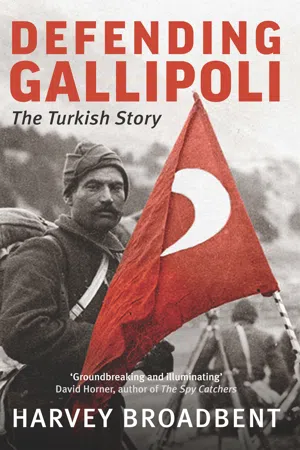
Based on exclusive access to Turkish archives, Defending Gallipoli reveals how the Turks reacted and defended Gallipoli. Author and Turkish language expert Harvey Broadbent spent five years translating everything from official records to soldiers' personal diaries and letters to unearth the Turkish story. It is chilling and revealing to see this famous battle in Australian history through the 'enemy' lens. The book commences with a jihad, which sees the soldiers fighting for country and God together. But it also humanises the Turkish soldiers, naming them, revealing their emotions, and ultimately shows how the Allies totally misunderstood and underestimated them Defending Gallipoli fills a huge gap in the history of the Gallipoli campaign.
- English
- ePUB (mobile friendly)
- Available on iOS & Android
eBook - ePub
About this book
Information
1
DRIFTING TO THE DARDANELLES
In November 1914 the First World War turned truly global. Great Britain, France and Russia had been fighting Germany and Austria-Hungary on the Western and Eastern fronts, respectively, since August. On 2 November 1914, as the convoy carrying the Australian Imperial Force (AIF) sent to join them was just one day out from Albany on the Indian Ocean, Russia declared war on the Turkish Ottoman Empire. The Ottoman Sultan and Caliph of Islam, Mehmed V, reciprocated by declaring war on Russia and her allies on 11 November and on 13 November, pronouncing it a jihad for all Moslems. Its text ran in part:
When the enemy attacks Islam, and attempts to invade and raid the country of Islam, and capture the people of Islam, if the Sultan of Islam orders mobilization for a war, should it not be an obligation for all the Muslims, young and old, to be ready to fight, as infantry and cavalry, with all their assets and lives pursuant to the Verse of the Koran which says, ‘Set off, light and heavy, and fight on the path of God with your assets and lives. If you only knew that this is more beneficial for you?’
The answer: It would be ‘God knows best’, written by Hayri Bin Avnî El-Ürgûbî.
Response in Moslem countries such as Egypt, India, Yemen and Saudi-Arabia was meagre, but the crumbling Ottoman Empire found itself committed to war on four fronts—Eastern Anatolia and the Caucasus, Iraq, Syria and Palestine and the Dardanelles Strait. It was the defence of the latter, with its sea route to the Ottoman capital, Istanbul (Constantinople), that was to lead to the Gallipoli Campaign and the Ottoman ultimate victory there in 1915.
The Ottoman Empire
The origins of the six hundred-year-old Turkish Ottoman Empire, one of the world’s greatest-known empires, dated back to the early fourteenth century. It led Islam with its Sultan as Caliph from 1516, and as the new guardian of the holy places of Mecca and Medina. The empire reached its zenith under Suleyman the Magnificent (1520–66) and his immediate successors. A slow decline over two hundred years, as territory was lost, followed. By the 1890s the Ottomans, endeavouring to modernise and threatened by Russian expansionist ambitions, sought German assistance. The newly powerful, unified and ambitious Germany emerged and strutted upon the Ottoman stage. Major Colmar von der Goltz headed a German military mission to the Empire in 1885, replacing British and French contractors. Then in 1889 and 1898, Kaiser Wilhelm II visited Istanbul to strengthen financial and military relations.
Despotic Sultan Abdul Hamid (1876–1909) was forced to install a fledgling parliamentary system after an uprising in 1908 led by the so-called Young Turks, the Committee (later Party) of Union and Progress (CUP). Their three leading pashas, Enver, Talat and Cemal (Djemal), would become the wartime leaders six years later. In 1909 they replaced Abdul Hamid II with his more malleable cousin, Mehmet Reshad, who became Sultan Mehmet V and a figurehead monarch.
Ottoman territorial losses continued, with the Libyan coastal strip being annexed by Italy after a short campaign in 1911. The First Balkan War followed in October 1912 with Montenegro, Serbia Bulgaria and Greece pushing Ottoman forces back disastrously close to Istanbul, only sixty kilometres away, before the Turks rallied. The Serbs took Macedonia and the Greeks, Salonika. Turkey’s border now lay near Adrianople (Edirne). The Ottomans reacted by importing German, British and French military and financial advisors in 1913. The German Military Reform Commission led by General Otto Liman von Sanders soon emerged as the most far-reaching and influential. British Admiral Limpus and his seventy British officers exercised control of the Ottoman Navy but that suddenly and dramatically, but not unexpectedly, changed with the outbreak of war in August 1914.
The Ottomans choose sides
Germany won the diplomatic game to secure an alliance with the Ottomans. The Ottomans stayed nominally neutral at first but Britain confiscated two powerful dreadnoughts being built for Turkey in British shipyards at South Shields. The ships had been financed by public subscription throughout the Ottoman Empire and the effect on opinion, both public and political, in Turkey was to throw the Ottomans into the German embrace. Britain and her allies feared that, when completed and in Turkish hands, these dreadnoughts would not only secure the Straits but would dominate Russia’s Black Sea Fleet.
Germany tightened the hug. Enver Pasha, as War Minister, the de facto military commander of Ottoman forces, was convinced that the Germans had superior military prowess and would best guarantee Ottoman territory against Britain’s ally Russia. The Ottoman Army was far from being prepared for war and needed time on its side. A German-Ottoman alliance was secretly signed on 2 August 1914, allowing time for Ottoman mobilisation to begin. On 3 August, as war was erupting in Europe, Enver ordered the mining of the southern end of the Dardanelles Strait and the northern end of the Bosphorus. All Russia’s grain exports and half of its other exports were now bottled up in the Black Sea. Events that would lead to the Ottoman entry into the war now speeded up as the British were failing in their attempts to ensure Ottoman neutrality.
On 10 August the Germans delivered the old battleships Goeben and Breslau, as ‘replacements’ for the confiscated dreadnoughts, to the entrance of the Dardanelles. Ignoring the treaty that prevented warships sailing through the Strait, Enver sent an order to allow them passage through to Istanbul. There, German crews exchanged their caps for fezzes and the ships were renamed Yavuz and Midilli. In these actions, Enver was forcing the issue, ignoring the ‘neutralists’ in parliament and taking his country one step away from involvement in the new war.
The Kaiser, adding external pressure, offered a timely large loan on 5 October, coupled with the extraordinary declaration to join the jihad, as a friend of all Moslems. The Ottoman government then suspended all foreign debt repayments and unilaterally abolished the hated free trade concessions to European countries, known as the Capitulations. On 29 October German Admiral Souchon, who had replaced British Admiral Limpus and was now Ottoman Navy Commander-in-Chief, led the Yavuz and Midilli up into the Black Sea and shelled the Russian ports but only caused minimal damage. It was enough to bring the Russian declaration of war against the Ottoman Empire on 2 November.
Germany had taken advantage of the Turkish fears of Russian ambitions. For Germany it meant the Turks could look after their interests in the region, keeping significant British naval and military forces engaged and away from the Western Front. Military measures were accelerated on all sides from November 1914, with the Ottomans openly in the war. Following Russian ground attacks in the Caucasus on 1 November 1914 an Anglo-French squadron of eighteen ships bombarded Turkish fixed fortifications at the entrance to the Dardanelles Strait on 3 November. It appears it was to test the Ottoman defences, and the results were deceptively encouraging for the British. In a 20-minute bombardment on the fort at Seddülbahir at the tip of the Gallipoli Peninsula, a single shell struck the magazine. Ten guns were dislodged though not destroyed but eighty-six Ottoman soldiers were killed and total casualties reached about 150, including forty Germans. Nothing more was achieved except that the attention of the Ottomans was drawn towards strengthening their defences. They set about expanding the minefield and reinforcing the Strait’s military and naval defences. The prelude to the 1915 Gallipoli Campaign had begun.
Defending the Dardanelles Strait
Defensive improvements of the Strait area now moved ahead a pace. An important veteran of the Balkan War, Major General Mehmed Esat, had been appointed Commander of the III Corps. He was tasked with defence of the Gallipoli Peninsula alongside the Strait Fortified Area Command. III Corps comprised the 7th, 8th and 9th divisions, but the 8th had been detached and sent to Sinai. The reconstructed 19th Division was sent in its place to join the 9th on the southern section of the Peninsula to fulfil the role of reserve division in the Strait. The 7th was deployed at the neck of the Peninsula at the Bulair (Bolayir) lines by the Gulf of Saros.
For the naval defences German assistance was sought from their naval mission. In attempted secrecy, six hundred German defence specialists were sent to assist the Turks with mine, gunnery, fortifications and torpedo warfare for the Dardanelles and the Bosphorus. This led to considerably extending the minefield as well as improving and updating shore fortifications, including the strengthening of the forts with their 12- and 15-inch cannons. Improvements to the Strait’s defences were overseen by Cevat (Djevat) Pasha, Turkish Commander of Strait’s Forts, and Germans Vice Admiral Guido von Usedom and his No. 2, Vice Admiral Merten. This split command, a result of the Ottoman-German alliance, was not always advantageous as various tensions down the command chain occurred from time to time.
By December 1914, the drift to the Dardanelles conflict became a stronger current. Russia began to question its participation in the war. It was teetering on the Eastern Front after major defeats at Tannenburg and the Masurian Lakes in late August and September 1914. Growing fears of the Ottomans in the Caucasus now meant an already stretched Russia had to open a second front. Large numbers of troops would need to be deployed there. The Russian Bear turned to the British Lion for help. Another front in the south against Turkey would prevent the Ottomans sending overwhelming troop numbers to deal with the Russians in the Caucasus. Heavy lobbying of the British began in political and diplomatic circles. By January 1915 Russia had played her ace—help us or we’ll pull out.
The threat was a separate armistice with Germany, a horrific scenario for the British and French. If that happened they would face the German Eastern Front Army massively redeployed to France and Flanders—easily enough to break the stalemate there. With a promise of a second front, and something of a prayer, the Allied strategy of a naval attack up the Dardanelles Strait was developed. At first it was to be the navy alone as British war minister, Lord Kitchener, had few troops to spare. He had earmarked his best division, the 29th, for bolstering numbers in France. The Australian and New Zealand Army Corps (ANZAC) divisions, then training in Egypt, could be used as follow-up troops to garrison occupied territory when the Ottomans surrendered.
The general plan, or theory, was for the fleet to sail to Istanbul, threaten the capital and demand surrender from the Ottomans. Tactically, the first step was to open the Strait to the Sea of Marmara by destroying the Turkish guns at the entrance and silencing the shore batteries. Then the forts at the Narrows would be destroyed and, most importantly, the rows of mines in the Narrows and the approach would be swept.
On 25 February the batteries and forts at the Strait’s entrance were destroyed, Turkish batteries being out of range to return effective fire. Allied landing parties at Seddülbahir and Kum Kale on 26 February then destroyed large guns before being forced to withdraw. Ominously, however, British minesweepers, crewed by British fishermen recruited for the purpose, were constantly repulsed by shore howitzer fire and the Turks were able to replace any swept mines at night. Despite this setback, the British Admiralty pushed the naval squadron commander, Vice Admiral Carden, ignoring his growing anxiety, to plan a major naval assault in March. After Carden suffered a nervous breakdown, Sir John de Robeck assumed naval command on 16 March and set down plans for the attack to clear the Strait and push through on 18 March.
By 1915, though, the Ottoman defences had been substantially developed along the 35-nautical mile-long Strait. Based on the November experience, Cevat Pasha considered the vulnerability of the outer forts was not to be easily put right. They were expendable. His three sector defensive system, ‘Outer’, ‘Intermediate’ and ‘Inner’ forts, meant that the balance of defensive strength was shifted to the Intermediate and then the Inner forts as events necessitated.
The main Turkish defence was the extended minefield concentrated at the Narrows. Eleven main lines were laid across the Strait near the Narrows, containing a total of 399 mines, by 18 March. The sea-based defences were supported by nine shore-based artillery divisions. In addition to mines at the Narrows, three 18-inch torpedo tubes were installed on the pier at Kilitbahir, giving field of fire across the Strait at virtually point-blank range. Twenty-four mobile howitzers were positioned along both sides of the Strait. They could be moved from one position to another, dragged by oxen teams to avoid the enemy getting a fix on them. Smoke canisters were used at various intervals to confuse the enemy gunners and draw fire away from the mobile batteries. The howitzers fired on enemy ships to keep them moving so no concentration of fire onto the forts could be achieved.
A critical event took place a few days before 18 March that would have great repercussions during the Allied naval assault. Undetected by the British fleet and their aerial reconnaissance, the Nusret minelayer laid the eleventh line of twenty-six mines at a hundred metres apart in Erenköy Bay under cover of night. This little vessel has now entered Turkish folklore and stands in a place of honour against the jetty of the small maritime museum at Çanakkale. The mine line it laid was to cause the ultimate loss of Allied ships Bouvet and Inflexible.
In Turkey, to the present day, 18 March 1915 is commemorated as the date of a great victory in Turkish history. De Robeck and the Allied fleet, led by the Queen Elizabeth, the newest of all dreadnoughts, failed to neutralise the Intermediate and Inner forts on 18 March. After initial passage past the Outer forts in the morning, the assaulting squadron began to flounder around 1.45 p.m., when the French battleship Gaulois was suddenly retreating, holed under the waterline. Then at 2 p.m. another French battleship, the Bouvet, swinging round to starboard after firing, struck one of the mines laid by the Nusret in Erenköy Bay. She rolled over and sank with only twenty of her 603 crew being rescued. Despite several hits on forts, the Turkish mines, supported by batteries, were determining the outcome. Four other battleships were then put out of action— the British Inflexible and Irresistable from...
Table of contents
- Cover
- Title
- Copyright
- Contents
- Preface
- Note on Pronunciations and Definitions
- 1 Drifting to the Dardanelles
- 2 Confusion and Courage
- 3 Desperate Defence
- 4 ‘What on earth will happen, my Captain?’
- 5 Martyrs and Ceasefire
- 6 Deadlock
- 7 ‘Truly an apocalypse’
- 8 ‘All is confusion and the situation is grave’
- 9 ‘Keeping up the spirited efforts’
- 10 Slipping Away
- Reflections
- Acknowledgements
- Select Bibliography
- Index
- Picture Section
Trusted by 375,005 students
Access to over 1.5 million titles for a fair monthly price.
Study more efficiently using our study tools.
Frequently asked questions
Yes, you can cancel anytime from the Subscription tab in your account settings on the Perlego website. Your subscription will stay active until the end of your current billing period. Learn how to cancel your subscription
No, books cannot be downloaded as external files, such as PDFs, for use outside of Perlego. However, you can download books within the Perlego app for offline reading on mobile or tablet. Learn how to download books offline
Perlego offers two plans: Essential and Complete
- Essential is ideal for learners and professionals who enjoy exploring a wide range of subjects. Access the Essential Library with 800,000+ trusted titles and best-sellers across business, personal growth, and the humanities. Includes unlimited reading time and Standard Read Aloud voice.
- Complete: Perfect for advanced learners and researchers needing full, unrestricted access. Unlock 1.5M+ books across hundreds of subjects, including academic and specialized titles. The Complete Plan also includes advanced features like Premium Read Aloud and Research Assistant.
We are an online textbook subscription service, where you can get access to an entire online library for less than the price of a single book per month. With over 1.5 million books across 990+ topics, we’ve got you covered! Learn about our mission
Look out for the read-aloud symbol on your next book to see if you can listen to it. The read-aloud tool reads text aloud for you, highlighting the text as it is being read. You can pause it, speed it up and slow it down. Learn more about Read Aloud
Yes! You can use the Perlego app on both iOS and Android devices to read anytime, anywhere — even offline. Perfect for commutes or when you’re on the go.
Please note we cannot support devices running on iOS 13 and Android 7 or earlier. Learn more about using the app
Please note we cannot support devices running on iOS 13 and Android 7 or earlier. Learn more about using the app
Yes, you can access Defending Gallipoli by Harvey Broadbent in PDF and/or ePUB format, as well as other popular books in History & World War I. We have over 1.5 million books available in our catalogue for you to explore.