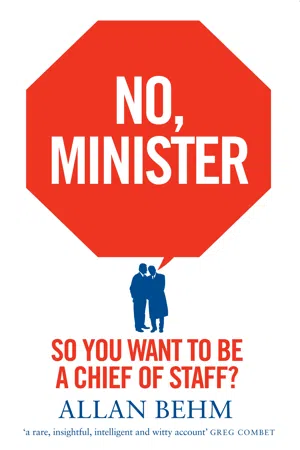
Nothing prepares a person for the job of chief of staff to a Commonwealth Minister. There are no professional development courses, no specialist recruitment agencies and no training manuals.
It was into this vortex that Allen Behm became chief of staff to Greg Combet in 2009, the minister responsible for managing carbon pricing and the pink batts crisis.
A seasoned troubleshooter, Behm has an uncanny ability to anticipate and deflect political crises. By his measure success as a chief of staff is being an invisible force. 'Invaluable insight from an experienced insider into the closed world of callow political advisers and their disastrous impact on the performance of many Ministers.'—TERRY MORAN
- 295 pages
- English
- ePUB (mobile friendly)
- Available on iOS & Android
eBook - ePub
About this book
Information
Subtopic
Politica globaleCHAPTER 1
What is a Chief of Staff?
He that has and a little tiny wit-
With hey, ho, the wind and the rain-
Must make content with his fortunes fit,
For the rain it raineth every day.
With hey, ho, the wind and the rain-
Must make content with his fortunes fit,
For the rain it raineth every day.
King Lear, III, 2
IN RECENT DECADES, the title ‘chief of staff’ has proliferated, and at many levels. Chief executive officers (CEOs) of corporations have a chief of staff, as do their division heads and various other functionaries down the line. Frequently, the chief of staff seems to be an over-promoted gatekeeper who protects a chief executive officer or other senior officer from unwanted intrusions by more junior staff or external stakeholders. Just as often, the chief of staff is a highly paid amanuensis who manages the senior executive’s incoming reports, briefing papers, diary and appointments in much the same way as private secretaries did in former times.
In Australia, senior executives of thirty years ago did not employ chiefs of staff. Rather, they mostly had a combination of personal secretary (who did the typing), private secretary (who managed the diary and ran the errands) and an executive assistant (who kept the paperwork in order and the desk tidy). Prime ministers and ministers had principal private secretaries who managed their offices and advised them principally on policy and occasionally on politics. And, in any case, their staffing levels were so low that a title such as chief of staff would have been taken for self-aggrandisement.
In the early 1980s, for instance, there were no chiefs of staff that I can recall. Yet by the late 1980s, the position had begun to emerge, partly influenced by the new management models of the US corporate world and partly by the ‘Chef de Cabinet’ position in European political and administrative practice. The combination of the new Parliament House in Canberra, which provided ministers with much more office space than the old Parliament House, the passage of the Members of Parliament (Staff) Act 1984, and the accelerating nature of the political cycle created a need for additional resources in the offices of ministers and parliamentary secretaries.
The new ‘value add’ would seem to be the chief of staff, usually a more highly educated person than the former private secretaries, with the ability to read and comprehend all the incoming material, provide summaries and identify non sequiturs, thereby generating a frisson of fear (and inevitably loathing) among the subordinates who provide the incoming material. For a lazy or over-burdened senior executive, a chief of staff can be a danger, eroding both responsibility and accountability as serious decisions are effectively devolved. If the chief of staff parades as the senior executive’s alter ego, the impact on leadership, management and communications can be disastrous.
So, it was important for me to define the features of the position that would best serve the minister’s political and policy interests, while at the same time meeting the professional needs of the other team members. The models I initially had in mind were the principal private secretaries I had encountered early in my career, when access to ministers’ offices in the old Parliament House was somewhat easier than it is today. John Ridley, Andrew Peacock’s principal private secretary in the late 1970s, was a confident, engaging and smart manager of the Foreign Minister’s policy demands and political interests. Richard Mills, Jim Killen’s principal private secretary towards the end of the second Fraser government, could have been the model for Bernard Woolley, Jim Hacker’s private secretary in Yes, Prime Minister. Mills was quick-witted, and an excellent manager of Killen’s sometimes relaxed habits as Defence Minister. Each Friday afternoon, after Killen had enjoyed a convivial lunch (no fewer than two bottles of red) and before the late-afternoon flight back to Brisbane, Mills would lead Killen around ‘the stations of the cross’—twelve in-trays ranging from the small-in-size (which Killen had to read and sign), to the slightly larger (which he had to sign without reading), to the larger still (which he had to note), to the huge piles of submissions that he had to be aware of, and finally to the cabinet submissions that he had to take home. I adopted a similar though less religious approach to paper management in Greg Combet’s office. But for real insight, I finally decided to turn to one who had the dramatist’s touch for complex relationships between powerful people and dispensable people.
Shakespeare offers key insights into most aspects of human behaviour. Strength, weakness, loyalty, treachery, love, hatred—all of these characteristics are portrayed with insight, drama and wit. But what about the portrayal of conscience, commentary and oversight, and the ability to challenge convention? The chief of staff cannot be a Hamlet, a Macbeth, a Richard III or a Lear. Even less can the chief of staff be a Romeo or a Julius Caesar. In holding up a mirror to thought and action, the chief of staff is more like Touchstone, the court jester from As You Like It, who comes close to the essence of the job when he says ‘the more pity that fools may not speak wisely what wise men do foolishly’.1
Lear’s fool, too, provides instruction. In some respects, King Lear is a political allegory: the leader is trapped in his own hubris and brought down by those who profess to love him. His chief of staff, the Fool, provides opaque counsel and comfort, but is ultimately unable to prevent Lear’s slide into insanity or, as Simon Russell Beale portrayed him in the 2014 National Theatre production, dementia. It was never my misfortune to have to deal with Goneril and Regan, though the former Howard government minister and current Speaker of the House of Representatives Bronwyn Bishop seems to remain in constant rehearsal for either role. But while Combet managed the vicissitudes of politics, though without the dementia, the Fool was never far from my mind. For the truth is, in politics, the rain it raineth every day.
Henry VIII’s jester was William Sommers, who was legendary for his ability to advise the king without crossing the boundaries that so constrained the more noble courtiers. James VI of Scotland retained Archibald Armstrong, who went on to be a moneylender in London. And Charles II promoted Thomas Killigrew to the position of Groom of the Bedchamber. His portrait was not only painted by Anthony Van Dyck but he was described by Samuel Pepys in his diary as holding ‘the office of the King’s fool and jester, with the power to mock and revile even the most prominent without penalty’.2 He went on to become a deservedly lesser-known dramatist.
Contemplation of the past provides some guidance for the future. But we actually live in the present, so I needed to address the defining characteristic of the current operating environment for chiefs of staff. Now chiefs of staff are very serious people who would not want to be taken for fools and jesters, notwithstanding the long tradition of political advisors whose roles fall outside defined boundaries. Yet it is precisely the lack of defined boundaries that distinguishes the position of chief of staff, and explains why some chiefs of staff succeed (Arthur Sinodinos comes to mind) and others (too many to number) come to grief.
The absence of defined boundaries is neither good nor bad. It is simply how things often are. In the domain of strategic planning, for instance, ambiguity and discontinuity are constant features of an ever-changing planning environment. And politics is possibly more inherently chaotic than any other field of human activity. So the key issue for any chief of staff is not the absence of boundaries and protocols, but rather how to support a minister and a government in an operating environment where the imposition of boundaries would simply lead to undue caution, risk aversion and ultimate political constipation.
At various stages during my career as a public servant, I worked closely with each of the eight people who served as Bob Hawke’s and Paul Keating’s chief of staff. Sandy Hollway was one of the architects of Australia’s uranium safeguards policy in the second half of the 1970s, ultimately serving as a departmental secretary. Dennis Richardson went on to become Director-General of ASIO, Ambassador to Washington, and secretary of two departments. Allan Hawke went on to become secretary of three departments and High Commissioner to New Zealand. But the person who did most to redefine the nature of the chief-of-staff position was Don Russell, Keating’s chief of staff from 1991 to 1993, and then again from the end of 1995 to the 1996 election, which Keating lost. Their relationship began when Keating was treasurer, and Russell replaced Tony Cole as Keating’s chief of staff on Cole’s recommendation.
For those who know Russell, discretion and quiet brilliance sum him up. Although he has not said very much publicly about his relationship with Keating, there is no doubt that it was very close and very effective. As Rod Rhodes and Anne Tiernan have observed, it was for others to describe the dynamics of the relationship. Allan Hawke put it in typically direct language: ‘Paul [Keating] is still grieving the loss of Don Russell … It was simply impossible to fill the gap that Russell left; no successor could hope to learn the way he had of talking to the prime minister, or earn the respect that Russell had earned’.3 Hollway observed that Russell was more a political than a policy advisor.4 I am not sure that is accurate. Notwithstanding Russell’s immense skill and reflective demeanour, Russell and Keating were totally aligned on personal, social and political values, and that, as distinct from political convergence, essentially defined the relationship. It is really an answer in search of a question to describe Russell as ‘Svenagli [sic]: keep [sic] of the government’s story’ as do Rhodes and Tiernan.5
Values were also central to the relationship between Prime Minister John Howard and his chief of staff, who, I submit, defines the modern role—Arthur Sinodinos. As a senior defence official, my personal interactions with Sinodinos were few, occurring mainly during the lead-up to the deployment of peacekeeping forces to East Timor in 1999. He was a supremely professional, calm and well-informed chief of staff, who knew what questions to ask, and how to ensure that the prime minister’s intentions were clearly understood by those who had to implement them. His reputation both within the Department of Prime Minister and Cabinet and the broader public service was legendary: always polite, always respectful to his public service interlocutors, always punctual and never too busy to ensure that those who visited the Prime Minister’s Office felt that their trip was worthwhile. As Howard’s chief of staff from 1997 to 2006, Sinodinos supported him during his most successful and productive years as prime minister. Many have commented that the Howard government began to decline when Sinodinos departed.
It was evident that Howard and Sinodinos were in lock step around values and political style—albeit in a very conservative and conventional way. They were also united in the conviction that sound policy was at the heart of good government.6 The hallmarks of Howard’s office under Sinodinos were calm, order and measure. They were not trapped in the glare of the twenty-four-hour news cycle, but rather they managed the prime minister’s media appearances deliberately, and almost never reactively. In other words, Howard and Sinodinos did not permit the media to dominate and take charge, but rather employed the media to their own advantage. Sinodinos’s approach mirrored that of his prime minister—take charge and stay in charge.
Sinodinos was also careful to ensure that the Coalition backbenchers, members of the Senate and House of Representatives alike, felt that they had a connection with the prime minister and his office. Russell Trood, for instance, a one-term senator for Queensland, told me that not long after his arrival in Canberra, he received a call from Sinodinos inviting him to visit him in his cubbyhole of an office for a quiet chat. Trood wondered what he could have done wrong so early in his political career, but what Sinodinos wanted to do was welcome him, reassure him and tell him that the door was always open should he ever feel the need to talk. Trood was impressed that the prime minister’s chief of staff found the time to talk to a newly arrived senator and offer such positive reassurance. That was Sinodinos’s style as chief of staff.
Late in the afternoon on most sitting days, Combet and I would take a walk around the corridors of Parliament House, not far enough away to miss the division bells, but far enough from the office to get a change of air and a change of perspective. We often bumped into Senator Sinodinos. Sinodinos needed no explanation concerning our perambulation: he understood implicitly that a minister and the chief of staff needed to escape the confines of the office in order to maintain head space. Sinodinos was always pleasant and affable. It was always of interest to me that most of the people we met in our corridor walks felt the need for a smart remark or a bit of puerile repartee, reflecting the confrontational demeanour affected by the partisan dimwits who are all too present on both sides of politics.
In my view, Sinodinos set the ‘gold standard’ in both defining the role of chief of staff and demonstrating the personal and professional qualities to do the job. It is a tragedy at both the personal and political levels that he found himself caught up in the corruption inquiries conducted by the New South Wales Independent Commission Against Corruption (ICAC) in 2014. His generally impeccable judgement appears to have deserted him at Australian Water Holdings. Sinodinos’s political career may well have peaked in the office of assistant treasurer. His experience, his evident strategic capacity, and his ability to rise above sectarian politics all set him up for a significant political role as a statesman rather than a cat-calling brawler. Australia’s polity is the poorer for his political decline and fall.
For one to be successful in a fast-moving and unpredictable environment, there must be a set of operating principles. As I contemplated my approach to the job, I identified eight core principles:
1 There is only one leader, the minister (no alter egos).
2 The chief of staff must empower, not control, and cannot be a gatekeeper.
3 Probity and integrity must define the office and its reputation.
4 There must be a set of values that ground the team’s overall approach to public policy and the political action that delivers it.
5 There must be a parallel set of values that drive the performance of the team itself.
6 The chief of staff must maintain the focus of the office on its strategic purpose, protecting the important over the immediate.
7 Wisdom, rather than technical expertise, should be the key attribute of the chief of staff.
8 Relationship management is paramount; sound relations with other ministers’ offices and the public service are the minister’s greatest assets, and stakeholders can make an enormous contribution to the effective design and delivery of policy outcomes.
I was not attempting to set myself up as representing the ideal chief of staff. But before taking on a new role that is even more demanding than it is complex, it is critically important to consider the qualities that are essential for successful performance.
Unity of Leadership
Henri Fayol was a mining engineer who is described by some as the father of modern management. During World War I he published Administration Industrielle et Générale in which he established his fourteen principles of management. ‘Unity of command’ prescribes that everyone should be answerable to only one superior, and that there should be no division or competition in direction. This principle has informed the development of command doctrine in all modern military forces, though it is sorely tested in coalition operations.
The minister is the leader. The role of the chief of staff is to ensure that there is no confusion regarding the minister’s intent or direction. This often requires the chief of staff to probe the minister’s thinking, and to assist in clarifying it, so that the team is able to work on it coherently and without duplication of effort. ‘Wheel spinning’, the expenditure of enormous energy for no forward movement—a phenomenon I observed in many ministerial offices during my career in the public service—is one of the most destructive habits in teams that work under pressure. It not only causes fatigue, but more importantly, it causes carelessness; the problem is not a lack of attention to detail, but that more insidious phenomenon, a lack of care. Multi- and contradictory tasking is a key cause of ‘wheel spinning’, and its effects can be disastrous, especially in the offices of lazy or weak ministers.
The chief of staff cannot stand in the place of the minister. If the chief of staff does so, the minister’s credibility is seriously eroded, and the senior public servants who interact with the minister’s office become at once dismissive of the minister and distrustful of the chief of staff. The dynamic and quality of the relationship between the senior public servants and the chief of staff is a major contributor to a minister’s success. Unity of leadership is not, however, an encouragement to despotism. While the minister leads the team in its external f...
Table of contents
- Cover
- Title
- Copyright
- Contents
- Foreword
- Preface
- 1 What is a Chief of Staff?
- 2 Becoming Chief of Staff
- 3 What Makes a Good Chief of Staff?
- 4 Who’s In or Out of the Minister’s Team?
- 5 Leadership Behind the Arras
- 6 Competition and Cooperation
- 7 Crossbenchers and the Opposition
- 8 Valuing the Public Service
- 9 The Minister’s Principal Policy Advisor
- 10 The Balance Between Stakeholders and Expectations
- 11 Politics and Policy
- 12 Celebrating Success and Coping with Defeat
- 13 Planning for Life after Death
- Acknowledgements
- Notes
- Index
Trusted by 375,005 students
Access to over 1.5 million titles for a fair monthly price.
Study more efficiently using our study tools.
Frequently asked questions
Yes, you can cancel anytime from the Subscription tab in your account settings on the Perlego website. Your subscription will stay active until the end of your current billing period. Learn how to cancel your subscription
No, books cannot be downloaded as external files, such as PDFs, for use outside of Perlego. However, you can download books within the Perlego app for offline reading on mobile or tablet. Learn how to download books offline
Perlego offers two plans: Essential and Complete
- Essential is ideal for learners and professionals who enjoy exploring a wide range of subjects. Access the Essential Library with 800,000+ trusted titles and best-sellers across business, personal growth, and the humanities. Includes unlimited reading time and Standard Read Aloud voice.
- Complete: Perfect for advanced learners and researchers needing full, unrestricted access. Unlock 1.5M+ books across hundreds of subjects, including academic and specialized titles. The Complete Plan also includes advanced features like Premium Read Aloud and Research Assistant.
We are an online textbook subscription service, where you can get access to an entire online library for less than the price of a single book per month. With over 1.5 million books across 990+ topics, we’ve got you covered! Learn about our mission
Look out for the read-aloud symbol on your next book to see if you can listen to it. The read-aloud tool reads text aloud for you, highlighting the text as it is being read. You can pause it, speed it up and slow it down. Learn more about Read Aloud
Yes! You can use the Perlego app on both iOS and Android devices to read anytime, anywhere — even offline. Perfect for commutes or when you’re on the go.
Please note we cannot support devices running on iOS 13 and Android 7 or earlier. Learn more about using the app
Please note we cannot support devices running on iOS 13 and Android 7 or earlier. Learn more about using the app
Yes, you can access No, Minister by Allan Behm in PDF and/or ePUB format, as well as other popular books in Politica e relazioni internazionali & Politica globale. We have over 1.5 million books available in our catalogue for you to explore.