How much do we know about the second most important office in the nation? Who was Australia's first treasurer? Who resigned because of a relationship breakdown with the PM? And who did Frank Hardy base his character Ted Thurgood in Power without Glory on? The Money Men is the first in-depth look at the twelve most notable and interesting men to have held the office of Treasurer of Australia. Former Treasurer Chris Bowen brings a unique insider perspective to the lessons learned from the successes and failures of those who went before him.Who does Chris Bowen think has been Australia's most exceptional Treasurer? With revealing interviews of the five last treasurers, The Money Men dares to answer that question.
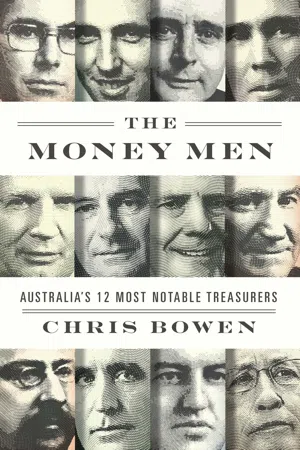
- 448 pages
- English
- ePUB (mobile friendly)
- Available on iOS & Android
eBook - ePub
About this book
Trusted by 375,005 students
Access to over 1.5 million titles for a fair monthly price.
Study more efficiently using our study tools.
Information
1
SIR GEORGE TURNER
SIR GEORGE TURNER
A Treasurer Pioneering

Born: August 1851, Melbourne
Died: August 1916, Melbourne
Treasurer: 1 January 1901 – 26 April 1904
17 August 1904 – 4 July 1905
Died: August 1916, Melbourne
Treasurer: 1 January 1901 – 26 April 1904
17 August 1904 – 4 July 1905
EVERY SO OFTEN, an opinion poll shows that comparatively few Australians can name Sir Edmund Barton as Australia’s first prime minister. It is undoubtedly the case that even fewer people could name Sir George Turner as Australia’s first treasurer. It is not so much that history has treated Turner badly; more that it has forgotten him. This is unfair. While Turner might not have had a sparkling personality, he was an influential figure in the formation of the Australian nation. His quiet determination and pragmatic approach to controversial questions were integral to the process of federation. He also played a key role in ensuring that Barton became the country’s first prime minister instead of the less inspiring Sir William Lyne. And as treasurer, he kept a steady, reliable hand on the nation’s finances. Turner made sound financial management a hallmark of his work, and he set important precedents in the Treasury portfolio.
If Turner’s contemporaries commented on him in their writings, they did so mainly to pass judgement on his dour personality and serious nature. Alfred Deakin, a political ally but not a close friend, said of Turner that ‘his colourless policy fitted a colourless personality’.1 Before Turner became premier of Victoria, a journalist described him to his editor as ‘a quiet little man in a brown suit’.2 In a rather extreme judgement call, the historian Ross McMullin says of Turner that ‘no Victorian premier has had less charisma’.3 Fellow historian Manning Clark describes him as
one of the model bourgeois, one of those upright, straightforward men who never allowed any passion to ruffle his domestic happiness or any private whim to interfere with his regular habits … he suffered from inadequate consciousness, but sound bourgeois that he was, that deficiency in his make-up did not trouble him.4
However, Turner understood the intricacies of government finance and was a prodigious worker. This was appreciated by the first Treasury secretary, George Allen, who in 1909 said that Turner ‘stands first and highest in the calendar of his masters. There has never been a Treasurer like Sir George.’5 His successor in the role, Sir Joseph Cook, described Turner as ‘one of the most useful public men Australia has ever known’.6 Even Deakin acknowledged that ‘his faculty of work was enormous, his love of detail great’.7 Manning Clark also credits Turner’s abilities, writing that ‘balancing the books was his great passion in life. By his great industry, his zeal and his deep conviction, he helped to raise that criterion into the standard by which politicians came to be judged in Australia.’8
To understand the office of Australian treasurer, it is important to understand its first incumbent, and the stamp he put on the role.
Beginnings
The year 1851 was a big one for the colony of Victoria. The great gold rush that saw a massive increase in Victoria’s (and Australia’s) wealth began in May, just before the colony achieved formal independence from NSW. It was also in 1851 that the man destined to be the first Australian-born premier of Victoria, and the first federal treasurer, was born in Melbourne.
George Turner came from a modest family of English immigrants. His father Alfred worked as a cabinet-maker, while his mother Ruth engaged in home duties. Turner was initially educated at Melbourne’s National Model School, the precursor to Melbourne High School, but he left when he was fourteen. Like many of his successors in the role of treasurer, his early years were marked by intense attention to self-improvement and part-time education. Turner became employed as a clerk for solicitor John Edwards, who was also a member of the Legislative Assembly. In 1874, at the age of twenty-three, Turner matriculated and became an articled clerk for another solicitor, Samuel Lyons. It is not clear how much the political activities of these two employers piqued his own interest in politics, but we do know that Lyons was a founder of the Australian Natives Association (ANA), an influential lobby group for Australian-born men that promoted liberalism, nationalism and federation, as well as sponsoring education and self-improvement for its members. Turner joined the Freemasons in 1882, becoming a senior grand warden in 1896, and was also involved in several friendly societies. Turner was admitted as a solicitor in 1881 and became Lyons’ partner in practice.
By this time, Turner had been married for nearly a decade to Rosa Morgan, whom he’d wed two days after his twenty-first birthday in 1872. Morgan was then a young English migrant who, by all reports, had seen potential and talent in this shy and retiring man. Deakin would later note that Turner was ‘fortunate in finding a partner who assisted him at every step and constantly pushed him forward’.9
Turner was elected to St Kilda Council in 1885 and became mayor in 1887. He maintained his seat on the council after he was elected to the Legislative Assembly, and even after he became the colony’s premier. It was said of him that he was ‘never more at home, never more himself, “plain George”, than after a council meeting in the mayoral supper room’.10
Turner’s election as the liberal Protectionist member for St Kilda took place in 1889. That poll saw twelve members of the ANA enter the Victorian Parliament, forming a powerful bloc that continued for many years. Turner and his colleagues supported the conservative–liberal coalition government of Duncan Gillies. However, the Gillies government fell after twelve months, largely due to its poor handling of a crippling maritime strike, and James Munro became premier—again with the support of Turner and his ANA colleagues. Turner impressed senior members of the government with his attention to detail and was appointed commissioner for trade and customs in 1891.
Turner added the solicitor-general’s job to his portfolio in 1892, the same year Munro was forced from office because he’d been a founder of, and shareholder in, one of the banks that engaged in the property speculation that led to the banking crash and subsequent economic crisis in Victoria in the early 1890s. He was replaced by William Shiels, who kept Turner in the Cabinet. In 1893, Shiels lost a vote on the floor of the assembly over the handling of the depression that was engulfing Victoria, and Turner soon found himself appointed leader of the opposition, up against the newly minted government of James Patterson. This was not a position he’d sought; rather, he’d largely been elected by a process of elimination.
The Patterson government proved no more adept at managing the economic crisis than had its predecessor, so Turner moved a motion of no confidence on the floor of the assembly, in the taciturn fashion for which he would become known:
On this occasion according to my usual practice, I do not propose to detain the House at any great length. It is well known that I do not claim to have a flow of language such as some members of the House possess, and I have always put matters as concisely and briefly as I can.11
Despite the less-than-inspiring nature of Turner’s call to arms, his motion was successful in precipitating an election.
Unusually for this period in Victorian politics, the cleavage between the premier and the leader of the opposition was clear: Patterson was a conservative and Turner was a liberal.12 Turner campaigned on a policy of direct taxation to repair the colony’s finances after the ravages of depression. He implied this would take the form of a ‘surplus wealth tax’ but was vague on details. Still, the trade union movement was attracted to Turner’s liberal policy agenda and campaigned for his election, as did the influential Age newspaper. Turner also promised public servants that savings in that area would be made by natural attrition rather than wholesale sackings, which led to strong public-sector support for his election.13
The election result was conclusive. The forces supporting Turner commanded sixty-five seats, including fourteen for the emerging Labor Party; the forces of the former government won just thirty seats. Aged forty-three, Turner was sworn in as the premier of Victoria.
Restoring Order
By the time Turner became premier, successive governments had contributed to the colony’s increasingly desperate economic situation. In addition, a worldwide recession was causing the prices of key commodities such as wool, wheat and silver to fall, pummelling Victoria’s terms of trade. Despite his big election win, Turner’s taciturn personality was hardly the type to inspire widespread confidence that he could do what his predecessors had failed to do. But Turner nonetheless set out to restore the colony’s damaged finances in a way that did not cause undue hardship in the community, and in this he largely succeeded.
Turner led what would prove to be a talented Cabinet. It contained one future prime minister of Australia (Deakin), one future federal attorney-general and governor-general (Isaac Isaacs) and one future three-time premier (Sir Alexander Peacock). For the first time, the majority of the Cabinet was Australian-born, giving it a distinctly modernising, liberal and nationalist outlook.
Turner allocated himself the Treasury portfolio. The historian John Rickard records that ‘throughout his Premiership, Turner was in his element introducing the budget, taking certain relish in showing his mastery of its detail. He tried to simplify its presentation, and submitted to the House “various printed statements” which seem to have been an innovation.’14 In presenting the 1896 Budget, Turner told the House, ‘I desire to make a plain business statement’,15 and on another occasion he told The Age, ‘I have always dealt with Government accounts in the same simple form in which I deal with my own private office accounts.’16
The new premier and treasurer soon set about implementing his policy of direct taxation to put the colony’s finances on a firmer footing without resorting to massive cutbacks in public service numbers or public works. Turner decided that the surplus wealth tax he had vaguely floated during the election campaign was not feasible—a land tax would never pass the landed gentry–dominated Legislative Council—so he settled on a direct personal income tax. This was an almost inevitable fiscal trend: the colonies were turning to personal income tax to assist in managing their finances. Tasmania had been the first colony to levy a personal income tax, which it did in 1880 amid a financial crisis. South Australia followed in 1884, and by 1907, each state had a personal income tax in place.
Turner levied a flat-rate tax that applied to people with an income of over £200 a year, which meant that only 31 000 people paid the tax across the entire colony. By 1897, he was able to report to the House in his budget speech that the colony was budgeting for a small surplus, a considerable turnaround in its finances.
This prudent financial management was a considerable selling point in the election that followed shortly afterwards. The emerging Labor Party continued to support Turner’s Protectionist government, which had introduced progressive workplace relations laws in the form of the Factories and Shops Amendment Act 1896. Such legislation was firmly in line with the liberal tradition that Turner endorsed, although such matters were still regarded as being subject to conscience, and members were not bound by party policy. The legislation proposed by Turner’s government was designed to protect women and children from exploitative practices, on the basis that men were robust-enough negotiators to look after themselves. An amendment moved by the Labor Party recognising that men were also worthy of some protection from sweatshop practices was carried, and Victoria had its most progressive labour legislation to that point enacted during Turner’s tenure.
The writer John Rickard is right to say that ‘Turner’s greatest claim as premier was that he had restored order to Victoria’s finances.’17 His income tax did not raise enough to prevent spending on infrastructure from being substantially reduced, such that public works spending in Victoria between 1895 and 1897 was one-sixth that of NSW.18 Nevertheless, the people of Victoria appreciated his steady hand, combined with his moderately reformist liberal instincts, and rewarded him with a second term in office at the 1897 election. Having got the colony’s finances on an even keel, he was able to turn his attention to the compelling question that was being asked across the continent: should Australia be one nation, and if so, how should it be constituted?
A Father of Federation
The rise in nationalism that accompanied an increasing majority of Australians being ‘native-born’ saw the campaign for federation grow in intensity in the 1880s, spurred on by improvements in transport and communications between the colonies, which fostered a more ‘national’ outlook. The output of the patriotic poets Henry Lawson and Banjo Paterson also fostered a spirit of nationalism, which in turn fed into the federation movement.
A conference in 1890 in Melbourne consisting of representatives of each of the colonies—including premiers, leaders of the opposition and Cabinet members—resolved in favour of federation, and a convention to settle a proposed constitution was scheduled for 1891. This resulted in a draft constitution (which would form the basis of the document eventually adopted). However, the movement stalled when the NSW Parliament failed to ratify the draft constitution, and other colonial parliaments declined to consider it given the NSW decision. Colony governments were also busy dealing with the bursting of the speculative bubble of the 1890s.
The campaign for federation was reignited in 1897, when the premiers agreed to hold another constitutional convention, this time with delegates elected by popular vote. Turner ran in the Victorian poll and topped it. The convention met several times throughout the year, with a final meeting in Melbourne in March 1898. Turner played a significant role in the proceedings, moving a motion that the senior NSW politician and prominent pro-federation campaigner Edmund Barton be the leader of the convention. Turner also used the occasion to give his first major address, which was typically strong on detail and light on rhetoric. Deakin, who was never too quick to praise Turner, was not impressed: ‘He looked and spoke like a busy little shop-keeper, being pushed forward by unwise colleagues to seize the earliest occasion of speech, [and] delivered an elaborate catalogue of radical proposals just as he would have read a list of goods and chattels at a sale.’19 Despite Deakin’s dismissive view, records of the convention indicate that Turner’s speech was welcomed by ‘loud and continuous cheers’, and many subsequent speakers congratulated him on his practical approach.
The convention had several controversial issues to deal with, which primarily went to the relative power balance between the larger colonies (and putative states) and the smaller jurisdictions. On these matters, there was a clear dividing line between NSW and Victoria on the one hand and the remaining colonies on the other. The small colonies wanted to ensure that NSW and Victoria did not have the ability to ride roughshod over the wishes of the minnow jurisdictions. The populations of NSW and Victoria, meanwhile, were strong in their views that the smaller jurisdictions should not have a right of veto over the wishes of the majority of the country’s population.
This was a robust debate, both among the delegates to the convention and the broader population. As an ex...
Table of contents
- Cover
- Title
- Copyright
- Contents
- Introduction
- 1 Sir George Turner
- 2 William Alexander Watt
- 3 Sir Earle Christmas Grafton Page
- 4 Edward Granville (Ted) Theodore
- 5 Joseph Benedict (Ben) Chifley
- 6 Sir Arthur William (Artie) Fadden
- 7 Dr James Ford (Jim) Cairns
- 8 William George (Bill) Hayden
- 9 John Winston Howard
- 10 Paul John Keating
- 11 Peter Howard Costello
- 12 Wayne Maxwell Swan
- Acknowledgements
- Endnotes
- Index
Frequently asked questions
Yes, you can cancel anytime from the Subscription tab in your account settings on the Perlego website. Your subscription will stay active until the end of your current billing period. Learn how to cancel your subscription
No, books cannot be downloaded as external files, such as PDFs, for use outside of Perlego. However, you can download books within the Perlego app for offline reading on mobile or tablet. Learn how to download books offline
Perlego offers two plans: Essential and Complete
- Essential is ideal for learners and professionals who enjoy exploring a wide range of subjects. Access the Essential Library with 800,000+ trusted titles and best-sellers across business, personal growth, and the humanities. Includes unlimited reading time and Standard Read Aloud voice.
- Complete: Perfect for advanced learners and researchers needing full, unrestricted access. Unlock 1.5M+ books across hundreds of subjects, including academic and specialized titles. The Complete Plan also includes advanced features like Premium Read Aloud and Research Assistant.
We are an online textbook subscription service, where you can get access to an entire online library for less than the price of a single book per month. With over 1.5 million books across 990+ topics, we’ve got you covered! Learn about our mission
Look out for the read-aloud symbol on your next book to see if you can listen to it. The read-aloud tool reads text aloud for you, highlighting the text as it is being read. You can pause it, speed it up and slow it down. Learn more about Read Aloud
Yes! You can use the Perlego app on both iOS and Android devices to read anytime, anywhere — even offline. Perfect for commutes or when you’re on the go.
Please note we cannot support devices running on iOS 13 and Android 7 or earlier. Learn more about using the app
Please note we cannot support devices running on iOS 13 and Android 7 or earlier. Learn more about using the app
Yes, you can access The Money Men by Chris Bowen in PDF and/or ePUB format, as well as other popular books in Politics & International Relations & Public Finance. We have over 1.5 million books available in our catalogue for you to explore.