Modern Australia was in part defined by its early embrace of China—a turning from the White Australia Policy of the 1950s to the country's acceptance of Asian immigration and engagement with regional neighbours. It saw the far-sighted establishment of an embassy in Beijing in the 1970s by Gough Whitlam, headed by Stephen FitzGerald. Here, FitzGerald's story as diplomat, China scholar, adviser to Gough Whitlam, first ambassador to China under prime ministers Whitlam and Malcolm Fraser, is interwoven with the wider one of this dramatic moment in Australia's history. Comrade Ambassador also highlights the challenge Australia faces in managing itself into an Asian future.
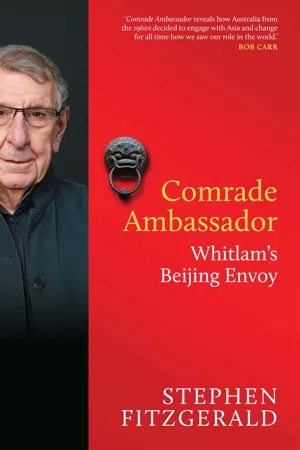
- 289 pages
- English
- ePUB (mobile friendly)
- Available on iOS & Android
eBook - ePub
About this book
Trusted by 375,005 students
Access to over 1.5 million titles for a fair monthly price.
Study more efficiently using our study tools.
Information
Chapter 1
An Australian Enlightenment
I SIT ACROSS THE room from the staff and they look at me, curious, reserved, there in the dun-coloured workaday armchairs in the Australian Embassy, just one converted bedroom in the old Peking Hotel, before 1949 the Six Nations or Grand Hôtel des Wagons-Lits. Grand still, with its expansive rooms and high ceilings and wainscots and a ballroom with sprung dance floor no longer danced on. But dowdy in its fallen state, dusty and dark, creaking floors and barely lit corridors, large old beds in service beyond retirement, plumbing reaching back to its founding in 1915, iron baths on great clawed feet watched from the corners of the bathroom by rats with bright black eyes. The hotel is home for all, and office. Communication with Canberra is by an antique cyphering machine lugged from Australia and kept in the good care of the British Embassy. It’s from this decrepit environment, the hotel not the British Embassy, that we launch Australia’s new China diplomacy. It’s April 1973, near midnight, and my wife Gay, our daughters Ingrid, three and half, and Justine, not yet one, their nanny Carene Klintworth and I have just arrived.
The advance party of six—Chargé d’affaires Ross Cottrill, Senior Administrative Officer Bert North, Third Secretary Shelley Warner, Administrative Officer Adrian Sever, Head of Mission Personal Assistant Billie Burke, and Communications Officer Joe Currie—have been here since January. It’s been exciting for them, these three months. Television cameras when they crossed into China. Just being in China a provocation to the mind and senses. But also tough. Dark, for Australians, in the slow-receding winter. Baffled by the working contacts with Chinese officialdom, anxious in Canberra’s spotlight on the new relationship, bonded in the common experience but divided in personality. Excitement has given way to stress and fraught relationships.
I’m thirty-four, an external appointee, never run an embassy, for them an unknown proposition, no received departmental whispers of suffered ambassadorial eccentricity. I’m here because I’m a China specialist. To launch this new diplomatic relationship I need the energy of happy and motivated colleagues and the sense of moment and adventure that the Labor Government and many Australians at home feel about what we’re doing. So we have a late night Temple of Heaven beer or two, talk about the personal message of compliment and encouragement I’ve brought from Prime Minister Gough Whitlam, and they fill me in on Beijing, and we joke and they relax and have another beer. It’s how I want the embassy to be. It’s a beginning.
Two days later, on 24 April, there’s the official beginning. I present my formal letter of appointment as ambassador to Dong Biwu, Acting President of China and, in 1921, a founding member of the Chinese Communist Party (CCP). And afterwards we sit in armchairs not unlike those in the Peking Hotel but newer and better sprung, and talk at length about a variety of things not altogether related to work. He’s possibly the only living Chinese to have passed the old Imperial exams under the Qing Dynasty, in 1901. Liver spots on his balding head, rheumy eyes, spindly grey moustache, cantilevered teeth. One of early modern China’s educated political activists, he abandoned the Confucian classics for a modern education, fought in the revolution that brought the Empire down in 1911, and worked as a secret agent for the founder of the Republic, Sun Yat-sen. Still alert and engaged, he asks about my book on China’s relations with the Overseas Chinese. Presumably it’s in his brief. He says most Overseas Chinese aren’t leftist or revolutionary but conservative and, in the past, liked to have their remains sent back to China for burial. And most people don’t know of a Qing Dynasty official who was so conservative he even brought his own dabian (pooh) back to be buried in Chinese soil. I’m one of those ‘most people’. Canberra will be fascinated by this, I think.
As we finish he says, ‘I’m getting on a bit, and in a few years I may have to start thinking about retiring.’ He’s eighty-six. ‘You’re young,’ he says, ‘and you should get to know some young people.’
‘Yes, of course,’ I say. ‘Like who?’
‘Like Premier Zhou Enlai,’ he says. Zhou’s seventy-five. And this isn’t a time in China when Zhou or any other Chinese leader is someone you simply ‘get to know’, like having regular chats, playing bridge or tennis, sitting down for a one-to-one lunch.
But we’re here. And we have an official relationship with China now when we haven’t had one since 1949.
How we, Australia, came to be here is part of a remarkable story of change. In policy, but more significantly in social attitudes to Asia and Asian people. It continued for more than two decades and still does in some measure, although against a newish tide of narrow nationalism that began under John Howard. The success of this change owes much to the leadership of ideas from politicians engaging and persuading the public, but also to the capacity for change by the Australian people when leadership is compelling. When the foreign policy and the pitch to domestic opinion have been in tune there’s been great progress.
With the possible exceptions of the anti-Vietnam War movement or the recognition of China, there’s really no single event we can mark or celebrate, no point where we could say ‘that was the moment when’, in the way some people claim, ahistorically, Australian and New Zealand Army Corps (ANZAC) marked the point at which Australia became a nation. But as a significant turning or maturing in our history, this change beats ANZAC. There’d been repeated ‘discoveries’ of Asia by individual Australians over more than a century. Some had publicly urged change in our attitudes. But these many discoveries didn’t convert into a change in the national consciousness, and it’s that conversion which is the most significant, and it didn’t begin until the late 1950s and early 1960s. It’s worth more than all the celebration people give to ANZAC, because it’s about a society that showed itself able to move from insularity and narrow intellectual horizons and racial exclusiveness towards being an open, tolerant and accepting one.
Australia now isn’t an Asian society, but it’s not exactly European either. If you look at it from the Europe where white Australians came from, you can’t help but be struck by just how ‘Asian’ we’ve become. It wouldn’t have seemed like this in the 1950s. But Asia is here now, in Australia’s demography and the miscegenetic embrace of Asians by many Caucasian Australians, and the honey-coloured patches in our society. About 12 per cent of the population, 2.4 million people, don’t come from a European ancestral background but from an Asian one. Back in 1961, when the census defined people by ‘race’ rather than ancestral background, there were a mere 40,277 ‘Asians’, just 0.382 per cent, in a population of 10.4 million.
Asia is here now in other ways too, visual and sensory, gustatory and aesthetic. And it’s not just our changed demography or Asia-enlivened gastronomy. It’s that Asia is present now in our consciousness, always there in the corner of the eye as it were, lurking in the national conversation. In Europe it’s not there, and Europeans don’t discuss Asia the way we do. While Europeans may be alive to the region’s importance, the question of being part of Asia obviously doesn’t arise. In Australia we’ve had to ask this question. We had a European inheritance and a past determined by European ideas and dominant European/Western power, but we lived in a non-European part of the world, and now we have a future irrevocably enmeshed (Bob Hawke’s term) with that part of the world, a dominant Asia. We have both, and having both is our good fortune and makes Australia an exciting place to live.
If we’re open to Asia in a way we never were in the 1950s, there is yet ambivalence, often indifference, sometimes resistance and, paradoxically, more so now than in the mid 1990s. It’s been a struggle of two goods, the good of our European inheritance and the good of our natural region. It’s not resolved because it’s not that kind of struggle. But Australia now has these two streams in its prevailing identity, where once it had one. It’s a great story.
I say two. I wish it were three. Aboriginal Australia is more part of the Australian heritage than either of these two. It has infiltrated the non-Aboriginal consciousness, with the 1967 referendum to amend the constitution to include Aboriginal people in the census and allow the Commonwealth to create laws for them, and subsequently in the policies of Whitlam and his successors. But, shamefully, Australia’s Aboriginal heritage can’t be said to be part of the prevailing Australian identity. We’re better now than we once were, as Noel Pearson’s oratory at the memorial for Gough Whitlam poetically affirmed. But we’ve failed in so many ways, and our Aboriginal heritage, even the visibility of it, is not yet part of the daily life of Australians.
My part in the story of Australia and Asia seems happenstance. I didn’t imagine becoming involved. I certainly didn’t begin as a likely candidate. But, then, who did in the 1950s? Imagine how it was. In Hobart, where I was born and grew up. The 1940s and early 1950s. The way people thought didn’t really contain Asia. There was almost nothing of Asian origin or influence that impinged on everyday life and anything that did was fleeting, irrelevant to our own selves. Most people felt comfortable with or at least not uncomfortable enough to want to challenge the White Australia policy. This was not so much a specifically directed, demonstrated racism. There were just not enough Asians in Hobart for that. But you don’t have to have Asians to be anti-Asian. We had the idea of being British and a sense that British was an exclusive ‘race’ to which we belonged, and stereotypes about extreme examples of non-British, like the Japanese, Chinese, or the Lascars we sometimes saw peering down from the ships that came to take Tasmanian apples to the home country. Although most of us had never known a Japanese, Chinese or Lascar, or been in the countries they came from, we knew we were lucky not to be them. The prejudice was latent, but strong, an unselfconscious leitmotif in family conversations, and at school, or in the newsreels shown after you’d stood for the British national anthem when you went to the pictures.
There was a tiny Chinese-Australian community in Hobart, just two extended families. Helene Chung, the ABC correspondent in Beijing in the 1980s, has written a lively and very funny account of growing up in one of these in the 1950s, Ching Chong China Girl. Some of her family members actually managed to travel to and from China in the fifties, a connection unknown to the rest of the Hobart population and one they would have found inexplicable, or suspect, had they known.
But walking through Hobart, if you sometimes passed, in different parts of town, one of the two Chinese greengroceries, the Chinese laundry, the tobacconist, the restaurant or the Pekin Gift Store, you could also go from one year’s end to another without seeing an Asian face. I didn’t know a single Asian person until I went to university in 1957. There were no Asians in the neighbourhoods where I grew up, none in the schools I went to. No one I knew spoke an Asian language, and you didn’t hear such languages in the street or the shops or on the tram. We might have read the stories of Pearl Buck, but there was nothing in our knowledge or surrounding discourse to give context to the people in these stories, and they seemed exotic, quaint, removed from us, specimens in a bookcase. No one I knew ate Asian food at home except for curry reinvented by the British. Some people went to the Chinese restaurant after the pubs closed. My older siblings went and reported eating chop suey, mostly canned pineapple in different meat and vegetable combinations. It was the canned pineapple that impressed, because at home we only knew it in cakes or desserts. But for my siblings there was no sparked interest in anything beyond. The Chinese restaurant was just a place that was open.
There was a special form of Britishness for many in Tasmania, including my paternal grandmother, an idea that we were English, and they liked to exclaim how like England the island was. This was a fantasy, and most of them had never been to England. Helene Chung writes of her Catholic girls’ school in Hobart: ‘We saw Tasmania as a little part of England.’ That ‘we’ means not just Helene and her relatives from those two extended Chinese families, but also the rest of the students, most of them Catholics whose families would have been of Irish descent.
The paradox was that many Tasmanians had had a direct involvement in Asia through being sent there to fight, against Japan in many countries, and then against communists in Korea and Malaya. But from these engagements there was no idea in the general community about those people, the ones we were against or the ones we were for, no opening of the mind to a wider world, no changing. If the wars in Asia engendered anything about that part of the world it was an image of threat, an emotion of fear. A place to be kept at arm’s length. There were also the starving millions, similarly unsettling and threatening. At home we knew about these people because my grandmother put a rice bowl on the dining table to collect money for Christian missions in China, but not about how poverty and starvation and oppression in that country had translated into revolution. While change swept the region to Australia’s north and countries became independent and the colonial powers retreated, in school we studied British history and a British take on European history, and a paternalistic and benign version of the British occupation of Tasmania and what had happened to the original Tasmanians. What was happening to Asian societies, the political change and the challenge of poverty and development within, and the assertion of independence and equality without, were nowhere in the curriculum.
So long as those who might have wanted to come ‘down’ to Australia remained over there, most Tasmanians could say the rest didn’t matter. Life for most was happily secure and peaceful, rarely subject to natural disaster. I lived in this idyll, in a well-nourished family, the youngest of five, and I loved its extensions and happenings. The family black-andwhite photos show us always outdoors, but I loved the indoors and the making and taking of food, the noisy meals around the nineteenth-century Huon Pine table from my mother’s grandmother. Many Australians recall the food they grew up with as something unlovely and unmissed. Not mine. It was ‘English’ in heritage, not the post-war British version or its Australian derivatives, commonly an endurance test and a standing joke, but in the English tradition of pre-industrial revolution, with herbs and spices, and lovely sauces for the meat or chicken, the crayfish and scallops, and the salad dressing we knew as ‘Tasmanian’ but which years later I came across in an early nineteenth-century English recipe book, and the pies and custards and spiced apples. Our meals floated on the delicious spontaneity of fresh and nearby produce. I helped my mother in the kitchen. I picked herbs from the garden, made the mint sauce, watched as she made tomato sauce, relish, pickled onions. As a child I learned to cook, small things. What we ate was about as far from Asian as you could get. It had nothing to do with China. But learning about food and cooking set me up for the revolution of the palate that was to come with Chinese cuisine. Our food at home may not have been typical Hobart, yet in its gastronomic conviction it was. What we ate in Hobart expressed our cultural heritage, and insularity.
It might seem Hobart was unrepresentative, a caricature. In the 1960s in the Canberra Press Gallery there was a popular expression, ‘Hobart smart’, heavily exaggerating the emphasis on the Ho in Hobart. It was coined by Gallery veteran Ian Fitchett, a heavy in both Gallery influence and booming downward-inflected speech, and he said it in mockery of an assertion by one of his colleagues that a certain Hobart senator was ‘quite smart’. In the patois of Gallery journalists, Hobart smart became for a time a general pejorative for everything provincial, unsophisticated, naive. And it raised a laugh as they raised their glasses at the Non-Members’ Bar in the old Parliament House. Australian journalists did a lot of this. Unsurprisingly, being Tasmanian, the senator and I were distantly related. But I laughed too. Australians relate instinctively to taking the piss.
Hobart might indeed have been small town and provincial. And while a mainland cosmopolitan’s view of island Tasmania ignored the creativity and talent it often produced, it’s true it was remote from the national capital, itself no cosmopolitan metropolis then or now, and from national life. But if in its mental and geographical remoteness from Asia it differed from other parts of the country, this was mainly in degree. In Victoria, New South Wales, Queensland and the Northern Territory and the northern towns of Western Australia, there were numerically more Asians, mostly but not only Chinese, and a more visible presence in little Chinatowns, and more white Australians rubbed shoulders with them. And Melbourne and Sydney were more sophisticated and cosmopolitan. But the rest of the ingredients were the same. Australia was not in any sense Asian, in daily life or in social attitudes. Still less was it Asian in the fact of White Australia and the support for this policy in public opinion. Arthur Calwell, Labor Immigration Minister in the late 1940s, owned to having Chinese friends, claimed to speak some Cantonese, and ate in Chinese restaurants. Chinese restaurateurs have always been very kind to immigration ministers. But when Calwell famously said, ‘Two Wongs don’t make a white,’ he spoke a truth about himself and about Australia.
There’d long been exceptions, scholars, diplomats, travellers, writers, politicians, church people and others who saw White Australia as morally unconscionable. But their opinions had not coalesced into a force in public argument. The government of the 1950s, the Liberal-Country Party coalition of Prime Minister Robert Menzies, claimed solidarity with Asia, or the non-communist parts, for example in military alliances and expeditions or the Colombo Plan, which trained Asians in Australian universities, or the 1957 Trade Treaty with Japan. But its dominant political message to the electorate, of fear and communist Asians...
Table of contents
- Cover
- Title
- Copyright
- Contents
- 1 An Australian Enlightenment
- 2 External Affairs, Cultural Cringe
- 3 China-watcher
- 4 Red Guards
- 5 Asianists
- 6 Whitlam and Zhou Enlai
- 7 Election 1972
- 8 An Australian in China
- 9 North Korea
- 10 Introducing Malcolm Fraser
- 11 Chinese Earthquakes
- 12 Brave New World
- 13 Performing Bear
- 14 Race, Asia, Immigration
- 15 Tiananmen 1989
- 16 East Asian Hemisphere
- 17 Asia in the Time of Howard
- 18 Asia-sceptics
- 19 Asian Hemisphere or Anglosphere?
- Notes
- Index
Frequently asked questions
Yes, you can cancel anytime from the Subscription tab in your account settings on the Perlego website. Your subscription will stay active until the end of your current billing period. Learn how to cancel your subscription
No, books cannot be downloaded as external files, such as PDFs, for use outside of Perlego. However, you can download books within the Perlego app for offline reading on mobile or tablet. Learn how to download books offline
Perlego offers two plans: Essential and Complete
- Essential is ideal for learners and professionals who enjoy exploring a wide range of subjects. Access the Essential Library with 800,000+ trusted titles and best-sellers across business, personal growth, and the humanities. Includes unlimited reading time and Standard Read Aloud voice.
- Complete: Perfect for advanced learners and researchers needing full, unrestricted access. Unlock 1.5M+ books across hundreds of subjects, including academic and specialized titles. The Complete Plan also includes advanced features like Premium Read Aloud and Research Assistant.
We are an online textbook subscription service, where you can get access to an entire online library for less than the price of a single book per month. With over 1.5 million books across 990+ topics, we’ve got you covered! Learn about our mission
Look out for the read-aloud symbol on your next book to see if you can listen to it. The read-aloud tool reads text aloud for you, highlighting the text as it is being read. You can pause it, speed it up and slow it down. Learn more about Read Aloud
Yes! You can use the Perlego app on both iOS and Android devices to read anytime, anywhere — even offline. Perfect for commutes or when you’re on the go.
Please note we cannot support devices running on iOS 13 and Android 7 or earlier. Learn more about using the app
Please note we cannot support devices running on iOS 13 and Android 7 or earlier. Learn more about using the app
Yes, you can access Comrade Ambassador by Stephen FitzGerald in PDF and/or ePUB format, as well as other popular books in Social Sciences & Social Science Biographies. We have over 1.5 million books available in our catalogue for you to explore.