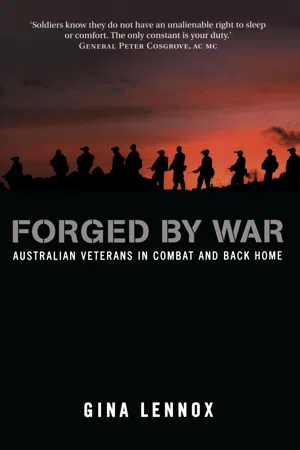
In Forged By War, Australian veterans and their families reveal the experience of combat and how it has changed their lives. These stark first-hand accounts describe the reality of military action and its personal consequences in every major conflict and peacemaking mission since World War II, including the invasion of Iraq.
Sometimes the reader is in lockstep with a soldier on patrol, watching as a land mine explodes, or a local militiaman points an AK–47 at Australian peacemakers. Other times, the reader is inside a returned veteran's head, feeling their superfluous adrenalin, their need to control their environment, even at home.
With accounts from Peter and Lynne Cosgrove, Graham Edwards, Frank Hunt (I Was Only Nineteen), other veterans of Vietnam, Glenda Humes (daughter of Capt Reginald Saunders), peacemakers and an SAS trooper, this compelling investigation by Gina Lennox in underpinned by the question: where does family fit in a soldier's life?
- 704 pages
- English
- ePUB (mobile friendly)
- Available on iOS & Android
eBook - ePub
Forged By War
About this book
Information
PART I DROPS OF BLOOD IN A POND OF WATER
WAR IN AFGHANISTAN (2001– ) AND IRAQ (2003– ) AND UN DEPLOYMENTS FROM 1989
Like UN peacekeeping and peacemaking missions, the wars in Afghanistan and Iraq operate morally and militarily in new paradigms, linked to a changed notion of conflict and the ‘enemy’ arising out of the Vietnam War era. They have been fought under strict rules of engagement, where even the number of enemy soldiers killed is of concern. Australia’s contribution to these wars has been small in quantity but high in quality, with the inclusion of our most elite troops: the SAS, or Special Air Service Regiment. Three SAS Sabre Squadrons rotated through Afghanistan, while for the war on Iraq, Australian SAS were the first Coalition forces to cross the border. Given the unusual nature of these wars, the SAS were required to be highly skilled in soldiering, peacemaking and cross-cultural relations, enhanced by training and experience in the Solomon Islands and elsewhere.
These and other UN contributions benefit from the depth of experience the ADF has accumulated in peacekeeping and peacemaking. Australia contributed to the first UN peacekeeping mission—Indonesia in 1947—Australians having commanded five UN missions: Nimmo in Kashmir (1950–66), Sanderson in Cambodia (1992–93), Ferguson in the Sinai (1994–97), Butler in Iraq (1997-98), and Ford in the Sinai (1998–2000), while Cosgrove led the multinational force in East Timor (1999–2000). Between 1975 and 1988 Australia was involved in eight UN missions (the Sinai, Kashmir, South Korea, Cyprus, Syria and Lebanon-all ongoing—as well as Rhodesia). Since 1989 many military personnel have become veterans of multiple missions. Between 1999 and 2004 the Australian contribution of eight thousand to UNAMET, INTERFET and UNTAET in East Timor was the largest Australian deployment since Vietnam.
Mandates for these missions are increasingly complex, many requiring the building of social and administrative institutions as well as the disarming and demobilizing of combatants. The soldier takes on multiple roles in dealing with people of different languages and cultures, usually with a long history of conflict. As soldier, police person, advocate, negotiator and garbage collector, as well as their specialist role of medic, signaller and so on, they operate in dangerous and unpredictable environments. They must know when to be sensitive and when to be tough, while always being mindful of the rules of engagement for that particular mission.
Civilians may ask ‘Under what conditions is military action justified?’ and ‘Which acts are justifiable?’—but it is the soldier who faces the ambiguities and, along with their families, lives with the consequences. Veterans of these deployments cannot but be changed by witnessing other cultures, extreme poverty and violence, as well as the strengths and pitfalls of the mission. Veterans who find life difficult as a result benefit from the trail blazed by Vietnam veterans in terms of understanding and services. They also benefit from having grown up in an era where men, as well as women, are not as bound by patriarchal stereotypes. Young veterans tend to be more willing and frank in acknowledging what is happening inside them. Yet it has taken forty years to fully appreciate the impact of the Vietnam War. The long-term effects of recent deployments on veterans and their families remain to be seen.
1 ALWAYS A LITTLE FURTHER
An SAS Veteran of Afghanistan and Iraq
Australia’s elite SAS Regiment was established in 1957. In Vietnam its members became known as ‘Phantoms of the Jungle’. Their next war was in the deserts and mountains of Afghanistan in 2001–02, where the first squadron sent over took part in Operation Anaconda, the biggest battle of the Afghanistan War, involving over two thousand allied soldiers. In Iraq in 2003, they were the ‘Phantoms of the Western Desert’, slipping from target to target as if on a magic carpet, their most urgent mission being to locate long-range missiles. Before these conflicts, they were involved in the multinational build-up in Kuwait to apply pressure on Iraq in 1998 and in East Timor and the Solomon Islands in 2000.
This is one SAS soldier’s personal account of his tours of duty in Afghanistan and Iraq, to which his wife and his father, who served as a forward scout in Vietnam with 9 Battalion in 1968–69, contribute. As anonymity is critical for SAS operators, pseudonyms have been used throughout.
I was working as a ringer on different properties in Northern Queensland, riding horses and chasing cattle for four years, when I met Clare. When we decided to marry in 1994, I thought joining the Army was a good way of settling down without slowing down. Dad having been in the Army, more than him being a Vietnam veteran, had everything to do with it. As a boy you think about following in your father’s footsteps. I see it in my own son.
Dad had a library of military books, so I’d read about the SAS in Vietnam and Borneo. Always in the back of my head was the thought ‘I wonder if I could do that.’ I did fairly well at Kapooka [training centre], and in 1 Battalion I became a sniper, physically training with SAS in mind. I was twenty-five when I went through the twenty-day selection course. It’s physical, but it is what you bring to it mentally that gets you through. The Senior Instructor warned us that his course would take our minds to places we had never been before. He was right. In 1-NAVEX [Navigation Exercises], we pack-marched fifty kilometres in twelve hours before being shown how to strip several weapons we hadn’t used before. After five days of marches and nightly foreign language lessons, at one stage being expected to read a map in the language to find our way, we were given one of the weapons to put back together. We were fed a small amount and woken six times a night. The whole course was designed to wear you down to see who you really were. It’s those who can do things at the limit of their endurance, and laugh about it, who end up in SAS. The way I got through was not so much thinking about what Dad went through, because he hasn’t told me, but thinking about what I’d read of Australian soldiers from the Maori Wars to Vietnam. I’d think: ‘It isn’t so hard. At least I’m not getting shot at.’
By the end of the course I wasn’t laughing but I was there. Of the 140 blokes who started, twenty-four stayed to the end. Six ended up in my troop. I came away thinking, ‘I went that far, how much further could I have gone?’ On operations, it’s no good to get so near your limits.
On 11 September 2001 I’d been with the Regiment four years and in the Army for seven. I was at home with Clare and the kids in Swanbourne, in Western Australia, where the Regiment is based, when we got a phone call from Clare’s father telling us to put on the television. As we watched the footage of the planes ploughing into the twin towers of the World Trade Center, I said to Clare, ‘This is going to be big.’ My gut feeling was the same as the other blokes in the Regiment: that this was one of those defining moments in world history. The Americans weren’t going to stand for it. My squadron was on line for a war role. When President Bush called for a ‘war on terror’, saying, ‘You’re either with us or against us’, I thought, ‘Yep, he’s serious.’ No soldier wants to be put into a situation where the people running the show are half-hearted.
There’s always other ways of doing things but when it boils down to it—no one person makes the final decision in isolation. There are hundreds of experts giving advice based on international law, safety of the troops, the end game, whatever. From what I was to see, it was not about getting rid of a few people. But at the end of the day it doesn’t matter what a soldier thinks—he follows orders; what matters is that he can do the job and that he is comfortable doing it. A side issue, but an important one, is that people at home believe in what he is doing.
We were well up to speed. By September 2001 my squadron had spent ten months training for different war scenarios, doing bush and mountain work, roping out of helicopters—the list is endless. Each troop specializes. There is a mobility troop, which concentrates on vehicle movements; a water troop, which does all facets of water work—diving, canoes and boarding ships; and a free-fall troop that parachutes out of helos and planes. The training makes a troop tight-knit. Clare jokes that you know the blokes better than you know your wife. You certainly spend more time with them, so sometimes you get sick of them, the same as any close relationship. I was fortunate with my troop: everyone got on well, everyone was a bloomin’ character. Six of us came from the bush. Four had fathers who’d been to Vietnam. You know each other so well you learn to complement each other. That is the strength of the Regiment. The myths of what SAS can do are built on the team. Coming from the country I was used to bush work, riding motorbikes, tracking, trapping and shooting rabbits and foxes, so I was a long-range sniper and photographer. Con was ex-Navy, a linguist and switched on with signals. Slipper, with his Egyptian background, was a linguist and a medic, and so on. Then it’s up to the patrol commander to gel it all together.
My squadron had already been to Kuwait in 1998 and to Timor in 2000, so we had experience in desert and jungle. For Kuwait, we arrived in February for Operation Pollard, our contribution to Operation Desert Thunder, in response to Saddam Hussein declaring eight palaces off limits to the UNSCOM weapons inspectors and kicking them out of the country. Kuwait was my first exposure to how big America’s war machine is, and Britain’s. It was also the first time since Vietnam that an SAS squadron had been deployed. We stayed overnight in Diego Garcia, the British and US Military base south of the Maldives, but mid-flight to Kuwait, we had to turn around and fly back to Garcia. A Kuwaiti VIP who wanted to give us the red carpet treatment wasn’t ready. When we landed the next night the VIP was waiting to shake everybody’s hand as we came off the plane. At two in the morning he insisted on shouting us breakfast: our first taste of Middle Eastern hospitality but the last thing we felt like. We were then bussed out into the desert and, just before dawn, given an hour’s rest in three big canvas tents. As the sun came up, all we could see was flat grey desert—not a blade of grass—and twenty metres above us, dozens of humming power lines.
After a two-hour drive we reached the Americans’ Ali Al Salim Air Base. For the next month we slept on stretchers in air-conditioned American Air Force tents, fifteen blokes to a tent, in a summer heat that reached 51 degrees Celsius. We started training, the SEALS [American Navy Special Forces], Canadians, Poms, Kiwis, Kuwaitis and Aussies competing for jobs: special reconnaissance for pinpointing targets so aircraft crews could do a bombing raid and CSAR [Combat Search And Rescue] for downed aircraft crews. I think our CSAR demos impressed the American commanders.
After three weeks we got the feeling that the Coalition build-up was more about applying pressure and some exercises became a matter of ‘Let’s go and test the motorbikes.’ We had time to yarn with the locals. Non-Kuwaitis minded the mobs of camels, sheep and goats or worked in wheel-less caravans that sold Coke and soccer balls along the highway. Most of them were virtually slave labour from Bangladesh or India. The Kuwaitis wouldn’t even pay them—they’d pay their parents back home. At dawn we’d see one sleeping on the ground next to a mob of sheep, with only a blanket, a plastic container of water and a bag of dates. There were a few Bedouin and their camels and then there were the rich Kuwaitis who came to the desert for a weekend camping trip in big seven-seat Chevrolets. Sometimes they brought their wives and children. We’d be out in the desert, fully cammed up [in camouflage] and if we saw one of their red-and-white striped tents, we went over. The men would be dressed in white kaftans and the red-and-white checked shamarg headgear. Most spoke English. We had a smattering of Arabic and Slipper was fluent, so we’d grab him and go ‘G’day, what’s happening?’ They would invite us into their tent for a drink of goat’s milk or tea, and always bent the rules for us: ‘Don’t worry about taking off your boots. Bring your gun.’ Inside there were woven kilims that acted as snake barriers, and usually a giant hunting falcon sitting on a pedestal. Kuwaitis love their falconing and if you showed an interest you were their mate. All of them knew about Australia because of our camels and lamb.
After a month in this pale desert your eyes adjust, so when we returned to Doha, on the edge of Kuwait City, colours were a surprise. Doha is known as the camp of no horizons—a concrete city behind high walls, a bit like a prison but with all the mod cons Americans like to cart around with them. Between exercises we could go into Kuwait City, a mixture of modern buildings, kebab stalls and teahouses full of men smoking hubbly bubblies. None of the people working in shops were Kuwaiti and you never saw Kuwaiti women drive—they weren’t allowed.
The UN Secretary-General, Kofi Annan, had meetings with Iraq’s Deputy Prime Minister, Tariq Aziz, in Kuwait and Saddam Hussein in Baghdad. Iraq was forced to agree to give weapons inspectors unrestricted access to all sites. It meant we came home but the trip opened our eyes to the people and the politics.
At that stage I had been married four years and had two children: Tom was two and Laura was a baby of five months. By the time I left for East Timor in January 2000, our third child, Isabelle, was six months old.
East Timor was my first experience of a combat area. We were working out of Dili and Balibo, providing Ready Reaction teams to apprehend people of interest, patrolling near the border to keep an eye on the TNI [Indonesian Army] border posts and stray militia. The biggest thing I learnt was handling the mental stress of going out with four to six blokes in close country, and the fear of the unknown, especially when we were being inserted. Once you’re on the ground it’s a relief. The country reminded me of the mountains north of Cairns. On patrol we didn’t talk unless it was absolutely necessary and then it was only a whisper. To sleep we’d find an impregnable spot and crawl in. For water we’d catch the rain or use local water. Most of the time we were too close to the border to cook.
Towards the end of the deployment we had more contact with the locals in the villages. One troop stayed with FALINTIL [National Armed Forces for the Liberation of East Timor] in their enclave to keep them entertained and out of trouble. One night they were sitting around a campfire and there was Nick dancing the Moonwalker and Sprinkler, a FALINTIL playing a guitar. The locals were happy to see us—the adults felt some connection, having protected our Commandos from the Japanese. When they took us to sites where people were buried I wished we’d got there earlier.
When I got home, ten-month-old Isabelle took a day or so before she gave me a cuddle—she wasn’t quite sure about me. Two months later, in June 2000, we were sent to the Solomon Islands, on the invitation of the Solomon Islands Government. The Malaita Eagles Force [MEF], led by Jimmy Rasta and other factional leaders, all running around in red berets and black balaclavas, had organized a coup and taken over Honiara. Since January 1999 there had been trouble between the MEF and Harold Keke and Joseph Sangu’s mob [the Isatabu Freedom Movement or IFM], who were indigenous to Guadalcanal and resented the Malaitans taking over land and businesses. The IFM were attacking Malaitans, then hiding out on the remote Weathercoast. We were to facilitate peace talks and would go to various places to pick up the key players and take them to HMAS Tobruk.
The islands are awesome: phenomenal little coastal coves with coral under twenty metres of crystal clear water, white beaches and palm trees. Officially we weren’t allowed to set foot on land, but we had to convince the leaders that it was safe to come with us, and it’s hard to do that if you expect them to swim out to you. We’d drive the boat onto the beach and have a yarn and sometimes a feed. After that, they were more than willing to come, except Keke—he refused to participate. His people had to take all the paperwork back to him, but everyone eventually agreed to a ceasefire and a future meeting in Townsville.
We were rotating through, so I went to the Solomons four times over an eighteen-month period. In October 2000 we were involved in bringing the important players to Townsville to make a peace agreement. Then, in June 2001, Harold Keke’s group tried to assassinate Premier Ezekiel Alebua in retaliation for police operations on the Weathercoast. An International Peace Monitoring team went over to advise and monitor, but guns were not being handed in and there was corruption in the police and government, especially with the Won-tok system, where family ties are more important than any others and that’s why Australians were invited back for a more active role in 2003.
So we’d been busy in the lead-up to September 11, and within days of the attacks we were hearing rumours that we would be deployed to Afghanistan. On 18 September, Prime Minister John Howard announced that President Bush had formally requested that Australia be involved. Squadron Headquarters started preparing. If we were to be called upon we knew the general nature of our tasks—to locate al-Qa’ida and Taliban, gather intelligence and do surveillance and search and rescues—but we didn’t know for sure if we were going. Week after week, units around Australia gear up for something that will never happen. But also, my squadron was about to be rotated out of war role and into counter-terrorism. Of course we wanted to go.
I was instructing a CQB [Close Quarter Battle] course for new blokes. It involves shooting live rounds in rooms and around buildings, it’s high tempo and dangerous but it w...
Table of contents
- FORGED BY WAR
- PART I DROPS OF BLOOD IN A POND OF WATER
- PART II GENERATIONS OF WAR
- PART III AS THE CALL, SO THE ECHO
Trusted by 375,005 students
Access to over 1.5 million titles for a fair monthly price.
Study more efficiently using our study tools.
Frequently asked questions
Yes, you can cancel anytime from the Subscription tab in your account settings on the Perlego website. Your subscription will stay active until the end of your current billing period. Learn how to cancel your subscription
No, books cannot be downloaded as external files, such as PDFs, for use outside of Perlego. However, you can download books within the Perlego app for offline reading on mobile or tablet. Learn how to download books offline
Perlego offers two plans: Essential and Complete
- Essential is ideal for learners and professionals who enjoy exploring a wide range of subjects. Access the Essential Library with 800,000+ trusted titles and best-sellers across business, personal growth, and the humanities. Includes unlimited reading time and Standard Read Aloud voice.
- Complete: Perfect for advanced learners and researchers needing full, unrestricted access. Unlock 1.5M+ books across hundreds of subjects, including academic and specialized titles. The Complete Plan also includes advanced features like Premium Read Aloud and Research Assistant.
We are an online textbook subscription service, where you can get access to an entire online library for less than the price of a single book per month. With over 1.5 million books across 990+ topics, we’ve got you covered! Learn about our mission
Look out for the read-aloud symbol on your next book to see if you can listen to it. The read-aloud tool reads text aloud for you, highlighting the text as it is being read. You can pause it, speed it up and slow it down. Learn more about Read Aloud
Yes! You can use the Perlego app on both iOS and Android devices to read anytime, anywhere — even offline. Perfect for commutes or when you’re on the go.
Please note we cannot support devices running on iOS 13 and Android 7 or earlier. Learn more about using the app
Please note we cannot support devices running on iOS 13 and Android 7 or earlier. Learn more about using the app
Yes, you can access Forged By War by Gina Lennox in PDF and/or ePUB format, as well as other popular books in History & Military Biographies. We have over 1.5 million books available in our catalogue for you to explore.