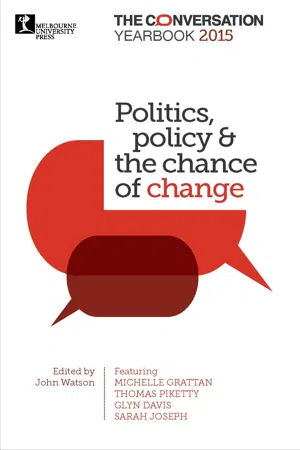
Continued political and economic turbulence, pervasive threats of terrorism and climate change: 2015 was a testing year. Even Australia's charmed run as 'the lucky country' threatened to come to an end. The pressures of government resulted in Malcolm Turnbull ousting Tony Abbott to become the country's fifth prime minister in five years. Will this prove to be a case of history repeating itself, or a turning point?
This collection of articles from The Conversation traverses the year's highs and lows, the issues and possible solutions from experts in education, environment and energy, business and health, the arts and society. Some commentators or writers capture events as they happened, others take a longer view, but all bring academic expertise to bear on the issues of the day and the challenges of tomorrow.
- 389 pages
- English
- ePUB (mobile friendly)
- Available on iOS & Android
eBook - ePub
About this book
Trusted by 375,005 students
Access to over 1.5 million titles for a fair monthly price.
Study more efficiently using our study tools.
Information
CHAPTER 1
Leadership challenges in changing times
What ails Abbott is but a symptom of the disease of government today
Shaun Carney
Adjunct Associate Professor, School of Social Sciences, Monash University
If a single speech is regarded as a make-or-break event for an Australian prime minister, then that prime minister faces an uncomfortable future. That’s because the ‘make’ part is a fraud. Tony Abbott could have finished himself off with a dreadful performance at his February 2 appearance at the National Press Club. But he never stood a chance of restoring his prime ministership simply by putting on a decent or even a brilliant showing.
That’s because once the make-or-break tests begin, they never stop. Get through this announcement, this parliamentary showdown, this interview and there’ll always be another one. That’s the zone Abbott will now inhabit for as long as he remains prime minister or until the next election, should he still hold the position then. He’s only ever one more blunder away from collapse.
So too is his government. The fixation with his leadership—whether he should be replaced and by whom—at the mid-point of its first term of office unfortunately follows a modern, predictable script. Surely, it’s reasoned, there’s nothing fundamentally wrong with the government; the problems are down to the leader and to messaging.
There are calls, as there have been since the Queensland state election rout, for Abbott to admit error, to change his ways, or to hand over to someone else. Change the face, ramp up the PR, find a new way to tell the people that what’s being done to them is for their own good, and everything will be back on track.
This obsession with leadership pays insufficient heed to the deeper reasons behind the government’s problems. This is a government with a very long ministerial tail. Its weaknesses start if not at the top then with the second-most-important minister, Treasurer Joe Hockey, and through various parts of the ministry.
The lion’s share of responsibility for the government’s trials and its apparent lack of public support must go to Abbott, of course. The power of prime ministers in contemporary Australia is immense. But in a cabinet system of government, there’s a collective responsibility that should be shared by all ministers.
This is all too easily forgotten. The government is not and never has been just Tony Abbott; it is the sum of the Liberal and National party organisations, all the way up to the people the parties put up for cabinet membership.
Where the government has gone wrong is in its attitude to policy formulation and its approach to governing since the Liberal party room made the fateful decision to install Abbott as leader in December 2009.
Under Abbott, the Coalition has pursued a set of default positions. On policy, it has taken up the modern nostrums of economic liberalism, of smaller government, free trade agreements, the sale of public assets such as Medibank Private, of applying higher consumer prices to government services such as health and higher education. It is assumed by many of the people who write about politics and by public servants and political advisers that the public is comfortable with these policy choices, but there’s mounting evidence that this is not so.
On its communications, the government has opted for the most risk-averse positions. In opposition, despite holding a massive lead over Labor before the 2013 election, it took the safe route and chose to assure voters that it would be able to fix the budget without any cost to voters, with no cuts, no excuses and no surprises. The adults would be back in charge. Surplus budgeting was in the Coalition’s DNA, and so forth.
In office, its ministers all deliver little more than talking points. Its members run down the clock in interviews with answers that rarely address the questions that have been asked.
Government MPs are not unique in this; Labor members have in recent years taken the same approach. But that’s where the Abbott government has got itself into so much strife so quickly.
When voters heard ‘no surprises’, ‘the adults are back in charge’ and a pledge not to impose costs on them during the repair job, they believed they were going to get authenticity and straight talk from an Abbott government, compared with the ALP’s chaotic, PR-obsessed shenanigans.
Instead, what voters got was a 2014–15 budget that contained nasty surprises such as a Medicare co-payment. They got a higher education policy that looked to place extra burdens on families and graduates.
Voters concluded that they’d been conned. They’d wanted something fresh, something straight. Instead—and qualitative polling by both sides suggests this—they’ve decided that they’ve elected another outfit committed to the political orthodoxy of spin and higher costs.
Being seen as a liar or a sneak is sudden death in modern politics because we appear to have moved into a new era in which—if the recent Victorian and Queensland elections are a reliable guide—there is no such thing as redemption.
The sense of crisis that has overtaken the Abbott government in the past week has been triggered by two events that have little material effect on national politics: Abbott’s awarding of an Australian knighthood to the Duke of Edinburgh, Prince Philip, and the Queensland state election result.
The reason that they’ve resonated so profoundly in Canberra is that they reflect public revulsion at not being told all of the truth. Abbott reintroduced Australian knighthoods only six months after the 2013 election. It was only a tiny surprise but an unnecessary one nonetheless. The shock of the first Hockey budget came soon after and the government has never recovered.
The Queensland result was the final response by voters to Campbell Newman’s 2012 pre-election promise that the jobs of state public servants and government workers were safe. Upon being elected, he promptly got rid of 14,000 of them, and his poll ratings started to fall away from that moment. His commitment to sell off government assets—a popular policy for adherents to the political orthodoxy but highly unpopular among many voters—locked in that fall.
Abbott did not do too badly at the National Press Club, although his call for political debate in which there were no cheap shots—and in which all players acted in the national interest and not their own self-interest—was, in the context of his own performance as leader, a bit of a stretch.
But it was merely the first of a long, long series of tests that Abbott will face every day from now on. And just getting a pass will never be enough.
Shaun Carney is an Adjunct Associate Professor at the School of Social Sciences, Monash University. He is a columnist with the Herald Sun newspaper in Melbourne, and was associate editor and chief political columnist at The Age newspaper 1997–2012.
Article first published February 2, 2015
The evolution of Malcolm Fraser was a wonderful thing to behold
Barry Jones
Professorial Fellow, University of Melbourne
What I came to admire, even love, in Malcolm Fraser was that, as he aged, he became more open, more radical, more attracted to the universal, more outraged by opportunism, and more courageous. At 84 he was better than he had been at 64, and far superior to the 44-year-old prime minister. That evolution was a wonderful quality in him.
Born in Toorak, brought up in the Riverina, Fraser was educated at Melbourne Grammar and Magdalen College, Oxford, where his lecturers included Isaiah Berlin and A.J.P. Taylor.
Elected as MP for Wannon in December 1955, aged 25, he was the youngest future prime minister to enter federal parliament. Paul Keating, a few months older, came next.
Fraser’s style and associations were patrician, something that the Melbourne-educated Robert Menzies aspired to, and the Oxford-educated John Gorton rejected. Gough Whitlam was patrician in style but not background, and Howard was determinedly populist.
Going directly to Oxford from Melbourne Grammar was probably a mistake, isolating him from Melbourne contemporaries and contributing to his rather awkward manner. Fraser’s marriage to Tamie (Tamara) Beggs in 1956 humanised him, and his children, in later decades, encouraged him to enlarge his range of issues.
He was always, as Bob Hawke said, impeccable on race. But in his early years in politics he was seen as hard right, influenced by the novels of Ayn Rand, with their heavy emphasis on individual freedom and opposition to state intervention, and—like Tony Abbott—attracted to the ideology of B.A. Santamaria.
These factors may have influenced Menzies to choose Billy Snedden and Peter Howson as ministers but not Fraser—a decision he came to regret.
During the Vietnam War, as army minister, Fraser began as a zealot, then became a sceptic, determined to resist Australian forces being subject to strategic deployment by the United States and doubtful that a victory by Hanoi would endanger Australian security in any way.
In 1992, he invited me to join the board of CARE Australia. We worked together closely for the next eight years. He drove himself and he drove the board, and he was increasingly appalled by contemporary horrors, especially Rwanda.
Despite the ‘late unpleasantness’ of The Dismissal in November 1975, Whitlam and Fraser took common cause on many issues and developed a mutual affection in their last decades.
Gough told me that he allocated responsibility for the dismissal as 70% John Kerr, 30% Fraser.
In May 2008, I organised a lunch for Gough attended by Malcolm, John Clarke and Bryan Dawe, Race Mathews, Graham Freudenberg and Julian Burnside. The rapport between Malcolm and Gough was obvious.
Fraser used to argue that he had not changed his political position, but everyone else had, with both the Liberals and the ALP moving from the centre to the right. He was deluding himself there. He had changed, very significantly.
He had become Liberal leader in March 1975 as a paladin of the right, defeating the moderate but ineffectual Billy Snedden.
He used to take conservative attitudes. He voted against the abolition of the death penalty (September 1973), abstained on Gorton’s motion to decriminalise homosexual acts (October 1973) and voted with John Howard and Philip Ruddock on the Lusher motion proscribing medical benefits for abortion (March 1979).
He made a serious error of judgement in adding a new division, Knight (AK) and Dame (AD), to the Order of Australia in June 1976. Because these awards went mostly to people who were already knighted, including Menzies, Burnet, Kerr, Cowen, Stephen, Barwick, Cutler and Syme, this aroused less controversy than Abbott’s exhumation of the honour in 2014.
Strikingly, when he spoke at the Melbourne launch of my autobiography, A Thinking Reed, in 2008, he read with deep emotion from my chapter on the death penalty.
As prime minister from 1975 to 1983, he maintained much of the Whitlam ‘platform’, including free universities, and was an ardent promoter of multiculturalism. He was a strong supporter of the ‘Yes’ case in the failed 1999 referendum on a republic and became a patron of the Dying With Dignity organisation.
With Julian Burnside, he was the outstanding advocate for reversing the cruel and dehumanising—but apparently electorally popular—policy of mandatory detention for asylum seekers. He was strong on Indigenous issues.
Malcolm was a gifted photographer and I bought one of his pieces for my collection by donating to CARE Australia.
During the 2007 election he would telephone me and say, ‘How are we going?’ I would always reply, ‘Who is this “we” to whom you refer? Is it the party that you used to lead?’ And he would say—it was a kind of game—‘Get stuffed.’
He became an enthusiastic tweeter and accused me of not keeping up with the times. On most issues, population excepted, we took a common view and he was certainly further to the left than anyone on the opposition frontbench in Canberra.
Malcolm was an extraordinary, often lonely, figure, and I shall miss him. The loss for Tamie, his family, his office staff, old friends will be profound and I send them my love.
Barry Jones is a Professorial Fellow at the University of Melbourne. He was a Member of the Australian Parliament 1977–98, Minister for Science 1983–90 and Australian Representative to UNESCO 1991–95.
Article first published March 23, 2015
National conference subdued about Labor revival as Shorten gets his way
Dennis Altman
Professorial Fellow in Human Security, La Trobe University
After Labor lost government in Tasmania last March, the ALP was in opposition federally and in all states across the country, with the sole exception of South Australia. Sixteen months later Labor has returned to power in two more states, Victoria and Queensland, and leads consistently in federal opinion polls.
One might have expected, then, more jubilation at its national conference than seemed to be the case. My impression was of being in the members’ section of a football team that was down on its luck but determined to keep up its spirits at all costs.
At a time of declining party loyalties, Labor’s national conference is a rallying point for the true believers. It is a chance to reassert their commitment to both a vision of Australia and the election of a Labor government.
Cynics argue that Labor is wedged between the left purists of the Greens and the populist right represented, if only fleetingly, by Clive Palmer. But given...
Table of contents
- Cover
- Title
- Copyright
- Contents
- Foreword Has a year of political turmoil changed the game?
- Chapter 1 Leadership challenges in changing times
- Chapter 2 Wrestling with reform
- Chapter 3 What price well-being?
- Chapter 4 Bubbles, busts and budgets
- Chapter 5 Crunch time for Earth’s custodians
- Chapter 6 Science: its wonders, mysteries and perils
- Chapter 7 Stacked decks: gender and race in Australia
- Chapter 8 In the eye of the beholder: the culture wars
- Chapter 9 Troubled times test our civilisation
- Chapter 10 Views from abroad
Frequently asked questions
Yes, you can cancel anytime from the Subscription tab in your account settings on the Perlego website. Your subscription will stay active until the end of your current billing period. Learn how to cancel your subscription
No, books cannot be downloaded as external files, such as PDFs, for use outside of Perlego. However, you can download books within the Perlego app for offline reading on mobile or tablet. Learn how to download books offline
We are an online textbook subscription service, where you can get access to an entire online library for less than the price of a single book per month. With over 1.5 million books across 990+ topics, we’ve got you covered! Learn about our mission
Look out for the read-aloud symbol on your next book to see if you can listen to it. The read-aloud tool reads text aloud for you, highlighting the text as it is being read. You can pause it, speed it up and slow it down. Learn more about Read Aloud
Yes! You can use the Perlego app on both iOS and Android devices to read anytime, anywhere — even offline. Perfect for commutes or when you’re on the go.
Please note we cannot support devices running on iOS 13 and Android 7 or earlier. Learn more about using the app
Please note we cannot support devices running on iOS 13 and Android 7 or earlier. Learn more about using the app
Yes, you can access Politics, policy & the chance of change by John Watson in PDF and/or ePUB format, as well as other popular books in Politics & International Relations & Global Politics. We have over 1.5 million books available in our catalogue for you to explore.