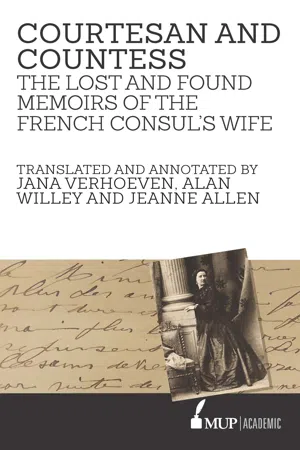
Cleste de Chabrillan, former courtesan and widow of the first French Consul to Melbourne, became the most prolific female stage writer in nineteenth-century France. Forever haunted by her scandalous past, Cleste fought to hold her place in an artistic world dominated by men. Courtesan and Countess tells the story not only of her struggle as a creative artist to survive and earn a living, but also of her fascinating life at the centre of the bohemian circles of Paris, surrounded by friends such as Alexandre Dumas pre, Georges Bizet and Prince Napolon. Courtesan and Countess paints a portrait of a remarkable woman and of the turbulent world of Paris during the Belle Epoque.Lost for more than eighty years until discovered by the authors in the attic of a French country manor, these are the unpublished and final set of memoirs from Cleste de Chabrillan.
eBook - ePub
Courtesan and Countess
The Lost and Found Memoirs of the French Consul's Wife
- English
- ePUB (mobile friendly)
- Available on iOS & Android
eBook - ePub
Courtesan and Countess
The Lost and Found Memoirs of the French Consul's Wife
About this book
Trusted by 375,005 students
Access to over 1.5 million titles for a fair monthly price.
Study more efficiently using our study tools.
Information
The Two Names
1
Three Hostile Encounters
At the end of ‘Un deuil au bout du monde’ (Death in a Distant Land) I mentioned the nature of the conversation that I had had with Monsieur de Lesseps,1 plenipotentiary Minister at the Foreign Affairs Office, and what the result had been. He had called me to his office to tell me that I had been refused the pension provided to widows of consular agents, as my marriage to the Count Lionel Moreton de Chabrillan was not valid. He further informed me that my husband’s family had decided to have the marriage annulled as quickly as possible. However, in order to avoid a scandal, they were disposed to grant me an annuity, either in the country or abroad, but on the strict condition that I abstain from any further writing. They also demanded that I cease to bear his name, as it would bring me back into people’s memory, and this was to be avoided at any cost, and nobody was to hear of me ever again.
Lesseps was quite tall and had the nose of a mulatto. His piercing black eyes made him look like the devil wanting to inspire fear or surprise to intimidate me. I was in heavy mourning and was just recovering from a long illness that I had contracted in Australia. I was all skin and bones, and even the most vulgar and uncivilised man would have taken pity on me. Nevertheless, I stood up straight and told him that I was going to keep my husband’s name and sign my works with it, as this was his wish, and that neither Lesseps nor those he represented would change my resolution. Monsieur Lesseps was not a stranger to me. I had known him when he was still forging his career and it is possible that he took such a disloyal and ruthless intervention against me because I brought back unpleasant memories to his mind. He knew perfectly well that my marriage was valid, having been contracted before a French as well as an English magistrate.2 When insisting on the contrary, and thus withholding the pension due to me, he had committed a moral crime. If I had pointed out his lack of sensitivity at that moment, I might perhaps have been accused of slander. Time alone will show his lack of conscience.

Lionel de Chabrillan, engraving after a photo taken by Antoine Fauchery in Melbourne (Archives Départementales de l’Indre)
On leaving the Ministry, I once again felt so weak that I could hardly hold myself upright, and I staggered through the street as if I were drunk. When I finally reached my apartment at 14 rue Royale in the Faubourg Saint-Honoré I needed to be helped up the stairs to the fifth floor, to be undressed and put to bed. My servant Marie, whom Alexandre Dumas père3 had nicknamed Grimo—because she only ever grumbled in monosyllables—an old maid who was as dim as she was kind, went to fetch my doctor right away. Doctor Ducholet had treated my husband and also saved my life when I returned from Australia. He realised instantly that I must have experienced a bad shock that had upset my digestive bile, a dangerous thing for people affected by liver problems. I told him in a few words what had happened, and then my speech became suffocated by tears. I couldn’t stop crying and did not even bother to wipe away my tears.
So the old man took my burning hands in his and said to me: ‘Listen child, as you have many more tears to shed, shed them only in memory of the man who rehabilitated you and wants you to join him in heaven. He was as kind-hearted as he was generous and, following the example of Christ, he said, “Lift yourself up, I forgive you your past and God will forgive you too.”’
The good man was very pious and feared that the loss of my husband had diminished my faith. And indeed I was very angry against God and all the saints in paradise.
As I didn’t have the time to be sick, I was back on my feet three days later and was preparing to go out when my maid came into my room and whispered:
‘Madame, a gentleman has arrived who wants to see you right away.’
‘What’s his name?’
‘I don’t know. I didn’t have the time to ask. The door to the salon was open and he just stormed in.’
‘What does he look like?’
‘Middle-aged, a bit stout, but with fine features, a distinguished face, but not at all accommodating.’
‘Ask for his name and the reason for his visit.’
She went out and came back almost immediately, whispering in an alarmed tone:
‘It is the brother of Madame’s husband, the Marquis de Chabrillan.4 He doesn’t seem to be like the others.’
I hadn’t seen him in six years and could well imagine that he had not come to see me to share pleasantries about our family by marriage. I tried to gather together in my mind any good or bad memories connected to our former relationship. He was nicknamed ‘the fat one’ and I had known him by reputation long before meeting his brother, who looked much younger than him.
Théodose had not been a saint in his youth either, but he had never caused a scandal. He wore fine suits from London and was rather calculating. When his eldest brother, Olivier de Moreton de Chabrillan, died tragically in 1830 at the age of only twenty-six, Théodose inherited the title of Marquis. He tried to arrange a marriage for Lionel, but it did not come to anything. He should have been a mentor for his younger brother, but instead he remained a passive if sympathetic observer of the follies and the mad spending that led to the ruin of my beloved. He professed to love Lionel tenderly, but never told him directly what he thought of his lifestyle. And then one day he had to get used to the idea of meeting me, his brother’s mistress, face to face. I don’t believe this prospect particularly horrified him because we mixed in similar circles. We all went to soirées attended by Emile Augier,5 Beaumont, Carillon la Tour and others. He never met other women there, apart from me, and so his reputation—he had in the meantime become a man of virtue—did not run the risk of being compromised.
But from time to time he could not abstain from giving us a lesson in morality. Lionel had known me for five years, and his brother once told us that he did not understand why men entered into a relationship with their mistress when the benefit of having a mistress was that one could change them as often as one pleases. The handsome and charming Emile Augier had assured me with a quick look that he was on my side and replied: ‘Well, Marquis, if one day I decided to marry, I would never take a wife without first getting to know all her qualities.’ Then he went on praise me in the highest terms, proclaiming that I had not only the arms of the Venus de Milo6 but also the bearing of an Empress. My Lionel was content, and so was I. The Marquis pouted a bit but did not contest the praise of my physical attributes, and this was enough for me. We left each other seemingly as good friends, but I think we had already started hating each other at that point.
I hadn’t seen him since and did not suppose that he had come back to speak of our former friendship. I was nervous and rather troubled and said to my maid: ‘Please ask him to wait a moment. I will be with him in a few minutes.’ I wanted to be calmer, master my emotions, and prepare for his assault. He had no doubt come to demand an annulment of my marriage, after his friend de Lesseps had failed.
But in the midst of all these thoughts a memory came back to me that did not predispose me to be submissive and indulgent towards my brother-in-law. Shortly after our departure for Australia, Emile Augier had written a vexatious play entitled Olympe’s Wedding.7 Augier, a man of wit and finesse, would usually abstain from overly melodramatic scenes with bombastic effects. He had almost finished the play, when he told my brother-in-law in the presence of my good friend Ernest Baroche,8 who had loyally remained devoted to me, that he wasn’t quite sure what to do with the character of Olympe.
‘Kill her off,’ the Marquis had answered.
So Olympe dies on stage, struck down by a pistol shot, to the great delight of a large and highly respectable audience. The premiere at the Théâtre de Vaudeville attracted much attention, and was even mentioned in the English papers we were able to read in Australia. Lionel was mainly angry with Augier, but I was angry with the whole world. It is not exactly delightful to know that people tore off their gloves in order to show their enthusiasm by applauding your imaginary execution.
Oh no, I did not doubt the anger of the Marquis. I had no doubt he was capable of ‘killing me off’ in real life. But I would resist his attempts to have my marriage annulled, and I let him wait so that I could win some time to prepare a clear and definite answer.
When I entered the room I could see that he was impatient, pacing up and down the room. I greeted him and pointed to a chair on the other side of my desk. I sat down opposite and waited for him to speak to me. He finally said:
‘I am sure, my dear, that my visit does not come as a surprise to you. Having refused the offer of my representative, the Comte de Lesseps, you must have expected it. I could have pursued the matter by involving the police, but I wanted to make a last attempt.’
As he had called me ‘my dear,’ I replied with a laugh:
‘The police, Monsieur, to do what and on what grounds?’
‘I will tell you that right away if you insist on keeping a name that he conferred upon you in his weakness, a weakness that now jeopardises the honour of our family.’
‘Interesting, Monsieur le Marquis. Why didn’t you dare tell this to his face?’
‘Now just you listen to me, because I shan’t say it twice. In view of your most dishonourable past, which you had the impudence to flaunt in writing your memoirs, you must understand that you can never be my wife’s sister-in-law or my son’s aunt. By exposing us to such dishonour, Lionel committed a despicable act. In his folly he disregarded the rules and failed to honour the obligations due to his family. This was the first time in centuries that our proud coat of arms was tarnished with a stain.’
Although I considered his anger against me quite natural, he had made a mistake in stirring up the past. I turned around to look at the portrait of Lionel above us on the wall, to gather strength and inspiration. I imagined that he was going to come to life and step down from his frame to defend himself. Then, coming back to reality, I remembered all that he had told me in the past and I started to speak out for him. Not leaving out a single detail of his story I began:
‘The family has a claim upon its members only when it carries out its duties towards them. But it was his very family, the noble Chabrillans, who caused his moral waywardness. When your elder brother died in 1830, you inherited the title as well as the responsibilities of the head of family. You should have been your young brother’s guardian, his mentor. Instead you joined him in his pleasure seeking, and only smiled at his reckless adventures and his expenses. By the age of nineteen he had accumulated considerable debts with your full knowledge and before your very eyes, and yet it was he alone who was sent away from France on 29 April 1838. He was only twenty and you had him sent to Copenhagen as a diplomatic attaché. He was handsome, intelligent, and from an illustrious family. He quickly became the lover of the Marquise de X, a very great lady who wore a knightly order and who had her privileged seat at court. Your brother, very flattered by her attentions, gave her necklaces and jewels, purchased on credit, which would have turned the head of a queen. You did nothing to prevent him from being led astray. So it was you who did not fulfil your duty, not he.
Lionel was seven years younger than you and had lost his mother when he was only ten years old. Your father, overcome with grief it seems, paid little attention to his youngest son. On leaving school, where he had already developed independent habits, Lionel found himself living at your house. He was running up debts with bookmakers; he loved betting on horses. You became his companion in these doubtful pleasures. Your brother was growing tired of it and was ready to put an end to this kind of life, a life of excess and decadence, which could easily have been turned around while there was still time. This could simply have been achieved by taking an interest in him, by dealing with him gently and in a caring way, because he had a kind heart and was very fond of you.
But he also loved this Jezebel who liberally accepted gifts from different men. She had another lover, Petipa, the famous dancer at the opera, and welcomed him at night into her palatial house. Your brother had been told of this, and lay in wait, accompanied by two of his servants, beside a little door situated at the bottom of the park, and to which Petipa had a key. One night, just when he was about to enter the park, he received a good thrashing from ...
Table of contents
- Cover
- Title
- Copyright
- Contents
- Acknowledgments
- Introduction
- Editorial Remarks
- Foreword
- Part 1: The Two Names
- Part 2: Little Diary of the End of my Life
- Postscript
- Timeline
- Bibliography
- Index
Frequently asked questions
Yes, you can cancel anytime from the Subscription tab in your account settings on the Perlego website. Your subscription will stay active until the end of your current billing period. Learn how to cancel your subscription
No, books cannot be downloaded as external files, such as PDFs, for use outside of Perlego. However, you can download books within the Perlego app for offline reading on mobile or tablet. Learn how to download books offline
Perlego offers two plans: Essential and Complete
- Essential is ideal for learners and professionals who enjoy exploring a wide range of subjects. Access the Essential Library with 800,000+ trusted titles and best-sellers across business, personal growth, and the humanities. Includes unlimited reading time and Standard Read Aloud voice.
- Complete: Perfect for advanced learners and researchers needing full, unrestricted access. Unlock 1.5M+ books across hundreds of subjects, including academic and specialized titles. The Complete Plan also includes advanced features like Premium Read Aloud and Research Assistant.
We are an online textbook subscription service, where you can get access to an entire online library for less than the price of a single book per month. With over 1.5 million books across 990+ topics, we’ve got you covered! Learn about our mission
Look out for the read-aloud symbol on your next book to see if you can listen to it. The read-aloud tool reads text aloud for you, highlighting the text as it is being read. You can pause it, speed it up and slow it down. Learn more about Read Aloud
Yes! You can use the Perlego app on both iOS and Android devices to read anytime, anywhere — even offline. Perfect for commutes or when you’re on the go.
Please note we cannot support devices running on iOS 13 and Android 7 or earlier. Learn more about using the app
Please note we cannot support devices running on iOS 13 and Android 7 or earlier. Learn more about using the app
Yes, you can access Courtesan and Countess by Jana Verhoeven, Alan Willey, Jeanne Allen, Jana Verhoeven in PDF and/or ePUB format, as well as other popular books in Social Sciences & Social Science Biographies. We have over 1.5 million books available in our catalogue for you to explore.