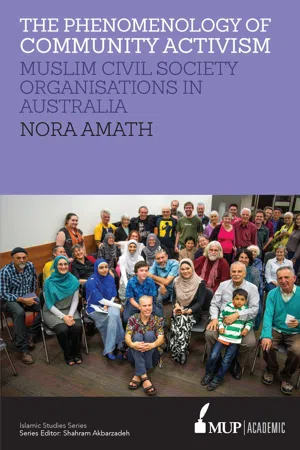
The Phenomenology of Community Activism explores how MCSOs have responded to the challenges of the Australian socio-political context, the perceived impact of these experiences, and how Islam is manifested within the contexts of these experiences. In contrast to much publicised jihadist and radical groups, MCSOs are far more representative of Muslim communities and integral to the long-term position of Islam in Australia. This book offers researchers, policy makers and those engaged in community development a rich understanding of Muslim community building, engagement and agency."This book reveals what will be surprising to some that there are many and varied MCSOs in Australia, that in many ways they are similar to other civil society organisations, serve similar purposes and encounter similar issues. This is a very important datum to stand against the prejudices about Muslims and their organisations."—Professor Emeritus Gary Bouma, Emeritus Professor of Sociology at Monash University, UNESCO Chair in Intercultural and Interreligious Relations-Asia Pacific.
eBook - ePub
ISS 19 The Phenomenology of Community Activism
Muslim Civil Society Organisations in Australia
- English
- ePUB (mobile friendly)
- Available on iOS & Android
eBook - ePub
ISS 19 The Phenomenology of Community Activism
Muslim Civil Society Organisations in Australia
About this book
Information
CHAPTER 1
Conceptualising Civil Society, the Intersection of Religion and Muslims in Australia
Introduction
This first chapter lays the foundation for the rest of the book. It provides the background and context, firstly introducing concepts, contending definitions and diverse approaches related to civil society which form part of the theoretical framework for the first part of this book’s research design. It also explores literature concerning the intersection of religion and civil society and, additionally, presents an overview of the relationship between Islam and civil society and discusses the differing views associated with this relationship. This chapter then progresses the concept from a political focus to one based on community building. Following this discussion, an introduction to the research context, that is, the Australian Muslim community and their long history in Australia, is detailed.
Civil Society: Origins, Characteristics, Boundaries and Definitions
Any study of civil society must first begin with defining this term, but this is no easy task as there is no consensus due to the varied nature of this field. There are so many meanings and conceptualisations posited by the different disciplines (at times with contradictory meanings) that Post and Rosenblum have aptly referred to civil society as the ‘chicken soup of social sciences’.1 Even within the same discipline, there is still a breadth of interpretations, and consensus as to what civil society means and encompasses remain elusive. Accordingly, Obadare adds, ‘For all this analytic intensity however, civil society continues to evade the critical gaze, and seemingly definitive statements about its meaning or origin have merely given rise to even knottier dilemmas’.2 Because the concept is highly contested, scholars like Young and Edwards offer a solution and contend that civil society should not be understood as a onesentence definition; rather, the understanding should encompass its inherent plurality, diversity and contexts.3 This view becomes clearer when we explore the genealogy of this term.
Many scholars observe that the concept of civil society became an en vogue term starting from the late seventeenth century, continuing on in the eighteenth and nineteenth centuries in Western societies with the writings of Adam Ferguson (1723–1816) and Thomas Paine (1737–1809), for example, and thus, start their discussion on this topic from that milieu.4 It is worth noting, however, that the term, like most relating to political discourse, can be traced back to ancient Greece, with Socrates, Plato (The Republic) and Aristotle (Politics) discussing the concept of an ideal society. The ideal society (that is, the polis),5 is one in which society and the state are merged into one entity. For these philosophers, an ideal polis evolved into a good society (societas civilis) where a person’s sense of personal, family and religious identity ‘became subordinate to the role of a free citizen and the needs of the polis’.6 To ensure this, rules were needed to maintain order, peace and civility. Roman philosophers, such as Cicero (106–43 BCE), held similar views, and European intellectuals, such as Rousseau (1712–78) and Kant (1724–1804), held that civil society was synonymous with the state. Edwards notes that these thinkers, like the early philosophers, did not necessarily distinguish between the state and society because for them the state propagated and maintained the ‘civil’ part of society; thus, the end goal of civil society was a ‘civilised’ society.7
The main characteristic of civil society in early history, aligning civil society with the state as discussed by these philosophers, started to be questioned by many writers in the seventeenth and eighteenth centuries, such as Thomas Paine and John Locke (1632–1704). These thinkers began conceptualising civil society as its own entity, not necessarily independent from the state, but rather one which provides the counterbalance or prevents the state from assuming all power. In particular, Locke was one of the first thinkers in modern times to impress on this point. For him, the foremost responsibility of civil society is to protect the individual, their rights and their property from the imposing arbitrary powers of the state.8
In the late nineteenth century, George Wilhelm Freidrich Hegel (1770–1831) developed the discussion further in his Elements of the Philosophy of Right. Pelczynski remarks that ‘the conceptual separation of the state and civil society is one of the most original features of Hegel’s political and social philosophy’.9 For Hegel, civil society (buergerliche Gesellschaft) represents the stage or position on the dialectical relationship of perceived opposites—the macro-community of the community and the micro-community of the family. In this understanding of the civil society sphere, the social interactions relate to one’s economic needs. It needs to be noted that these interactions may not always be harmonious and can be diverse and even divisive. Accordingly, Hegel was not against the state or its strong powers; rather, he believed that civil society is dependent on the state and recognised that the state can and should unify and reconcile these divergent interactions. This trichotomy of relationships is often referenced to be behind the contemporary ‘third way’ or the ‘third sector’ understanding of civil society.10 Hegel’s contemporaries and supporters pursued this split into the political left and right. For Karl Marx (1818–83), the split to the political left became the foundation for his economic visions and all non-state aspects of society. For others on the right, such as the neo-Tocquevillians, it became the source for a deeper understanding of the third sector, comprising voluntary associations and institutions between the market and the state.
While Hegel’s discussion on civil society contributed to an important evolution in the understanding of the distinction between state, civil society and family, it is Alexis de Tocqueville (1805–59),11 a French political philosopher, who is credited to be one of the first scholars to study, discuss and extend the concept of civil society extensively with his influential work Democracy in America (1835 [volume 1]; 1840 [volume 2]).12 On his nine-month visit to the United States in the early nineteenth century, Tocqueville concluded that the free voluntary associations he witnessed provided the true role of civil society—that is, they were positioned well between the citizens and the state. He also contended that through civil society, democratic ideals and civic virtues can be learned and better realised. Tocqueville’s thoughts on civil society continue to be influential in this field, especially his early ideas about ‘social capital’, which will be explored further in the subsequent sections.13
In contemporary times, the works of social anthropologist Ernest Gellner (1925–95) also provide much reflection on these issues. For Gellner civil society is a natural state of human freedom and consists of diverse non-governmental associations powerful enough to act as a set of checks and balances against the state, ‘while not preventing the state from fulfilling its role of keeper of the peace and arbitrator between major interests’.14 Putnam’s often-quoted works, Bowling Alone and Making Democracy Work, argue that civil society associations are vital in a vibrant, functioning society. The main role of these organisations is to socialise people, by building networks, reciprocity and trust. Correspondingly, this produces social capital (social connections; social networks) and ‘should be positively associated with good government’.15
For the purpose of this book and to localise this heterogeneous, global and complex concept, I will be using the definition put forth by the Australian Centre for Civil Society, which states that civil society ‘refers to the relationships and associations that make up our life at grass-roots levels of society, in families, neighbourhoods and voluntary associations, independent of both government and the commercial world’.16 With respect to this definition, civil society organisations (CSOs) include non-government organisations, nonprofit and professional associations, trade unions and community, neighbourhood groups, registered charities, men’s and women’s groups, educational and religious organisations.
Religion and Civil Society
It has been observed by some theorists that the earliest forms of civil society were religious institutions.17 Some further argue that these religious-based institutions may have even pre-dated the governmental and state institutions we know of today.18 Henningham, for example, states that ‘the oldest continuing institution in the world is the Catholic Church’.19 Despite the rich history, it has been only in recent times that greater attention, recognition and scholarship have been given to the relationship between religious institutions and civil society.20 The definition advanced for religious civil society organisations (RCSOs), like many concepts within the social sciences, can be ambiguous. Referring to the definition of civil society as highlighted in the previous section, as well as drawing inspiration from Anhelm’s and Berger’s conceptions, this book defines RCSOs as independent, non-governmental and non-profit associations whose identity, vision and aims are derived from one or more religious or spiritual traditions.21
Putnam concludes in Bowling Alone that in the twentieth century the rapid disappearance of CSOs (especially community-based organisations) is linked to the decrease in religious practice. As a result, scholars like Wagner encourage the study of the interplay between religion and civil society, and suggest two models for analysing the relationship: the contractualist model of deliberate democracy and the communitaria...
Table of contents
- Cover
- Title
- Copyright
- Contents
- Acknowledgements
- Introduction
- 1 Conceptualising Civil Society, the Intersection of Religion and Muslims in Australia
- 2 Researching through Phenomenological Inquiry
- 3 Muslim Communities in Australia: Past and Present Community Building
- 4 Engaging in Active Citizenship: Social Capital, Social Exclusion and Social Inclusion
- 5 Visible and Vocal Voices of Islam: The Impact of 9/11 on Australian Muslim Civil Society Organisations
- 6 ‘Bringing the Two Worlds Together’: Negotiating Minority Identity in a Multicultural Western Context
- Conclusion
- List of Tables and Figures
- List of Acronyms
- Glossary of Arabic terms
- Bibliography
- Index
Trusted by 375,005 students
Access to over 1.5 million titles for a fair monthly price.
Study more efficiently using our study tools.
Frequently asked questions
Yes, you can cancel anytime from the Subscription tab in your account settings on the Perlego website. Your subscription will stay active until the end of your current billing period. Learn how to cancel your subscription
No, books cannot be downloaded as external files, such as PDFs, for use outside of Perlego. However, you can download books within the Perlego app for offline reading on mobile or tablet. Learn how to download books offline
Perlego offers two plans: Essential and Complete
- Essential is ideal for learners and professionals who enjoy exploring a wide range of subjects. Access the Essential Library with 800,000+ trusted titles and best-sellers across business, personal growth, and the humanities. Includes unlimited reading time and Standard Read Aloud voice.
- Complete: Perfect for advanced learners and researchers needing full, unrestricted access. Unlock 1.5M+ books across hundreds of subjects, including academic and specialized titles. The Complete Plan also includes advanced features like Premium Read Aloud and Research Assistant.
We are an online textbook subscription service, where you can get access to an entire online library for less than the price of a single book per month. With over 1.5 million books across 990+ topics, we’ve got you covered! Learn about our mission
Look out for the read-aloud symbol on your next book to see if you can listen to it. The read-aloud tool reads text aloud for you, highlighting the text as it is being read. You can pause it, speed it up and slow it down. Learn more about Read Aloud
Yes! You can use the Perlego app on both iOS and Android devices to read anytime, anywhere — even offline. Perfect for commutes or when you’re on the go.
Please note we cannot support devices running on iOS 13 and Android 7 or earlier. Learn more about using the app
Please note we cannot support devices running on iOS 13 and Android 7 or earlier. Learn more about using the app
Yes, you can access ISS 19 The Phenomenology of Community Activism by Nora Amath in PDF and/or ePUB format, as well as other popular books in Social Sciences & Sociology. We have over 1.5 million books available in our catalogue for you to explore.