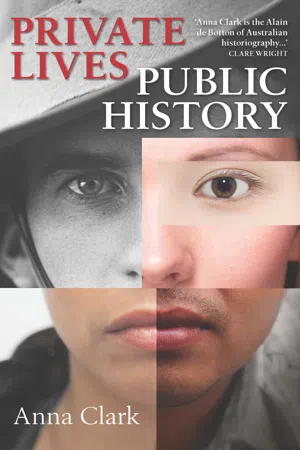
The past is consumed on a grand scale: popularised by television programs, enjoyed by reading groups, walking groups, historical societies and heritage tours, and supported by unprecedented digital access to archival records. Yet our history has also become the subject of heated political contest and debate. In Private Lives, Public History, historian Anna Clark explores how our personal pasts intersect with broader historical questions and debates. Drawing on interviews with Australians from five communities around the country, she uncovers how we think about the past in the context of our local and intimate stories, and the role history plays in our lives.
- 183 pages
- English
- ePUB (mobile friendly)
- Available on iOS & Android
eBook - ePub
Private Lives, Public History
About this book
Information
1

Thinking About History
IT’S 3 A.M. and I’m in the front seat of a taxi on my way to the airport to attend a conference in New Zealand. ‘What do you do?’ asks the driver. I’m a historian. I’m still half asleep and don’t feel like talking. ‘What do you study?’ he continues. Australian history. ‘History?’ he roars. ‘History!’ My driver tells me he comes from Serbia. According to him, ‘Australian history is just white people came here and killed the Aboriginals. Is not history, is bullshit!’
I was too tired to argue that morning, but his incredulity has stayed with me. And today I’m still trying to come up with a response that would satisfy my cabby and my friends alike: what does Australian history mean? How does it function in our lives? Does it matter?
We know that history matters for Australia, because its contested narratives are publicly debated all around us. The ‘national story’ captivates governments, enrages historians and public commentators, grabs headlines, and spawns endless public commentary. It divides and delights; it politicises and polarises.
The ‘history wars’, as those debates have come to be known, play out over museum exhibits, national commemorations, public apologies and the ways we teach the past to the next generation: should the Australian War Memorial commemorate the victims of the Australian frontier wars? Should Australia Day be moved? Should we be sorry for the historical actions of the past? Should Australian history be compulsory? (And so on.)1
But does that ‘national story’ have any meaning for Australian families and communities? Are those historical questions also debated in our sports clubs, living rooms and community centre kitchenettes? Do they figure in everyday conversations?
In other words, does that history matter for us?
This book is an answer of sorts. It ponders how we think about the nation’s past in the context of our own local and intimate narratives, and it tries to understand the meaning of Australian history for Australians. It does so from the ground up, by exploring the ways people negotiate their own everyday understandings of history in the context of those powerful national narratives (such as the Anzac revival, the history wars, the apologies to the Stolen Generations and the Forgotten Australians, as well as the national curriculum).
Historical interest is booming at a community level. There are thousands of local history organisations and museums around the country, as well as genealogical societies and family history groups. The past is consumed on a grand scale, popularised by local and imported television programs such as Who Do You Think You Are? and Walking with History. It’s enjoyed by reading groups, walking groups and heritage tour groups around the country. What’s more, the growing digitisation of archives and reach of the Internet have enabled unprecedented access for people to research and write their own family histories and personal memoirs.2
But to what extent does the interest in those intimate pasts intersect with broader national historical questions and debates? How do we navigate the range of historical engagement across our public and private spheres?

THE FIRST STEP is to think about what constitutes this thing we call ‘history’.
• Is it ‘what happened’?
• Is it what we’re taught at school?
• Does it have to be recorded?
• Is it in museums?
• Is it in a book, or a television show, or a movie? Does it have to be true?
• Is it what we do when we think about the past?
• Is it what we do on Anzac Day? Or Australia Day? (Or even Christmas, birthdays, funerals?)
My feeling is, all of the above: history is what happened, and it’s something we do. History is learned, studied and critiqued. It’s also gossiped, chattered, whispered, imagined and laughed. We do it at home, at school and at university, as well as in the media, in libraries, in politics and in public.
We connect with some bits, and disconnect from others. And we variously inherit, commemorate, contest and place ourselves in it.
But in order to traverse that historical landscape, we need to think about history as more than just the sum of its many parts. We need an idea of history that accommodates not only ‘what happened’, but the many ways we ‘think’ about the past.
‘Historical consciousness’ gives us this: it describes humanity’s interest in its past—the ways we remember and why, as well as how we learn and engage with historical knowledge and practice. Historical consciousness is uniquely and universally human. ‘Human beings are history-makers’, the ethnographic historian Greg Dening once mused. ‘Of all the systems that are expressions of who a people are, the sharpest and clearest is their historical consciousness.’3
While there’s some disagreement over the exact meaning of historical consciousness, the interpretation that has gained increasing acceptance comes from the German theorist Jörn Rüsen, who describes it as making sense of the past. For Rüsen, the term historical consciousness explains how the ‘past is interpreted for the sake of understanding the present and anticipating the future’.4
I also like this definition because it’s not about states of consciousness, about achievement in historical knowledge or expertise. It doesn’t matter whether you’ve studied history at school, how well you can evaluate historical evidence, or even if you know the name of the first Australian prime minister. Instead, Rüsen’s explanation covers the role history plays in our lives and the various ways we play with history.
More than simply helping us to understand how we connect to history or how well we know it, this interpretation of historical consciousness also reveals history as fundamental to the way we think about ourselves. Historical consciousness, Rüsen insists, covers ‘every form’ of thinking about the past, from ‘historical studies’ to the ‘use and function of history in private and public life’.5 It is both innate (in that we recollect) and learnt (through the disciplinary skills of history), writes Canadian history educationist Peter Seixas.6
In other words, historical consciousness defines how we engage with, and make, history. As historian Tom Griffiths explains, with his characteristic light touch, history ‘can be constructed at the dinner table, over the back fence, in parliament, in the streets, and not just in the tutorial room, or at the scholar’s desk’.7
Growing interest in historical consciousness isn’t unique to Australia. Over the last twenty years or so, several significant attempts have been made to explore the historical consciousness of particular nations and communities. Each has influenced historical discussions in their national domains. Taken together, they also consolidate our understandings of historical consciousness and how it operates.
In 1998, American historians Roy Rosenzweig and David Thelen published the findings from a qualitative and quantitative survey of around 1400 Americans. The Presence of the Past was motivated by a visible, yet mysterious, social paradox: politicians railed over an apparent historical illiteracy among Americans, particularly schoolchildren, who seemed unfazed by their own historical ignorance; meanwhile, an explosion of historical production and consumption in the form of books, television, movies, heritage and community historical interest—what the authors termed ‘popular history making’—was equally apparent.8
Rosenzweig and Thelen’s study became hugely influential because it shifted dominant public and political questions about what people don’t know of history to ask what do they know? It was a critical turning point in research into, and understandings of, historical consciousness, and it spawned several other national studies around the world.
Based on that American project, Paul Ashton and Paula Hamilton undertook their ‘Australians and the Past’ project, interviewing hundreds of Australians about their relationships with the past. This work was published in 2010. A further Canadian project was also completed using similar methodologies, surveying around 3500 people throughout that country.9
These studies challenge professional understandings about who is practising history and what constitutes historical knowledge. They reveal a distinct lack of community engagement with more formal national narratives, which people feel are too prescribed and disconnected from their everyday lives; and they note a simultaneous popular contemplation of history that Ashton and Hamilton neatly call ‘past-mindedness’.10
Although participants in those projects often found it difficult to engage directly with the national history they learnt at school, for example, their own stories and experiences generated very strong connections with the past. Respondents kept objects to pass on to their own children or grandchildren, participated in family reunions, compiled genealogies, and visited museums, heritage trails and historical societies. They talked about the past with their friends and families, and they avidly consumed history—in the form of historical fiction, documentaries and popular history books.11
In other words, such research noted an uneasiness between professional and popular historical discourses. One is official and knowledge-based—taught in schools, tested in official surveys, and promoted by public institutions.12 The other is familiar, experiential and tactile, and is deeply connected to people’s families and communities.
Yet I also wonder whether we can see in that space not only a disjuncture but a possible intersection: do these distinct types of history ever come together? And if so, how? How do we think about our own histories in the context of national and public historical narratives? And, just as critically, how do we navigate Australian history in light of our own family and community pasts?
IN HIS 1932 presidential address to the American Historical Association, Carl Becker unwittingly pre-empted those studies into historical consciousness over half a century later. He declared that the practice of history wasn’t restricted to academic scholarship and research, and insisted rather boldly that ‘History is the memory of things said and done’. In order to fully understand those dimensions of history beyond its professional and public sphere, historians needed to consider the engagement of ‘Mr. Everyman’ with the past. Becker suggested: ‘Mr. Everyman is not a professor of history, but just an ordinary citizen’.13
Mulling over my own research questions and approach, I realised that I also needed to understand the historical engagement of so-called ‘ordinary’ citizens. How else could the intersection of intimate and public histories in Australians’ historical consciousness be discerned?
But who was this ‘Mr Everyman’, and where would I find him? (Or some more appropriate and inclusive modern rendition?)
So I trawled research that explored community attitudes in Australia. Political and academic interventions in Australian history have generated hundreds of thousands of words in mainstream media and scholarly publications. I was interested in whether any of that public and professional concern had reached out beyond the opinion pages and across the garden fences. Do those discourses about Australia’s past mean anything to people outside the public domain?
Political and sociological researchers Tim Phillips and Philip Smith used focus groups to explore grassroots attitudes to Australian identity. Their ‘gallery of Australians’ took part in community-based discussions that provided a window into the ways public discourse and debates about national identity played out in the community.14
Others, such as Murray Goot and Tim Rowse, drew on quantitative data to explore public attitudes towards national issues such as reconciliation and Indigenous history. They saw how the ‘Australian public’ is at once real and imagined: it’s constantly invoked in political and popular rhetoric, but also shapes people’s understandings of themselves (as members of the ‘public’) in relation to national and community issues.15
My scholarly desire to get in touch with ‘Mr Everyman’ was also influenced by Judith Brett and Anthony Moran’s brilliant long-term qualitative study Ordinary People’s Politics. Using extended interviews and life histories, Brett and Moran explored the political beliefs and engagement of several ordinary Australians over many years and helped me to think about the influence of ‘ordinary people’ in the iteration of Australian collect...
Table of contents
- Cover
- Title
- Copyright
- Contents
- 1 Thinking About History
- 2 Connection
- 3 Inheritance
- 4 Commemoration
- 5 Contest
- 6 Place
- 7 Presence of the Past
- Acknowledgements
- Notes
- Select Bibliography
Trusted by 375,005 students
Access to over 1.5 million titles for a fair monthly price.
Study more efficiently using our study tools.
Frequently asked questions
Yes, you can cancel anytime from the Subscription tab in your account settings on the Perlego website. Your subscription will stay active until the end of your current billing period. Learn how to cancel your subscription
No, books cannot be downloaded as external files, such as PDFs, for use outside of Perlego. However, you can download books within the Perlego app for offline reading on mobile or tablet. Learn how to download books offline
Perlego offers two plans: Essential and Complete
- Essential is ideal for learners and professionals who enjoy exploring a wide range of subjects. Access the Essential Library with 800,000+ trusted titles and best-sellers across business, personal growth, and the humanities. Includes unlimited reading time and Standard Read Aloud voice.
- Complete: Perfect for advanced learners and researchers needing full, unrestricted access. Unlock 1.5M+ books across hundreds of subjects, including academic and specialized titles. The Complete Plan also includes advanced features like Premium Read Aloud and Research Assistant.
We are an online textbook subscription service, where you can get access to an entire online library for less than the price of a single book per month. With over 1.5 million books across 990+ topics, we’ve got you covered! Learn about our mission
Look out for the read-aloud symbol on your next book to see if you can listen to it. The read-aloud tool reads text aloud for you, highlighting the text as it is being read. You can pause it, speed it up and slow it down. Learn more about Read Aloud
Yes! You can use the Perlego app on both iOS and Android devices to read anytime, anywhere — even offline. Perfect for commutes or when you’re on the go.
Please note we cannot support devices running on iOS 13 and Android 7 or earlier. Learn more about using the app
Please note we cannot support devices running on iOS 13 and Android 7 or earlier. Learn more about using the app
Yes, you can access Private Lives, Public History by Anna Clark in PDF and/or ePUB format, as well as other popular books in History & Australian & Oceanian History. We have over 1.5 million books available in our catalogue for you to explore.