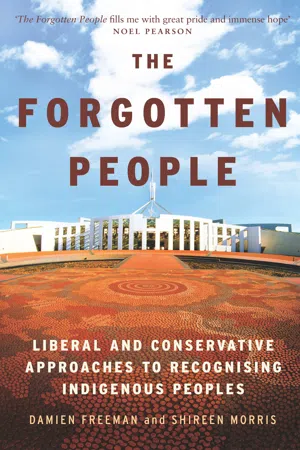
The Forgotten People challenges the assumption that constitutional recognition of indigenous Australians is a project of the left in Australia.It demonstrates that there may be a set of reforms that can achieve the change sought by indigenous leaders, while addressing the critical concerns of constitutional conservatives and classical liberals. More than that, this collection illustrates the genuine goodwill that many Australians, including Major General Michael Jeffery, Cardinal George Pell, Chris Kenny and Malcolm Mackerras, share for achieving indigenous recognition that is practically useful and symbolically powerful.
eBook - ePub
The Forgotten People
Liberal and conservative approaches to recognising indigenous peoples
- 270 pages
- English
- ePUB (mobile friendly)
- Available on iOS & Android
eBook - ePub
The Forgotten People
Liberal and conservative approaches to recognising indigenous peoples
About this book
Trusted by 375,005 students
Access to over 1.5 million titles for a fair monthly price.
Study more efficiently using our study tools.
Information
PART I
PERSPECTIVES ON THE NEED FOR RECOGNITION
1
THE RACE CARD
There are times when my rational aversion to spirituality is challenged. It amounts to the inverse of the devout experiencing doubts about their faith. Perhaps there is an innate yearning for spirituality that undermines faithlessness or maybe some things hold such exquisite beauty that only the ethereal provides a plausible explanation. Immersing yourself in the full splendour of Handel’s Messiah, it is difficult not to perceive the composer as a mere vessel for a higher being. And sitting atop a ridgeline in the Flinders Ranges, it is impossible to scoff at the indigenous connection with the landscape that we often describe in the shorthand, ‘spirit of place’.
When I need to recharge, I take myself to the Flinders Ranges, a rugged and relatively unspoiled finger of semi-arid landscape protruding north from Spencer Gulf into the deserts of South Australia. The ramparts, colours, smells and sounds lift a load from my shoulders. When you can’t be there, just the thought of the place can be comfort enough. In my mind—as Neil Young sings when recalling his childhood home and his need for a place to go to in ‘Helpless’—the Flinders are never far away.
To sit on those ancient hills, home to some of the planet’s oldest fossils, and watch a willy-willy raise dust on the flats or a wedge-tailed eagle ascend on the warming air is to realise your own insignificance in time and space. This landscape and its natural cycles existed for tens of thousands of years before you, and will endure far beyond. Like the dust tossed by the wind, you matter little. What’s more, my pale skin and European heritage mark me as a visitor. For all my love of this landscape and acquired knowledge of its ways, I am alien to it.
I would not presume or attempt to describe how this sense of place must be different for indigenous Australians and their tribal homelands. What I can do is express my love of country and aspirations for it. Born in Australia, to parents born here, I cherish its lands, waters, heritage, values, institutions and character. Yet I feel some connection to other places; my own heritage links me to Ireland, and through my children there are passages back to India, Italy and Croatia. Many indigenous Australians will, of course, have a similarly rich variety of cultural links. But if their connection to this continent is deeper or less complicated than mine, it is not something to resent but admire. It is not something to dismiss but to cherish and share.
NOT YET RECONCILED
Whether indigenous or non-indigenous, we are neither less nor more Australian than each other. But we can have a different perspective. It is, despite the traumas and tragedies of the past, a largely symbiotic relationship. We have borrowed much from each other in language and concepts, such that we could no more easily remove the indigenous influence from this nation’s character than reverse the impact of European settlement. Yet there is an unease, an absence of settlement. We are not reconciled. If some Australians don’t sense this, that is fine. It doesn’t change the reality others feel.
From time to time we show that we are anything but comfortable and relaxed. In 2015, the champion footballer and former Australian of the Year Adam Goodes became the fulcrum of an ugly controversy. He had taken a stand against on-field racism and identified strongly with indigenous causes while still playing for the Sydney Swans. An imposing, damaging and demonstrative forward/midfielder, Goodes is the kind of player opposing fans love to rile. He was booed. The booing became increasingly prevalent and many claim it increased after he singled out a racist insult from a thirteen-year-old girl in a Melbourne crowd in 2013, and again after performing an indigenous war dance on field in 2015. Eventually we saw an overreaction from both ends of the spectrum. Many were too quick to blame Goodes’s treatment on widespread and deep-seated racism while others denied that the football champion’s political advocacy on indigenous issues and racism played any role at all. The episode showed, at the very least, a lack of maturity in the way our nation handles these issues. At worst it underlines a sense that we haven’t yet found a way to resolve the place—the political place—of indigenous people in our society.
That we can see such fissures open up, that our land of tolerance and a ‘fair go’ can so easily turn into a land of shrill resentment, tells us something about how far we still have to go. This is not an argument I make from the liberal-left side of the political debate, where denouncing others as racist or parading some special understanding of indigenous culture is a transparent way of trumpeting one’s own tolerance and moral superiority. In my view that hectoring approach, all too often, is the most divisive of all. A settlement of indigenous grievance is as important to end sanctimonious shouting from that liberal left as it is to convince the conservative right that everything is not all right.
Indigenous men and women have made the case for constitutional recognition, or some such settlement, eloquently and forcefully, much more than I can do. In his Quarterly Essay, A Rightful Place, Noel Pearson looked back on the writings of land rights leader Galarrwuy Yunupingu and wrote about the ‘existential angst of the tribal leader who fears for the future of his people’. Despite winning substantial gains for his people, Yunupingu wrote that he spends his days ‘worrying about how I can protect the present from the future’.1 This is the generational importance of recognition. It doesn’t downplay the practical needs of the present, nor ignore the achievements of the past, but it seeks to establish an ongoing place for indigenous Australians in the affairs of this nation, so that no gains can be squandered.
What I can do is attempt to make the case for recognition from the position of a politically right-of-centre, non-indigenous Australian. If there is to be change it is not for indigenous Australians, it is not for one cohort. We know that if there is to be constitutional amendment the support must come from most Australians—a majority of people in a majority of states. Yet it is more than this matter of psephology. The challenge is not to present the best case for recognition of indigenous Australians that the broader population will tolerate. Rather we need to construct a settlement that the wider community can embrace not because it delivers what indigenous Australians want but because it makes our nation better and stronger. To be worthwhile, the change must be for all of us.
For people of a libertarian bent and those on the centre right of politics, there is a strong temptation to leave well enough alone. We have good intentions and fine institutions, and we accord every person, of whatever status in wealth, gender, race or creed, appropriate and equal rights. Why seek any special accommodation with just one group, the indigenous people? Didn’t we have a national apology for well-intentioned but damaging past policies? Isn’t practical advancement the most important way forward? Don’t we need to get past the victim mentality and encourage self-reliance?
ESTRANGED IN A HOMELAND
The Goodes controversy prompted an illuminating mini-essay by Stan Grant, a highly successful, well-travelled and widely experienced broadcast journalist. It provided a troubling insight because Grant is far too pragmatic and rational to fall into the simplistic denunciation of supposedly racist football crowds. An indigenous man, he courageously acknowledged some of the fault in this ugly episode might have rested with Goodes. However, as Grant wrote, he felt no need to expand on that case because others were doing so. ‘Here’s what I can do,’ he wrote. ‘I can tell you what it is like for us.’2
Eloquently, poignantly and bluntly, he wrote about the humiliation of racism and the accompanying pride and defiance: ‘race is what we have clung to even as it has been used as a reason to reject us’. There was one searing line in this confronting piece that, in my mind, spoke directly to the issue of recognition: ‘Estranged in the land of our ancestors, marooned by the tides of history on the fringes of one of the richest and demonstrably most peaceful, secure and cohesive nations on earth.’
I know Stan. How could such a man ever feel ‘estranged in the land’ of his ancestors? Reading those words hurt. They made my country feel smaller.
We can sit on a Wilpena rampart and feel the spirit of place. We can be comforted or threatened by the timelessness of the earth to which we will return. But in the here and now, in the daily discourse of rights and responsibilities, in the division of resources and dispensing of justice, and in the political jousting, can we tolerate a nation where indigenous people can feel estranged? If our institutions, our foundational document, can belatedly embrace indigenous Australians, would it not benefit us all? Would it not make our country bigger? Would it not complete our nation?
In advocating this reform we cannot afford to be in a hurry. This is a project that has been more than two hundred years in the making and needs a resolution that will stand the test of time. Putting a referendum question that fails would be disastrous but just as damaging in the long term would be a successful referendum that does not satisfy our historical and institutional hunger. As a whole polity the nation tends to act conservatively and it will not tolerate an endless ratcheting up of indigenous grievances. Whatever comes from the recognition push needs to deliver some sort of end point—it should not be the precursor to a treaty, or be seen as presaging indigenous seats in parliament. Recognition should be the settlement in our structures of government that underpins reconciliation and supports ongoing attempts to redress indigenous disadvantage.
THE RACE CARD
On descent for landing into one of our neighbouring South East Asian nations I was filling out the requisite immigration form when I was taken aback by a question. There was a space that required me to nominate my race. I was new to travel in the region, having joined the staff of then foreign minister Alexander Downer. Immediately expressing my distaste at the question, I asked him whether I should even supply an answer. Downer smiled and showed me what he had written on his card: Human. This became my standard response, too, in countries preoccupied with such things—Race: Human.
This is a liberating thought, and a unifying one. It has a deep resonance for the very simple reason that it is true. It is the most liberal distillation of the complex world of race issues that have dogged humankind—there is one race, the human race, and we all belong, equally.
In an ideal world, race would not be an issue. We dream and sing about an idealised homogeneity—a great big melting pot—or we hope and legislate for colour-blind societies. However, race is a factor in human relations and we had better be adult enough to deal with it. Heaven knows enough lives have been ruined or taken by our inability to reconcile racial differences. In many countries such failings are still a matter of life and death. And you would have to be wilfully ignorant to pretend racial prejudice and disadvantage are not among the most telling flaws in our own nation—particularly, dramatically and demonstrably when it comes to indigenous Australians.
We do not have to subscribe to the black-armband view of Australian history to recognise injustices of the past and incremental steps over the centuries to redress them. We can see the good with the bad. In some colonies, the settlers specifically created offices of the ‘Protector’ of Aborigines. Condescending and imperfect as these efforts might seem now, they were at their time a sign of some enlightenment and duty of care.
In some colonies indigenous Australians were allowed to vote and, in 1895, South Australia became one of the first places in the world to legislate the female franchise. So, in South Australia, indigenous women enjoyed a democratic right denied to the overwhelming majority of women across the world. A fat lot of good it did them, we might say, and it is true that in those times few Aborigines enrolled to vote. Still, there are records showing regular voting at mission communities even before Federation, and the point is that amid what we know of injustice, killings and mistreatment, there were some serious institutional efforts to accord democratic rights to the original Australians.
Yet Federation was an artful compromise to manage the competing interests and mutual strengths of six pre-existing British colonies that artlessly exempted the interests of indigenous Australians. The spoils of the continent were shared under the presumption of terra nullius and to the extent that indigenous Australians were mentioned it was to be excluded. Recognition can repair this mistake. But it is a complicated debate.
Denunciation of the Constitution as racist is not helpful. We could eliminate every race reference from the document and still do nothing to recognise indigenous people. This would achieve little except remove anachronistic redundancies. Besides, as writer and historian Keith Windschuttle has explained, not all the race references necessarily intended harm3 (although, soberingly, there was a pitiful focus on ‘smoothing the pillow of a dying race’4 that persisted for decades). Windschuttle has relayed how section 25 (which excludes Aborigines from being counted in a state’s population if they are not accorded the vote) was not an attempt to banish Aborigines but to ensure states that excluded them suffered the appropriate democratic penalty (federal electorates could only be allocated on the basis of people entitled to vote, not bolstered on the basis of a disenfranchised indigenous population). Likewise, section 127 (which excluded Aborigines from census counts) was not an attempt to pretend them away but a practical measure to balance customs and taxation arrangements at the establishment of Federation.
While there was varying exploitative intent in these constitutional provisions, there can be no denying that racial provisions were in our Constitution from the start—and they remain. The word ‘race’ appears three times in section 25 and once in section 51 (xxvi) (the race power), while the words ‘Aboriginal natives’ appeared in section 127 (now repealed). These realities put the lie to current arguments from some conservatives that recognition of indigenous Australians would insert race into our Constitution. Race is in our Constitution. Without amendment it will remain. With the right amendments it can be removed and an appropriate means of recognition can be delivered.
In this way the railing against a ‘racist’ Constitution by those on the left who might overreach on recognition changes and the arguments against putting ‘racial’ references into the Constitution by the hard right who want no change, could create an ugly marriage of constitutional inaction that leaves nineteenth-century race references in the Constitution—an outcome both groups would, on the face of it, be unhappy about.
INDIGENOUS SELF-IDENTIFICATION
We seem to be sufficiently alive to race that we can be proud of our heritage, boasting of the multicultural cocktails our children personify. If we can relish the cultural richness of varied ethnic backgrounds, surely we shouldn’t have to turn away in fear when we need to include race issues in serious debates about national affairs. If we want to have a serious discussion about indigenous recognition in our Constitution we have to accept that race will be part of the argument because the way the descendants of the first Australians have historically been identified—and have self-identified—is primarily through their racial and cultural background.
Conservative commentator Andrew Bolt has argued strongly against any specific mention of indigenous Australians in the Constitution on what amounts to classical liberal grounds—all men must be treated equally. ‘I was born here, I live here and I call no other country home,’ he wrote in January 2014.5 ‘I am therefore indigenous to this land and have as much right as anyone to it.’ It is a powerful and, at its heart, inclusive argument. Yet the common law rights delivered by the Mabo judgement sink this argument in a technical sense—there are Australians who have actual rights to native title that have been handed down the generations as a legal inheritance.
We should be clear that racial background is not the core of the issue. It is about recognising the first Australians—a significant stakeholder overlooked in the establishment of the nation. As The Australian’s legal affairs editor Chris Merritt has pointed out, the issue of indigeneity, not race, is at the core of the argument: ‘The st...
Table of contents
- Cover
- Title
- Copyright
- Foreword by Noel Pearson
- Contents
- Preface
- Introduction: The forgotten people
- PART I—PERSPECTIVES ON THE NEED FOR RECOGNITION
- PART II—RECOGNITION: THE SYMBOLIC AND PRACTICAL
- Conclusion: Understanding where they’re coming from
- Contributors
- Notes
- Index
Frequently asked questions
Yes, you can cancel anytime from the Subscription tab in your account settings on the Perlego website. Your subscription will stay active until the end of your current billing period. Learn how to cancel your subscription
No, books cannot be downloaded as external files, such as PDFs, for use outside of Perlego. However, you can download books within the Perlego app for offline reading on mobile or tablet. Learn how to download books offline
Perlego offers two plans: Essential and Complete
- Essential is ideal for learners and professionals who enjoy exploring a wide range of subjects. Access the Essential Library with 800,000+ trusted titles and best-sellers across business, personal growth, and the humanities. Includes unlimited reading time and Standard Read Aloud voice.
- Complete: Perfect for advanced learners and researchers needing full, unrestricted access. Unlock 1.5M+ books across hundreds of subjects, including academic and specialized titles. The Complete Plan also includes advanced features like Premium Read Aloud and Research Assistant.
We are an online textbook subscription service, where you can get access to an entire online library for less than the price of a single book per month. With over 1.5 million books across 990+ topics, we’ve got you covered! Learn about our mission
Look out for the read-aloud symbol on your next book to see if you can listen to it. The read-aloud tool reads text aloud for you, highlighting the text as it is being read. You can pause it, speed it up and slow it down. Learn more about Read Aloud
Yes! You can use the Perlego app on both iOS and Android devices to read anytime, anywhere — even offline. Perfect for commutes or when you’re on the go.
Please note we cannot support devices running on iOS 13 and Android 7 or earlier. Learn more about using the app
Please note we cannot support devices running on iOS 13 and Android 7 or earlier. Learn more about using the app
Yes, you can access The Forgotten People by Damien Freeman, Shireen Morris in PDF and/or ePUB format, as well as other popular books in Social Sciences & Sociology. We have over 1.5 million books available in our catalogue for you to explore.