![]()
Part 1
Evolving the purposes of schooling
![]()
CHAPTER 1
Time for a reboot
Shifting away from distractions to improve Australia’s schools
John Hattie
This chapter argues that we must intentionally change the narrative that frames our definition of ‘success’ in education and our priorities for reform. The narrative of choice and autonomy has impeded and undermined our focus on enhancing achievement for every student. Keating et al. (2013, 276–7) addressed this issue:
There is evidence to suggest that marketization produces the opposite effect, amplifying and normalising ‘brand value’ associated with academic excellence. Instead of promoting greater diversity, secondary schools … find themselves chasing the same academic pot of gold in a market in which ‘being academic’ is the prime indicator of market value … There is limited incentive in this environment for schools to develop vocational or alternative (or personalised) learning models, as doing so optimises their market position. Then the government school sector is also forced to privilege an academic curriculum in order to compete with the private sector for middle-class and high-achieving students.
This current narrative of ‘success’ leads to a relentless focus on the differences between schools and on arguments about school choice. We risk a major residualisation of our public school system (and parts of our Catholic and independent systems) while at the same time increases in education funding are funnelled towards uses that do not improve educational quality or outcomes. Over the past ten years we have had more than double the funding to schools relative to increased student numbers, but our overall performance is stagnating or declining. Spending more to continue the current system is not wise behaviour and is unlikely to affect student achievement.
Social stratification is sharper in Australia, and we now have a lower proportion of students attending socially mixed schools than in most countries to which we most typically wish to compare. Paradoxically, this leads not only to more low-income students facing greater obstacles to educational achievement because they are segregated into residualised schools but also to more ‘cruising’ schools that may serve better off students but do not add significant value to their educational achievement. In this chapter I argue that this latter trend is a major contributor to Australia’s declining educational performance.
We need a reboot that focuses effort and resources on supporting teachers to work together, collaboratively, to improve student achievement over time. This requires that we build a narrative based on identifying and valuing expertise, working together and opening classrooms to collaboration, targeting resources at need, and teachers and leaders accepting evidence and evaluating progress transparently over time.
1 The need for a reboot in our education system
When your computer system has major problems, it might be time for a reboot. A reboot causes the system to reconfigure itself, preserving the essential things you have on your computer, but makes it run more smoothly, gets rid of corruption and ensures that the desired pathways are restored. Like a computer, it is time for this reboot of Australian schooling—provided we keep the excellence we have but rid ourselves of the creeping, perverse parts of our system that are clogging up this excellence, leading us down wrong paths, and leading to introducing absurd corrections to solve the wrong problems.
There are at least four major indicators that the Australian Education system is moving in the wrong direction and ready for a reboot. The major argument is that the narrative driving our education system is wrong and that we are wasting so much money on driving the wrong narrative.
(i) We are among the world’s biggest losers in literacy and numeracy
Literacy and numeracy remain the critical bases of any educated person, and while many would (correctly) argue that these are attributes of narrow excellence, they are the building blocks of the wider excellence to which many of us aspire. Our PISA results in reading, mathematics and science have slipped in every testing cycle since the turn of this century, and this decline occurs in every Australian state. A deeper analysis of the PISA decline shows that Australia has more cruising schools and students than other countries. The major source of variance in the decline is among the top 40 per cent of our students (Ainley and Gebhardt 2015). This decline has occurred during a time when funding to schools has increased by 30 per cent (while student numbers have increased by only 13 per cent). Our major reboot needs to reverse this trend.
(ii) We are overly focused on school differences
Australia has embarked on major debates about school choice. We have invited parents to debate the merits of schools (and they do incessantly), but the variance between schools in Australia is much smaller than the variance within schools. What matters most is the teacher your child has. Despite this we do not (for many good reasons) allow parents to choose teachers but default to give them the almost meaningless decision about the choice of school—which ratchets up the competition. School choice has led to a clogging of the motorways. In Melbourne, the majority of students bypass their local schools en route to a chosen alternative—and nearly all this choice is based on hearsay, the nature of the students, and rarely on whether the school is or is not adding value to the students’ learning. We need a reboot in our debates about the value of the local school.
(iii) We do not have as a driver that schools must be inviting places to learn
Levin, etal. (2007) showed that the best predictor of adult health, wealth and happiness was not achievement at school but the number of years of schooling. So how do we make our schools inviting places for students to want to come to learn? One in five Australian students do not complete high school—this should be a national disgrace. Yes, some students leave to take apprenticeships or further training, and this is positive. But the retention rate has barely changed for twenty years. The major exception are Aboriginal students, who have almost doubled their retention rate over the same time. Across all students, 26 per cent do not attain Year 12 or equivalent by age 19. The SES gap is as much as 28 per cent between highest and lowest SES sectors (Lamb et al. 2015).
(iv) The growing pains of inequality
Kenway (2013) noted that the ‘Gonski report provided stark evidence and a nationally humiliating reminder that Australia does not have a high-performing education system as it does not combine quality with equity’ (p. 288). She noted the branding of the high-status schools (mostly independent) via the introduction of the International Baccalaureate (IB), country ‘adventure’ campuses, benchmarking against other national education ‘product differentiation’ systems, and inclusion of well-being programs—all playing a critical role in their marketing of their product. The OECD has long recognised Australia’s dismal showing among highly developed nations—it has a high-quality but low-equity education system.
Social stratification is sharper in Australia and a lower proportion of students go to socially mixed schools than in most countries with which we wish to compare. Students from wealthy, privileged backgrounds tend to go to high-fee, independent high schools; whereas students from low-income, disadvantaged backgrounds tend to go to government high schools. Attending a low SES school amounts to more than a year’s difference in academic performance. We have created a system in which schools compete for students and funds, we privilege autonomy that increases the spread, and we entice principals to steal students from other schools to make them look good.
2 The steps to reboot our education system
(i) Changing the narrative: identifying and valuing expertise
Among the most important things we need to retain as we reboot relates to the expertise of the teachers and school leaders—especially those who can show that their students are making at least a year’s progress for a year’s input (Hattie 2009). The magnitude of the effects of expertise towers above the structural influences (class size, ability grouping, private vs public school and so on). It is teachers working together as evaluators of their impact, their skill in knowing what students now know and providing them with explicit success criteria near the beginning of a series of lessons, ensuring high trust in the classroom so that errors and misunderstanding are welcomed as opportunities to learn, maximising feedback to teachers about their impact (especially from assessments; ensuring a balance of surface and deep learning, and focusing on the Goldilocks principles of challenge for students (not too hard, not too boring) while providing maximum opportunities for students to deliberately practise and attain these challenges. The mantra of visible learning relates to teachers seeing learning through the eyes of students and students seeing themselves as their own teachers.
Expertise is critical, but dependably recognising this expertise is also critical. Attestations, test scores alone and portfolios of exemplar lessons do not cut it for dependability. There needs to be rigorous emphasis on teachers demonstrating their conceptions of challenge and impact, through exemplars of students’ progress (in their work, their test scores, their commitment to wanting to reinvest in learning, as well as student voice about learning in this class). This is what the AITSL process involves based on the Australian Professional Standards for Teachers: to move into Graduate, then to Proficient, Highly Accomplished, and Lead Teachers. The states make these decisions, moderated by AITSL at a national level. The solution is already with us.
(ii) Changing the narrative: what do we mean by ‘impact’?
There needs to be a robust discussion about what ‘impact’ means in teaching within and across schools; the sufficiency of the magnitude of this impact; and the equity question about how many students are attaining this impact. The aim is to ensure that teachers have a common conception of progress. It should not be random that every time a student meets a new teacher they go up or down in their learning, depending on that teacher’s particular notion of challenge and progress. It is necessary to work collectively to understand what sufficient progress means, what it means to be good at X, and what it means to gain a year’s growth for a year’s input.
(iii) Changing the narrative: appease the students and stop appeasing the parents (or at least re-educate the parents)
When the various influences are considered, it becomes obvious that so many of the most debated issues in schools across Australia concern those that sit nearer the bottom of the list of impact. These include autonomy, teacher aides, money, class size—and the list goes on. We love to debate the things that matter least. As part of the Revolution School, the ABC undertook a survey of 1004 Australian adults about what they considered to be the major influences on student achievement and well-being in our schools. These adults considered the highest rated influence on student achievement to be smaller class sizes (91 per cent), followed by providing extra-curricular activities aimed at improving academic results (76 per cent), enforcing homework (71 per cent of which has a negative effect on the basis of research), whether the school is religious or non-religious (70 per cent, but there are no demonstrable differences), and wearing school uniforms (66 per cent, a zero effect from the research). In the middle, and therefore about half and half saying yes or no, are retention (repeating a year; 59 per cent, one of the most systematically negative influences), private or government school (56 per cent, when prior achievement before they enter a school is considered, the differences between government and non-government schools is very small), poorer or richer social zones (50 per cent), single sex or co-ed (49 per cent, no differences), lengthening time in schooling (38 per cent, no differences), and distance versus face-to-face teaching (38 per cent, no differences). If we listen to the voters, we will invest in the very things that have the least effect on the learning lives of students!
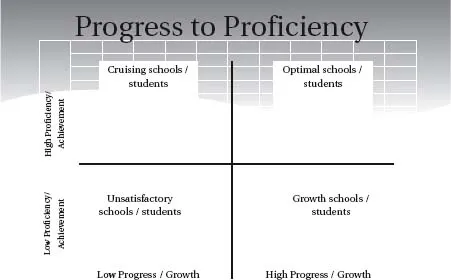
Figure 1.1: Progress and Proficiency
In the United Kingdom, a similar survey was undertaken with 4300 teachers. More than half (56 per cent) argued that reducing class sizes was the best way to improve learning, nearly three times as many as the second most popular option: better teacher pay (at 19 per cent). Cranston, Mulford, Keating and Reid (2010) surveyed Australian principals, and 80 per cent of the responses saw barriers ‘external’ to the school as the problems (inadequate resourcing, unsympathetic politicians and bureaucracies, broader societal problems laid at the school door, and negative media). As Andreas Schleicher (2010) commented: ‘Successful countries such as Finland, Japan, and Korea emphasize more classroom time and higher teacher salaries, whereas the United States invests more heavily in reducing class size and limiting salaries.’ High-performing systems tend to prioritise the quality of teaching over the size of classes. If they have to make a choice over a better teacher and a smaller class, they go for the better teacher. … Reductions in class size is ‘a very expensive move and you can’t reverse it. Once you’ve gone down that road, nobody is going to accept going back.’ ‘It’s very expensive and it drives out other possibilities. You can spend your money only once. If you spend it on a smaller class, you can no longer spend it on more professional development, on better working conditions, or on more pay and so on.’
(iv) Changing the narrative: moving from achievement to progress
We have a current perverse notion of what success looks like in our system. We prize high achievement, we prize schools that have high ATARs, and we consider that successful students are the brightest. This is corrupting our system, leading parents to seek the wrong schools, with too many students not being esteemed for being the best learners because they do not start as the brightest. We continually demand that students meet high achievement standards, we go on (particularly each year when NAPLAN results are released) about the woeful performance of schools who have below average scores in Reading, Writing and Numeracy. We point to the private sector as a beacon because private schools are more likely to have above average students, and we criticise parents for not investing more resources in their children’s schooling to share this dream of being ‘above average’.
Instead, consider the chart in figure 1.1. Imagine achievement up on the left axis and progress along the bottom axis. Surely the fundamental purpose of schooling is to ensure that every student gains at least a year’s achievement growth for a year’s input. This applies no matter where they start, and even those who start above average deserve a year’s growth. There are four quadrants: (1) Cruising schools and students are those who start above average but do not gain a year’s growth; (2) Unsatisfactory schools start below average and do not gain a year’s growth; (3) Growth schools start below average but gain more than a year’s progress; and (3) Optimal schools start above average and gain a year’s growth. A major claim is that Australia needs to change its concept of excellent schools from high (or above average) achievement to high progress (regardless of where they start). My estimate, based on NAPLAN, is that about 60 per cent of Australian schools are in the excellent school’s quadrants (high progress). Too often we disparage those in the Growth zone where teachers and school leaders are achieving stunning growth; and we esteem those in the Cruising zone where little is added. Indeed, a close analysis of the PISA decline shows that the major issue for Australia is that it has more cruising schools and students than expected—the major source of variance in the decline is among our top 40 per cent of students (Ainley and Gebhardt 2015). Too many private schools compared to state schools are in the Cruising quadrant, and we falsely esteem them. We must change our narrative about successful schools.
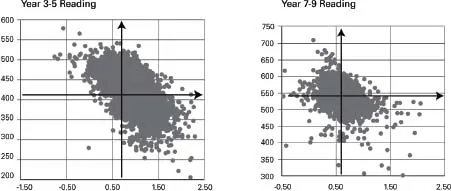
Figure 1.2: Plot of all schools in Australia for Year 3–5 and Year 7–9 Reading
With this new concept of excellence, let us consider Australian schools—i...