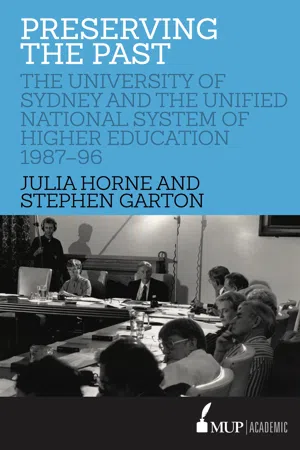
The Dawkins reforms of the late 1980s and the creation of the Unified National System roused passions at many universities across the nation over fears for the academic enterprise and Australia's system of free, public university education. With much at stake, the Dawkins reforms became a hot topic of discussion across university campuses, and even between Vice-Chancellors and state education ministers. Vice-Chancellors were threatened with motions of no-confidence, staff argued furiously against change and students protested against fees, yet mostly to no avail. The reforms were introduced and universities became subject to new ways of funding by the Commonwealth that changed the way higher education was organised in Australia.This volume tells the story of the Dawkins reforms at Australia's oldest university, the University of Sydney, and the unlikely alliance between the University's Vice-Chancellor and the New South Wales government in the scramble for more students. Between 1988 and 1996, the University grew exponentially. At the same time it strove to preserve its honoured past despite profound change. Did this desire to preserve an older tradition compromise its effort to master the future?
eBook - ePub
Preserving the Past
The University of Sydney and the Unified National System of Higher Education, 1987–96
- English
- ePUB (mobile friendly)
- Available on iOS & Android
eBook - ePub
Preserving the Past
The University of Sydney and the Unified National System of Higher Education, 1987–96
About this book
Trusted by 375,005 students
Access to over 1.5 million titles for a fair monthly price.
Study more efficiently using our study tools.
Information
Topic
EducationSubtopic
Education GeneralCHAPTER 1
A difficult transition
By the mid-1970s the significant post-war Commonwealth investment in the Australian university system had reached its peak. The result of considerable Commonwealth support to fund the expected demands of a transformed post-war economy, as recommended by the 1957 Murray Report, it was further propelled by the three-volume 1964 Martin Report’s recommendation for a significant expansion in the Australian higher education system.1 There were now more universities than ever, more students, more academics and even more buildings, some reaching soaring heights and outfitted with the latest gadgets that would have challenged the sensibilities of even the most progressive nineteenth-century professors. This transformation was especially true of the University of Sydney.2
Under its ‘steely and skilled’ Vice Chancellor Bruce Williams (1967–81; to become Sir Bruce on his knighthood in 1980), the University of Sydney had flourished, despite the turmoil and tumult of radical student and staff movements of the late 1960s and early 1970s.3 The University had grown significantly under his leadership, fuelled by increasing Commonwealth investment. By 1975 Sydney had 18 368 student enrolments—around 16 000 Equivalent Full-Time Student Units (EFTSU)—and 1220 academic staff, making it the largest university in the country. In terms of external research funding, the University was significantly ahead of its rivals. By the mid-1970s, although competitive research funding for the Australian university system was relatively small, Sydney received on average 35 per cent more than its major rivals, the universities of Melbourne and New South Wales; ANU, with its special Commonwealth research funding, was excluded from participating in such nationally competitive schemes.4 Sydney’s research reputation at this time was greatly enriched by the presence of such figures of international renown as physicists Robert Hanbury Brown, the first to measure the diameter of stars, Bernard Mills, inventor of the Mills Cross radio telescope, as well as pioneering statistician Oliver Lancaster, who first drew the correlation between latitude and melanoma, philosopher David Armstrong, classical archaeologist Alexander Cambitoglou and theoretical chemist Noel Hush.5 The University’s standing was further publicised by the presence of the captivating head of the School of Physics (1952–87) Harry Messel, whose fund-raising, outreach and capacity-building efforts were legendary.
Bruce Williams, Melbourne born and educated, was an economist who, after a distinguished twenty-year career in the United Kingdom, was appointed Vice-Chancellor of Sydney in 1967. He had been Professor of Economics at Manchester, where he became a highly regarded expert on science policy, industry and investment. He also had a career in Whitehall, having been an adviser to the Ministry of Technology and the Prices and Income Board. He arrived at Sydney with excellent credentials—a clear understanding of fiscal issues, insight into technology, education and public policy and experience in working with and through university and government bureaucracies.
The Chancellor for much of Williams’ term of office at Sydney was Sir Hermann Black (1970–90), also an economist. Together these two astute and adroit university politicians navigated some of the University’s most difficult challenges. Black was a Sydney man through and through; educated at Rockdale Public and Fort Street Boys’ High, he won a teachers scholarship to Sydney where he graduated BEc (1927) and MEc (1937) and, after a brief stint of teaching, was appointed to an assistant lectureship in Economics at Sydney in 1933. Black’s brand of economics borrowed more from Joseph Shumpeter’s approach to the entrepreneur as hero than Keynes’ call for state intervention in the boom and bust cycles of liberal democracies. Sir Hermann saw the benefit of an economics degree as the application of economics to practical issues rather than its theorising. He remained at the University in various roles until his death in 1990.
Black, like Williams, however, was not captive to the ‘ivory tower’. He had extensive networks in successive New South Wales governments, often as adviser to premiers and ministers and to the State public service, and contributed to important public policy forums and organisations such as the Australian Institute of International Affairs. He was committed to bridging the gap between ‘town and gown’ and devoted much of his time to ensuring that the University met the needs of the community and that the community in turn supported the efforts of the University. Although his academic output was modest, even by the standards of the day, he was a brilliant speaker, possessing a ‘vibrant, cultivated and mellifluous’ voice, which he used to great effect in the frequent radio broadcasts that made him a household name. He was appointed Chancellor in 1970, holding this position till his death in 1990.6
While on one level the steady flow of Commonwealth income through the 1960s fuelled necessary expansion and growth in research with comparative ease, the University of Sydney, like Monash, La Trobe, Flinders and the University of Queensland, was also challenged by student and staff unrest. As the oldest university in Australia, Sydney was often the focus of particular attention by the emerging New Left. The list of major disruptions and protests at Sydney is impressive. In addition to more wide-ranging protests over conscription and the Vietnam War, there were struggles over the nature of the University itself; the creation of the Free University in 1967 (where students and staff attracted to theories of Marxism and later feminism were taught off-campus by radical staff), the petitions and sit-ins protesting library fines (1967), a dispute over the University’s student admissions policy and the powers over student discipline, struggles in favour of continuous assessment rather than formal examinations, the protest over the refusal of the University to admit a Macquarie University student (Vicky Lee) to Sydney, despite the fact that she had passed Sydney’s first-year Anthropology course as an external student (1970), the philosophy strike of 1973 (demanding the right to teach feminism as a legitimate subject) and the agitation for a separate department of political economy (1974–76). Some of these involved clashes between radical staff and students and police, occupations of university buildings, including the Vice Chancellor’s office, and picketing of lectures. Among staff there was also considerable agitation for a greater say for non-professorial staff in university governance, a challenge to the ‘god professor’.7
Williams, supported by Black once he became Chancellor in 1970, handled these major disruptions with a mixture of toughness and adroitness. He remained calm throughout—refusing heavy-handed security interventions while ensuring the safety of person and property as well as possible in the circumstances, issuing discussion papers that canvassed viewpoints from both sides and engaging protestors in polite argument. He also acted decisively when he thought protestors had ‘gone too far’, suspending the worst offenders when he felt the occasion demanded. His dignity under pressure impressed many and quietened some of the noisiest offenders, although it did not stem the flow of radical protest. Equally important, Black and Williams worked to limit significant disquiet on the University Senate, which if given public voice would have only incited more dissent. They also needed to secure Senate acquiescence to their proposed reforms aimed at accommodating and defusing student and staff demands.8 The reforms were far-reaching. Williams instituted the transition of the Professorial Board to a new Academic Board with elected non-professorial staff, brought in more liberal admission, disciplinary and assessment practices, split the philosophy department in two, so that radical philosophers could govern their own academic programs while leaving the traditionalists in charge of theirs, and approved the creation of a separate political economy stream of courses in Economics to appease radical staff and students. It worked, although some of Williams’ successors felt the legacy of divided departments was less than ideal. By the late 1970s, relative calm had been restored and many of the radical demands had been incorporated into university structures, policies and processes.9
By 1980, however, he had been in office for nearly fourteen years. More pressing was the health of his wife Roma and the need to devote more of his time to looking after her, a difficult undertaking while holding such onerous office. Reluctantly, it seems, he indicated to the Chancellor his intention to retire.10 In February 1981 Sir Hermann established the appropriate joint Senate and Academic Board committee to search for a replacement, chaired by the Chancellor with the Deputy Chancellor, Chair of the Academic Board, Fellows of Senate, such as Rodney Cavalier (Member for Fuller in the New South Wales Legislative Assembly and later Minister for Education in the Wran and Unsworth Labor governments), and prominent professors, as its members. The committee received forty-seven expressions of interest for the position and debated the merits of each candidate over the course of ten meetings. An international candidate was even flown to Sydney.11 The search proved fruitless. One university senior officer of the period, but not on the committee itself, believes that the preferred international candidate declined the offer and the committee was left with no suitable candidate.12 It was certainly the case that the external search proved fruitless.
In this context the obvious internal candidate was the then longest serving Deputy Vice-Chancellor, Michael Taylor (1975–91), a distinguished physiologist who had held a number of senior appointments at the University, including chair of the Professorial Board (1969–73). Remembered by his colleagues as a ‘kind, generous and tolerant person’, Taylor was equally at home in the worlds of scientific research and the arts. He played the piano, composed an opera and frequented gallery, museum and literary events.13 Puzzling is why Taylor was neither officially encouraged to apply or appointed Acting Vice-Chancellor while the search continued. One member of the committee thinks that Sir Hermann believed Taylor was unsuitable.14 Instead, the committee opted for the other Deputy Vice-Chancellor appointed just two years before in 1979, the Challis Professor of History, John Manning Ward.
Ward was a surprising choice. He was the same age as Williams, had health difficulties, was looking forward to his forthcoming retirement and seemed genuinely surprised by the offer. Born in 1919, a member of staff for nearly forty years and Challis Professor for thirty, Ward was clearly approaching the twilight of a distinguished career. He had been chair of the History Department for many years, dean of the Faculty of Arts (1962), last chair of the Professorial Board (1974–75) and first chair of the new Academic Board (1975–77), before taking up the position of Deputy Vice Chancellor.15 To friends and colleagues he intimated his intention to retire in the hope of spending more time on research and writing.16 Taylor was seven years younger than Ward and perhaps more likely to commit to a long career at the helm if he were offered the position. Nonetheless, on 13 April 1981 the University asked Ward whether he would consider taking on the role of Acting Vice-Chancellor. Ward, ever the good university citizen, responded favourably to the suggestion, believing that he had things to contribute, although he alerted the University to the fact that his health prevented him from travelling by air: he had a long-standing hearing condition that required a hearing aid, and had been warned by doctors to avoid air travel. He wanted to inform the University officially of this fact to ensure that it was considered in the decision process. Moreover, he had no intention of staying in the role long. Ward had not applied for the position because ‘if I had been appointed my term of office would necessarily be a short one. I would have the advantage of knowing the University well and being immersed in its problems, but another Vice-Chancellor would have to be chosen soon.’17
Ward was appointed Acting Vice-Chancellor from 1 July 1981, with every expectation that his term would be short given that there was an active search underway for someone to succeed Sir Bruce.18 At the September meeting of the University Senate, however, the selection committee reported that after an extensive search and the consideration of a number of candidates and referee reports, the recommendation was to appoint Ward as Vice-Chancellor. In the view of the committee, Ward was ‘well liked and trusted … regarded as a man of great integrity … has an impressive understanding of academic policy and administration … [and] he is competent and possesses the necessary detailed knowledge to make what may be difficult and unpleasant decisions’. The committee did not consider his lack of training in ‘financial ...
Table of contents
- Cover
- Title
- Copyright
- Contents
- Tables
- Acknowledgements
- Abbreviations
- Introduction
- 1 A difficult transition
- 2 Changing times
- 3 Developments in New South Wales
- 4 The Sydney scramble
- 5 Research
- 6 Implementing amalgamations
- 7 Remaking the University
- 8 Conclusion
- Appendix: Summary tables
- Bibliography
- Index
Frequently asked questions
Yes, you can cancel anytime from the Subscription tab in your account settings on the Perlego website. Your subscription will stay active until the end of your current billing period. Learn how to cancel your subscription
No, books cannot be downloaded as external files, such as PDFs, for use outside of Perlego. However, you can download books within the Perlego app for offline reading on mobile or tablet. Learn how to download books offline
Perlego offers two plans: Essential and Complete
- Essential is ideal for learners and professionals who enjoy exploring a wide range of subjects. Access the Essential Library with 800,000+ trusted titles and best-sellers across business, personal growth, and the humanities. Includes unlimited reading time and Standard Read Aloud voice.
- Complete: Perfect for advanced learners and researchers needing full, unrestricted access. Unlock 1.5M+ books across hundreds of subjects, including academic and specialized titles. The Complete Plan also includes advanced features like Premium Read Aloud and Research Assistant.
We are an online textbook subscription service, where you can get access to an entire online library for less than the price of a single book per month. With over 1.5 million books across 990+ topics, we’ve got you covered! Learn about our mission
Look out for the read-aloud symbol on your next book to see if you can listen to it. The read-aloud tool reads text aloud for you, highlighting the text as it is being read. You can pause it, speed it up and slow it down. Learn more about Read Aloud
Yes! You can use the Perlego app on both iOS and Android devices to read anytime, anywhere — even offline. Perfect for commutes or when you’re on the go.
Please note we cannot support devices running on iOS 13 and Android 7 or earlier. Learn more about using the app
Please note we cannot support devices running on iOS 13 and Android 7 or earlier. Learn more about using the app
Yes, you can access Preserving the Past by Julia Horne, Stephen Garton in PDF and/or ePUB format, as well as other popular books in Education & Education General. We have over 1.5 million books available in our catalogue for you to explore.