eBook - ePub
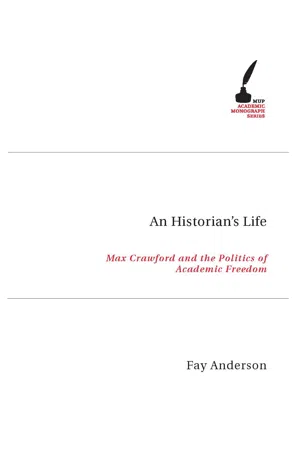
An Historian's Life
Trusted by 375,005 students
Access to over 1.5 million titles for a fair monthly price.
Study more efficiently using our study tools.
Information
CHAPTER 1
Origins and Influences
‘One is all too aware of opportunities of original work missed, of work confidently planned that remains undone, of false leads followed.’1 After a career that spanned thirty-four years as Professor of History at Melbourne University, Max Crawford reflected on his chosen vocation with a mixture of satisfaction and regret. One of the original projects that remained undone was his historical study of contemporary Spain, devised whilst tutoring at Oxford in 1932. The emphasis was to be on the historical roots rather than the political implications of the conflict in that country.
This project laid the foundations for his synoptic view of history. Crawford never lived in Spain; this was intended to be a purely intellectual inquiry. Yet he immersed himself in the language, examined the culture and historical events, and read modern Spanish literature to familiarise himself with the prevailing ‘attitudes and temper’.2
Although the project was terminated before it really began, Crawford would always remember its themes and inspiration with pride and sadness. The year 1932 foreshadowed the trajectory of his future scholarship and unpublished work. The excited anticipation of his careful planning would gradually diminish as he struggled to execute the plan.
When Crawford was seventeen he imagined a very different future. His keen perception of himself as a serious intellectual moved him to prophesise:
One day I shall write. What it shall be — drama or poetry or novels I don’t know. But I do know I shall write...I feel it. I feel that I am being carried on the crest of a wave about to break, and when it does break I shall be freed. I shall write.3
Crawford described his inability to express his individuality, but was confident that maturity would liberate and strengthen him. He also hoped to inspire others. This boyish testimony, written during Crawford’s last year at High School, embodied all the determination and ambition of youth. Despite his confidence in his destiny, however, it would take nine years of struggle before he embarked on any writing project of substance. This was neither the great Australian novel, nor the poetry to which Crawford devoted a wavering commitment. Instead, it was the historical study of Spain. His roots and youthful experiences provide some indication of the intellectual he would become and the inconsistent direction his career would take.
Crawford was the ninth of twelve children (the second child died in infancy). He was born in 1906 to Henry (who was always known as Harry) and Harriet Crawford and raised in the Sydney suburb of Bexley. He depicted his childhood retrospectively as one of genteel poverty. In reality, his young life was sometimes challenging, disrupted by the First World War, the enlistment of his older brother and uncle, the struggles of his father and the aspirations of his mother. The absence of the impact of the war in Crawford’s childhood recollections is startling. The war destroyed a generation of men and resulted in a break between the post-war survivors and the old men who had sent them to the battlefields of Europe.4
An uncle and elder brother served in Gallipoli and France, and a brother-in-law was one of those shattered ‘vets who took to the drink’.5 Yet Crawford did not mention the loss, the change in social attitudes and values that resulted from the wasteful carnage, nor political reaction against war. It is only in an historical account written for an American audience that he referred to the war in any length, and his style is detached, the meaning vague:
I am conscious in my own retrospect of a hiatus: in those years after the war when I was a schoolboy and undergraduate, I can think of only one of my teachers of note who belonged to the generation of soldiers. We were taught by the middle-aged and the aged, and we too much lacked the bridge between of those nearer our own age who might have guided us safely past some of the pits into which we fell.6
The other notable and mystifying autobiographical disparity was Crawford’s recollection that his family was not politically minded. ‘It might seem that radical opinions were my family inheritance’, Crawford observed later in life, ‘in fact I knew little of this until recent years... We lived in a house of books and took study for granted; but I do not recall it as a political household.7
Yet his father, Harry a gentle, sociable man with the ‘soul of a poet’,8 was ‘deeply involved’ in the Railwaymen’s Union for much of his life. Max Crawford’s daughter, Margaret, was told that her grandfather contributed to the union magazine and visited union members all over New South Wales.9 As the eldest of his generation of the family, Harry had supported his younger siblings, much to his wife’s chagrin, and purchased the radical newspaper, Vedette, for his brother James, the family favourite who became a Queensland MP and was drowned in the Clermont floods. Yet the words, ‘that traitor Mannix’, uttered by Crawford’s father, were apparently the only political recollection of his youth.10
Although Crawford could not recall political debate, he would later speculate that the family’s political legacy most profoundly affected his brother Jack. That formative inheritance was a mistrust of politics. His uncles had followed W. A. Holman out of the Labor Party in the wartime split over conscription. One of them, Thomas Crawford, the former Presbyterian Minister in Newcastle and the southern Riverina, had been the Labor MP for Marrickville since 1910. He later stood as a National and lost his seat in the 1917 state elections. In the same year, he was appointed a Crown Prosecutor in New South Wales and, from 1940 until his retirement in 1947, he was Senior Crown Prosecutor.
Hence, Crawford emphasised his uncles’ reluctance to bind their consciences to the dictates of one party, and suggested that such independence influenced his brother Jack. Later knighted, Jack would become known as one of the ‘seven dwarfs’, one of the top bureaucrats of diminutive size who etched his career in Canberra and became a distinguished public servant, working for both Labor and Liberal-Country Party ministers.11
The family influence was not confined to Jack: Max also refused to bind himself to any party loyalty—or so he maintained. Despite this, the youngest sibling, Ken, claimed that both Jack and Max were habitual Labor voters. Max would later write that he knew nothing of his uncles as MPs or the ‘Vedette venture’.12
If Crawford could not recollect political discussion among his family, he was not unaware of his family’s sentiments or his own views. Despite his protestations, he possessed a strong vision for Australia. He confidently pondered such issues as communism, class, and attitudes towards the British in Germany and France. These were hardly the thoughts of a man who was ‘quite unpolitical’.13 At the same time he insisted that politics ‘bored him’. It was his fascination with Machiavelli that aroused an interest in statecraft, and he took from Machiavelli the moral dilemma inherent in politics that ‘good may be bad and bad good’.14
Crawford also suggested in retrospect that the influences that shaped the careers of his political uncles might have operated ‘subliminally’ in his own parents’ house. He cited a readiness to sympathise with the underdog.15 Convinced that Bexley was the setting of Christina Stead’s classic book, The Man Who Loved Children, Crawford considered the ‘real poverty’ in the Bexley-Rockdale district—the widows and deserted wives with children. He recalled that if you moved further out to Sutherland, the poverty was even more confronting. One of Crawford’s elder sisters would ‘cry her eyes out for the little girls in her class who came to school in winter barefoot and wearing worn out flimsy cotton dresses’.16 Crawford later speculated that they were probably the children of casual and itinerant workers. The humanity that he observed in his siblings was also a trait that was constantly emphasised about Crawford himself.
Education was pivotal to Crawford’s childhood. He fulfilled all expectations, excelled without apparent effort at Fort Street High School and distinguished himself at the University of Sydney. He graduated with first-class honours in English and History, one of an emergent class of intellectuals who were highly motivated, upwardly striving children of the lower-middle classes. University study was, among other things, a ladder to higher status and security.17 Academic achievement was to be his escape from the sprawling suburb of Bexley and the life of his close and devout Presbyterian family. Crawford’s success inspired others.18
At Sydney University, Crawford fell under the spell of George Arnold Wood, J. F. Bruce and John Le Gay Brereton. They were an intoxicating combination, and Brereton became the object of Crawford’s unabashed admiration, which he likened to ‘just out and out hero-worshipping’.19 Even with the encouragement of his three mentors to embrace new ideas, he could not break from accepted beliefs and the need for compliance. In a letter written in 1928, when Crawford was attending Oxford, he provided a ‘mental biography’ that reviewed his performance at Sydney. ‘You probably noticed while we were in Arts’, Crawford wrote in a fit of self-criticism, ‘that if the conversation urged towards the controversial in the matter of the living, I either dodged it or asserted the conventional ideas’.20
Crawford also ob...
Table of contents
- Cover
- Title
- Copyright
- Contents
- List of abbreviations
- Acknowledgements
- Introduction
- 1. Origins and Influences
- 2. ‘Forward the Professors’
- 3. War and Diplomacy
- 4. Brave New World
- 5. Academic Freedom and the Australian Story
- 6. ‘Things Will Never Be the Same’
- 7. ‘Into the Night’
- Conclusion
- Bibliography
- Index
Frequently asked questions
Yes, you can cancel anytime from the Subscription tab in your account settings on the Perlego website. Your subscription will stay active until the end of your current billing period. Learn how to cancel your subscription
No, books cannot be downloaded as external files, such as PDFs, for use outside of Perlego. However, you can download books within the Perlego app for offline reading on mobile or tablet. Learn how to download books offline
Perlego offers two plans: Essential and Complete
- Essential is ideal for learners and professionals who enjoy exploring a wide range of subjects. Access the Essential Library with 800,000+ trusted titles and best-sellers across business, personal growth, and the humanities. Includes unlimited reading time and Standard Read Aloud voice.
- Complete: Perfect for advanced learners and researchers needing full, unrestricted access. Unlock 1.5M+ books across hundreds of subjects, including academic and specialized titles. The Complete Plan also includes advanced features like Premium Read Aloud and Research Assistant.
We are an online textbook subscription service, where you can get access to an entire online library for less than the price of a single book per month. With over 1.5 million books across 990+ topics, we’ve got you covered! Learn about our mission
Look out for the read-aloud symbol on your next book to see if you can listen to it. The read-aloud tool reads text aloud for you, highlighting the text as it is being read. You can pause it, speed it up and slow it down. Learn more about Read Aloud
Yes! You can use the Perlego app on both iOS and Android devices to read anytime, anywhere — even offline. Perfect for commutes or when you’re on the go.
Please note we cannot support devices running on iOS 13 and Android 7 or earlier. Learn more about using the app
Please note we cannot support devices running on iOS 13 and Android 7 or earlier. Learn more about using the app
Yes, you can access An Historian's Life by Fay Anderson in PDF and/or ePUB format, as well as other popular books in History & Australian & Oceanian History. We have over 1.5 million books available in our catalogue for you to explore.