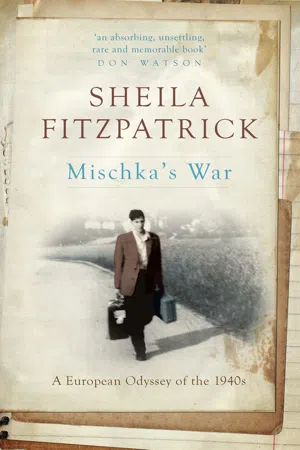
On a winter's day in 1943, 22-year-old Mischka Danos chanced on a terrible sight as he skied through Latvian woods—a pit filled with the bodies of Jews killed by the occupying Germans. The world was full of such atrocities, which makes Mischka's decision to escape conscription to the Waffen-SS by going on a student exchange to Germany all the more remarkable. Even more so when Mischka later discovered he was part-Jewish.But his was no ordinary life. He narrowly escaped death in the Allied fire bombing of Dresden. He then lived the precarious life of a Displaced Person in occupied Germany before heading north with the hope of crossing the border into Denmark, where he finally reunited with his mother Olga. He went on to become a member of the exceptional Heidelberg school of physics. They were both resettled in the US at the beginning of the 1950s, which is where, much later, he met, fell in love with and married Sheila Fitzpatrick.Fitzpatrick pieces together her late husband's story through diaries, correspondence and recollections: 'This is a historian's book but it's also a wife's book about her husband... an offering of love that is also a search for knowledge.'
- English
- ePUB (mobile friendly)
- Available on iOS & Android
eBook - ePub
About this book
Trusted by 375,005 students
Access to over 1.5 million titles for a fair monthly price.
Study more efficiently using our study tools.
Information
1
Family

Olga and Arpad Danos around the time of their marriage, 1920.
NOSTALGIA for the home we once slammed the door on often creeps up on expatriates. But not on Misha. Uniquely, in my experience, he held firm to his original conviction that the place he had grown up in was a provincial backwater that he had been right to leave at the earliest possible moment. His two brothers had stayed in Riga, though not exactly by choice. In the 1990s, when Latvia emerged from the Soviet Union and opened up again, Misha resisted, for as long as he could, his brother Jan’s urgent invitations to visit Riga, then yielded unwillingly, and squirmed all the time he was there. He and I had both, as teenagers, longed to leave the parochial, narrow-minded, intolerant place that we had, by some cosmic mistake, been born in and get out into the real world. But my feelings about Australia had mellowed over the years, while rational Misha had seen no reason to change his attitude. Or perhaps it wasn’t the rational Misha who held so strongly to this position: the Riga past was a bit of an emotional minefield for him. He cherished the memory of Olga and his elder brother Arpad, a sometime prisoner of Gulag of whom Misha spoke almost with reverence. But Olga had ended up, like him, in America; and it was the remembered Arpad that he felt close to, not the still-living one, long back in Riga but permanently damaged by his Soviet experiences. The only thing in Riga to which Misha had a straightforward ‘this is my own, my native land’ response was Rigās Jūrmala, the beloved beach resort of his childhood. I found it on the bleak side.
Misha had a strong sense of himself as a European. But he was skittish about nationality, refusing even to commit himself to a native language (he said German, Latvian and Russian were all spoken in his milieu, and resisted my suggestion that German seemed to be his native language, since his German was much better than his Russian or, as far as I could tell, his Latvian). This was one of the few contexts in which his father, the multilingual cosmopolitan, was cited with unreserved approval, particularly for his dismissive attitude to things Latvian. Misha never expressed any particular feeling of kinship with Latvians, whose interwar (and, in the displaced persons camps, postwar) nationalism had left unpleasant memories. He displayed marginally more interest in Hungarians, of whom there were many in his chosen community of physics, though I couldn’t say it went as far as a feeling of kinship (skill at entering revolving doors behind you and exiting in front was emphasised, and Misha did not have that skill). Still, I thought he might be interested in going to Hungary, since we travelled a lot in Europe, and given the Hungarian father, but he wasn’t at all. Quite the contrary. We never went there, which given my professional ties with Eastern Europe, almost amounted to a statement.
Of the stories Misha told me about his childhood, the one I remember most vividly was about his expulsion from the Riga German classical gymnasium (academic high school), for rudeness to a teacher, which he considered outrageous since all he had been doing was non-disruptively pointing out that the man didn’t know what he was talking about. Even sixty years later, he didn’t really see why the teacher had been so annoyed; unlike the rest of us as we get older, he had not become persuaded that seniority deserves respect. When he started to write his musings for me, not much about his childhood or family background struck him as significant enough to be remembered. There was a memory, from the family’s prosperous days in the early 1920s, of going upstairs to the kitchen to the warm, comfortable presence of the servants, who though welcoming, conveyed some sense that he wasn’t supposed to be there. After a while, he worked out that this must be his mother’s edict, based on the principle of non-fraternisation between classes, which opened up a small crack in his previously wholesale acceptance of his mother’s wisdom. But that, from Misha, was not a story about the beginning of class consciousness. His dislike of separation into hierarchical categories in which some were held to be inferior extended in practice not only to age (he had no special way of treating either five- or 95-year-olds) but even to species (he treated dogs as not clearly distinct from humans, and in return they seemed to treat him as not clearly distinct from a dog).
Another memory was of his strong internal protest against the indignity of having to get rotten apples from the market because they were cheap—a consequence of the family’s financial crisis in the early 1930s. It was a memory of humiliation stemming from a sense of pride, and thus potentially contradictory to the anti-distinction position I have just outlined. But Misha would have said that the pride that was damaged by the rotten apples was his pride as an individual, unique and unrepeatable, not his pride as the member of a family that had formerly been prosperous but was now poor. In any case, it was a story implicitly critical of his father (who argued that rotten apples were only rotten in parts and remained basically eatable) and supportive of his mother, who evidently thought that the family’s plight did not justify quite such extreme measures. That, as he was growing up and the parents were quarrelling, was Misha’s usual choice of allegiance.
The one musing he wrote on family history, entitled ‘Stories from the Grandfather’s Times’, concerned his mother’s Latvian father, not the essentially unknown Hungarian (or Jewish) grandfather on the paternal side. There was a reason for Misha’s interest in the Latvian grandfather that we will come to later. But the substance of the musing is notable for its scrupulous attention to detail, especially geographic, economic and technological. As I read it, I am irresistibly reminded of going for walks with Misha along the C&O Canal near our house in Washington. The canal runs beside the Potomac River. As we walked, Misha would be registering water levels, landscape contours, vegetation, and wildlife in and out of the water, and at the same time carefully examining any machine or construction along the way to determine its purpose and operational principles. I saw virtually none of these things, not only because I am short-sighted but also because I don’t pay attention. The only things that would strike me on the towpath were the people we passed, from whose dress, facial expression, demeanour and behaviour to each other I would make some quick, automatic deductions about character, social status, relationship to each other and so on. But Misha didn’t even notice them.
‘The grandmother, Julia, was born 1870’ is how ‘Stories from the Grandfather’s Times’ starts. But we hear no more of Julia, though she lived in the Danos household for most of Misha’s childhood, something of a kill-joy presence as far as I could gather from Misha’s rare remarks about her. As the musing continues,
the grandfather, Janis Viksne, was a little, not much, older; probably born 1865, i.e., after, even though not much after, the removal of serfdom. Thus, a few, very few, serfdom stories survived, but only from Julia’s side … My mother was born in 1897, into a household, an economic enterprise, based on a water mill, with a dam across the Jugla river, a tributary to the Jugla lake (Stintsee in German), not far from Riga. In German it would be called ‘ein Bach’, not ‘ein Fluss’. I have not seen that place; my mother visited it: nothing had survived WWI, not even the dam. At any rate, the power generated by that water wheel was sufficient to power not only a wood-working shop, but even an electric generator, supplying electric lights to the Viksne population. That aspect was a thorn in the side of the local German baron—the ex-serfholder of that region: ‘This Viksne, he has electricity and I do not!’ Actually, that was the first electricity in the district, if not the Baltics; I think his electricity certainly predates the electrification of Riga; probably not that of some of Riga’s industries.
The electricity motif had some personal significance for Misha because of his work as a young man at the VEF, Riga’s great electrotechnical factory. But it had significance in the history of Latvia as well, because Riga in the decades before the First World War was one of the Russian Empire’s economic showpieces. Large, modern industrial plants, many of them foreign-owned, had sprung up in the latter part of the nineteenth century, metalworking, mechanical engineering and chemicals being the biggest industries. In the decade before the First World War, Latvia’s annual growth rate was a spectacular 6.4 per cent, while Riga’s population doubled. Misha’s grandfather was a beneficiary, since he had set up a woodworking shop at his mill that made stopcocks (external valves regulating the flow of liquid) for beer kegs, and Riga’s breweries constituted a flourishing market.
Latvia is a small country wedged between two big ones, Germany and Russia, whose periodic incursions provided many of the great events of its history. Up to the First World War, it was a part of the Russian Empire, having been won from the Swedes by Peter the Great at the beginning of the eighteenth century. For a century before, it had been a site of contestation between the Teutonic Knights, the Polish–Lithuanian Commonwealth, Sweden and Russia. Before that, from the twelfth to the sixteenth century, Riga had been an important town in the Hanseatic League, connecting it with the German language, culture and trading network.
Since the Reformation, the majority of the population of present-day Latvia identified as Lutheran by confession, although the eastern region of Latgale remained Roman Catholic, and Orthodoxy made inroads in the Russian period. The German presence remained large, with German nobles—the so-called ‘Baltic barons’—the main landowners. Their serfs, mainly ethnic Latvians, were for the most part emancipated in the early nineteenth century, but resentment against the Baltic barons remained. Russification policies of the 1880–90s aimed to reduce the German dominance, including linguistically, but in the short term their effect was mainly to sharpen Latvian resentment against Russians as well as Germans.
Latvia’s population grew rapidly in the course of the nineteenth century, from a base of 720,000 to two million, with large-scale and varied immigration, which reduced the ethnic Latvian proportion of the population from 90 per cent at the beginning of the century to 68 per cent at the end. The biggest minorities at the turn of the century were Russians (8 per cent), Germans (7 per cent) and Jews (6 per cent)—the figures, from Latvian sources, may err on the low side—and in Riga both German and Russian were officially recognised languages. In culture, German remained the dominant influence: it wasn’t only ethnic Germans who spoke German at home and sent their children to German schools, but also many others.
Rapid social and economic change brought a variety of discontents, including, as a by-product of industrialisation, the appearance of a large and radical working class, from which came a whole cohort of Latvian revolutionaries. In the 1905 Revolution, which plunged the whole of the Russian Empire into chaos for more than a year, Riga was in the forefront. Misha’s grandfather was not a revolutionary, but—appropriately for an ancestor of Misha’s—he was interested in technology, including photography. He had got too rich, according to Misha’s analysis (perhaps based on his mother’s report) and was ‘bored to death’:
So he dabbled with this and that, and tended to disappear for months at a time, reappearing dead drunk in the middle of the night, to disappear again some months later. His last entry in the book of history was in 1905, when he assembled photographic equipment and left to photograph and document the [Russian] revolution. He never returned.
That was the part of the grandfather’s story Misha particularly liked, the reason the grandfather deserved a musing. Provincial Latvia had bored Grandfather Janis, so he left. Misha as an adolescent approved of that. He had similar plans for himself, though in his case the idea was to go west rather than east.
Olga was one of Janis and Julia’s three children, including an older sister, Mary, and a son who played the violin, fought in the First World War and either died there or, in one version, went off to fight for the Reds in the Russian Civil War (around 1918) and never came back. The departure of Olga’s father when she was eight must have made for a difficult childhood, all the more since her mother was away for months in hospital and sanatorium. As the family—Olga does not specify its members, but it included an uncle and a piano-playing cousin—gathered to celebrate Julia’s long-awaited return, her fourteen-year-old cousin played a Chopin étude that was forever marked in Olga’s memory.
I never knew Olga, who died long before I met Misha, and his unfailingly admiring comments about his mother inspired a certain unspoken scepticism on my part: someone so wise, benevolent and generally saintly seemed not only implausible but almost dull (how wrong I was about that). It didn’t help that Misha expressed to me in the 1990s the same feelings about the sanctity of motherhood and the special qualities of maternal love that, as I now know, he had written in almost identical words in his diary in his twenties. This was alien territory for me, and for a long time it turned me off Olga. When I first started doing research on the family, I started with his father.
The bare outlines of the story that I got from Misha were as follows. Arpad Danos, born in 1882, was a Hungarian who, as a singer with the Hamburg Opera, was touring in Riga when the First World War broke out. Since Hungary was on the Axis side in the war and Russia on the Allied, Arpad became overnight an enemy alien. He solved this problem by going undercover as a soloist with the Riga opera, using his stage name of Arimondi (this overt way of going underground greatly appealed to Misha). There he met and married a young Latvian singer in the opera chorus, Olga Viksne, daughter of the absconding miller and his wife Julia. A gymnasium graduate and cosmopolitan Anglophile, he subscribed to the London newspaper the Morning Post, probably more for its excellent international and cultural coverage than for its conservative politics. Arpad was not only an opera singer but also a sportsman: he had competed in the Paris Olympic Games in 1900 in the triple jump, Misha said, but gave up competitive sport on the insistence of his singing teacher. Twenty years later, and pushing forty, he had acquired a girth suitable for an opera singer of the day but definitely not for a triple jumper—as we see from the photograph at the head of this chapter.
Now there’s an interesting parent, I thought. Indeed, I think so to this day, although much about Arpad remains frustratingly elusive. The puzzles start with his family back in Hungary. Misha, although photographed at the age of six in Hungarian costume, had little interest either as child or adult in Hungary or the ramifications of the Danos family. His brothers Arpad Jr and Jan were more attentive, and much of what I found out about the family after Misha’s death came from them. They both remembered visits from the Danos aunts who brought the Hungarian costumes at the end of the 1920s, and Arpad Jr knew the Hungarian side of the family quite well, having as a fifteen-year-old spent a year with them in Hungary because of ill health. According to their accounts, the paternal grandfather, Josef Deutsch, was a Catholic schoolteacher of German colonist stock who, as a civil servant at the turn of the century, had to take a Hungarian name because of the government’s Magyarisation policies, and chose the name of Danos. He was married to a Spaniard, the impressively named Johanna da Quilla, and they had nine children (though Arpad remembered the names of only eight of them), of whom Arpad was the third. Jan amended the original version, after postwar contact with surviving members of the Hungarian family in which he discovered that the family was at least partly Jewish, to make grandmother Johanna da Quilla a Spanish Jew and a baroness.
Given my curiosity about the Jewish part of the family tree, I was fascinated but also puzzled by this information. Did Spanish Jew mean Sephardic? Were Spanish Jews likely to be baronesses, and if so, according to whose titles of nobility? I pestered all my friends with expertise in Jewish history about these questions and essentially came up with a blank. Nobody knew anything about aristocratic, possibly Sephardic, Jews called da Quilla, in Hungary or anywhere else. So I found a young Hungarian researcher, Kata Bohus, and set her on a search in the birth and marriage and other contemporary records. She came up with a marriage record for Joszef (sic) Deutsch, but alas the wife had the more prosaic name of Janka Weiner. The parents’ name change was not recorded, but in 1898, four of their sons registered a change of last name to Danos.
The parents’ marriage certificate contained no information on the nationality, race or religion of the couple, but all the other documents Kata found, as well as some in Jan’s private archive, indicated that the children of the marriage were consistently identified as ‘Israelite’, both in their school records and in the registration of name changes. It may be, as Jan suggests, that for Hungarian bureaucratic purposes in cases of mixed marriages, the mother’s nationality was passed to the children, and that the Danos children were baptised and brought up as Catholic and identified as such. Certainly Arpad Sr called himself a Catholic when marrying Olga in Riga. Of the family remaining in Hungary under the Nazis in the Second World War, most came through alive, but one sister was denounced as a Jew and perished in a concentration camp. Deutsch, however, was often a Jewish name in Eastern Europe, and other Hungarian families who changed their name from Deutsch to Danos in the same period appear to have been Jewish, though not necessarily identifying as such. My sense, and Kata’s, is that the Josef Danos family was very likely Jewish on both sides, albeit assimilated, German-speaking and secular.
Everybody gets their family stories a bit wrong and it’s a shame to spoil a good one. But as regards other elements of the family, I must sadly report that according to Kata’s researches, Arpad Sr did not compete in the Paris Olympic Games, despite Arpad Jr and Jan confirming Misha’s recollection on this point. Still, you can see why the Olympics lodged in family memory as a shorthand. Arpad Sr actually was a promising athlete, first mentioned in the Budapest sporting press around 1899, whose best events initially were the long jump and the triple jump, and who then became Hungarian national champion in the high jump in 1903. He did indeed qualify for the Olympics in 1900, but lack of funds evidently prevented him from going to Paris to compete.
Arpad landed in Riga accidentally and never seems to have thought much of Latvia, although by a quirk of fate he would be the only member of the family who did not try to leave it in 1944. Yet when he arrived there in 1914, Riga was in the midst of an artistic flowering; not at all a bad place to be as far as culture was concerned. A spectacular local Art Nouveau movement in architecture in the prewar decade, led by the Russian-educated Latvian German Mikhail Eisenstein (father of the famous Soviet filmmaker Sergei), had given Riga the highest concentration of this style in the world. In the 1920s, Arpad Danos and his family would live in one of the Art Nouveau apartment blocks, with the family of Isaiah Berlin (the British philosopher) round the corner in another. Arpad’s affinity with the modern in music, particularly the art songs of the French composer Claude Debussy, would have been congenial to the international- and modern-minded Riga public. Opera was also flourishing. U...
Table of contents
- Cover
- Title
- Copyright
- Contents
- Introduction
- Mischka and Olga
- 1 Family
- 2 Childhood
- 3 Riga under the Soviets
- 4 Riga under the Germans
- 5 Wartime Germany
- 6 The Bombing of Dresden
- 7 Displaced Persons in Flensburg
- 8 Olga, from Flensburg to Fulda
- 9 Student in Hanover
- 10 Physics and Marriage in Heidelberg
- 11 Olga’s Departure
- 12 Mischka’s Departure
- Afterword
- Notes
- Sources
- Acknowledgements
- Index
- Illustration
Frequently asked questions
Yes, you can cancel anytime from the Subscription tab in your account settings on the Perlego website. Your subscription will stay active until the end of your current billing period. Learn how to cancel your subscription
No, books cannot be downloaded as external files, such as PDFs, for use outside of Perlego. However, you can download books within the Perlego app for offline reading on mobile or tablet. Learn how to download books offline
Perlego offers two plans: Essential and Complete
- Essential is ideal for learners and professionals who enjoy exploring a wide range of subjects. Access the Essential Library with 800,000+ trusted titles and best-sellers across business, personal growth, and the humanities. Includes unlimited reading time and Standard Read Aloud voice.
- Complete: Perfect for advanced learners and researchers needing full, unrestricted access. Unlock 1.5M+ books across hundreds of subjects, including academic and specialized titles. The Complete Plan also includes advanced features like Premium Read Aloud and Research Assistant.
We are an online textbook subscription service, where you can get access to an entire online library for less than the price of a single book per month. With over 1.5 million books across 990+ topics, we’ve got you covered! Learn about our mission
Look out for the read-aloud symbol on your next book to see if you can listen to it. The read-aloud tool reads text aloud for you, highlighting the text as it is being read. You can pause it, speed it up and slow it down. Learn more about Read Aloud
Yes! You can use the Perlego app on both iOS and Android devices to read anytime, anywhere — even offline. Perfect for commutes or when you’re on the go.
Please note we cannot support devices running on iOS 13 and Android 7 or earlier. Learn more about using the app
Please note we cannot support devices running on iOS 13 and Android 7 or earlier. Learn more about using the app
Yes, you can access Mischka's War by Sheila Fitzpatrick in PDF and/or ePUB format, as well as other popular books in History & European History. We have over 1.5 million books available in our catalogue for you to explore.