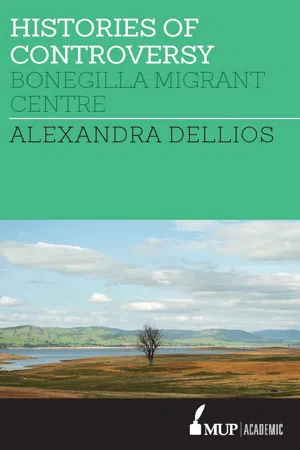
Bonegilla was a point of reception and temporary accommodation for approximately 320, 000 post-war refugees and assisted migrants to Australia from 1947 to 1971. Its function was integral to the post-war immigration scheme, something officially lauded as an economic and cultural success. However, there were considerable hardships endured at Bonegilla, particularly during times of economic and political insecurity. Enforced family separation, poor standards of care, child malnutrition, and organised migrant protest need to be recognised as part of the Bonegilla story. Histories of Controversy: The Bonegilla Migrant Centre gives this alternative picture, revealing the centre's history to be one of containment, control, deprivation and political discontent. It tells a more complex tale than a harmonious making of modern Australia to include stories of migrant resistance and their demands on a society and its systems.
- English
- ePUB (mobile friendly)
- Available on iOS & Android
eBook - ePub
About this book
Trusted by 375,005 students
Access to over 1.5 million titles for a fair monthly price.
Study more efficiently using our study tools.
Information
CHAPTER 1
Separation, Family and Unsettling Settlement
The separation of families, including individual partners and siblings, is a salient feature of the memories of many non-British assisted migrants and refugees from 1949 to the 1960s. Family separation is a part not only of Bonegilla’s history, but also of other centres for non-British migrants across the country. Only non-British assisted migrants and refugees who had signed assisted passage agreements, found themselves separated under the conditions of their two-year work contract with the Commonwealth. The widespread experience of separation demonstrates the degree of control exercised by government departments over the lives and movements of non-British arrivals. Examples of family separation serve as a reminder of the ways in which state power can intervene in familial life: it wrought disruption to countless families and their adjustment into their new lives. Developing any sense of ‘independence’, as former DP Adam Dukars noted in 1949, was stalled: ‘When our two years’ contract is over, we look forward to a home and independence again’.1
This chapter will offer a policy and social context for understanding the forced separation of migrant families—exploring political justifications and individual migrant responses to those circumstances. Ideas around the role of family in cultural assimilation, somewhat paradoxically, still features in this history, and this chapter presents examples of how this assimilationist philosophy functioned to contain the expectations of new arrivals. Finally, resistance is also a continuous feature in histories of family separation, and I attempt to offer as many examples as possible. Migrants resisted the sometimes astonishing power of individual bureaucrats and government departments over their lives. Although migrant agency did not always manifest in outright resistance, or even successful family reunion, these stories are offered in the hope that this book does not descend into familiar modes of retelling Australian migration history, with new arrivals cast as the faceless recipients (or even victims) of policy decisions and mass movements. I offer instances in which DPs and assisted migrants tried to wrest back control of their movements, families and life trajectories.
Alongside these stories of resistance to work allocation that incurred family separation, we must remember that some circumstances remained beyond people’s control, proving at times debilitating and traumatic. For others, the prospect of secure, ongoing employment (albeit often undesirable, dirty, difficult and remote employment) could even be reassuring. Some could subvert the controls of the work contract to fulfil their desires to escape family obligations, for example. This chapter is ultimately an exploration of the relationship between control and migrant resistance that the work contract created.
It must also be said that government definitions of ‘family’, while largely undervalued by the conditions of the work contract, were also narrow in their wider application. For Australian officials, as well as International Refugee Organisation (IRO) staff in DP camps, a ‘family’ was formed by a (male) breadwinner and his dependants. Marriage was also a key part of this conception of family. Those who had lived through the war and later spent time in DP camps, also knew that marriage could be a matter of convenience and safety. The rates of marriage, divorce and desertion across this period were therefore very high. This narrow definition of family was an anomaly in postwar Europe.
Historian Ruth Balint analyses families’ attempts to find each other across continents in a ruined postwar Europe and at the beginning of the Cold War. According to Balint, DP families in Australia and around the world lodged thousands of enquiries with the Australian Red Cross tracing service, one of the few means available to communicate with or locate dispersed family members divided by the Cold War and Russian occupation.2 Displacement and separation continued in many forms for years after migration and escape from persecution. Countless histories of the refugee situation in postwar Europe—of the 700 DP camps spread across Germany and into southern Italy—have been told and retold.3 More than 20 million people were displaced by war. Many families also moved across DP camps in search of family and friends, or even just to attach themselves to their respective ethnic or regional groups.4 In this context, families were made and remade—they were fluid. These remade families could also hold the prospect of safety and stability.
Histories of Migrant Family Separation
Australian historians of immigration have intermittently referred to family separation, and yet it remains an officially unacknowledged aspect of the postwar immigration scheme. In 1988, historian Catherine Panich, whose parents passed through Bathurst Reception and Training Centre in New South Wales, evocatively labelled the separation of families in postwar Australia a ‘national disgrace’ that has gone virtually unheeded. Her history contends: ‘no other country deliberately destroyed family life’.5 Around the same time, Louis Maroya, a former resident of Bonegilla, referred to all centres as bearing ‘silent witness to emotional scenes as fathers, working-age children and single adults departed for their distant assigned placed of employment’. In his efforts to establish a migration museum in Bonegilla’s last remaining huts in 1987, Maroya referred to this forgotten aspect of Australia’s migration history: ‘Centres enforced separations of families and friends, which caused a great deal of stress and unhappiness’.6 More recently, historian Karen Agutter, in her account of migrants’ post-arrival mobility in South Australia, examines the trauma inflicted on refugees who had already experienced ‘so much separation even before they arrived in Australia’, during the war and in DP camps in Europe.7 Stories of separation, resistance and outrage should not be seen as a footnote to the immigration history of Australia, but rather as an integral part of the settlement experience of many. The following discussion builds on these provocative statements regarding family separation.
Although family separation has not been addressed at length, questions of containment and control, accommodation and hospitality, are not new to the historiography of the postwar immigration scheme.8 Historian Ann-Mari Jordens, in her history of the Department of Immigration and in her efforts to address historians’ ‘blanket condemnation’ of the department, ultimately argues that the scheme and its settlement services were ‘considerable if inadequate’.9 The settlement services on offer within Department of Immigration centres constituted an extensive strategic achievement for the government. Yet, at times, the department displayed a haphazard and woefully unprepared approach to processing human lives. While the scheme is retrospectively considered an ambitious ‘grand plan’ that inadvertently changed Australia’s ethnic make-up, this study of the work contract also reveals instances of the government’s ‘patchwork job’, inadequate welfare services, and xenophobia, which John Lack and Jacqueline Templeton describe as integral to the postwar immigration scheme.10
Explaining Separation and the Work Contract
As a condition of their admission to Australia, individual signatories to the two-year work contract would ‘undertake approved employment found for them by the Commonwealth for a period of two years after their arrival in Australia’—provided they were over the age of 16.11 The work contract, in theory, ‘guaranteed’ them two years’ employment at the direction and discretion of the government. Generally, migrants were to fill quotas in heavy industry, agriculture, manufacturing or, for women, in domestic service. The focus of the scheme, however, remained on labour better suited to able-bodied men. Those who found work without the assistance or direction of Commonwealth employment officers were to report their change of work and accommodation to their local Commonwealth Employment Office—indeed, all aliens were bound by this reporting requirement.
The government was at first unprepared for the desire of DPs from the IRO scheme to maintain family unity upon migration and during the initial settlement process. Family separation, as an outcome of employment contracts, was a condition that did not apply to British migrants: internal departmental memos from 1949 stated many times that it was ‘not desirable that British dependants be separated from their breadwinner’.12 These conditions remained in place for much of the postwar immigration scheme, from 1947 to the 1960s. Australia was the only country to mandate a two-year work contract as a condition of entry for new arrivals. Other countries seeking to recruit suitable settlers from Germany’s refugee camps, such as Canada and the United States, did not apply the same conditions to IRO entrants.
Ironically, DPs fleeing Soviet invasion in eastern Europe found themselves migrating to Australia due to its leniency on accepting family units from 1948: unlike Canada and sometimes the United States, Australia was more willing to accept family units for emigration—even as its work contract sanctioned for their separation after migration. As historian Catherine Panich reveals in her account of postwar immigration to Australia, keeping the family together was of the utmost importance for DPs, and it was for that reason that many families chose to go to Australia.13 This indicates that many were unaware of the restraints and conditions placed on them as a result of signing the work contract.
The work contract also secured new arrivals subsidised (but still financially onerous) accommodation in Department of Immigration centres across Australia, like Bonegilla. According to Agutter, ‘For the dubious privilege of this separation a refugee was obliged to pay up to £3 a week’, which could take up most of one’s earnings and operated as an incentive to move out of the centre system as soon as possible.14 Only pregnant women and women with young children were exempt from the indentured contract, although many departmental memos indicate that these women were officially encouraged to take up work, and indeed found it necessary in order to cover the costs of centre accommodation. This became the case for single ‘unsupported’ mothers as well, many of whom found they were unable to afford to pay off rent debts to holding centres. They remained in centre accommodation for years on end.
In the early years of the scheme, the government justified family separation by insisting that it was ‘for their own interest’.15 For DPs, the government did not consider maintaining the family unit as essential to their initial settlement. The terms of the work contract saw many living in a liminal state, without the cultural and social support of family in a new country, and without the right to family life and reunification during the term of their two-year contracts.
Once the conditions of the work contract became clear, they were not necessarily onerous to everyone. For example, many young male Italian migrants, arriving after 1952 when the Australian and Italian governments negotiated a migration agreement, welcomed the prospect of guara...
Table of contents
- Cover
- Title
- Copyright
- Contents
- Acknowledgements
- List of Abbreviations
- Introduction
- 1. Separation, Family and Unsettling Settlement
- 2. Food
- 3. Health, Wellbeing and Children
- 4. Unemployment and Protest
- Conclusion
- Bibliography
- Index
Frequently asked questions
Yes, you can cancel anytime from the Subscription tab in your account settings on the Perlego website. Your subscription will stay active until the end of your current billing period. Learn how to cancel your subscription
No, books cannot be downloaded as external files, such as PDFs, for use outside of Perlego. However, you can download books within the Perlego app for offline reading on mobile or tablet. Learn how to download books offline
Perlego offers two plans: Essential and Complete
- Essential is ideal for learners and professionals who enjoy exploring a wide range of subjects. Access the Essential Library with 800,000+ trusted titles and best-sellers across business, personal growth, and the humanities. Includes unlimited reading time and Standard Read Aloud voice.
- Complete: Perfect for advanced learners and researchers needing full, unrestricted access. Unlock 1.5M+ books across hundreds of subjects, including academic and specialized titles. The Complete Plan also includes advanced features like Premium Read Aloud and Research Assistant.
We are an online textbook subscription service, where you can get access to an entire online library for less than the price of a single book per month. With over 1.5 million books across 990+ topics, we’ve got you covered! Learn about our mission
Look out for the read-aloud symbol on your next book to see if you can listen to it. The read-aloud tool reads text aloud for you, highlighting the text as it is being read. You can pause it, speed it up and slow it down. Learn more about Read Aloud
Yes! You can use the Perlego app on both iOS and Android devices to read anytime, anywhere — even offline. Perfect for commutes or when you’re on the go.
Please note we cannot support devices running on iOS 13 and Android 7 or earlier. Learn more about using the app
Please note we cannot support devices running on iOS 13 and Android 7 or earlier. Learn more about using the app
Yes, you can access Histories of Controversy by Alexandra Dellios in PDF and/or ePUB format, as well as other popular books in History & Australian & Oceanian History. We have over 1.5 million books available in our catalogue for you to explore.