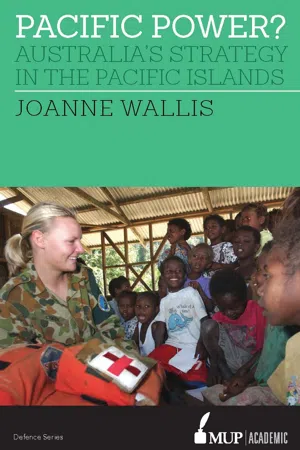
Australia is much larger and has significantly more military and economic power than its Pacific Island neighbours. As a result, it is frequently described as having a natural right to lead in the region. Yet, Australia has found it difficult to effectively influence Pacific Island states in pursuit of its strategic interests. It provides the definitive account of how, and how effectively, Australia has sought to influence Pacific Island states in pursuit of its strategic interests since 1975, the year that Papua New Guinea, Australia's former colonial territory, gained independence. Informed by interviews with key decision makers, Pacific Power? analyses why Australia has had difficulty exercising influence in the Pacific Islands and identifies how Australia can more effectively influence Pacific Island states in pursuit of its strategic interests, and how Australia can present itself more as a Pacific partner than power.
- English
- ePUB (mobile friendly)
- Available on iOS & Android
eBook - ePub
About this book
Trusted by 375,005 students
Access to over 1.5 million titles for a fair monthly price.
Study more efficiently using our study tools.
Information
Part 1
Australia’s evolving strategic interests in the Pacific Islands
CHAPTER 1
From colonial concerns to benign neglect
In this chapter, I plot the historical background to Australia’s strategic interests in the Pacific Islands until 1988. I identify that Australia has long been anxious about its proximity to the region, the region’s vulnerability to penetration by potentially hostile powers, and its distance from their coloniser, Britain, and later major ally, the United States (US). Yet, despite this anxiety, the level of attention that Australia has paid to the Pacific Islands has ebbed and flowed. I describe how, in the late nineteenth century, the Australian colonies were concerned that hostile powers could establish a foothold in the region and encouraged Britain to colonise territories. Following a period of relative calm, the Japanese advance through the region during World War II was Australia’s ‘moment of truth’ concerning its vulnerability to threats from or through the Pacific Islands.1 Despite this, as Australia’s defence policy followed the principles of ‘Forward Defence’ in the 1960s and ‘Defence of Australia’ in the 1970s, the region beyond Papua and New Guinea played little role in strategic planning. After most Pacific Island states became independent, Australia’s first Defence White Paper in 1976 identified the region as the area of Australia’s primary strategic concern. Australia’s main fear was that Pacific Island states could fall under the influence of external great powers, a risk heightened by Cold War competition for influence. Australia accordingly adopted a policy of ‘strategic denial’ in the region. Nevertheless, Australia’s role in the region during this period was characterised by ‘benign neglect’. Australia’s focus on the region sharpened from the mid-1980s, following the 1986 Dibb Review and 1987 Defence White Paper and a number of security challenges to Pacific Island states. Subsequently, Australia began to acknowledge that it had a strategic interest in ensuring the security, stability and cohesion of the region, as instability might provide opportunities for potentially hostile external influences to take hold.
The Australian colonies
The strategic geography of the Pacific Islands was evident to Australian leaders before Federation, as Australia and the region (referred to as ‘Australasia’) were commonly thought of as a whole.2 Indeed, the ‘Letters Patent’ given to Captain Arthur Phillip, who landed in Australia on 23 January 1788, defined the territories over which he and his successors were to exercise jurisdiction as ‘comprehending all the Islands adjacent in the Pacific Ocean’.3 Australia’s geography, particularly its distance from it coloniser, Britain (and later its ally, the United States), and its ‘proximity’ to Asia and the Pacific Islands has long ‘been regarded as a cause for alarm and anxiety’.4 Throughout the late nineteenth century, there were frequent calls for the extension of British—if not ‘Australian’—influence in response to the perceived strategic threat from the encroachment of other European powers in its region.5 Nevertheless the British were reluctant; they were unconvinced that the expense was warranted.6
The Australian colonies’ perception of the Pacific Islands was also coloured by race; there was a desire to use the region as a barrier to immigration, although cloaked in language that referred to a civilising and protecting mission. For example, referring to the process of ‘blackbirding’, whereby Pacific Islanders were kidnapped to provide indentured labour for the Australian sugar industry, in 1872 the Victorian Parliament debated the motion:
That in the opinion of this House, it is imperatively necessary in the interests of humanity and civilisation, and as the most effectual way of stopping the slave trade in the South Pacific, that the British Government should take immediate possession of all the islands in the Pacific Ocean, not already occupied or under the protectorate of any civilized power; and in the event of the Imperial Government declining to do so, that their sanction be sought to enable the Australian colonies and New Zealand, jointly or any of them separately, to take possession of such Islands as dependencies.7
This motion also reflects the frustration felt by the Australian colonies regarding what they perceived as Britain’s intransience in addressing their desire to ensure that the Pacific Islands ‘remained an English-speaking enclave under their influence’.8
In response to the growing presence of the French, the Germans and the Dutch, a council of the Australian colonies held a convention on the annexation of the Pacific Islands in Sydney on 27 November 1883. Two years later, this council became the Federal Council of Australasia, with, among other powers, legislative authority over the relations between Australia and the Pacific Islands.9 In a move that marked the start of Australian strategic policy, the convention proclaimed a policy of incorporating ‘the whole of the Pacific south of the equator’ within the British Empire;10 a policy described as the ‘Australasian Monroe doctrine’.11 There was also a strong presence of Australian missionaries and commercial interests across the region.
Annexation of Papua, 1883
The clearest example of Australia’s strategic anxiety about the Pacific Islands was Queensland’s attempt to annex Papua. In April 1883, Premier Thomas McIlwraith proclaimed the whole of eastern New Guinea to be British territory. Justifying the move, the Queensland Administrator, Sir Arthur Palmer, argued: ‘For some time past the imminent danger of annexation by a foreign power of the adjacent island of New Guinea has caused my Government much concern and uneasiness.’12 Although this action was ostensibly taken for security reasons, commercial interests and latent colonial ambitions were also influential.13
Britain was against a colony taking unilateral action to annex territory. As the British Government refused to ratify the proclamation, McIlwraith’s actions had no force in international law. Germany also protested, particularly as it formally annexed New Guinea in 1884. Subsequently, the two powers agreed their spheres of interest and influence in 1885.14
Concerns over German intrusion continued; in 1887 Germany intervened in Samoa. This generated anxiety in Australia, and bitterness that Britain was avoiding confronting Germany.15 Pressure from the Australian colonies on these issues and, most importantly, their willingness to bear the financial burden, persuaded Britain to formally annex Papua in September 1888 and to establish the British Government of Papua in June 1888 under the guidance of the Governor of Queensland (although Britain retained the right to veto any law).16
After Federation
After Federation in 1901, Australia’s strategic policy was guided by the principle of Commonwealth Defence, whereby Australia would contribute to, and coordinate with, Britain. In the Pacific Islands, Australia remained preoccupied with the threat posed by potentially hostile powers gaining a foothold in the region, and a sense that the region was its rightful sphere of influence.17 Australian leaders began to question Australia’s reliance on the British Empire for security, particularly as it required the deployment of Australian imperial forces to distant battles in Europe and the Middle East, yet the British were reluctant to respond to Australian concerns about threats within the region, particularly Japan, the so-called Yellow Peril.18
To deal with the potential encroachment of hostile forces in the region, Australian leaders began to envisage deeper integration between Australia and the Pacific Islands. In the first session of the Australian parliament, Prime Minister Edmund Barton commented that he looked forward to ‘the long centuries for which I hope New Guinea is to be a territory, perhaps, a State of this Commonwealth’.19 He also envisaged that Australia might acquire other islands (potentially Solomon Islands and the New Hebrides, now Vanuatu) to make a ‘federation of the seas’.20
Australia also saw itself as having a special responsibility for Britain’s colonies in the Pacific Islands. This responsibility was taken seriously; in addition to the more general power under section 51 (xxix) to make laws with respect to ‘external affairs’, the Australian Constitution included section 51 (xxx), which specified that Parliament had power to make laws with respect to ‘the relations of the Commonwealth with the islands of the Pacific’. This clause was ‘a direct expression of Australia’s anxiety for security in its own geographic sphere’.21
Because of Australia’s desire to influence the Pacific Islands, in 1901 Parliament debated whether to assume Commonwealth control over Papua. Billy Hugh...
Table of contents
- Cover
- Title
- Copyright
- Contents
- Foreword
- Tables and figures
- Acknowledgements
- Glossary
- Introduction: Australia as a Pacific power?
- Part 1 Australia’s evolving strategic interests in the Pacific Islands
- Part 2 The levers of Australian influence
- Part 3 The limits on Australian influence
- Conclusion: Pacific partner in an ‘arc of opportunity’
- Appendix: List of interviews
- Bibliography
- Index
Frequently asked questions
Yes, you can cancel anytime from the Subscription tab in your account settings on the Perlego website. Your subscription will stay active until the end of your current billing period. Learn how to cancel your subscription
No, books cannot be downloaded as external files, such as PDFs, for use outside of Perlego. However, you can download books within the Perlego app for offline reading on mobile or tablet. Learn how to download books offline
Perlego offers two plans: Essential and Complete
- Essential is ideal for learners and professionals who enjoy exploring a wide range of subjects. Access the Essential Library with 800,000+ trusted titles and best-sellers across business, personal growth, and the humanities. Includes unlimited reading time and Standard Read Aloud voice.
- Complete: Perfect for advanced learners and researchers needing full, unrestricted access. Unlock 1.5M+ books across hundreds of subjects, including academic and specialized titles. The Complete Plan also includes advanced features like Premium Read Aloud and Research Assistant.
We are an online textbook subscription service, where you can get access to an entire online library for less than the price of a single book per month. With over 1.5 million books across 990+ topics, we’ve got you covered! Learn about our mission
Look out for the read-aloud symbol on your next book to see if you can listen to it. The read-aloud tool reads text aloud for you, highlighting the text as it is being read. You can pause it, speed it up and slow it down. Learn more about Read Aloud
Yes! You can use the Perlego app on both iOS and Android devices to read anytime, anywhere — even offline. Perfect for commutes or when you’re on the go.
Please note we cannot support devices running on iOS 13 and Android 7 or earlier. Learn more about using the app
Please note we cannot support devices running on iOS 13 and Android 7 or earlier. Learn more about using the app
Yes, you can access Pacific Power? by Joanne Wallis in PDF and/or ePUB format, as well as other popular books in Technology & Engineering & Military Science & Technology. We have over 1.5 million books available in our catalogue for you to explore.