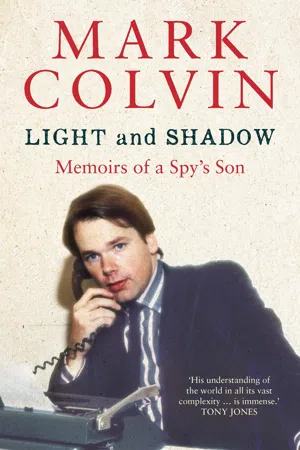
Light and Shadow is the incredible story of a father waging a secret war against communism during the Cold War, while his son comes of age as a journalist and embarks on the risky career of a foreign correspondent. Mark covered local and global events for the ABC for more than four decades, reporting on wars, royal weddings and everything in between. In the midst of all this he discovered that his father was an MI6 spy. Mark was witness to some of the most significant international events, including the Iranian hostage crisis, the buildup to the first Gulf War in Iraq and the direct aftermath of the shocking genocide in Rwanda. But when he contracted a life-threatening illness while working in the field, his world changed forever.Mark Colvin's engrossing memoir takes you inside the coverage of major news events and navigates the complexity of his father's double life. Light and Shadow was published seven months before Mark's death, and he had the pleasure of seeing it become a bestseller. Award-winning ABC journalist Tony Jones pays tribute to his friend in an afterword.
- English
- ePUB (mobile friendly)
- Available on iOS & Android
eBook - ePub
About this book
Trusted by 375,005 students
Access to over 1.5 million titles for a fair monthly price.
Study more efficiently using our study tools.
Information
Chapter 1
A Long Shadow
THE FIRST TIME I set off to cross a national border as a foreign correspondent, I forgot my passport. It was January 1980, and at twenty-seven years old I had just arrived as the greenest of green recruits at the ABC’s London bureau. It was cold and dark when the bureau’s veteran cameraman, Les Seymour, picked me up at 6 a.m. to drive to Dover.
It was hardly going to be an earth-shattering piece by any standard, let alone Seymour’s. He’d covered massive stories, from the 1973 Yom Kippur War between Israel and the Arab states onwards. A constant fund of heavily embellished but usually hilarious anecdotes from his years on the road, Les would have regarded this story as run-of-the-mill, almost filler. It was in fact quite literally a ‘boring’ story we were off to film: a piece on the hoary proposal to bore a tunnel under La Manche, as the French call it—the English Channel.
Since the election of Margaret Thatcher seven months before, the idea of the ‘Chunnel’ had been revived. But as it had first been mooted by Napoleon in 1802, the digging begun in the 1880s had been short-lived, and sporadic attempts to revive it throughout the twentieth century had all fizzled out, the prospect of the great project ever becoming reality still seemed speculative at best. There had always seemed to be too much at stake in the idea of joining two nations with such a history of mutual hostility and misunderstanding, whatever the benefits to trade and tourism.
Nonetheless, there we were, with a couple of interviews under our belts and plenty of Victorian architectural plans, even the abandoned nineteenth-century borehole entrances on film, but nothing actually moving. TV stories need colour and movement and people, so the obvious thing to do was film the things the tunnel—if it were ever dug—would disrupt: the Channel ferries.
We’d arranged to film on the trip from Dover to Boulogne, and we had an appointment with the 9 a.m. ferry. Nothing could possibly go wrong. Until it did.
About half an hour from home, Les asked me casually: ‘Got everything?’
‘Of course,’ I said. ‘Tape recorder, notebook, mostly written piece to camera. All fine.’
‘Got your passport?’
It took a moment to sink in. Somehow I’d thought that since we were just going to get on a boat and sail to Boulogne and back, without setting foot on French soil, I wouldn’t need travel documents. It hadn’t occurred to me that we’d have to go through Immigration to get on the ferry.
There was just one thing in my mind at that moment. I. Am. An. Idiot.
For the next three years in London, Les seldom let me forget that moment, the sotto voce ‘Got your passport?’ becoming a running joke, even on a short walk to the pub.
The story worked out fine, by the way: we turned back and I got the passport, then rang the ferry company to tell them we were going to be late. They obligingly put us on a crossing an hour or two later than the one originally planned. But over the next seventeen years or so as a travelling journalist, I scarcely ever left home without my passport. Some lessons you have to learn the hard way, and it’s best you learn them as early as possible, with as little damage done.
* * *
I was appointed London correspondent in mid-November 1979. At the time I was working on a TV current affairs program called Nationwide, set up just that year by a brilliant journalist and producer named John Penlington, who’d been a reporter in the early years of Australia’s first real current affairs program, Four Corners, which began in 1961. At Nationwide I had felt incredibly lucky to work alongside far more experienced figures in TV journalism. I’d also had a brief stint at Four Corners, where people like Caroline Jones had mentored me with kindness and patience. I thought I’d kept my head above water—just—in exalted company, but I was still surprised, when I applied to fill the London vacancy created by the return of Richard Palfreyman, to be given the job. I’d be arriving in London on New Year’s Day 1980, to work under Bureau Chief Ken Begg and alongside Tim Clark, both of whom I’d known as a cadet reporter in Canberra, and with the charismatic ex-This Day Tonight journalist Tony Joyce.
It was a daunting prospect, but I’d visited the bureau on a previous trip to London and I knew the lie of the land: there was a fair amount of grunt work, turning around and rewriting the day’s international stories using BBC audio we had the rights to, handling the many freelancers who filed for AM and sent their pieces via the London office, and covering British politics, which in those early days of the Thatcher government was still making big news in itself. So I felt that I’d be able to do something useful day to day while putting down roots and trying to develop a feel for the bigger international stories. I was especially keen to try to get to Tehran, where the fall of the Shah and the return of Ayatollah Khomeini had precipitated a continuing revolution featured on TV screens almost every night, and where students had just taken over the US embassy and were holding fifty-two Americans hostage.
Then, just over a month before I was due to leave Sydney, came the bombshell—the news that Tony Joyce, the man I’d most looked forward to working with, and next to whom I was going to be sitting for the next couple of years, had been shot.
Tony was best friends with Paul Murphy, who worked at the desk next to mine at Nationwide. The two had a lot in common: penetrating journalistic insight, lacerating wit, and a near-heroic capacity for tackling that now almost-forgotten journalistic institution, the Long Lunch, while still being able (mostly) to function as broadcasters afterwards. Both were brilliant raconteurs and mimics, Paul in particular. He would recount, word for word, conversations he’d had with Gough Whitlam or Billy McMahon years before, in voices so convincing you’d swear they were in the room—he would later do all the voices on the satirical animation Rubbery Figures. He’d been my principal mentor and protector for the last couple of years, and I’d grown deeply fond of him. I arrived at Nationwide that morning to find the place in shock, with Paul at the epicentre.
The only thing we knew for sure was that Tony Joyce was in Zambia with a bullet in his head. He and cameraman Derek McKendry had flown there in a hurry: in one of the very last gasps of Rhodesia’s attempt to maintain itself as a white-ruled enclave, a British-supplied Rhodesian Hawker Hunter jet had bombed a bridge and border post between that country (soon to become Zimbabwe) and Zambia. Zambia was at the time the main host for the training camps and bases of the anti-Rhodesian forces led by Joshua Nkomo and Robert Mugabe respectively.
Already, the Zambians had started to cover up the story of how Tony came to be shot. Paul, although in shock, was working the phones, trying to talk to Tony’s wife Monica and taking other calls. One was from a senior ABC executive who told Paul that his ‘intelligence connections’ had told him that Tony had been unaccredited and in an unauthorised zone. This, as I and others would find out later, was a lie. Tony and Derek had checked in at the Information Ministry, told them they were going to the border to film the bomb damage, been given the all-clear and been told to return the next day to complete their ‘formal’ accreditation.
Derek McKendry is dead now—he had a heart attack in 1999 in his native New Zealand—but he was a fine man and a deeply experienced newsgatherer, having for instance been in the first Australian TV team to enter China after the Cultural Revolution, covering the arrival of Australia’s first ambassador to the People’s Republic of China, Dr Stephen Fitzgerald. I worked with Derek frequently in the years 1980–83, and over time, piece by piece, he told me the real story of what had happened in Zambia.
Tony and Derek took a taxi to the border post, filmed the bomb damage, talked to some locals, and recorded a piece to camera with the wrecked bridge in the background. On the way, they’d passed through a number of military checkpoints without incident, their papers in order. On their return, though, there was another stop, and here there was a problem.
In Derek’s telling, this time there were not only soldiers but an angry, shirtless man with a pistol, apparently in charge, who shouted at them that they were spies, Rhodesian mercenaries, and who refused to be convinced by their press papers or Australian and New Zealand passports. His eyes were bloodshot, and Derek believed he was both drunk and had been smoking weed. He seems to have identified himself at one point as a local ‘cadre’, or official of the ruling party of Zambia’s president, Kenneth Kaunda.
At any rate, although the soldiers appeared willing to listen, this man’s rage did not abate. He insisted Derek and Tony get themselves and their film gear out of the taxi and into a police car. It was after my colleagues had complied that this armed ‘civilian’ fired his handgun into the police vehicle. Derek thought the shot was random, it could even have been the result of a reflex grip of the trigger finger, but he remembered clearly the sensation of the bullet whistling past his face and into the right side of Tony’s head. Inside the skull, specialists back in London would eventually conclude, the bullet continued to ricochet, carving a path through Tony Joyce’s brain.
For Derek and Tony, though, at that roadside stop in Zambia, the nightmare was only beginning. Evidently panicked by what had happened, their captors arrested them. Derek remembered Tony being apparently semi-conscious for at least part of the journey back to Lusaka, where his injured colleague was transferred to a poorly equipped hospital. McKendry was thrown into a fetid, cramped, sweltering jail cell, still under suspicion of being a Rhodesian mercenary, but, he would believe for the rest of his life, actually under pressure to lie about what had happened and help the Zambians cover up what amounted to a war crime.
Tony Joyce may have been doomed from the moment the bullet entered his head, but we’ll never know. His skull was grotesquely swollen, the cranial cavity inflamed and full of fluid, and the only hope of survival would have been to get him specialist care immediately and medevac him back to London within hours. An English missionary doctor at a hospital in Lusaka did her best under difficult circumstances to keep Tony alive, but he needed much more.
While Tony and Derek endured the harshest possible conditions, a series of negotiations took place between Canberra, Sydney, London and Lusaka, with the manager of the ABC’s London office, Stuart Revill, and Ken Begg forced to fly to Zambia on the earliest possible plane, with Tony’s wife Monica. As the Lusaka authorities were still making spurious allegations that Tony and Derek were Rhodesian spies, the negotiations were appallingly slow, the authorities obstructive at every turn, even to the point of refusing for some time to let Monica see her husband. In fact, despite a direct plea from Australian Prime Minister Malcolm Fraser to President Kaunda, new obstacles kept arising, with different officials countermanding each others’ orders.
One of Britain’s top neurosurgeons flew in to help, and eventually there was agreement that Tony Joyce could be put on a plane back to London, and the comparative safety of St Bartholomew’s Hospital. But even as Tony’s comatose body was wheeled out of the hospital on a gurney for transfer, with Monica Joyce at his side, they were surrounded by armed Zambian soldiers who shouted that he was a mercenary and tried to prevent him from leaving.
I remember Stuart Revill and Ken Begg both telling me months later of the intensity of fear and hysteria in those hours, and the sense that nothing would be settled until they were finally on the plane and in the air.
Meanwhile, Derek McKendry was still in a dirty, crowded cell, and under pressure to change his story. Zambia wanted him to agree to their version, which was that Tony had been in the taxi, not the police car, and had been hit by a stray bullet in a war zone. They even drove him back to the scene of the crime in an effort to persuade him, but he stood his ground. He was released after five days, and then only after intense, high-level diplomatic pressure involving the Australian and New Zealand governments.
When I arrived in London, Tony Joyce was still alive but had been in a deep coma for five weeks. His hospital room was one of my first destinations, and I will never forget it. He lay there with tubes and wires and an oxygen mask, and Monica sat beside him, talking cheerfully to him, playing Rolling Stones tracks. She told me how he would sometimes twitch or seem to squeeze her hand. ‘You’ve lost a few pounds, Tony,’ she told him, and turned to me with a smile to explain that he’d been worrying about putting on weight recently. She was there for him constantly, then and the next month. But the damage had been done: the bullet had not only driven through the brain tissue, but the days of largely untreated inflammation had ensured that none of the essence of Tony, the vibrant, courageous, irreverent man who had baited politicians and never flinched from war zones, would ever be back. His inevitable death finally came on a wet, dark London February day, and it left a family—and a bureau of his colleagues—grief-stricken.
And so it was that my life as a foreign correspondent began under a long shadow. The ABC’s office at 54 Portland Place, just a couple of blocks from the BBC’s great steamship-like edifice, Broadcasting House, was a mournful place at the beginning of 1980, one where the prevailing depression was such that it was difficult for many of us to do much more than go through the motions. Tony had been a ball of energy in the office, and I found that everyone had a fund of stories about him, from Les Seymour, who’d filmed with him, to soundman Paul Adams and production assistant Gill Kimsey. We all spent quite a lot of time at one of his favourite lunch haunts, the Cleveland Kebab House, where the owner, a young Cypriot named Sav, operated an informal lock-in system that allowed us to keep drinking during the afternoon. The self-medication of grief.
An inquest backed by a Scotland Yard investigation was given zero cooperation by Zambia. But it still managed, using convincing forensic evidence about the path and speed of the bullet, to totally discredit the theory that Tony Joyce had been shot in crossfire, backing Derek McKendry’s account of how it had happened. It wasn’t going to bring him back, though, and the gloomy finality of the memorial service, for which Paul Murphy had flown over to give the eulogy, and where Tony’s six-year-old son Daniel held his mother’s hand and stood straight and grave in a dark suit, left us all wrung out.
We were all still there, supposedly, as foreign correspondents, and the one thing all who’d known Tony agreed on was that he would never have wanted us to stop reporting from the field. I hadn’t come to London just to do what Ken Begg used to call ‘techno-hackery’, or what The Guardian’s Nick Davies, decades later, would call ‘churnalism’: rewriting wire copy and recycling BBC actuality. That was an inescapable part of the job, but the point was to get out of the office, out of town, out of the country. But no-one—in Sydney or in London—particularly wanted to be the first to take the decision to send a reporter to another potential flashpoint.
And so it was Channel Tunnel stories and the like, and a trip to Rome for an EU summit, where I tried to cover a press conference by the UK foreign secretary, Lord Carrington, only to be rebuffed by a vote of the travelling British press, who didn’t want any upstart colonials in there with them. The Sydney Morning Herald’s Ian Frykberg and I sat outside drumming our heels for forty-five minutes, wondering if we’d come on a wild goose chase, until it was over. Then I went up to Carrington and introduced myself as being from the ABC. ‘Oh the Aussies?’ he drawled. ‘The dinky-dis? I’ve always got time for the dinks.’ Carrington was a classic English political aristocrat, one of whose ancestors had been governor of NSW and who had himself been British high commissioner in Canberra in the 1950s, so his affection for Australia was real enough, but the language reflected a patronising post-colonial attitude that was a lot more prevalent in Britain then. Still, Carrington was quite forthcoming in the interview I recorded, and I filed a piece for AM, before going for a walk, buying some nice silk ties, then having a fairly uproarious dinner with the hard-drinking Frykberg and flying back to London the next morning. It beat sitting in the office, but it still wasn’t what I’d become a correspondent for.
Chapter 2
An Innocent Abroad
IN EARLY NOVEMBER 1979, not long before the death of Tony Joyce in Zambia, Iranian revolutionary students besieged and then overran the US embassy in Tehran. They were enraged by Washington’s decision to allow its long-term client, the now-exiled Shah of Iran, to enter the USA to be treated for what was by then terminal cancer. For President Jimmy Carter, it may have seemed a humanitarian gesture towards a man who had e...
Table of contents
- Cover
- Title Page
- Copyright
- Contents
- Preface
- 1 A Long Shadow
- 2 An Innocent Abroad
- 3 Drunk as Lords
- 4 We Are Corpses
- 5 Eagle Claw
- 6 An Actual War
- 7 The View from the Back Seat
- 8 Maximum Ambiguity
- 9 The Last Roar
- 10 Worlds I’d Never Known
- 11 Not-So-Elysian Fields
- 12 The First Turn of the Screw
- 13 Faux Diplomacy
- 14 Standing Alone
- 15 Night Tripping
- 16 Foreign Devil
- 17 Dear God, the Ear
- 18 Five Lines of Copy
- 19 A Deliberate Middle Finger
- 20 Rage and Revelation
- 21 Dark Glasses
- 22 The Pleasure of Collaboration
- 23 The Rule of Revolutions
- 24 Obviously KGB
- 25 The Edge for the Scoop
- 26 Human Stories
- Postscript
- Acknowledgements
- In memory of Mark Colvin by Tony Jones
- Index
- Photo Section
Frequently asked questions
Yes, you can cancel anytime from the Subscription tab in your account settings on the Perlego website. Your subscription will stay active until the end of your current billing period. Learn how to cancel your subscription
No, books cannot be downloaded as external files, such as PDFs, for use outside of Perlego. However, you can download books within the Perlego app for offline reading on mobile or tablet. Learn how to download books offline
Perlego offers two plans: Essential and Complete
- Essential is ideal for learners and professionals who enjoy exploring a wide range of subjects. Access the Essential Library with 800,000+ trusted titles and best-sellers across business, personal growth, and the humanities. Includes unlimited reading time and Standard Read Aloud voice.
- Complete: Perfect for advanced learners and researchers needing full, unrestricted access. Unlock 1.5M+ books across hundreds of subjects, including academic and specialized titles. The Complete Plan also includes advanced features like Premium Read Aloud and Research Assistant.
We are an online textbook subscription service, where you can get access to an entire online library for less than the price of a single book per month. With over 1.5 million books across 990+ topics, we’ve got you covered! Learn about our mission
Look out for the read-aloud symbol on your next book to see if you can listen to it. The read-aloud tool reads text aloud for you, highlighting the text as it is being read. You can pause it, speed it up and slow it down. Learn more about Read Aloud
Yes! You can use the Perlego app on both iOS and Android devices to read anytime, anywhere — even offline. Perfect for commutes or when you’re on the go.
Please note we cannot support devices running on iOS 13 and Android 7 or earlier. Learn more about using the app
Please note we cannot support devices running on iOS 13 and Android 7 or earlier. Learn more about using the app
Yes, you can access Light and Shadow Updated Edition by Mark Colvin in PDF and/or ePUB format, as well as other popular books in Social Sciences & Social Science Biographies. We have over 1.5 million books available in our catalogue for you to explore.